
Class 12 Biology Chapter 3: Reproductive Health Notes
This chapter in five lines
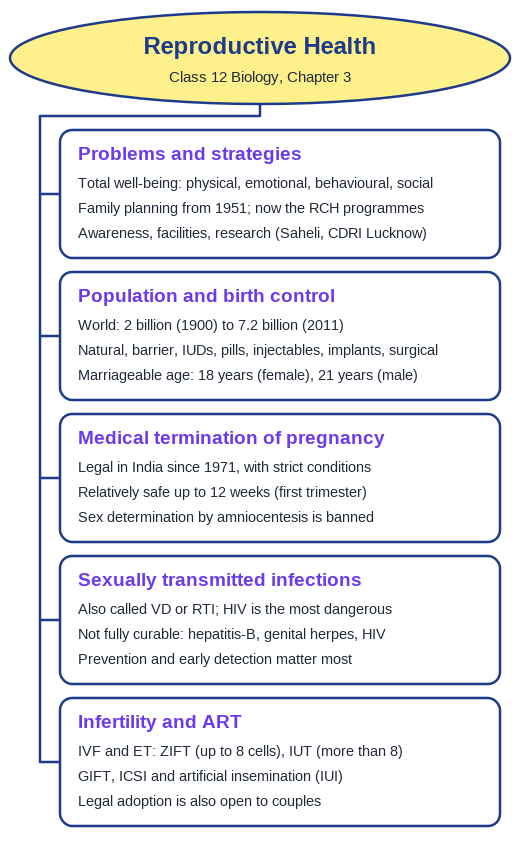
Reproductive health means total well-being in all aspects of reproduction: physical, emotional, behavioural and social. India works towards it through the Reproductive and Child Health Care (RCH) programmes. The chapter covers population growth and contraceptive methods, medical termination of pregnancy (MTP), sexually transmitted infections (STIs), and infertility with the assisted reproductive technologies (ART) that help childless couples.
What is this chapter about?
Chapter 2 described the human reproductive system. This chapter asks a wider question: what makes a society reproductively healthy? In its narrow sense, reproductive health means healthy reproductive organs that work normally. The World Health Organisation (WHO) gives it a broader meaning: total well-being in all aspects of reproduction, that is, physical, emotional, behavioural and social.
The chapter has five parts: the problems and the strategies used to solve them, population growth and birth control, medical termination of pregnancy, sexually transmitted infections, and infertility. It is a short chapter, full of names, years and full forms, so revise it with tables and charts.
What are the problems and strategies of reproductive health?
India was among the first countries in the world to start action plans at the national level for reproductive health. These programmes, called family planning, began in 1951 and were reviewed from time to time. Wider programmes now run under the name Reproductive and Child Health Care (RCH) programmes. Their two main tasks are to create awareness about reproduction-related matters and to provide facilities and support for a reproductively healthy society.
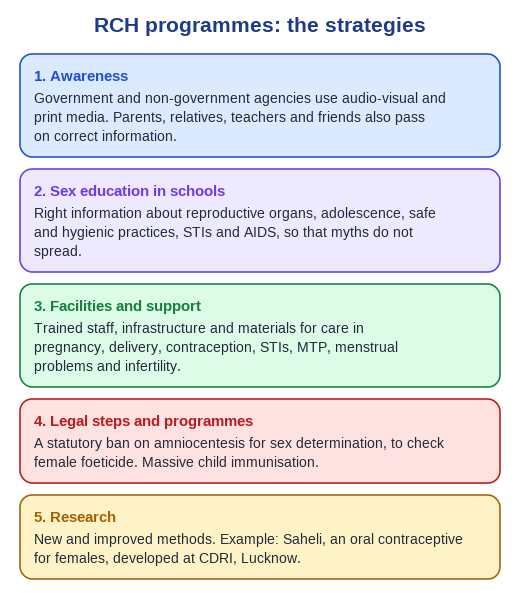
Awareness. Government and non-government agencies use audio-visual and print media. Parents, close relatives, teachers and friends also have a large role. The book says sex education in schools should be encouraged, so that young people get correct information and do not believe myths. Useful information covers the reproductive organs, adolescence and its changes, safe and hygienic sexual practices, and sexually transmitted infections including AIDS.
People of marriageable age and fertile couples also need to know about birth control options, the care of pregnant mothers, post-natal care of mother and child, the importance of breastfeeding, and equal opportunities for the male and the female child. Awareness of the problems of uncontrolled population growth and of social evils such as sex abuse and sex-related crimes helps people to prevent them.
Facilities. These plans need strong infrastructure, professional expertise and material support, so that people get medical help with pregnancy, delivery, STIs, abortions, contraception, menstrual problems and infertility.
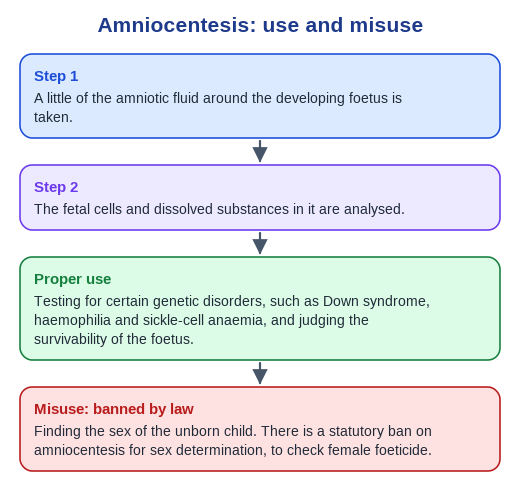
Legal steps and research. Two measures the book singles out are massive child immunisation and the statutory ban on amniocentesis for sex determination, which checks female foeticide. Research is supported too: Saheli, an oral contraceptive for females, was developed at the Central Drug Research Institute (CDRI), Lucknow.
Signs of improvement. Better awareness, more medically assisted deliveries, better post-natal care leading to lower maternal and infant mortality rates, more couples with small families, and better detection and cure of STIs all show that the reproductive health of society has improved.
Why did the population grow so fast?
In the last century, better health facilities and living conditions improved the quality of life, and the population grew explosively. The world population was around 2 billion in 1900, about 6 billion by 2000 and 7.2 billion in 2011. India had approximately 350 million people at independence, came close to a billion by 2000 and crossed 1.2 billion in May 2011.
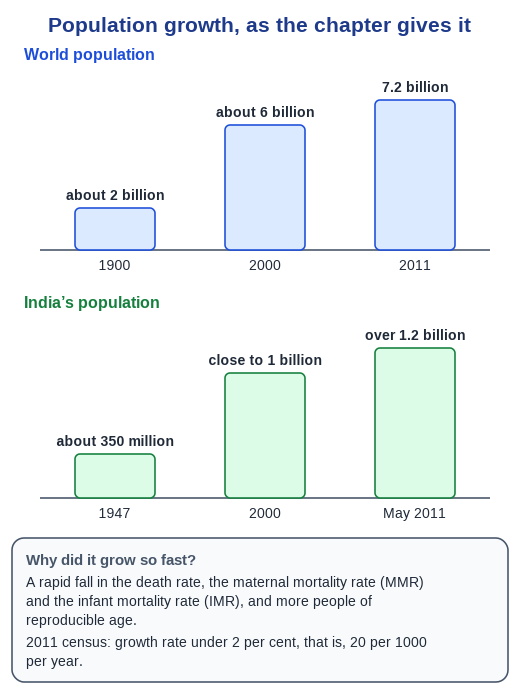
The probable reasons are a rapid decline in the death rate, the maternal mortality rate (MMR) and the infant mortality rate (IMR), and an increase in the number of people of reproducible age. The RCH programme brought the growth rate down only slightly. In the 2011 census it was still a little under 2 per cent, that is, 20/1000/year. Growth at this rate could cause a scarcity of even food, shelter and clothing.
The measures taken include:
- motivating smaller families through contraceptive methods, with the slogan Hum Do Hamare Do (we two, our two); many young, urban, working couples have adopted a one-child norm;
- raising the marriageable age by law to 18 years for females and 21 years for males;
- incentives for couples with small families.
What are the methods of birth control?
An ideal contraceptive is user-friendly, easily available, effective and reversible, with no or least side effects. It should not interfere with the sexual drive, desire or act of the user. The book groups the methods as natural or traditional, barrier, IUDs, oral contraceptives, injectables, implants and surgical methods.
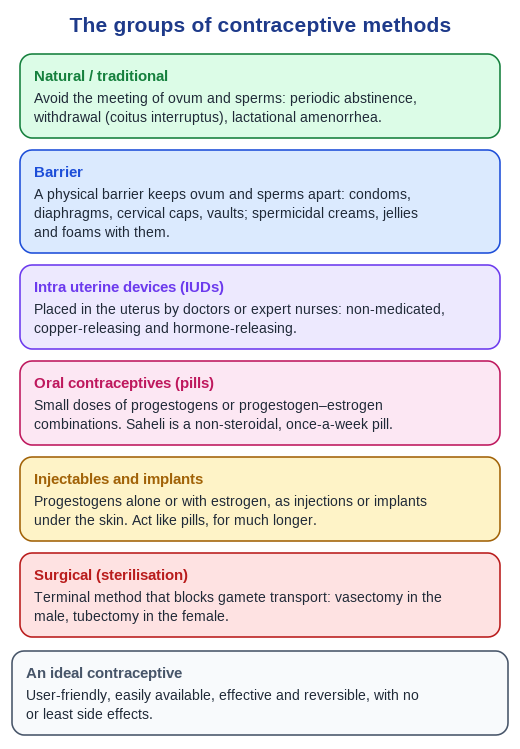
| Group | Principle | Examples |
|---|---|---|
| Natural | Ovum and sperms get no chance to meet | Periodic abstinence, withdrawal, lactational amenorrhea |
| Barrier | A physical barrier keeps them apart | Condoms, diaphragms, cervical caps, vaults |
| IUDs | Device placed in the uterus | Lippes loop, CuT, Multiload 375, LNG-20 |
| Pills | Hormones stop ovulation and implantation | Progestogen or progestogen–estrogen pills, Saheli |
| Injectables, implants | Same action as pills, lasting much longer | Progestogens alone or with estrogen |
| Surgical | Gamete transport is blocked | Vasectomy, tubectomy |
The choice and use of a method should always be made in consultation with qualified medical professionals. Contraceptives are not a regular requirement of reproductive health; they are used to prevent, delay or space pregnancy. Their possible ill-effects, such as nausea, abdominal pain, breakthrough bleeding, irregular menstrual bleeding or even breast cancer, are not very significant but should not be ignored. Each method is explained in birth control methods.
What is medical termination of pregnancy?
Medical termination of pregnancy (MTP), or induced abortion, is the intentional or voluntary ending of a pregnancy before full term. Nearly 45 to 50 million MTPs are performed in a year all over the world, about 1/5th of all conceived pregnancies in a year. The Government of India legalised MTP in 1971, with strict conditions to prevent misuse. MTP is considered relatively safe in the first trimester, up to 12 weeks; second-trimester abortions are much riskier.
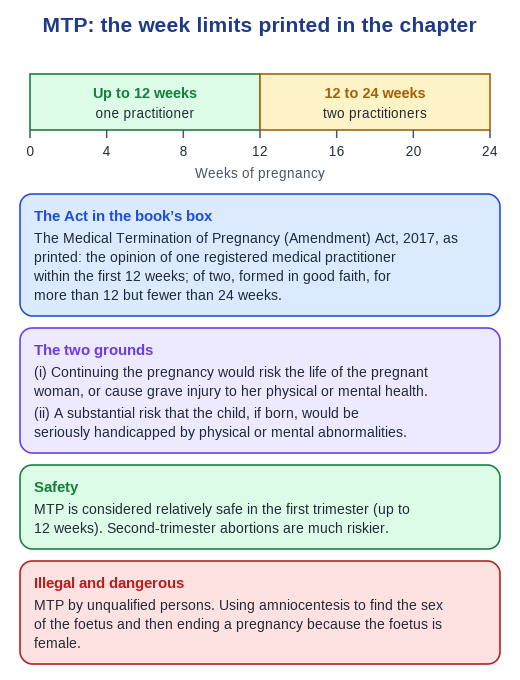
Two trends worry the book: many MTPs are done illegally by unqualified persons, and amniocentesis is misused to find the sex of the unborn child, followed by MTP if the foetus is female. Both are illegal and dangerous.
What are sexually transmitted infections?
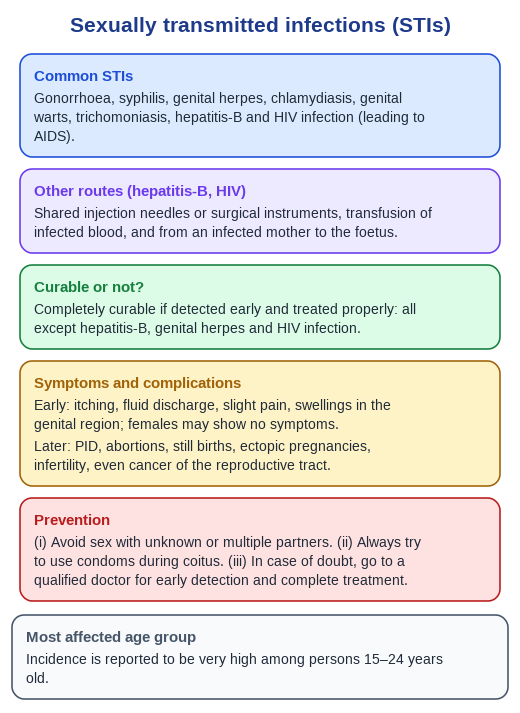
Infections passed on through sexual intercourse are called sexually transmitted infections (STIs), venereal diseases (VD) or reproductive tract infections (RTI). The common ones are gonorrhoea, syphilis, genital herpes, chlamydiasis, genital warts, trichomoniasis, hepatitis-B and HIV infection, which leads to AIDS. All except hepatitis-B, genital herpes and HIV infection are completely curable if detected early and treated properly. Prevention rests on three simple principles: avoid sex with unknown or multiple partners, always try to use condoms during coitus, and see a qualified doctor early in case of doubt.
What is infertility, and how does ART help?
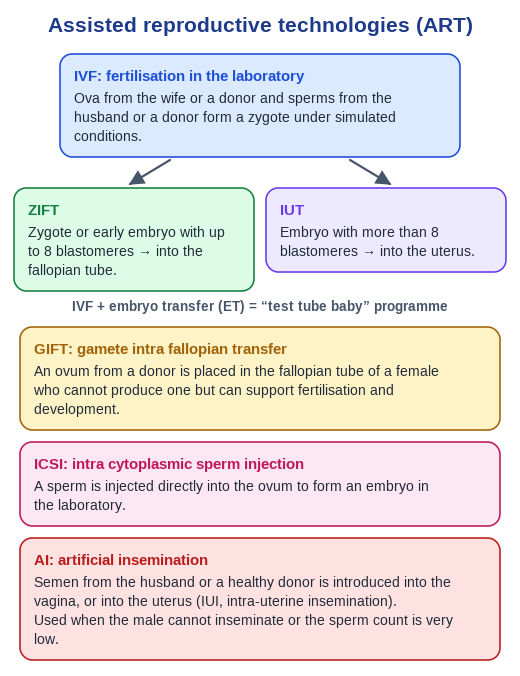
A couple is infertile when they cannot produce children in spite of unprotected sexual cohabitation. The cause may lie in either partner. Infertility clinics can diagnose and correct some disorders. Where correction is not possible, assisted reproductive technologies (ART) can help: IVF followed by embryo transfer (ZIFT or IUT), GIFT, ICSI and artificial insemination. Legal adoption is another good way to parenthood. MTP, STIs and ART are covered in STIs and infertility.
Before we move on
Learn this chapter as lists: the strategies, the seven groups of contraceptives with one example each, the facts about MTP, the STIs and the ART full forms. All 12 exercises are answered in the NCERT solutions for Chapter 3.
Key terms
| Term | Meaning |
|---|---|
| Reproductive health | Total well-being in all aspects of reproduction: physical, emotional, behavioural and social (the WHO meaning used in the book). |
| RCH programmes | Reproductive and Child Health Care programmes: India's current programmes for awareness, facilities and support in reproduction-related areas. |
| Amniocentesis | A test in which some amniotic fluid of the developing foetus is taken to study fetal cells and dissolved substances. Its use for sex determination is banned. |
| Contraceptive | A method or device that prevents conception. An ideal one is user-friendly, easily available, effective and reversible, with no or least side effects. |
| Periodic abstinence | A natural method: no coitus from day 10 to day 17 of the menstrual cycle, the fertile period when ovulation is expected. |
| Lactational amenorrhea | Absence of menstruation during intense breastfeeding after childbirth. As a contraceptive method it works for up to six months at most. |
| IUD | Intra uterine device, placed in the uterus by a doctor or expert nurse: non-medicated, copper-releasing or hormone-releasing. |
| Saheli | A non-steroidal oral contraceptive for females, taken once a week, developed at the Central Drug Research Institute (CDRI), Lucknow. |
| Vasectomy and tubectomy | Sterilisation in the male (a part of the vas deferens removed or tied) and in the female (a part of the fallopian tube removed or tied). |
| MTP | Medical termination of pregnancy, or induced abortion: the intentional ending of a pregnancy before full term. Legal in India since 1971, with strict conditions. |
| STIs | Sexually transmitted infections, also called venereal diseases (VD) or reproductive tract infections (RTI): infections passed on through sexual intercourse. |
| Infertility | Inability of a couple to produce children in spite of unprotected sexual cohabitation (the summary says even after 2 years). |
| ART | Assisted reproductive technologies: special techniques such as IVF with embryo transfer, GIFT, ICSI and artificial insemination. |
| IVF and ET | In vitro fertilisation (in the laboratory, in body-like conditions) followed by embryo transfer: the test tube baby programme. |
Topics in this chapter
Practice
-
Family planning programmes were started in India in:
Show answer
Answer: (b) 1951
-
Which of these is a copper-releasing IUD?
Show answer
Answer: (c) Multiload 375
-
Saheli, the once-a-week oral contraceptive, was developed at:
Show answer
Answer: (b) CDRI, Lucknow
-
In ZIFT, the zygote or early embryo is transferred into the:
Show answer
Answer: (c) fallopian tube
-
Which of these STIs is NOT completely curable even when detected early?
Show answer
Answer: (c) genital herpes
-
Emergency contraceptives are effective if used within how many hours of coitus?
Show answer
Answer: (d) 72
Questions students ask
What are the main topics of Class 12 Biology Chapter 3?
Reproductive health and the RCH programmes, population stabilisation and birth control methods, medical termination of pregnancy (MTP), sexually transmitted infections (STIs), and infertility with assisted reproductive technologies (ART).
Is Reproductive Health in the 2026-27 NCERT Class 12 Biology book?
Yes. It is Chapter 3 of Unit VI, Reproduction, in Biology, the Class 12 textbook marked Reprint 2026-27, on pages 41 to 50. It has 12 end-of-chapter exercises.
What does the book mean by reproductive health?
It uses the World Health Organisation's meaning: total well-being in all aspects of reproduction, that is, physical, emotional, behavioural and social. It is more than having normal reproductive organs.
Which full forms should I learn from this chapter?
RCH, MMR, IMR, IUD, MTP, STI, VD, RTI, PID, ART, IVF, ET, ZIFT, IUT, GIFT, ICSI, AI and IUI. Each is explained on these pages where it first appears.
Stuck on a question?
Take a photo and Lagnever AI explains it step by step. Try it for 7 days for ₹2.
Get it on Google Play Open in browser
For parents: after the trial, the plan renews monthly by UPI or card autopay. You can cancel anytime in the app.