
What are MTP, STIs and infertility?
Answer in short
Medical termination of pregnancy (MTP) is the intentional ending of a pregnancy before full term, legal in India since 1971 under strict conditions. Sexually transmitted infections (STIs) spread through sexual intercourse; most are curable if detected early. Infertility is the inability to have children despite unprotected cohabitation, and assisted reproductive technologies such as IVF, GIFT, ICSI and IUI can help.
Stuck on a question? Take a photo and Lagnever AI explains it step by step. Try it for 7 days for ₹2. Get it on Google Play
What is medical termination of pregnancy?
Intentional or voluntary termination of a pregnancy before full term is called medical termination of pregnancy (MTP) or induced abortion. Nearly 45 to 50 million MTPs are performed in a year all over the world, which is 1/5th of the total number of conceived pregnancies in a year. Many countries still debate whether MTP should be legal, because emotional, ethical, religious and social issues are involved.
The Government of India legalised MTP in 1971, with strict conditions to avoid misuse. These restrictions matter all the more because illegal female foeticide is reported to be high in India.
Why MTP? It ends unwanted pregnancies that follow casual unprotected intercourse, failure of a contraceptive, or rape. It is also essential when continuing the pregnancy could be harmful or even fatal to the mother, the foetus or both.
When is it safe? MTP is considered relatively safe during the first trimester, up to 12 weeks of pregnancy. Second-trimester abortions are much riskier.
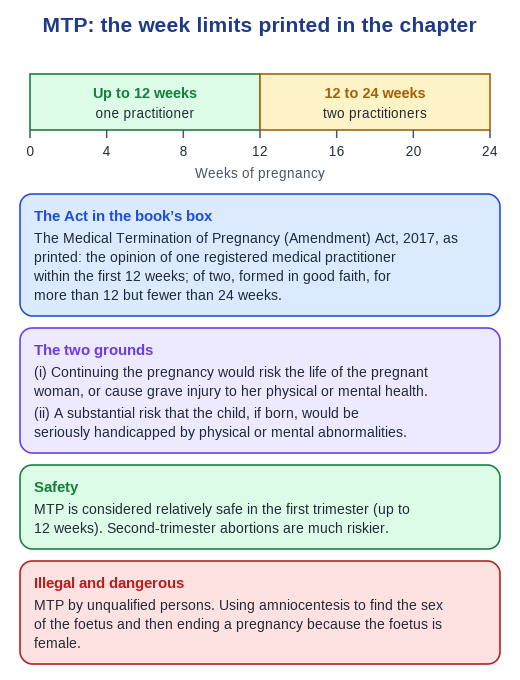
The box on page 46 of the book gives the law as the Medical Termination of Pregnancy (Amendment) Act, 2017, meant to reduce illegal abortion and the maternal deaths and illness that follow it. As printed there, a pregnancy may be terminated on certain grounds within the first 12 weeks on the opinion of one registered medical practitioner; beyond 12 but under 24 weeks, two registered medical practitioners must agree, in good faith, that the grounds exist. The grounds are a risk to the life of the pregnant woman or of grave injury to her physical or mental health, or a substantial risk that the child would be born with serious physical or mental abnormalities.
Two dangerous trends. A majority of MTPs are performed illegally by unqualified persons, which is unsafe and can be fatal. And amniocentesis is misused to find the sex of the unborn child, often followed by MTP if the foetus is female, which is against the law. The book asks for effective counselling and more health care facilities to reverse these trends.
What are sexually transmitted infections?
Infections or diseases transmitted through sexual intercourse are together called sexually transmitted infections (STIs), venereal diseases (VD) or reproductive tract infections (RTI). The common ones are gonorrhoea, syphilis, genital herpes, chlamydiasis, genital warts, trichomoniasis, hepatitis-B and HIV infection leading to AIDS. HIV infection is the most dangerous; the book discusses it in Chapter 7.
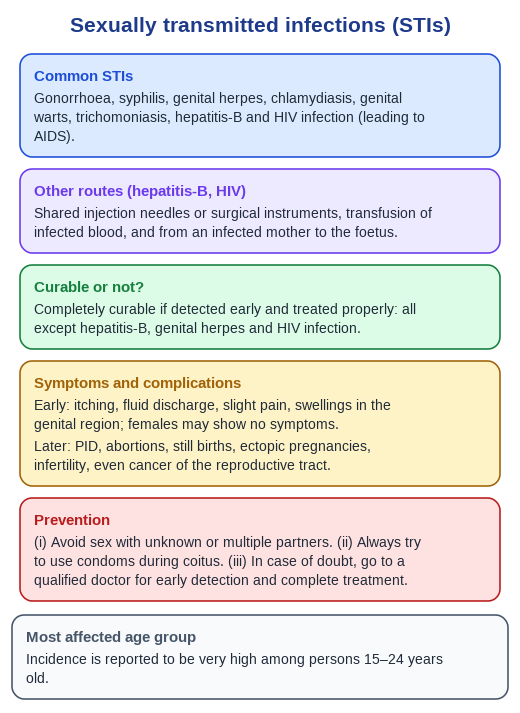
| Point | What the chapter says |
|---|---|
| Other routes | Hepatitis-B and HIV also spread by shared injection needles or surgical instruments, blood transfusion, and from an infected mother to the foetus |
| Cure | All except hepatitis-B, genital herpes and HIV infection are completely curable if detected early and treated properly |
| Early symptoms | Itching, fluid discharge, slight pain, swellings in the genital region; infected females may often be asymptomatic |
| Complications | Pelvic inflammatory diseases (PID), abortions, still births, ectopic pregnancies, infertility, even cancer of the reproductive tract |
| Age group | Incidence is very high among persons aged 15–24 years |
Slight early symptoms and social stigma make people delay treatment, and the delay brings the complications.
How can STIs be prevented?
The book says there is no reason to panic, because prevention is possible. It gives three simple principles:
- Avoid sex with unknown partners or multiple partners.
- Always try to use condoms during coitus.
- In case of doubt, go to a qualified doctor for early detection, and get complete treatment if an infection is diagnosed.
What is infertility?
A large number of couples all over the world, including India, are infertile: they are unable to produce children in spite of unprotected sexual cohabitation. (The chapter’s summary adds “even after 2 years”.) The reasons can be physical, congenital, diseases, drugs, immunological or even psychological.
In India the female is often blamed, but the book points out that, more often than not, the problem lies in the male partner. Infertility clinics can diagnose and treat some of these disorders. Where that is not possible, assisted reproductive technologies (ART) can help the couple to have children.
What are the ART techniques?
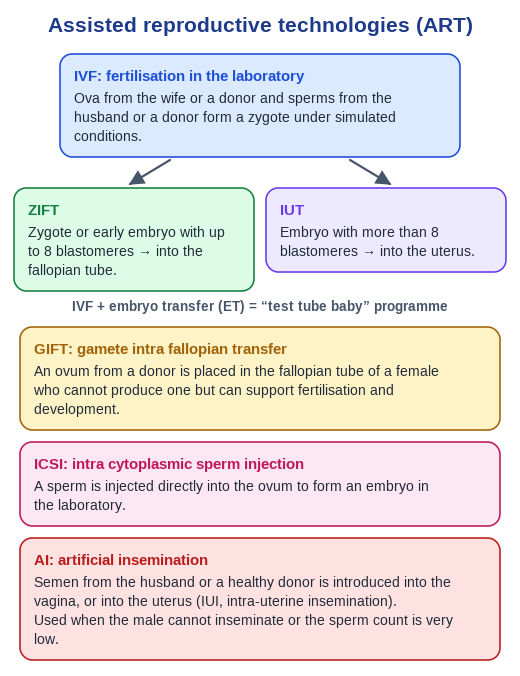
- IVF and ET. In vitro fertilisation is fertilisation outside the body, in conditions almost like those inside it. Ova from the wife or a donor and sperms from the husband or a donor are collected and made to form a zygote in the laboratory. Embryo transfer follows. This is popularly called the test tube baby programme.
- ZIFT (zygote intra fallopian transfer): the zygote or an early embryo with up to 8 blastomeres is transferred into the fallopian tube.
- IUT (intra uterine transfer): an embryo with more than 8 blastomeres is transferred into the uterus.
- Embryos formed by in vivo fertilisation (fusion of gametes inside a female) can also be transferred to help females who cannot conceive.
- GIFT (gamete intra fallopian transfer): an ovum from a donor is transferred into the fallopian tube of another female who cannot produce one but can provide a suitable environment for fertilisation and development.
- ICSI (intra cytoplasmic sperm injection): a sperm is injected directly into the ovum to form an embryo in the laboratory.
- AI (artificial insemination): semen from the husband or a healthy donor is introduced into the vagina, or into the uterus (IUI, intra-uterine insemination). It corrects infertility due to the male’s inability to inseminate or to very low sperm counts.
What limits the use of ART?
These techniques need very precise handling by specialised professionals and expensive instruments. So they are available in very few centres in the country, and only a limited number of people can afford them. Emotional, religious and social factors also hold people back. The book reminds us that India has many orphaned and destitute children, and that our laws permit legal adoption, which it counts among the finest routes to parenthood.
Previous topic: birth control methods. See also the chapter notes and the NCERT solutions.
Practice
-
The Government of India legalised MTP in:
Show answer
Answer: (b) 1971
-
An embryo with more than 8 blastomeres is transferred into the:
Show answer
Answer: (c) uterus
-
Which technique injects a sperm directly into the ovum?
Show answer
Answer: (b) ICSI
-
Why may STIs remain undetected for a long time?
Show answer
Answer: Early symptoms are minor (itching, fluid discharge, slight pain, swellings), and infected females may often show no symptoms at all. The social stigma attached to STIs also keeps people from going for timely detection and treatment.
-
For which kinds of infertility is artificial insemination used?
Show answer
Answer: When the male partner cannot inseminate the female, or when the sperm count in the ejaculate is very low. Semen from the husband or a healthy donor is introduced into the vagina or, in IUI, into the uterus.
Questions students ask
Why is MTP needed, according to NCERT?
To end unwanted pregnancies caused by casual unprotected intercourse, failure of the contraceptive used, or rape. It is also essential when continuing the pregnancy could be harmful or even fatal to the mother, to the foetus or to both.
Which STIs are not completely curable?
Hepatitis-B, genital herpes and HIV infection. The book says the other STIs are completely curable if they are detected early and treated properly.
What is the test tube baby programme?
It is in vitro fertilisation (IVF) followed by embryo transfer (ET). Ova and sperms are collected and made to form a zygote in the laboratory under body-like conditions, and the zygote or embryo is then transferred into the female.
What is the difference between ZIFT and IUT?
In ZIFT (zygote intra fallopian transfer) the zygote or an early embryo with up to 8 blastomeres is transferred into the fallopian tube. In IUT (intra uterine transfer) an embryo with more than 8 blastomeres is transferred into the uterus.
Stuck on a question?
Take a photo and Lagnever AI explains it step by step. Try it for 7 days for ₹2.
Get it on Google Play Open in browser
For parents: after the trial, the plan renews monthly by UPI or card autopay. You can cancel anytime in the app.