
What are the methods of birth control?
Answer in short
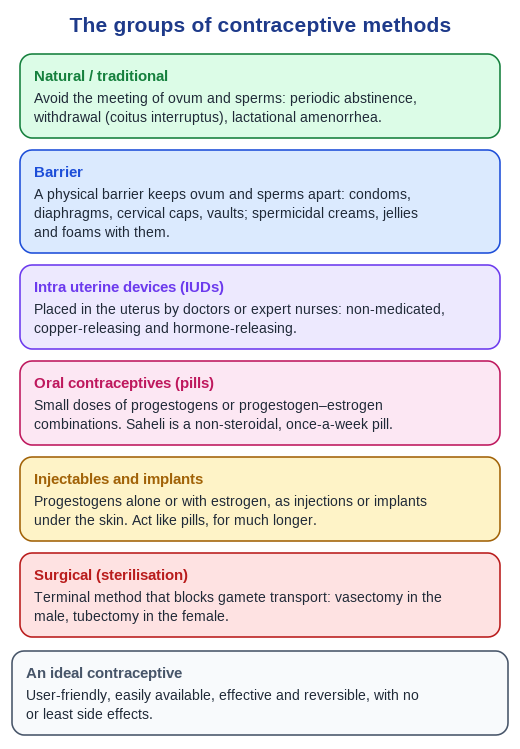
Contraceptive methods prevent conception. The chapter groups them as natural methods (periodic abstinence, withdrawal, lactational amenorrhea), barrier methods (condoms, diaphragms, cervical caps, vaults), intra uterine devices, oral pills, injectables and implants, and surgical methods (vasectomy and tubectomy). An ideal contraceptive is user-friendly, easily available, effective and reversible, with no or least side effects.
Stuck on a question? Take a photo and Lagnever AI explains it step by step. Try it for 7 days for ₹2. Get it on Google Play
Why are contraceptives needed?
Section 3.2 of the chapter links birth control to population. India’s population crossed 1.2 billion in May 2011, and the most important step to slow this growth is to encourage smaller families through contraceptive methods, which prevent unwanted pregnancies. An ideal contraceptive should be:
- user-friendly and easily available;
- effective and reversible;
- with no or least side effects;
- no hindrance to the sexual drive, desire or act of the user.
How do natural methods work?
Natural methods work by avoiding any chance of the ovum and sperms meeting. No medicine or device is used.
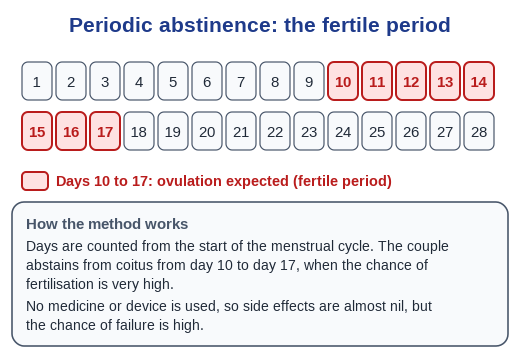
- Periodic abstinence: the couple avoids coitus from day 10 to day 17 of the menstrual cycle, when ovulation can be expected. The chance of fertilisation is very high on these days, so they are called the fertile period.
- Withdrawal (coitus interruptus): the male partner withdraws just before ejaculation, so that insemination is avoided.
- Lactational amenorrhea: ovulation, and so the menstrual cycle, does not occur during intense lactation after childbirth. While the mother fully breastfeeds the child, the chance of conception is almost nil. This holds only up to a maximum of six months after parturition.
Side effects are almost nil, but the chance of failure of these methods is high.
How do barrier methods work?
In barrier methods, a barrier physically stops the ovum and sperms from meeting. They exist for both males and females.
- Condoms are thin rubber or latex sheaths. The male condom covers the penis; the female condom covers the vagina and cervix. They are used just before coitus so that semen does not enter the female reproductive tract. Nirodh is a popular brand for males. Condoms are disposable and can be self-inserted, which gives privacy to the user. Their use has grown because they also protect the user from STIs and AIDS.
- Diaphragms, cervical caps and vaults are rubber barriers placed in the female reproductive tract to cover the cervix during coitus. They block the entry of sperms through the cervix and are reusable.
- Spermicidal creams, jellies and foams are usually used along with these barriers to raise their efficiency.
What are IUDs?
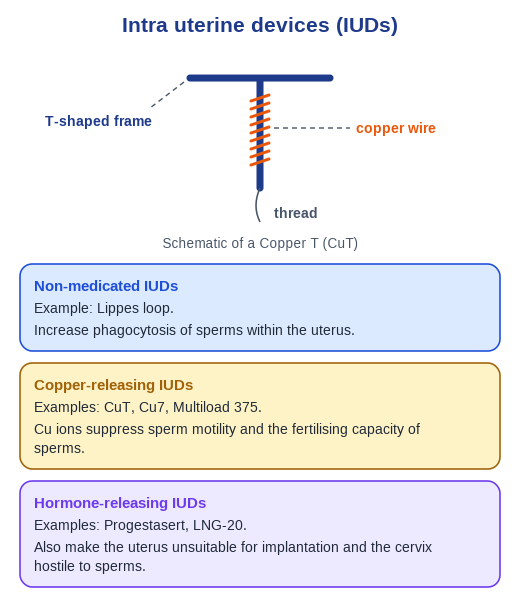
Intra uterine devices (IUDs) are inserted into the uterus through the vagina by doctors or expert nurses.
| Type | Examples | Action |
|---|---|---|
| Non-medicated | Lippes loop | More phagocytosis of sperms in the uterus |
| Copper-releasing | CuT, Cu7, Multiload 375 | Cu ions suppress sperm motility and fertilising capacity |
| Hormone-releasing | Progestasert, LNG-20 | Uterus unsuitable for implantation, cervix hostile to sperms |
IUDs suit females who want to delay pregnancy or to space children, and they are among the most widely accepted contraceptives in India.
How do pills, injectables and implants work?
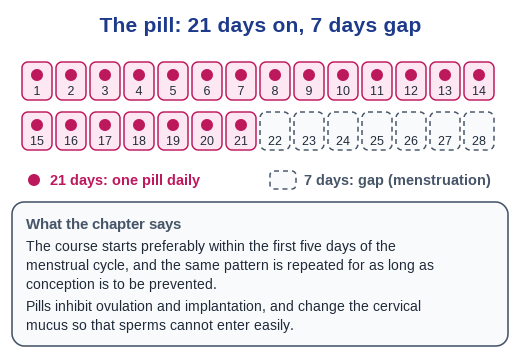
Oral contraceptives, the pills, contain small doses of either progestogens or progestogen–estrogen combinations. A pill is taken daily for 21 days, starting preferably within the first five days of the menstrual cycle. After a gap of 7 days, during which menstruation occurs, the pattern is repeated for as long as conception is to be prevented. Pills act in three ways: they inhibit ovulation, they inhibit implantation, and they change the cervical mucus so that sperms are kept out or slowed. They are very effective, have fewer side effects and are well accepted.
Saheli is different: it contains a non-steroidal preparation and is a once-a-week pill with very few side effects and high contraceptive value.
Injectables and implants: progestogens alone, or with estrogen, can also be given to females as injections or as implants under the skin. They act like pills, but their effect lasts much longer.
Emergency contraceptives: progestogens, progestogen–estrogen combinations or IUDs given within 72 hours of coitus are very effective. The book mentions them for avoiding a possible pregnancy after rape or casual unprotected intercourse.
What are the surgical methods?
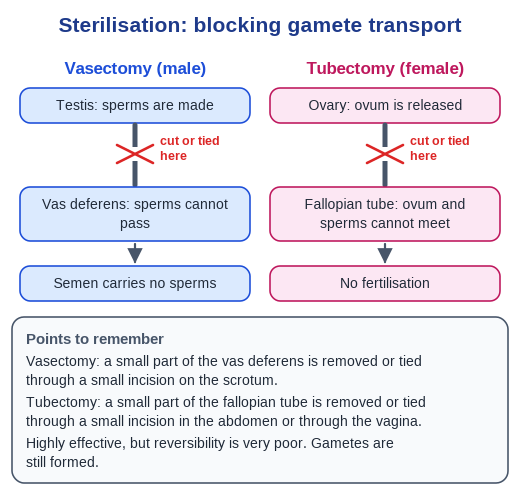
Surgical methods, or sterilisation, are generally advised as a terminal method, for a partner who wants no more pregnancies. Surgery blocks the transport of gametes and so prevents conception.
- Vasectomy (male): a small part of the vas deferens is removed or tied up through a small incision on the scrotum.
- Tubectomy (female): a small part of the fallopian tube is removed or tied up through a small incision in the abdomen, or through the vagina.
Both are highly effective, but their reversibility is very poor.
What should be kept in mind about contraceptives?
- A suitable method should always be chosen and used in consultation with qualified medical professionals.
- Contraceptives are not a regular requirement for reproductive health. They act against a natural event, conception, and are used to prevent, delay or space pregnancy.
- Their wide use helps to check population growth.
- Possible ill-effects include nausea, abdominal pain, breakthrough bleeding, irregular menstrual bleeding or even breast cancer. The book calls these not very significant, but says they should not be totally ignored.
Next topic: STIs and infertility. See also the chapter notes and the NCERT solutions.
Practice
-
In periodic abstinence, coitus is avoided on which days of the menstrual cycle?
Show answer
Answer: (c) days 10 to 17
-
Which of these is a hormone-releasing IUD?
Show answer
Answer: (d) LNG-20
-
Lactational amenorrhea is reported to be effective for a maximum of:
Show answer
Answer: (c) six months
-
How do copper-releasing IUDs prevent conception?
Show answer
Answer: Like all IUDs, they increase phagocytosis of sperms within the uterus. In addition, the Cu ions they release suppress sperm motility and the fertilising capacity of the sperms.
-
Why is sterilisation called a terminal method?
Show answer
Answer: It is advised to a male or female partner who wants no more pregnancies. A part of the vas deferens or the fallopian tube is removed or tied, and the reversibility of this is very poor.
Questions students ask
What is an ideal contraceptive according to NCERT?
One that is user-friendly, easily available, effective and reversible, with no or least side effects. It should also not interfere with the sexual drive, desire or the sexual act of the user.
How do oral contraceptive pills work?
They contain small doses of progestogens or progestogen–estrogen combinations. They inhibit ovulation and implantation, and alter the quality of the cervical mucus so that the entry of sperms is prevented or slowed.
What is the difference between vasectomy and tubectomy?
Vasectomy is sterilisation in the male: a small part of the vas deferens is removed or tied through a small incision on the scrotum. Tubectomy is sterilisation in the female: a small part of the fallopian tube is removed or tied through a small incision in the abdomen or through the vagina.
Which contraceptive method is widely accepted in India?
The book says IUDs are one of the most widely accepted methods of contraception in India. They suit females who want to delay pregnancy or space children.
Stuck on a question?
Take a photo and Lagnever AI explains it step by step. Try it for 7 days for ₹2.
Get it on Google Play Open in browser
For parents: after the trial, the plan renews monthly by UPI or card autopay. You can cancel anytime in the app.