
NCERT Solutions Class 12 Biology Chapter 7: Human Health and Disease
Answers to all 17 end-of-chapter exercises of Chapter 7, Human Health and Disease, of Biology, the Class 12 NCERT textbook. Page numbers follow the 2026-27 reprint (pages 129–148). The exercises are quoted from the book as printed; the answers are our own, built from the chapter, and every fact from outside the chapter is marked Extra. The questions the chapter text asks along the way are answered in short at the end. The book prints no answer key for this chapter. These answers are for exam study, not medical advice. Short notes: Chapter 7 notes.
Exercises 1 to 5: preventing infectious diseases
1. “What are the various public health measures, which you would suggest as safeguard against infectious diseases?”
- Clean water and food: decontaminate drinking water; clean and disinfect tanks, pools, reservoirs and cesspools at regular intervals; follow standard hygiene in public catering.
- Sanitation: proper disposal of waste and excreta.
- Vector control: no stagnant water near homes; regular cleaning of household coolers; mosquito nets; Gambusia fish in ponds to eat mosquito larvae; insecticide spraying in ditches, drainage areas and swamps; wire mesh on doors and windows.
- Immunisation programmes with vaccines.
- Air-borne diseases: avoid close contact with infected people and their belongings.
- Awareness about diseases and how they spread, along with safe blood and disposable needles and syringes in hospitals and clinics.
Alongside these, every person should keep up personal hygiene: a clean body and clean food, vegetables and fruits.
2. “In which way has the study of biology helped us to control infectious diseases?”
- Knowing the pathogen and its route. Biology identified the bacteria, viruses, protozoans, helminths and fungi that cause diseases, their life cycles (such as that of Plasmodium, with two hosts) and how they spread. This tells us what to block: clean water for typhoid, vector control for malaria and filariasis.
- Vaccines and immunisation. Understanding immune memory led to vaccines. They eradicated smallpox and have controlled polio, diphtheria, pneumonia and tetanus to a large extent.
- Newer vaccines. Recombinant DNA technology makes antigenic polypeptides in bacteria or yeast, for example the hepatitis B vaccine from yeast, allowing large-scale production.
- Treatment. Antibiotics and other drugs treat many infectious diseases effectively.
- Diagnosis. Tests such as the Widal test for typhoid and ELISA for HIV detect infections.
- Passive immunisation. Preformed antibodies, such as tetanus antitoxin and the antibodies given after a snakebite, give quick protection.
3. “How does the transmission of each of the following diseases take place? (a) Amoebiasis (b) Malaria (c) Ascariasis (d) Pneumonia”
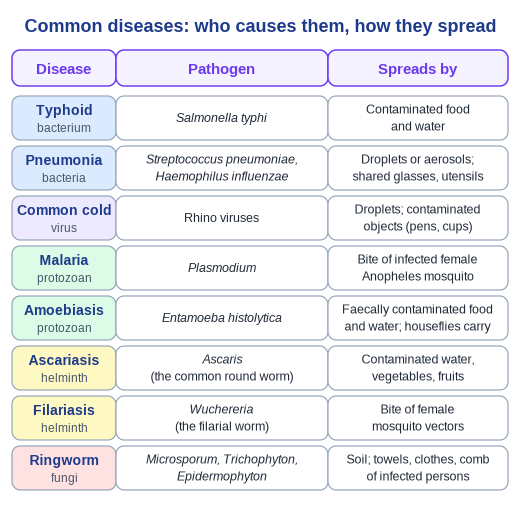
| Disease | Pathogen | How it is transmitted |
|---|---|---|
| (a) Amoebiasis | Entamoeba histolytica | Drinking water and food contaminated by faecal matter. Houseflies act as mechanical carriers, taking the parasite from the faeces of an infected person to food. |
| (b) Malaria | Plasmodium | The bite of an infected female Anopheles mosquito, which injects sporozoites. The mosquito picks up the parasite when it bites an infected person. |
| (c) Ascariasis | Ascaris | Eggs pass out with the faeces of infected people and contaminate soil, water and plants. A healthy person is infected through contaminated water, vegetables and fruits. |
| (d) Pneumonia | Streptococcus pneumoniae, Haemophilus influenzae | Inhaling droplets or aerosols released by an infected person, or using the same glasses and utensils as an infected person. |
4. “What measure would you take to prevent water-borne diseases?”
Water-borne diseases such as typhoid, amoebiasis and ascariasis spread through contaminated water and food. Measures from the chapter:
- Drink only clean water, and eat clean food; wash vegetables and fruits.
- Dispose of waste and excreta properly, so that faecal matter does not reach water sources.
- Clean and disinfect water reservoirs, tanks, pools and cesspools periodically.
- Keep houseflies away from food, and follow hygiene in public catering.
- Keep the body clean, for example by washing hands (Extra: washing hands with soap before eating and after using the toilet).
Extra: at home, water is commonly made safe by boiling it or by using a filter or chlorine tablets, as advised by local health authorities.
5. “Discuss with your teacher what does ‘a suitable gene’ means, in the context of DNA vaccines.”
The chapter explains that recombinant DNA technology can produce antigenic polypeptides of a pathogen in bacteria or yeast. DNA vaccines go one step further (Extra, discuss with your teacher):
- A DNA vaccine carries a gene of the pathogen, usually in a plasmid, instead of the protein itself. The person’s own cells read the gene and make the antigen, which then triggers an immune response and memory.
- A suitable gene is one that:
- codes for an antigenic protein of the pathogen, one that the immune system recognises and responds to strongly;
- cannot cause the disease by itself, because it is only one gene, not the whole pathogen;
- is expressed properly in human cells to make enough antigen;
- is from a part of the pathogen that does not change much, so the memory cells still recognise the pathogen later.
So “suitable” means the gene gives protective immunity and memory, safely.
Exercises 6 to 9: the immune system
6. “Name the primary and secondary lymphoid organs.”
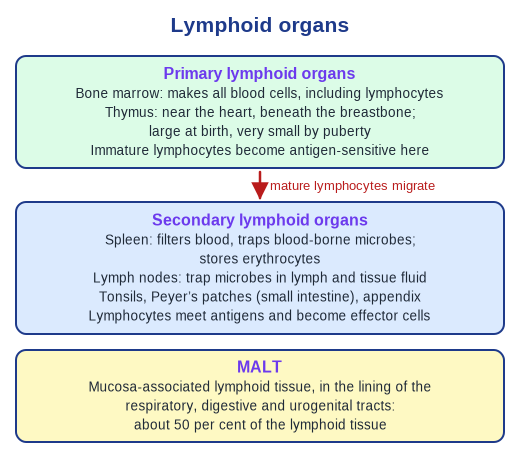
- Primary lymphoid organs: bone marrow and thymus. Immature lymphocytes differentiate here into antigen-sensitive lymphocytes.
- Secondary lymphoid organs: spleen, lymph nodes, tonsils, Peyer’s patches of the small intestine, and appendix. Here lymphocytes meet antigens and proliferate into effector cells. The mucosa-associated lymphoid tissue (MALT) in the lining of the major tracts also belongs here.
7. “The following are some well-known abbreviations, which have been used in this chapter. Expand each one to its full form: (a) MALT (b) CMI (c) AIDS (d) NACO (e) HIV”
| Abbreviation | Full form | |
|---|---|---|
| (a) | MALT | Mucosa-Associated Lymphoid Tissue |
| (b) | CMI | Cell-Mediated Immunity |
| (c) | AIDS | Acquired Immuno Deficiency Syndrome |
| (d) | NACO | National AIDS Control Organisation |
| (e) | HIV | Human Immuno deficiency Virus |
8. “Differentiate the following and give examples of each: (a) Innate and acquired immunity (b) Active and passive immunity”
(a)
| Innate immunity | Acquired immunity |
|---|---|
| Present at birth | Developed during life, after meeting a pathogen or a vaccine |
| Non-specific | Pathogen-specific |
| No memory | Has memory: a weak primary response, then a strong secondary response |
| Works through four kinds of barriers: physical, physiological, cellular and cytokine | Works through B-lymphocytes (antibodies) and T-lymphocytes (CMI) |
| Examples: skin and mucus; stomach acid, saliva, tears; neutrophils, monocytes, natural killer cells, macrophages; interferons | Examples: antibodies against a pathogen after an infection; protection after a vaccine; graft rejection by T cells |
(b)
| Active immunity | Passive immunity |
|---|---|
| The host’s body makes its own antibodies | Ready-made antibodies are given |
| Slow; takes time to reach full effect | Quick |
| Generates memory | Short-lived protection (Extra: the given antibodies are slowly removed and no memory cells form) |
| Examples: natural infection; immunisation with a vaccine | Examples: colostrum (IgA) for the new-born; antibodies from mother to foetus through the placenta; tetanus antitoxin; antibodies against snake venom |
9. “Draw a well-labelled diagram of an antibody molecule.”
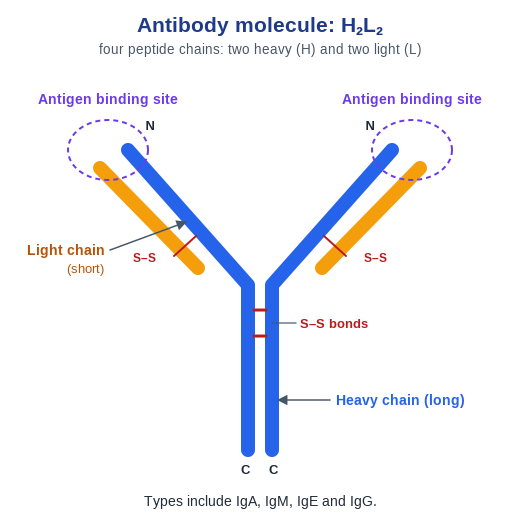
Labels to show:
- Two heavy chains (long), forming the stem and the inner side of both arms.
- Two light chains (short), along the outer side of the arms.
- Disulphide bonds (S–S) joining the chains.
- Two antigen binding sites at the tips of the arms (N-terminal ends); the C-terminal ends at the base.
- Title: antibody molecule, H₂L₂.
Draw a clear Y with two parallel lines for each chain and label with straight horizontal lines.
Exercises 10 to 13: AIDS and cancer
10. “What are the various routes by which transmission of human immuno-deficiency virus takes place?”
- Sexual contact with an infected person.
- Transfusion of contaminated blood and blood products.
- Sharing infected needles, as among people who inject drugs.
- From an infected mother to her child through the placenta.
HIV spreads only through body fluids; it does not spread by touch or physical contact. People at high risk include those with multiple sexual partners, people who inject drugs, people who need repeated blood transfusions and children of infected mothers.
11. “What is the mechanism by which the AIDS virus causes deficiency of immune system of the infected person?”
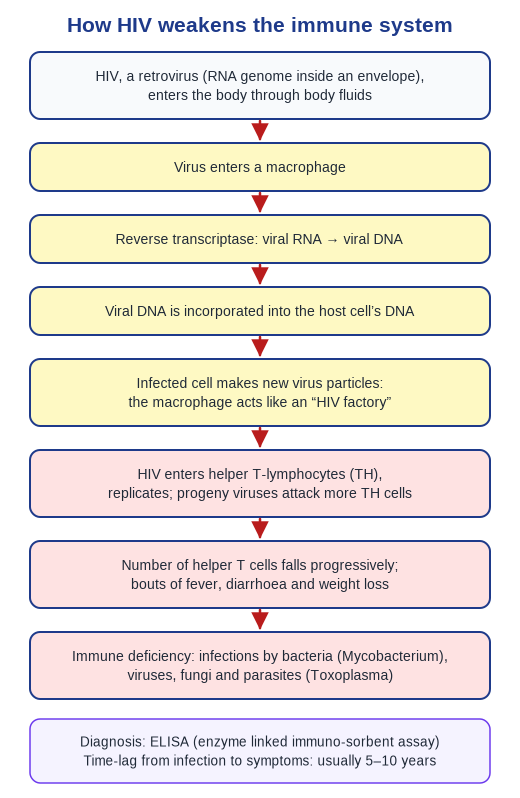
- HIV, a retrovirus, enters macrophages.
- Reverse transcriptase copies its RNA genome into viral DNA.
- The viral DNA is incorporated into the host cell’s DNA, and the cell makes new viruses. The macrophage keeps producing virus, like an HIV factory.
- HIV also enters helper T-lymphocytes, replicates, and the progeny viruses attack more helper T cells.
- This repeats, so the number of helper T cells falls progressively. Helper T cells are needed for B cells to make antibodies, so the whole acquired immune response weakens. The person has bouts of fever, diarrhoea and weight loss.
- The person becomes so immuno-deficient that infections by bacteria (Mycobacterium), viruses, fungi and parasites (Toxoplasma) cannot be fought off.
12. “How is a cancerous cell different from a normal cell?”
| Normal cell | Cancerous cell |
|---|---|
| Growth and differentiation are highly controlled | The regulatory mechanisms have broken down |
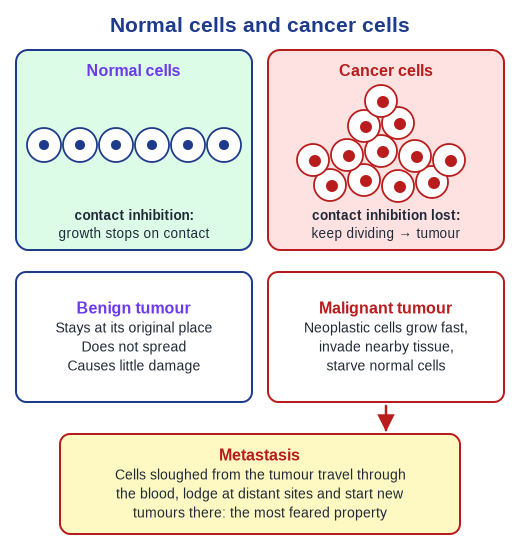
| Shows contact inhibition: contact with other cells stops its growth | Has lost contact inhibition, so it keeps dividing and forms a tumour |
| Stays in its tissue | Malignant cells invade and damage nearby tissue and can spread (metastasis) |
| Shares nutrients normally | Competes for vital nutrients and starves normal cells |
| Recognised by the immune system | Can avoid detection and destruction by the immune system |
13. “Explain what is meant by metastasis.”
Metastasis is the spread of a malignant tumour to other parts of the body. Cells slough off the tumour, travel through the blood to distant sites, and wherever they lodge, they start a new tumour. It is the most feared property of malignant tumours; benign tumours do not show it.
Exercises 14 to 17: drugs and alcohol
These answers follow the chapter’s message: drug and alcohol abuse harms health, and help is available. Anyone who is worried about themselves or a friend should talk to a parent, a teacher or a doctor.
14. “List the harmful effects caused by alcohol/drug abuse.”
- Immediate: reckless behaviour, vandalism and violence.
- Overdose: coma and death from respiratory failure, heart failure or cerebral haemorrhage; mixing drugs, or drugs with alcohol, often leads to overdosing and death.
- Infections: people who inject drugs and share needles can get AIDS and hepatitis B, both chronic and ultimately fatal.
- Long-term: damage to the nervous system and liver (cirrhosis); alcohol use in adolescence can lead to heavy drinking in adulthood.
- Pregnancy: harm to the foetus.
- Warning signs in youth: falling marks, unexplained absence from school or college, poor personal hygiene, withdrawal and isolation, depression, tiredness, aggressive behaviour, damaged relationships with family and friends, and changes in sleep, appetite and weight.
- Social: an abuser may turn to stealing for money; the family and friends suffer mental and financial distress.
- Misuse in sports: some sportspersons misuse anabolic steroids (drugs that build muscle) and similar substances. Side effects:
- In females: male-like features (masculinisation), aggressiveness, mood swings, depression, abnormal menstrual cycles, extra hair on the face and body, and a deeper voice.
- In males: acne, aggressiveness, mood swings, depression, smaller testes and less sperm production, kidney and liver problems, breast enlargement, early baldness and an enlarged prostate gland.
- In adolescents: severe acne, and early closure of the growth centres of the long bones, which can stunt growth.
- With long use, these effects may be permanent.
- Tobacco: nicotine raises blood pressure and heart rate; smoking is linked with cancers of the lung, urinary bladder and throat, bronchitis, emphysema, heart disease and gastric ulcer, and chewing tobacco with cancer of the mouth.
15. “Do you think that friends can influence one to take alcohol/drugs? If yes, how may one protect himself/herself from such an influence?”
Yes. The chapter names peer pressure as a factor in drug and alcohol abuse among adolescents, along with the idea that smoking, drugs or alcohol are “cool”.
Ways to protect oneself:
- Respect your own choices and personality; say no firmly, and do not give in to pressure to “fit in”.
- Spend time with friends who share healthy interests, and avoid situations where drugs or alcohol are around.
- Talk to parents, teachers or close and trusted friends early; sharing worries helps.
- Learn to handle stress, disappointment and failure as part of life, and put energy into sports, reading, music, yoga and other activities.
- If a friend is using drugs or alcohol, tell a parent or teacher, in that friend’s interest.
- Seek counselling or professional help when needed.
16. “Why is that once a person starts taking alcohol or drugs, it is difficult to get rid of this habit? Discuss it with your teacher.”
- Addiction: a psychological attachment to the short-lived ‘high’ and sense of well-being that drugs and alcohol produce. It drives people to take drugs or alcohol even when not needed, or when the use becomes self-destructive.
- Tolerance: with repeated use, the tolerance of the body’s receptors rises, so they respond only to larger amounts. Intake keeps increasing.
- A vicious circle: these effects pull the user into regular use (abuse). The chapter warns that even one use can lead to addiction.
- Dependence: if regular use is stopped suddenly, the body shows a withdrawal syndrome: anxiety, shakiness, nausea and sweating. This makes stopping hard, and severe withdrawal can be life-threatening and needs medical supervision.
So without guidance, counselling and medical help, the person stays dependent. With such help and determination, the chapter says, a person can overcome the problem completely.
17. “In your view what motivates youngsters to take to alcohol or drugs and how can this be avoided?”
What motivates youngsters (from the chapter):
- Curiosity, the need for adventure and excitement, and experimentation.
- Using them to escape facing problems, after a first use out of curiosity.
- Stress from pressure to excel in studies or examinations.
- The idea that smoking, drugs or alcohol are “cool” or progressive, spread by television, films, newspapers and the internet.
- Unstable or unsupportive families, and peer pressure.
How it can be avoided (the chapter’s measures):
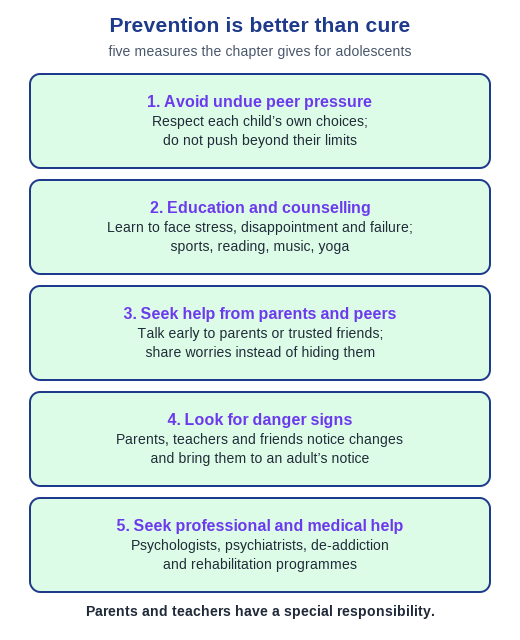
- Avoid undue peer pressure: respect each child’s choices; do not push beyond their limits in studies or sports.
- Education and counselling: learn to face problems, stress, disappointment and failure; channel energy into sports, reading, music and yoga.
- Seek help from parents and peers early, to talk about worries.
- Look for danger signs: parents, teachers and friends should notice warning signs and act.
- Seek professional and medical help: psychologists, psychiatrists, and de-addiction and rehabilitation programmes.
Parenting that combines warmth with consistent discipline is linked with a lower risk, so parents and teachers have a special role.
Questions asked inside the chapter
These are not quoted; each is restated briefly with its page.
Page 135: why can’t organs be taken from just anybody, and what do doctors check? The body tells “self” from “non-self”. A graft from an unmatched source is attacked by the cell-mediated immune response and rejected sooner or later. Doctors check tissue matching and blood group matching before a transplant, and the patient takes immuno-suppressants for life.
Page 136: why is mother’s milk essential for the new-born? The first milk, colostrum, is rich in IgA antibodies that protect the infant. This is passive immunity, given while the baby’s own immune system is still developing.
Page 137: sneezing in a new place. Sneezing and wheezing that start in a new place and stop on leaving it can be an allergy to pollen, mites and similar allergens, which differ from place to place. A doctor can find the cause.
Page 139: when do people need repeated blood transfusions? Extra, to discuss with your teacher: in inherited blood disorders such as thalassaemia, haemophilia and sickle-cell anaemia (see Chapter 4); after heavy blood loss in accidents or major surgery; and in some cancers of the blood and their treatment. Such patients need blood screened for HIV.
Practice
-
Which of these gives passive immunity?
Show answer
Answer: (c) Colostrum fed to a new-born
-
Peyer's patches are found in the:
Show answer
Answer: (b) small intestine
-
Allergy is due to the release of histamine and serotonin from:
Show answer
Answer: (a) mast cells
-
Name the enzyme HIV uses to make DNA from its RNA, and the cells it destroys.
Show answer
Answer: Reverse transcriptase. HIV destroys helper T-lymphocytes, whose number falls steadily in an infected person.
-
Name one carcinogen from each group: physical, chemical and biological.
Show answer
Answer: Physical: X-rays, gamma rays or UV rays. Chemical: the chemicals in tobacco smoke. Biological: oncogenic viruses, which carry viral oncogenes.
Stuck on a question?
Take a photo and Lagnever AI explains it step by step. Try it for 7 days for ₹2.
Get it on Google Play Open in browser
For parents: after the trial, the plan renews monthly by UPI or card autopay. You can cancel anytime in the app.