
NCERT Solutions Class 12 Biology Chapter 8: Microbes in Human Welfare
Answers to all 15 end-of-chapter exercises of Chapter 8, Microbes in Human Welfare, of Biology, the Class 12 NCERT textbook. Page numbers follow the 2026-27 reprint (pages 149–160). The exercises are quoted from the book as printed; the answers are our own, built from the chapter, and every fact from outside the chapter is marked Extra. The questions the chapter text asks along the way are answered in short at the end. The book prints no answer key for this chapter. Short notes: Chapter 8 notes.
Exercises 1 to 4: microbes in the kitchen
1. “Bacteria cannot be seen with the naked eyes, but these can be seen with the help of a microscope. If you have to carry a sample from your home to your biology laboratory to demonstrate the presence of microbes with the help of a microscope, which sample would you carry and why?”
I would carry a small amount of curd in a clean, closed container.
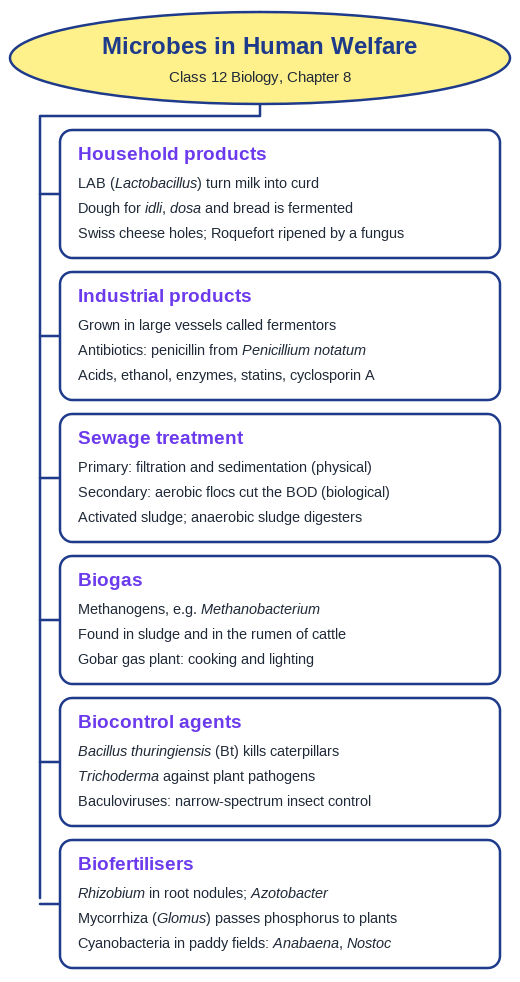
- Curd is made by lactic acid bacteria (LAB) such as Lactobacillus. Even a small amount used as a starter contains millions of LAB, so a tiny drop is enough to show many bacteria.
- It is a safe, everyday food, easy to carry, and the bacteria in it are useful, not disease-causing.
- Under the microscope the bacteria appear as small rod-shaped cells (Extra: this is what Lactobacillus looks like).
Fermented idli or dosa batter would also work, since it is fermented by bacteria. Prepare and observe the slide in the laboratory only with your teacher.
2. “Give examples to prove that microbes release gases during metabolism.”
| Example | Microbe | Gas |
|---|---|---|
| Idli and dosa dough looks puffed up | Bacteria | CO₂ |
| Bread dough is fermented | Baker’s yeast, Saccharomyces cerevisiae | CO₂ (Extra: this is what makes bread dough rise) |
| Large holes in Swiss cheese | Propionibacterium sharmanii | A large amount of CO₂ |
| Fermentation to make beverages | Brewer’s yeast, S. cerevisiae | CO₂ (the chapter names CO₂ as the main gas here) |
| Anaerobic sludge digesters in sewage treatment | Anaerobic bacteria | Methane, hydrogen sulphide and CO₂ |
| Biogas plant and rumen of cattle | Methanogens, e.g. Methanobacterium | Mostly methane, with CO₂ and H₂ |
3. “In which food would you find lactic acid bacteria? Mention some of their useful applications.”
Lactic acid bacteria (LAB), such as Lactobacillus, are found in curd, which they make from milk.
Useful applications:
- Making curd. They produce acids that coagulate and partly digest milk proteins, turning milk into curd.
- Better nutrition. They increase the vitamin B₁₂ content, so curd is more nutritious.
- Health. In our stomach, LAB check the growth of disease-causing microbes.
- Industry. Lactobacillus is used for the commercial production of lactic acid.
4. “Name some traditional Indian foods made of wheat, rice and Bengal gram (or their products) which involve use of microbes.”
| Grain or pulse | Foods | Microbe |
|---|---|---|
| Rice (with black gram) | Idli, dosa | Bacteria ferment the dough (from the chapter) |
| Wheat | Bread; Extra: bhatura, jalebi and naan, whose dough or batter is fermented | Baker’s yeast or bacteria |
| Bengal gram (gram flour, besan) | Extra: dhokla and khaman, made from fermented gram-flour batter | Bacteria (and yeast) |
The chapter itself names idli, dosa and bread; the other foods are common examples to confirm with your teacher.
Exercises 5 and 6: antibiotics
5. “In which way have microbes played a major role in controlling diseases caused by harmful bacteria?”
- Some microbes produce antibiotics: chemicals that kill, or slow the growth of, other disease-causing microbes.
- The first antibiotic, penicillin, came from the mould Penicillium notatum. Fleming saw that Staphylococci could not grow around it; Chain and Florey established its full potential, and it saved many wounded soldiers in World War II.
- After penicillin, other antibiotics were purified from other microbes.
- Diseases that once killed millions, such as plague, diphtheria (gal ghotu), whooping cough (kali khansi) and leprosy (kusht rog), can now be treated with antibiotics. The summary of the chapter also names pneumonia.
So microbes help control bacterial diseases by making the very chemicals that act against harmful bacteria.
6. “Name any two species of fungus, which are used in the production of the antibiotics.”
- Penicillium notatum, the mould from which penicillin was first obtained (from the chapter).
- Extra: Penicillium chrysogenum, used in the industrial production of penicillin; or Acremonium chrysogenum (earlier called Cephalosporium acremonium), which gives cephalosporin antibiotics.
The chapter names only one antibiotic-producing fungus, so the second name has to come from outside the book; check it with your teacher.
Exercises 7 to 9: sewage and energy
7. “What is sewage? In which way can sewage be harmful to us?”
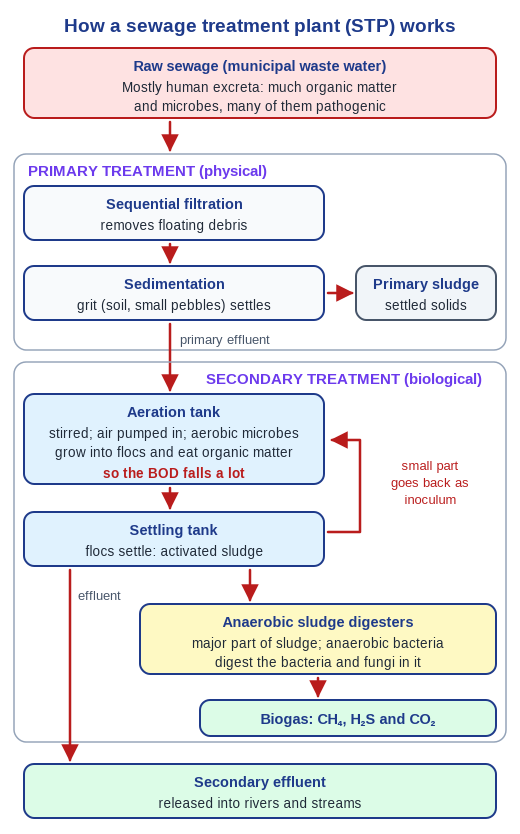
Sewage is the municipal waste water produced every day in cities and towns. Its major component is human excreta.
It can harm us because:
- It is loaded with organic matter, and it carries microbes, a lot of them pathogenic (disease-causing).
- If discharged untreated into rivers and streams, it pollutes them and leads to an increase in water-borne diseases.
- Its organic matter gives it a high BOD, and the greater the BOD, the greater the polluting potential. Extra: bacteria breaking down this organic matter use up oxygen dissolved in the river, which can kill fish and other aquatic life.
That is why sewage is treated in sewage treatment plants before disposal.
8. “What is the key difference between primary and secondary sewage treatment?”
Primary treatment is physical; secondary treatment is biological.
| Primary treatment | Secondary treatment | |
|---|---|---|
| Nature | Physical removal of particles | Biological, by microbes |
| Steps | Sequential filtration (floating debris), then sedimentation (grit) | Aeration tanks: stirring and pumping in air; aerobic microbes form flocs; then a settling tank |
| What is removed | Large and small particles | Most of the organic matter, so the BOD falls significantly |
| Products | Primary sludge and primary effluent | Activated sludge (part reused as inoculum, most digested anaerobically to biogas) and secondary effluent |
9. “Do you think microbes can also be used as source of energy? If yes, how?”
Yes. Microbes produce biogas, a fuel.
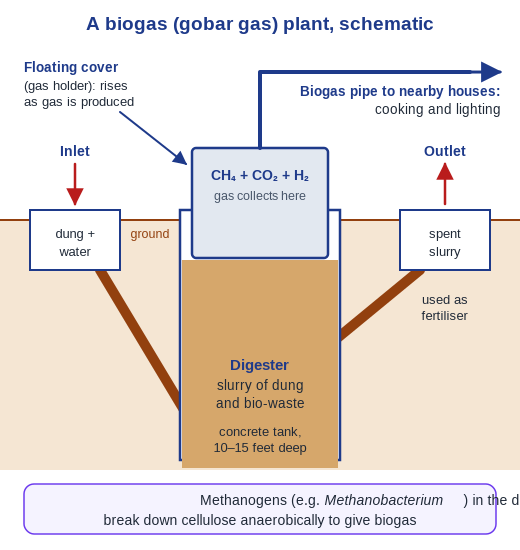
- Methanogens, such as Methanobacterium, grow anaerobically on cellulose-rich material and give off large amounts of methane, with CO₂ and H₂.
- They live in the rumen of cattle, so cattle dung (gobar) is rich in them.
- In a biogas plant, a slurry of dung is fed into a concrete tank 10–15 feet deep. As the microbes produce gas, a floating cover rises; a pipe carries the gas to nearby houses for cooking and lighting. The spent slurry can be used as fertiliser.
- In sewage treatment, anaerobic sludge digesters also produce biogas (methane, hydrogen sulphide and CO₂), which burns and can be used as a source of energy.
- The chapter also notes that yeast is used for the commercial production of ethanol. (Extra: ethanol can be blended with petrol and used as a fuel.)
Exercises 10 and 11: farms and BOD
10. “Microbes can be used to decrease the use of chemical fertilisers and pesticides. Explain how this can be accomplished.”
In place of chemical fertilisers: biofertilisers.
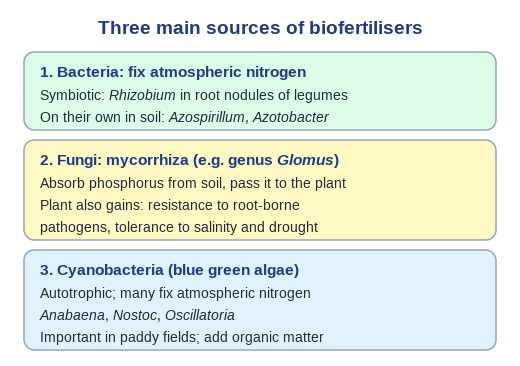
- Rhizobium in the root nodules of legumes, and free-living Azospirillum and Azotobacter in the soil, fix atmospheric nitrogen.
- Mycorrhizal fungi, such as members of the genus Glomus, absorb phosphorus and pass it to the plant, and also make it resistant to root-borne pathogens and tolerant of salinity and drought.
- Cyanobacteria such as Anabaena, Nostoc and Oscillatoria fix nitrogen and add organic matter, especially in paddy fields.
In place of chemical pesticides: biocontrol agents.
- Bacillus thuringiensis (Bt) spores sprayed on plants kill butterfly caterpillars when eaten, without harming other insects; Bt toxin genes in plants such as Bt-cotton make them resistant to insect pests.
- Trichoderma fungi control several plant pathogens.
- Baculoviruses (Nucleopolyhedrovirus) attack insects in a species-specific, narrow-spectrum way, suitable for integrated pest management.
- Natural predators such as the ladybird (aphids) and dragonflies (mosquitoes) also help.
Using these, farmers can keep pests at manageable levels and replenish soil nutrients while depending far less on toxic chemicals.
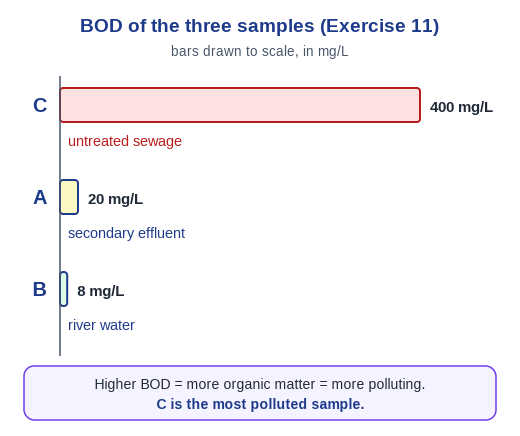
11. “Three water samples namely river water, untreated sewage water and secondary effluent discharged from a sewage treatment plant were subjected to BOD test. The samples were labelled A, B and C; but the laboratory attendant did not note which was which. The BOD values of the three samples A, B and C were recorded as 20mg/L, 8mg/L and 400mg/L, respectively. Which sample of the water is most polluted? Can you assign the correct label to each assuming the river water is relatively clean?”
BOD is a measure of organic matter: the higher the BOD, the more polluted the water.
| Sample | BOD | Label |
|---|---|---|
| C | 400 mg/L (highest) | Untreated sewage water: full of organic matter |
| A | 20 mg/L | Secondary effluent: most organic matter removed by the flocs, so its BOD is much lower |
| B | 8 mg/L (lowest) | River water: relatively clean |
Sample C is the most polluted. Order of BOD: C (400) > A (20) > B (8).
Exercises 12 to 15: research and reasoning
12. “Find out the name of the microbes from which Cyclosporin A (an immunosuppressive drug) and Statins (blood cholesterol lowering agents) are obtained.”
- Cyclosporin A: the fungus Trichoderma polysporum. Patients who receive an organ transplant are given it to suppress the immune system.
- Statins: Monascus purpureus, which the book calls a yeast. Statins lower blood cholesterol by competitively inhibiting the enzyme responsible for making cholesterol.
Extra: Monascus purpureus is usually described as a mould (a filamentous fungus). In the exam, write the name as the book prints it.
13. “Find out the role of microbes in the following and discuss it with your teacher. (a) Single cell protein (SCP) (b) Soil”
(a) Single cell protein (SCP). The 2026-27 chapter does not discuss SCP, so this answer is Extra; discuss it with your teacher.
- SCP is the protein-rich biomass of microbes, such as algae, bacteria, yeasts and fungi, grown for use as food or animal feed.
- An example often given is the cyanobacterium Spirulina. Such microbes can be grown on cheap materials such as waste water from potato processing, straw, molasses or animal manure.
- Microbes multiply very fast, so a lot of protein can be produced in a small space and short time, and waste is reduced at the same time.
(b) Soil. From the chapter:
- Nitrogen fixation: Rhizobium in root nodules; Azospirillum and Azotobacter free-living in soil; cyanobacteria such as Anabaena, Nostoc, Oscillatoria.
- Phosphorus uptake: mycorrhizal fungi such as Glomus.
- Organic matter: blue green algae add organic matter and increase fertility.
- Plant protection: Trichoderma, common in root ecosystems, acts against plant pathogens.
Extra: soil microbes are also decomposers: they break down dead plants and animals, form humus and recycle nutrients such as carbon and nitrogen back into the soil.
14. “Arrange the following in the decreasing order (most important first) of their importance, for the welfare of human society. Give reasons for your answer. Biogas, Citric acid, Penicillin and Curd”
The order is a matter of reasoned judgement; one well-supported order is:
Penicillin > Biogas > Curd > Citric acid
- Penicillin. It saves lives. The first antibiotic, it opened the way to treating deadly bacterial diseases such as plague, diphtheria, whooping cough and leprosy, which once killed millions. The chapter says we cannot imagine a world without antibiotics.
- Biogas. A cheap, renewable fuel for cooking and lighting, especially in villages, made from cattle dung and sewage sludge. It also gives spent slurry as fertiliser and helps manage waste.
- Curd. An everyday food; its LAB improve nutrition (more vitamin B₁₂) and check disease-causing microbes in the stomach.
- Citric acid. A useful industrial chemical made by Aspergillus niger, but it does not directly save life, provide energy or nutrition on the same scale.
15. “How do biofertilisers enrich the fertility of the soil?”
Biofertilisers are living organisms that make the soil richer in nutrients:
- Nitrogen. Rhizobium, in symbiosis with the roots of leguminous plants, fixes atmospheric nitrogen into organic forms the plant uses. Azospirillum and Azotobacter fix nitrogen while free-living in the soil. Cyanobacteria such as Anabaena, Nostoc and Oscillatoria also fix nitrogen, notably in paddy fields.
- Phosphorus. Mycorrhizal fungi (many members of Glomus) absorb phosphorus from the soil and pass it to the plant; they also give resistance to root-borne pathogens and tolerance to salinity and drought.
- Organic matter. Blue green algae add organic matter to the soil.
So they replenish soil nutrients and reduce the need for chemical fertilisers.
Questions asked in the chapter text
These are not quoted; each is restated briefly with its page.
Page 149: which kingdoms contain micro-organisms, and which are only microscopic? Extra (from Class XI, five-kingdom classification): micro-organisms are found in Monera (bacteria), Protista and Fungi (for example yeasts and moulds). Monera and Protista are microscopic, single-celled kingdoms; Fungi also includes large forms such as mushrooms. Viruses, viroids and prions are not placed in any kingdom.
Page 151: which metabolic pathway gives the CO₂ in dough, and where do the bacteria come from? Extra (from Class XI, respiration): the CO₂ comes from fermentation, the anaerobic breakdown of sugars (glycolysis followed by fermentation). The bacteria for idli and dosa batter come naturally from the rice and black gram themselves, and from the surroundings: utensils, hands and air.
Page 152: which metabolic reactions make ethanol in yeast? Extra (from Class XI, respiration): alcoholic fermentation. Glycolysis breaks glucose into pyruvic acid, and under anaerobic conditions pyruvic acid is converted into ethanol and CO₂.
Page 153: name some other antibiotics and their sources. Extra: streptomycin from the bacterium Streptomyces griseus; tetracycline from Streptomyces species; cephalosporins from the fungus Acremonium (Cephalosporium).
Page 155: can human beings digest the cellulose in our food? No. Extra: humans do not make the enzyme cellulase and have no rumen with methanogens, so cellulose passes through undigested as roughage (dietary fibre), which helps bowel movement.
Page 158: what does the fungus gain from mycorrhiza? Extra: the fungus gets food (sugars and other organic compounds) made by the plant in photosynthesis, and a place to live in the root. So both partners benefit: a mutualistic association.
Practice
-
Sample X has a BOD of 300 mg/L and sample Y a BOD of 12 mg/L. Which is more polluted?
Show answer
Answer: (a) X
-
The gases given off in anaerobic sludge digesters, as the book names them, are:
Show answer
Answer: (b) methane, hydrogen sulphide and carbon dioxide
-
Which pair is matched correctly?
Show answer
Answer: (b) Butyric acid: Clostridium butylicum
-
Name the microbes that give cyclosporin A and statins.
Show answer
Answer: Cyclosporin A comes from the fungus Trichoderma polysporum; statins come from Monascus purpureus, which the book calls a yeast.
-
Name one symbiotic and one free-living nitrogen-fixing bacterium.
Show answer
Answer: Symbiotic: Rhizobium, in the root nodules of leguminous plants. Free-living: Azotobacter or Azospirillum, in the soil.
Stuck on a question?
Take a photo and Lagnever AI explains it step by step. Try it for 7 days for ₹2.
Get it on Google Play Open in browser
For parents: after the trial, the plan renews monthly by UPI or card autopay. You can cancel anytime in the app.