
Class 12 Biology Chapter 8 NCERT Solutions Hinglish mein: Microbes in Human Welfare
Class 12 NCERT textbook Biology ke Chapter 8, Microbes in Human Welfare, ki saari 15 end-of-chapter exercises ke answers. Page numbers 2026-27 reprint ke hain (pages 149–160). Sawaal Hinglish mein translate kiye gaye hain; answers hamare apne hain, chapter par based, aur chapter ke bahar ki har baat Extra likhi gayi hai. Chapter ke beech mein poochhe gaye sawaal aakhir mein short mein hal hain. Book is chapter ki answer key nahi deti. Short notes: Chapter 8 notes.
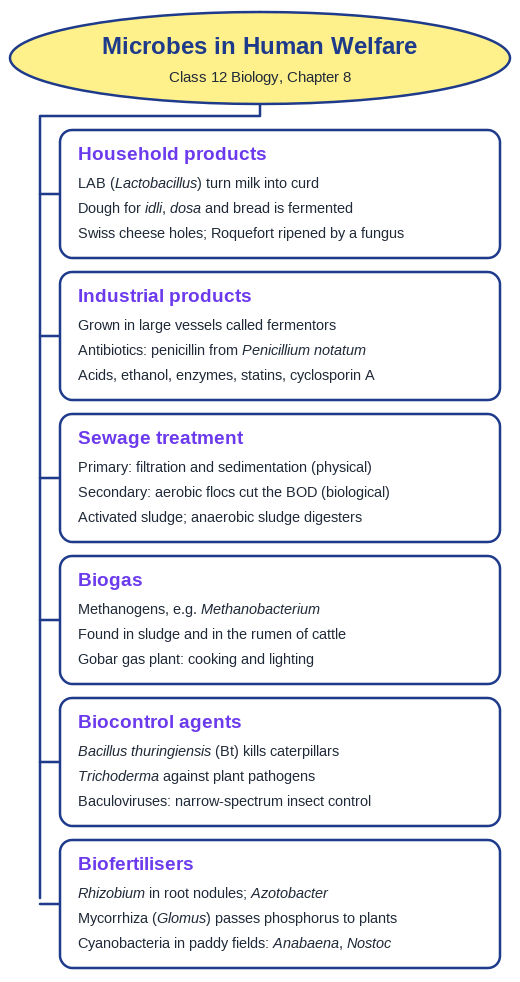
Exercises 1 se 4: kitchen ke microbes
1. Bacteria naked eye se nahi dikhte, par microscope se dikh jaate hain. Agar aapko ghar se biology laboratory tak ek sample le jaana ho, jisse microscope ki madad se microbes ki maujoodgi dikhayi ja sake, to aap kaun sa sample le jaoge aur kyun?
Main ek saaf, band dabbe mein thoda sa curd le jaaunga.
- Curd Lactobacillus jaise lactic acid bacteria (LAB) se banta hai. Starter ki tarah use hone wale thode se curd mein bhi millions (das lakh se zyada) LAB hote hain, isliye ek chhoti boond mein hi bahut bacteria dikh jaayenge.
- Ye roz ka safe khaana hai, le jaana aasaan hai, aur iske bacteria kaam ke hain, bimaari wale nahi.
- Microscope mein bacteria chhote rod jaise cells dikhte hain (Extra: Lactobacillus aisa hi dikhta hai).
Fermented idli ya dosa batter bhi chalega, kyunki wo bacteria se ferment hota hai. Slide laboratory mein sirf teacher ke saath banao aur dekho.
2. Aise examples do jo saabit karein ki microbes metabolism ke dauraan gases chhodte hain.
| Example | Microbe | Gas |
|---|---|---|
| Idli aur dosa ka dough phoola dikhta hai | Bacteria | CO₂ |
| Bread ka dough ferment hota hai | Baker’s yeast, Saccharomyces cerevisiae | CO₂ (Extra: isi se bread ka dough phoolta hai) |
| Swiss cheese ke bade chhed | Propionibacterium sharmanii | Bahut saara CO₂ |
| Beverages ke liye fermentation | Brewer’s yeast, S. cerevisiae | CO₂ (chapter yahan CO₂ ko main gas batata hai) |
| Sewage treatment ke anaerobic sludge digesters | Anaerobic bacteria | Methane, hydrogen sulphide aur CO₂ |
| Biogas plant aur cattle ka rumen | Methanogens, jaise Methanobacterium | Zyadatar methane, CO₂ aur H₂ ke saath |
3. Lactic acid bacteria aapko kis khaane mein milenge? Inke kuch useful applications batao.
Lactobacillus jaise lactic acid bacteria (LAB) curd mein milte hain, jise ye doodh se banate hain.
Useful applications:
- Curd banana. Ye acids banate hain jo doodh ke proteins ko coagulate aur thoda digest karke doodh ko curd bana dete hain.
- Behtar nutrition. Ye vitamin B₁₂ badhaate hain, isliye curd zyada nutritious hai.
- Health. Hamare pet mein LAB bimaari wale microbes ki growth rokte hain.
- Industry. Lactobacillus se commercially lactic acid banta hai.
4. Gehun, chawal aur chana (Bengal gram) ya unke products se bane kuch paramparik Indian khaano ke naam batao jinmein microbes ka use hota hai.
| Anaj ya daal | Khaane | Microbe |
|---|---|---|
| Chawal (urad ke saath) | Idli, dosa | Bacteria dough ferment karte hain (chapter se) |
| Gehun | Bread; Extra: bhatura, jalebi aur naan, jinka dough ya batter ferment hota hai | Baker’s yeast ya bacteria |
| Chana (besan) | Extra: dhokla aur khaman, fermented besan batter se | Bacteria (aur yeast) |
Chapter khud idli, dosa aur bread ka naam leta hai; baaki khaane aam examples hain, teacher se confirm karo.
Exercises 5 aur 6: antibiotics
5. Harmful bacteria se hone wali bimaariyon ko control karne mein microbes ne kis tarah badi bhoomika nibhaayi hai?
- Kuch microbes antibiotics banate hain: aise chemicals jo doosre, bimaari wale microbes ko maarte hain ya unki growth dheemi karte hain.
- Pehla antibiotic, penicillin, mould Penicillium notatum se mila. Fleming ne dekha ki iske aas-paas Staphylococci nahi ug paaye; Chain aur Florey ne iski poori capability dikhayi, aur World War II mein isne bahut se ghayal soldiers ki jaan bachaayi.
- Penicillin ke baad doosre microbes se doosre antibiotics bhi nikaale gaye.
- Jo bimaariyan kabhi duniya bhar mein millions logon ki jaan leti thi, jaise plague, diphtheria (gal ghotu), whooping cough (kali khansi) aur leprosy (kusht rog), ab antibiotics se treat ho sakti hain. Chapter ka summary pneumonia ka naam bhi leta hai.
Yaani microbes khud wahi chemicals banakar harmful bacteria ki bimaariyon ko control karne mein madad karte hain.
6. Fungus ki koi do species batao jo antibiotics banane mein use hoti hain.
- Penicillium notatum, wo mould jisse pehli baar penicillin mila (chapter se).
- Extra: Penicillium chrysogenum, jo penicillin ke industrial production mein use hota hai; ya Acremonium chrysogenum (pehle Cephalosporium acremonium), jisse cephalosporin antibiotics milte hain.
Chapter sirf ek antibiotic banane wale fungus ka naam deta hai, isliye doosra naam book ke bahar se hai; teacher se check karo.
Exercises 7 se 9: sewage aur energy
7. Sewage kya hai? Sewage hamare liye kis tarah nuksaandeh ho sakta hai?
Sewage shehron aur towns mein roz banne wala municipal waste water hai. Iska main hissa human excreta hai.
Ye nuksaan kar sakta hai kyunki:
- Ismein bahut organic matter hota hai, aur ye microbes le kar chalta hai, jinme kai pathogenic (bimaari failane wale) hain.
- Bina treat kiye rivers aur streams mein chhodne par ye unhe pollute karta hai aur water-borne bimaariyan badhaata hai.
- Organic matter ki wajah se iska BOD zyada hota hai, aur BOD jitna zyada, pollution ki capability utni zyada. Extra: ye organic matter todne wale bacteria nadi ki ghuli hui oxygen kha jaate hain, jisse fish aur doosre aquatic jeev mar sakte hain.
Isliye chhodne se pehle sewage ko sewage treatment plants mein treat kiya jaata hai.
8. Primary aur secondary sewage treatment mein main farq kya hai?
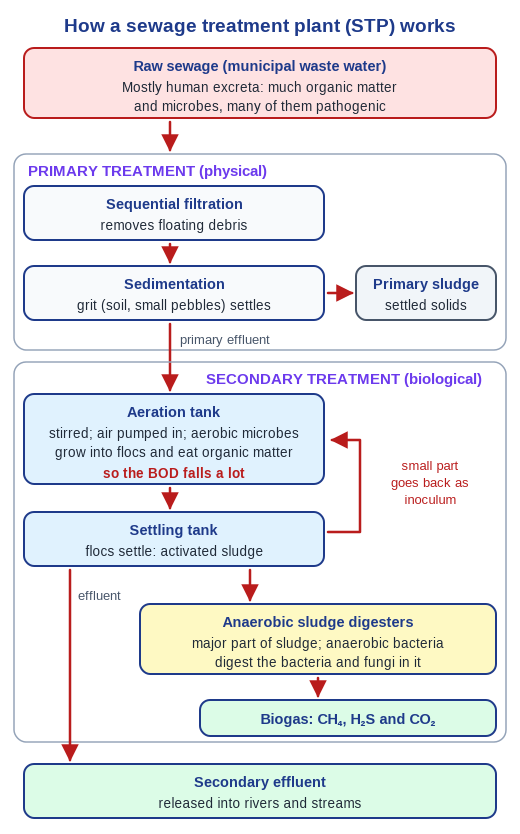
Primary treatment physical hai; secondary treatment biological hai.
| Primary treatment | Secondary treatment | |
|---|---|---|
| Nature | Particles ko physically hataana | Biological, microbes se |
| Steps | Sequential filtration (tairta kachra), phir sedimentation (grit) | Aeration tanks: hilaana aur hawa pump karna; aerobic microbes flocs banate hain; phir settling tank |
| Kya hatta hai | Chhote-bade particles | Zyadatar organic matter, isliye BOD kaafi girta hai |
| Products | Primary sludge aur primary effluent | Activated sludge (kuch inoculum ki tarah wapas, zyadatar anaerobically digest ho kar biogas) aur secondary effluent |
9. Kya aapko lagta hai ki microbes energy ke source ki tarah bhi use ho sakte hain? Agar haan, to kaise?
Haan. Microbes biogas banate hain, jo ek fuel hai.
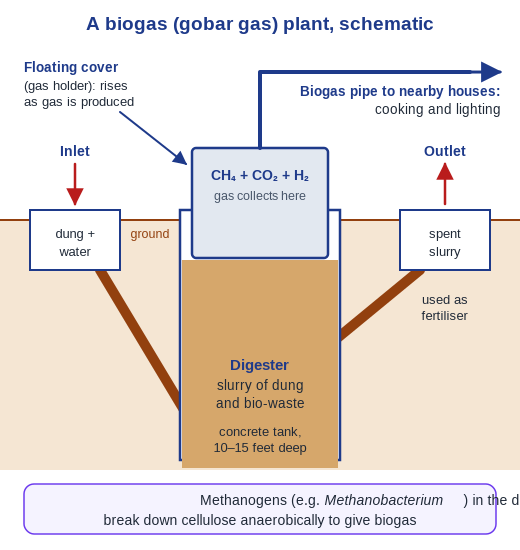
- Methanobacterium jaise methanogens cellulose wale material par anaerobically badhte hain aur CO₂ aur H₂ ke saath bahut methane chhodte hain.
- Ye cattle ke rumen mein rehte hain, isliye gobar inse bhara hota hai.
- Biogas plant mein gobar ki slurry 10–15 feet gehre concrete tank mein daali jaati hai. Microbes gas banate hain to floating cover upar uthta hai; pipe gas ko paas ke gharon tak cooking aur lighting ke liye le jaata hai. Spent slurry fertiliser ki tarah kaam aati hai.
- Sewage treatment ke anaerobic sludge digesters bhi biogas (methane, hydrogen sulphide aur CO₂) banate hain, jo jalti hai aur energy source ki tarah use ho sakti hai.
- Chapter ye bhi batata hai ki yeast se commercially ethanol banta hai. (Extra: ethanol petrol mein mila kar fuel ki tarah use ho sakta hai.)
Exercises 10 aur 11: khet aur BOD
10. Microbes ka use chemical fertilisers aur pesticides ka use kam karne mein ho sakta hai. Samjhao ki ye kaise kiya ja sakta hai.
Chemical fertilisers ki jagah: biofertilisers.
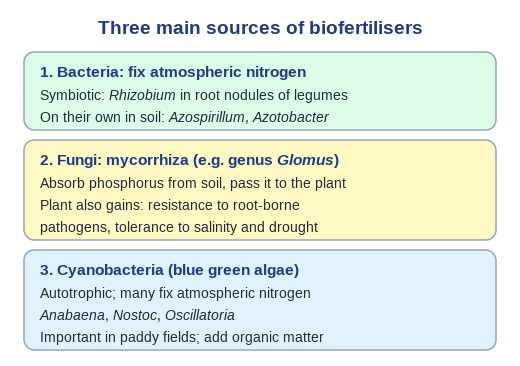
- Legumes ke root nodules mein Rhizobium, aur mitti mein free-living Azospirillum aur Azotobacter, hawa ki nitrogen fix karte hain.
- Genus Glomus jaise mycorrhizal fungi phosphorus absorb karke plant ko dete hain, aur use root-borne pathogens se bachaate aur salinity aur drought sehne layak banate hain.
- Anabaena, Nostoc aur Oscillatoria jaise cyanobacteria nitrogen fix karte hain aur organic matter badhaate hain, khaas kar paddy fields mein.
Chemical pesticides ki jagah: biocontrol agents.
- Plants par spray kiye Bacillus thuringiensis (Bt) spores khaane par butterfly caterpillars mar jaate hain, doosre insects ko nuksaan nahi hota; Bt-cotton jaise plants mein Bt toxin genes unhe insect pests se bachaate hain.
- Trichoderma fungi kai plant pathogens ko control karte hain.
- Baculoviruses (Nucleopolyhedrovirus) species-specific, narrow-spectrum tareeke se insects par hamla karte hain, jo integrated pest management ke layak hai.
- Ladybird (aphids) aur dragonflies (mosquitoes) jaise natural predators bhi madad karte hain.
Inse farmers pests ko kaabu mein rakh sakte hain aur mitti ke nutrients wapas la sakte hain, zehreele chemicals par bahut kam nirbhar reh kar.
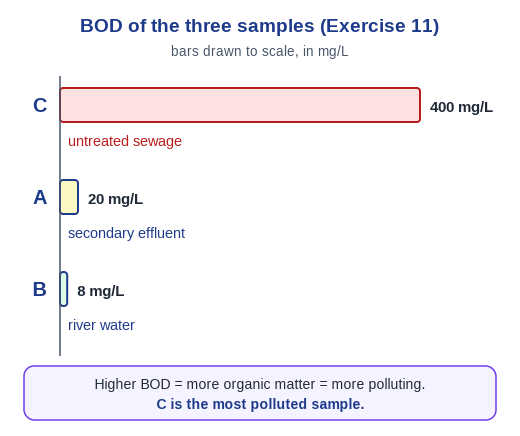
11. Teen water samples, yaani river water, untreated sewage water aur sewage treatment plant se nikla secondary effluent, ka BOD test kiya gaya. Samples par A, B aur C label lage, par laboratory attendant ne ye note nahi kiya ki kaun sa kaun hai. Samples A, B aur C ke BOD kramashah 20 mg/L, 8 mg/L aur 400 mg/L record hue. Kaun sa sample sabse zyada polluted hai? River water ko relatively saaf maan kar kya aap har sample ko sahi label de sakte ho?
BOD organic matter ka naap hai: BOD jitna zyada, paani utna zyada polluted.
| Sample | BOD | Label |
|---|---|---|
| C | 400 mg/L (sabse zyada) | Untreated sewage water: organic matter se bhara |
| A | 20 mg/L | Secondary effluent: flocs ne zyadatar organic matter hata diya, isliye BOD kaafi kam |
| B | 8 mg/L (sabse kam) | River water: relatively saaf |
Sample C sabse zyada polluted hai. BOD ka order: C (400) > A (20) > B (8).
Exercises 12 se 15: research aur reasoning
12. Pata karo ki Cyclosporin A (ek immunosuppressive drug) aur Statins (blood cholesterol kam karne wale agents) kin microbes se milte hain.
- Cyclosporin A: fungus Trichoderma polysporum. Organ transplant wale patients ko immune system dabaane ke liye diya jaata hai.
- Statins: Monascus purpureus, jise book yeast kehti hai. Statins cholesterol banane wale enzyme ko competitively inhibit karke blood cholesterol kam karte hain.
Extra: Monascus purpureus ko aam taur par mould (filamentous fungus) kaha jaata hai. Exam mein naam book jaisa likho.
13. Neeche diye mein microbes ki bhoomika pata karo aur apne teacher se discuss karo. (a) Single cell protein (SCP) (b) Soil
(a) Single cell protein (SCP). 2026-27 ka chapter SCP discuss nahi karta, isliye ye answer Extra hai; teacher se discuss karo.
- SCP microbes, jaise algae, bacteria, yeasts aur fungi, ka protein se bharpoor biomass hai, jo khaane ya animal feed ke liye ugaaya jaata hai.
- Aksar diya jaane wala example cyanobacterium Spirulina hai. Aise microbes sasti cheezon par ugaaye ja sakte hain, jaise potato processing ka waste water, straw, molasses ya animal manure.
- Microbes bahut tezi se badhte hain, isliye kam jagah aur kam samay mein bahut protein ban sakta hai, aur saath mein waste bhi kam hota hai.
(b) Soil. Chapter se:
- Nitrogen fixation: root nodules mein Rhizobium; mitti mein free-living Azospirillum aur Azotobacter; Anabaena, Nostoc, Oscillatoria jaise cyanobacteria.
- Phosphorus: Glomus jaise mycorrhizal fungi.
- Organic matter: blue green algae organic matter badhaa kar fertility badhaati hain.
- Plant protection: root ecosystems mein common Trichoderma plant pathogens ke khilaaf kaam karta hai.
Extra: mitti ke microbes decomposers bhi hain: ye mare hue plants aur animals ko tod kar humus banate hain aur carbon aur nitrogen jaise nutrients mitti mein wapas laate hain.
14. Neeche diye ko insaani samaaj ki bhalaai ke liye unki importance ke ghatte order (sabse important pehle) mein lagao. Apne answer ke kaaran do. Biogas, Citric acid, Penicillin aur Curd
Order tark par based raay hai; ek achhe se samjhaaya ja sakne wala order:
Penicillin > Biogas > Curd > Citric acid
- Penicillin. Ye jaan bachaata hai. Pehle antibiotic ne plague, diphtheria, whooping cough aur leprosy jaisi jaanlewa bacterial bimaariyon ke ilaaj ka raasta khola, jo kabhi millions logon ki jaan leti thi. Chapter kehta hai ki antibiotics ke bina duniya ki kalpana nahi kar sakte.
- Biogas. Cooking aur lighting ke liye sasta, renewable fuel, khaas kar gaon mein, gobar aur sewage sludge se bana. Ye spent slurry ke roop mein fertiliser bhi deta hai aur waste manage karne mein madad karta hai.
- Curd. Roz ka khaana; iske LAB nutrition badhaate hain (zyada vitamin B₁₂) aur pet mein bimaari wale microbes ko rokte hain.
- Citric acid. Aspergillus niger se bana kaam ka industrial chemical, par ye seedhe jaan nahi bachaata, na utne bade level par energy ya nutrition deta hai.
15. Biofertilisers mitti ki fertility kaise badhaate hain?
Biofertilisers aise living organisms hain jo mitti mein nutrients badhaate hain:
- Nitrogen. Rhizobium leguminous plants ki jadon ke saath symbiosis mein hawa ki nitrogen ko plant ke kaam ke organic forms mein fix karta hai. Azospirillum aur Azotobacter mitti mein free-living reh kar nitrogen fix karte hain. Anabaena, Nostoc aur Oscillatoria jaise cyanobacteria bhi nitrogen fix karte hain, khaas kar paddy fields mein.
- Phosphorus. Mycorrhizal fungi (Glomus ke kai members) mitti se phosphorus le kar plant ko dete hain; saath mein root-borne pathogens se bachaav aur salinity aur drought sehne ki capability bhi dete hain.
- Organic matter. Blue green algae mitti mein organic matter badhaati hain.
Is tarah ye mitti ke nutrients wapas laate hain aur chemical fertilisers ki zaroorat kam karte hain.
Chapter ke andar poochhe gaye sawaal
Ye quote nahi kiye gaye; har ek ko page ke saath short mein likha gaya hai.
Page 149: kin kingdoms mein micro-organisms hain, aur kaun se sirf microscopic hain? Extra (Class XI, five-kingdom classification se): micro-organisms Monera (bacteria), Protista aur Fungi (jaise yeasts aur moulds) mein milte hain. Monera aur Protista microscopic, single-celled kingdoms hain; Fungi mein mushrooms jaise bade forms bhi hain. Viruses, viroids aur prions kisi kingdom mein nahi rakhe gaye.
Page 151: dough mein CO₂ kis metabolic pathway se banti hai, aur bacteria kahan se aate hain? Extra (Class XI, respiration se): CO₂ fermentation se banti hai, yaani sugars ka anaerobic breakdown (glycolysis ke baad fermentation). Idli aur dosa batter ke bacteria khud chawal aur urad se, aur aas-paas se aate hain: bartan, haath aur hawa.
Page 152: yeast mein kaun si metabolic reactions ethanol banati hain? Extra (Class XI, respiration se): alcoholic fermentation. Glycolysis glucose ko pyruvic acid mein todta hai, aur anaerobic conditions mein pyruvic acid ethanol aur CO₂ mein badal jaata hai.
Page 153: kuch aur antibiotics aur unke sources batao. Extra: bacterium Streptomyces griseus se streptomycin; Streptomyces species se tetracycline; fungus Acremonium (Cephalosporium) se cephalosporins.
Page 155: kya insaan khaane ka cellulose digest kar sakte hain? Nahi. Extra: insaan cellulase enzyme nahi banate aur unke paas methanogens wala rumen nahi hai, isliye cellulose bina digest hue roughage (dietary fibre) ki tarah nikal jaata hai, jo bowel movement mein madad karta hai.
Page 158: mycorrhiza se fungus ko kya fayda hai? Extra: fungus ko plant ke photosynthesis se bana khaana (sugars aur doosre organic compounds) aur root mein rehne ki jagah milti hai. Isliye dono partners ka fayda hai: mutualistic association.
Practice karo
-
Sample X ka BOD 300 mg/L aur sample Y ka 12 mg/L hai. Kaun zyada polluted hai?
Jawab dekho
Jawab: (a) X
-
Book ke anusaar anaerobic sludge digesters mein kaun si gases nikalti hain?
Jawab dekho
Jawab: (b) methane, hydrogen sulphide aur carbon dioxide
-
Kaun sa pair sahi hai?
Jawab dekho
Jawab: (b) Butyric acid: Clostridium butylicum
-
Cyclosporin A aur statins kin microbes se milte hain?
Jawab dekho
Jawab: Cyclosporin A fungus Trichoderma polysporum se milta hai; statins Monascus purpureus se, jise book yeast kehti hai.
-
Ek symbiotic aur ek free-living nitrogen fix karne wala bacterium batao.
Jawab dekho
Jawab: Symbiotic: Rhizobium, leguminous plants ke root nodules mein. Free-living: Azotobacter ya Azospirillum, mitti mein.
Koi sawal atak gaya?
Photo lo, Lagnever AI step-by-step samjhayega. 7 din ka trial sirf ₹2.
Google Play se app lo Browser mein kholo
Parents ke liye: trial ke baad plan har mahine UPI ya card autopay se renew hota hai. App mein kabhi bhi cancel kar sakte hain.