
Class 12 Biology Chapter 8: Microbes in Human Welfare Notes Hinglish mein
Ye chapter 5 lines mein
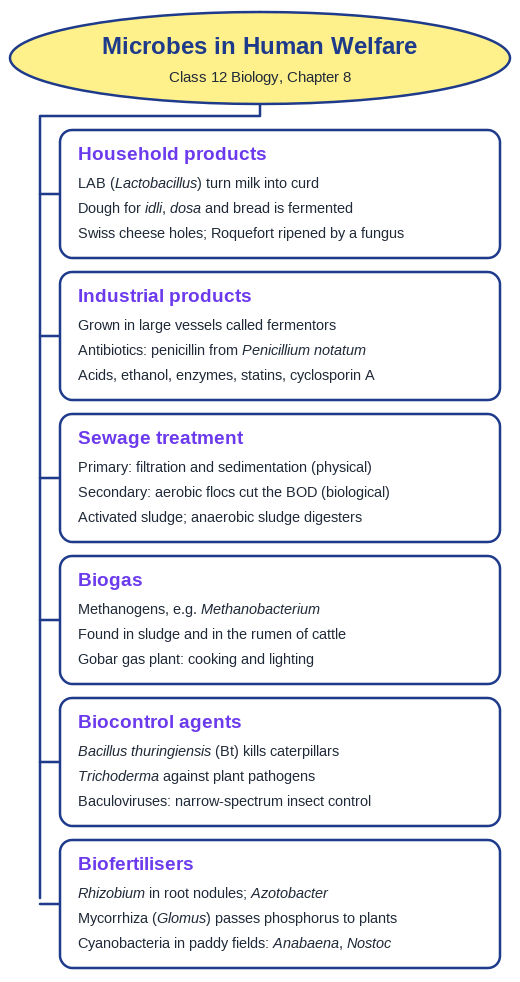
Saare microbes bimaari nahi failate; bahut se kaam ke hain. Chapter dikhata hai ki microbes ghar ke products (curd, idli-dosa ka dough, bread, cheese) aur industry ke products (fermented beverages, antibiotics, organic acids, enzymes aur doosre bioactive molecules) kaise banate hain, sewage treatment plants mein sewage kaise saaf karte hain, methanogens biogas kaise banate hain, aur microbes biocontrol agents aur biofertilisers ki tarah kaise kaam aate hain.
Ye chapter kis baare mein hai?
Chapter 7, Human Health and Disease, mein dekha ki kai bimaariyan microbes se hoti hain. Ye chapter, Unit VIII Biology in Human Welfare ka doosra chapter, doosra pehlu dikhata hai: bahut se microbes insaan ke kaam ke hain, ghar mein, industry mein, gande paani ki safai mein, fuel banane mein aur kheton mein.
Teen topic pages detail mein jaate hain: ghar aur industry mein microbes, sewage treatment aur biogas, aur biocontrol agents aur biofertilisers. Saari 15 exercises NCERT solutions mein hain.
Microbes kya hain, aur kahan milte hain?
Jo plants aur animals hum dekh sakte hain, unke alawa microbes bhi living world ka bada hissa hain. Chapter kai tarah ke microbes ginata hai: protozoa, bacteria, fungi, microscopic plant aur animal viruses, viroids, aur prions, jo protein se bane infectious agents hain.
Ye mitti, paani aur hawa mein, aur animals aur plants ke shareer ke andar rehte hain. Ye wahan bhi milte hain jahan koi aur life form nahi reh sakta: geysers (thermal vents) ke andar gehraai mein, jahan temperature 100 °C tak ho sakta hai, mitti mein bahut neeche, kai metre moti barf ke neeche, aur bahut acidic jagahon mein.
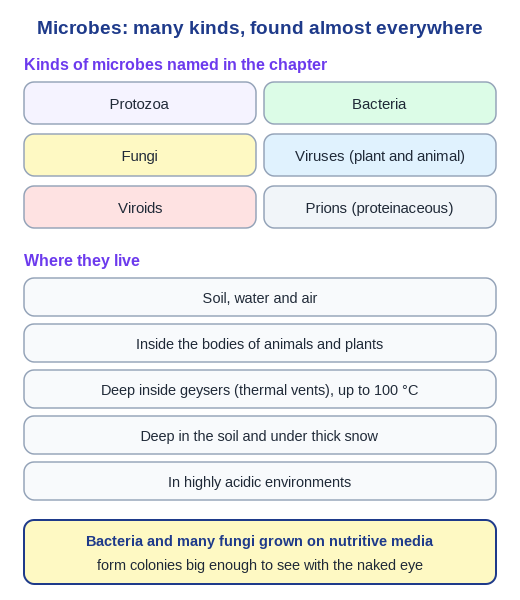
Nutritive media par bacteria aur kai fungi itni badi colonies banate hain ki wo naked eye se dikh jaati hain. Aise cultures micro-organisms ki study mein kaam aate hain. (Culture ugaana laboratory ka kaam hai: sirf teacher ke saath karo.)
Ghar ke products mein microbes kaise madad karte hain?
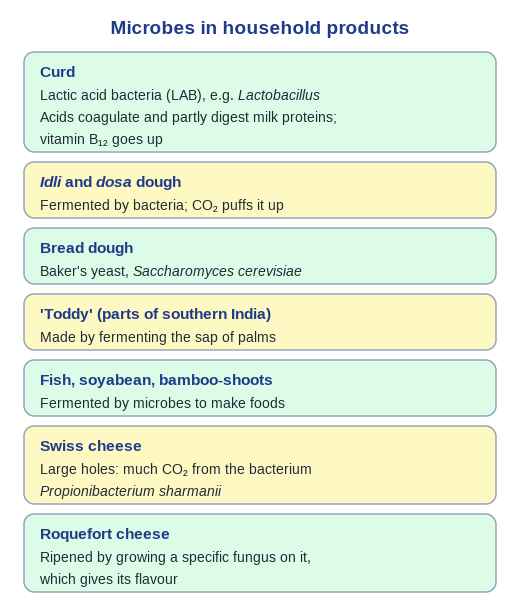
- Curd. Lactobacillus aur doosre lactic acid bacteria (LAB) doodh mein badhte hain. Inke banaye acids doodh ke proteins ko coagulate aur thoda digest karte hain. Taaze doodh mein daala gaya thoda curd inoculum ya starter ka kaam karta hai: ismein lakhon LAB hote hain, jo sahi temperature par badhte hain. Curd mein vitamin B₁₂ bhi badhta hai, isliye uski nutritional quality behtar hoti hai. Hamare pet mein bhi LAB bimaari wale microbes ko rokne mein madad karte hain.
- Idli aur dosa. Dough bacteria se ferment hota hai; CO₂ banne ki wajah se wo phoola hua dikhta hai.
- Bread. Dough baker’s yeast, Saccharomyces cerevisiae se ferment kiya jaata hai.
- Paramparik khana aur drinks. Southern India ke kuch hisson mein palm ke sap ko ferment karke ‘toddy’ naam ka paramparik drink banta hai. Fish, soyabean aur bamboo-shoots ko bhi microbes se ferment karke khana banaya jaata hai.
- Cheese, microbes se bane sabse purane khano mein se ek. Har variety ka texture, flavour aur taste uske khaas microbes se aata hai. Swiss cheese ke bade chhed bacterium Propionibacterium sharmanii ke banaye bahut saare CO₂ se hote hain. Roquefort cheese par ek khaas fungus ugaakar use ripen kiya jaata hai, jisse uska flavour aata hai.
Industry mein microbes kaise use hote hain?
Industrial scale par product banane ke liye microbes bahut bade bartano mein ugaaye jaate hain, jinhe fermentors kehte hain.
Fermented beverages
Industry mein beverages banane ke liye yeasts ka use bahut purana hai. Bread wala hi Saccharomyces cerevisiae, jise yahan brewer’s yeast kehte hain, malted cereals aur fruit juices ko ferment karke ethanol banata hai. Kaun sa drink banega, ye raw material aur processing par depend karta hai:
| Processing | Book mein diye products |
|---|---|
| Bina distillation | Wine, beer |
| Fermented broth ke distillation ke saath | Whisky, brandy, rum |
Exam ke liye ye industrial fermentation ka example hai: bade fermentors mein yeast sugars ko ethanol mein badalta hai.
Antibiotics
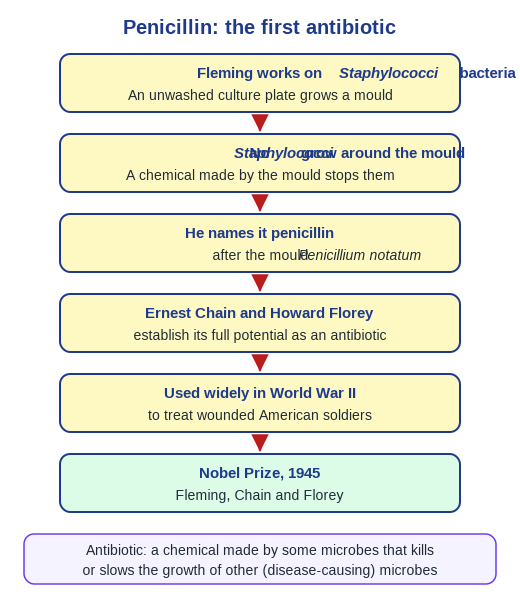
Antibiotics kuch microbes ke banaye chemicals hain jo doosre, bimaari failane wale microbes ko maarte hain ya unki growth dheemi karte hain. Shabd ka matlab ‘against life’ hai, par insaan ke liye ye ‘pro life’ hain. Chapter inhe 1900s ki badi khojon mein ginta hai.
Penicillin sabse pehla antibiotic tha, aur ye sanyog se mila. Alexander Fleming Staphylococci bacteria par kaam kar rahe the; ek bina dhuli culture plate par unhe ek mould dikha, jiske aas-paas Staphylococci nahi ugey. Mould ka banaya ek chemical iska kaaran tha; unhone mould Penicillium notatum ke naam par use penicillin kaha. Baad mein Ernest Chain aur Howard Florey ne iski poori capability dikhayi. World War II mein ghayal American soldiers ke ilaaj mein iska khoob use hua, aur teeno scientists ko 1945 mein Nobel Prize mila.
Baad mein doosre microbes se doosre antibiotics bhi nikaale gaye. Antibiotics ki wajah se aaj kabhi jaanlewa rahi bimaariyon ka ilaaj ho sakta hai: plague, whooping cough (kali khansi), diphtheria (gal ghotu) aur leprosy (kusht rog).
Chemicals, enzymes aur doosre bioactive molecules
| Product | Microbe (book ke hisaab se) | Use |
|---|---|---|
| Citric acid | Aspergillus niger (fungus) | Organic acid |
| Acetic acid | Acetobacter aceti (bacterium) | Organic acid |
| Butyric acid | Clostridium butylicum (bacterium) | Organic acid |
| Lactic acid | Lactobacillus (bacterium) | Organic acid |
| Ethanol | Yeast, Saccharomyces cerevisiae | Commercial alcohol |
| Lipases | Microbial enzymes | Detergents: kapdon se tel ke daag hataana |
| Pectinases aur proteases | Microbial enzymes | Bottled fruit juices ko saaf (clear) karna |
| Streptokinase | Bacterium Streptococcus, genetic engineering se modified | ‘Clot buster’: myocardial infarction (heart attack) ke patients ki blood vessels se clots hataana |
| Cyclosporin A | Fungus Trichoderma polysporum | Organ-transplant patients ke liye immunosuppressive agent |
| Statins | Yeast Monascus purpureus (book ke shabdon mein) | Blood cholesterol kam karna; cholesterol banane wale enzyme ko competitively inhibit karke |
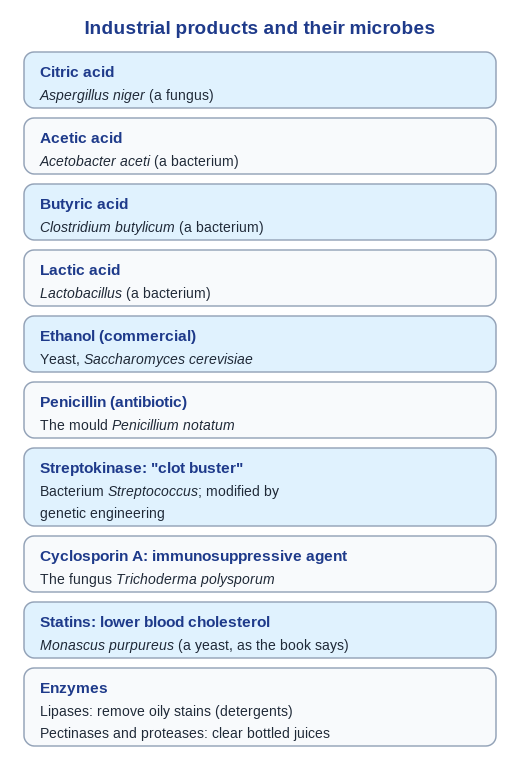
Detail mein, jaise bottled juice ghar ke juice se saaf kyun hota hai, ghar aur industry mein microbes par hai.
Microbes sewage kaise saaf karte hain?
Shehar aur towns roz bahut saara waste water banate hain, jiska bada hissa human excreta hai. Is municipal waste water, sewage, mein bahut organic matter aur microbes hote hain, jinme kai pathogenic hain, isliye ise seedhe rivers aur streams mein nahi chhoda ja sakta. Pehle ise sewage treatment plants (STPs) mein, sewage mein pehle se maujood heterotrophic microbes ki madad se, do stages mein treat kiya jaata hai.
Primary treatment (physical). Chhote-bade particles filtration aur sedimentation se hataaye jaate hain. Pehle sequential filtration se tairta kachra hatta hai; phir grit (mitti aur chhote kankad) neeche baith jaati hai. Baithe solids primary sludge banate hain; upar ka liquid (supernatant) effluent hai, jo secondary treatment mein jaata hai.
Secondary treatment (biological). Primary effluent bade aeration tanks mein jaata hai, jahan machines use hilaati hain aur hawa pump ki jaati hai. Kaam ke aerobic microbes tezi se badh kar flocs banate hain: bacteria aur fungal threads ke mesh jaise jhund. Badhte hue ye zyadatar organic matter kha jaate hain, jisse BOD kaafi gir jaata hai.
- BOD (biochemical oxygen demand): ek litre paani ke saare organic matter ko bacteria dwara oxidise karne ke liye jitni oxygen chahiye. BOD test batata hai ki sample ke micro-organisms kitni tezi se oxygen lete hain, isliye ye organic matter ka indirect naap hai. BOD jitna zyada, paani utna zyada polluting.
- BOD kaafi kam hone par effluent settling tank mein jaata hai, jahan flocs baith jaate hain. Is sediment ko activated sludge kehte hain. Iska chhota hissa inoculum ki tarah aeration tank mein wapas jaata hai; bada hissa bade anaerobic sludge digesters mein jaata hai, jahan anaerobic bacteria sludge ke bacteria aur fungi ko digest karte hain aur methane, hydrogen sulphide aur CO₂ nikalte hain. Ye gases biogas banati hain, jo jalti hai aur energy source ki tarah use ho sakti hai.
- Secondary treatment ka effluent aam taur par rivers aur streams mein chhoda jaata hai.
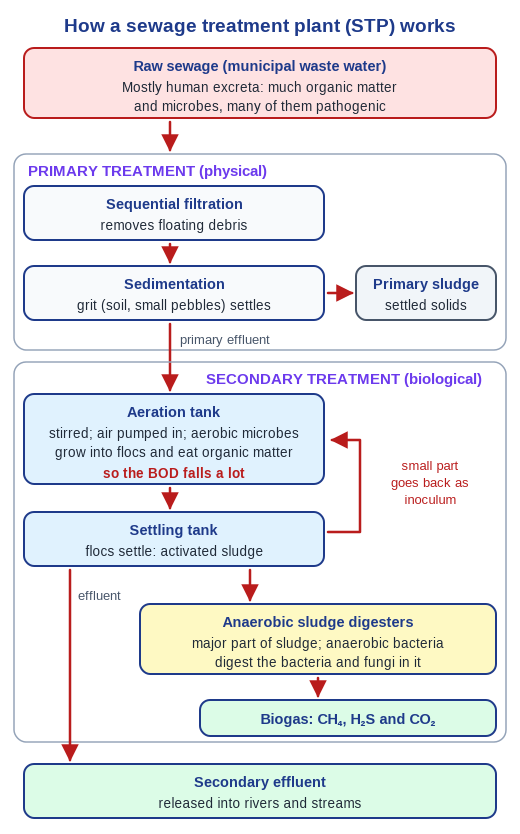
Chapter batata hai ki ye tareeka sau saal se zyada se lagbhag poori duniya mein use ho raha hai, aur abhi tak koi man-made technology microbial sewage treatment ki barabari nahi kar paayi. Par ab shehar pehle se kahin zyada sewage banate hain aur STPs utne nahi badhe, isliye untreated sewage aksar rivers mein jaata hai, jisse pollution aur water-borne bimaariyan badhti hain. Do badi nadiyon ko bachane ke liye Ministry of Environment and Forests ne Ganga Action Plan aur Yamuna Action Plan shuru kiye, jinme bahut se sewage treatment plants banane ki yojana hai taaki in nadiyon mein sirf treated sewage jaaye.
Microbes biogas kaise banate hain?
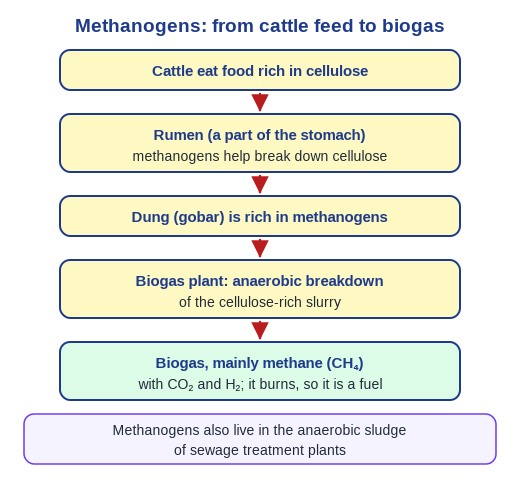
Biogas gases ka mixture hai, zyadatar methane, jo microbial activity se banta hai aur fuel ki tarah use hota hai. Kaun si gas banegi, ye microbe aur uske khaane par depend karta hai. Dough, cheese aur beverages mein main gas CO₂ hai. Par kuch bacteria jo cellulose wale material par anaerobically badhte hain, CO₂ aur H₂ ke saath bahut methane dete hain. Inhe methanogens kehte hain; ek common methanogen Methanobacterium hai.
- Methanogens sewage treatment ki anaerobic sludge mein milte hain.
- Ye cattle ke rumen (pet ka ek hissa) mein bhi rehte hain, jahan ye cattle ke khaane ka cellulose todne mein madad karte hain aur cattle ke nutrition mein kaam aate hain. Isliye cattle ka dung, gobar, methanogens se bhara hota hai, aur isse bani biogas ko gobar gas kehte hain.
Biogas plant. 10–15 feet gehra concrete tank bio-wastes jama karta hai aur ismein gobar ki slurry daali jaati hai. Slurry ke upar ek floating cover hota hai jo gas banne par upar uthta rehta hai. Ek outlet pipe se juda hota hai jo paas ke gharon tak cooking aur lighting ke liye biogas pahunchata hai; spent slurry doosre outlet se nikalti hai aur fertiliser ki tarah kaam aa sakti hai. Gaon mein gobar bahut milta hai, isliye biogas plants zyadatar rural areas mein bante hain. India mein ye technology mainly Indian Agricultural Research Institute (IARI) aur Khadi and Village Industries Commission (KVIC) ki koshishon se develop hui.
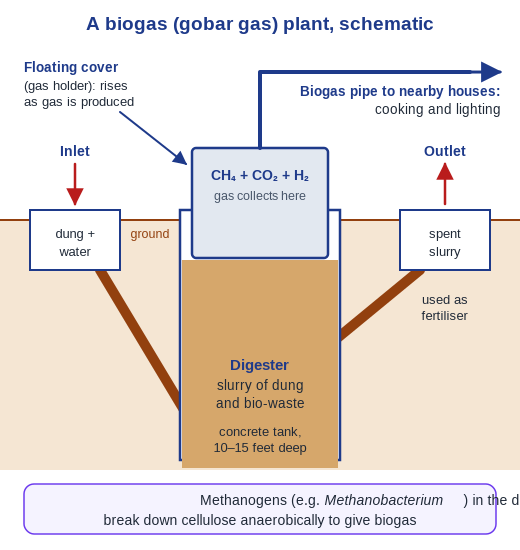
Sewage aur biogas ki poori kahani sewage treatment aur biogas par hai.
Microbes biocontrol agents ki tarah kaise kaam karte hain?
Biocontrol ka matlab hai plant diseases aur pests ko biological tareekon se control karna. Chemical insecticides, pesticides aur weedicides zehreele hain, insaan aur janwaron ko nuksaan karte hain, aur mitti, ground water, phal, sabziyan aur fasal ko pollute karte hain.
Chapter organic farmer ki soch batata hai: biodiversity se health badhti hai. Pests ko khatam karne ki jagah farmer unhe natural checks and balances se kaabu mein rakhta hai, kyunki kaam ke predatory aur parasitic insects unhi par depend karte hain. Khet ke predators aur pests, unke life cycles, khaane ke tareeke aur pasand ki jagahein jaanne se sahi biocontrol chunne mein madad milti hai.
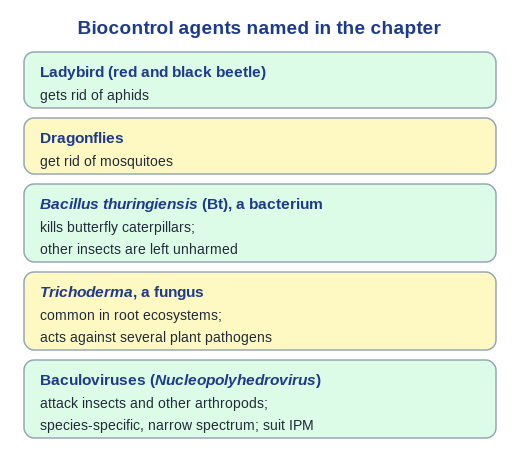
- Ladybird (laal-kaala beetle) aur dragonflies kramashah aphids aur mosquitoes se chhutkaara dilaate hain.
- Bacillus thuringiensis (Bt), ek bacterium, butterfly caterpillars ko control karta hai. Iske sookhe spores paani mein mila kar brassicas aur fruit trees jaise plants par spray kiye jaate hain; caterpillars inhe khaate hain, unke gut mein toxin nikalta hai aur wo mar jaate hain, jabki doosre insects ko nuksaan nahi hota. Bt toxin genes plants mein bhi daale gaye hain, jaise Bt-cotton, jisse wo insect pests se bachte hain (Chapter 10).
- Fungus Trichoderma, root ecosystems mein bahut common ek free-living fungus, kai plant pathogens ke khilaaf asardaar biocontrol agent hai.
- Baculoviruses, zyadatar genus Nucleopolyhedrovirus ke, insects aur doosre arthropods par hamla karte hain. Ye species-specific aur narrow-spectrum hain, aur plants, mammals, birds, fish ya non-target insects par inka koi bura asar nahi dikha, isliye ye integrated pest management (IPM) aur ecologically sensitive areas ke liye theek hain.
Microbes biofertilisers ki tarah kaise kaam karte hain?
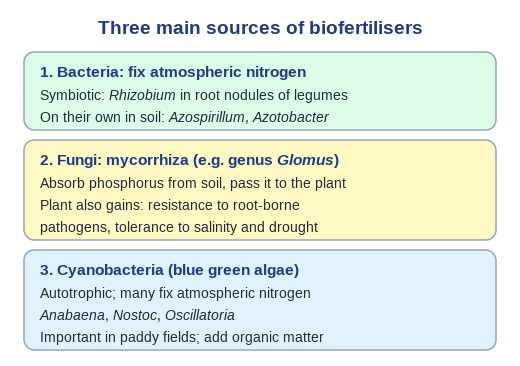
Chemical fertilisers ke zyada use se pollution badha hai, isliye organic farming ki taraf jaane ka dabaav hai, jismein biofertilisers use hote hain: aise living organisms jo mitti mein nutrients badhate hain. Inke main sources bacteria, fungi aur cyanobacteria hain.
- Bacteria. Rhizobium leguminous plants ki jadon par symbiotic association mein root nodules banata hai aur hawa ki nitrogen ko plant ke kaam ke organic forms mein fix karta hai. Azospirillum aur Azotobacter mitti mein free-living reh kar nitrogen fix karte hain.
- Fungi. Genus Glomus ke kai members plant roots ke saath mycorrhiza banate hain. Fungus mitti se phosphorus le kar plant ko deta hai. Aise plants root-borne pathogens se bachte hain, salinity aur drought sehte hain, aur behtar badhte hain.
- Cyanobacteria. Paani aur zameen ke ye autotrophic microbes, jaise Anabaena, Nostoc aur Oscillatoria, hawa ki nitrogen fix karte hain. Paddy fields mein ye zaroori biofertiliser hain, aur blue green algae mitti mein organic matter bhi badhaati hain.
India mein ab bahut se biofertilisers bikte hain, aur farmers inhe mitti ke nutrients wapas laane aur chemical fertilisers par nirbharta kam karne ke liye use karte hain. Aur detail biocontrol agents aur biofertilisers par.
Aage badhne se pehle
Ye chapter Chapter 7, Human Health and Disease (pathogens ki tarah microbes), par tika hai aur Chapter 10, Biotechnology and its Applications (Bt crops), ki taraf le jaata hai. Har product–microbe pair binomial ke saath bilkul book jaisa yaad karo, sewage treatment ka flow aur labelled biogas plant draw karne ki practice karo, aur BOD ka matlab aur secondary treatment mein uske girne ka kaaran samjho. Saari 15 exercises Chapter 8 ke NCERT solutions mein hain.
Key terms (zaroori shabd)
| Term | Matlab |
|---|---|
| Lactic acid bacteria (LAB) | Lactobacillus jaise bacteria jo doodh mein badh kar use curd bana dete hain. Inke banaye acids doodh ke proteins ko coagulate aur thoda digest karte hain, aur curd mein vitamin B₁₂ badh jaata hai. |
| Fermentor | Bahut bada bartan jismein industrial scale par product banane ke liye microbes ugaaye jaate hain. |
| Antibiotic | Kuch microbes ka banaya chemical jo doosre, bimaari failane wale microbes ko maar sakta hai ya unki growth dheemi kar sakta hai. Sabse pehla penicillin tha. |
| Sewage | Shehron aur towns ka municipal waste water. Iska main hissa human excreta hai, isliye ismein organic matter aur bahut se microbes hote hain, jinme kai pathogenic hain. |
| Flocs | Bacteria aur fungal filaments ke mesh jaise jhund. Ye secondary treatment ke aeration tanks mein bante hain aur organic matter kha jaate hain. |
| BOD (biochemical oxygen demand) | Ek litre paani ke saare organic matter ko bacteria dwara oxidise karne mein jitni oxygen lagegi. BOD jitna zyada, paani utna zyada polluting. |
| Activated sludge | Secondary treatment ke baad settling tank mein baithe bacterial flocs. Iska chhota hissa inoculum ki tarah aeration tank mein wapas jaata hai; zyadatar anaerobic sludge digesters mein jaata hai. |
| Methanogens | Bacteria jo cellulose wale material par anaerobically badhte hain aur CO₂ aur H₂ ke saath bahut methane dete hain, jaise Methanobacterium. |
| Biocontrol | Plant diseases aur pests ko zehreele chemicals ki jagah biological tareekon se control karna. |
| Biofertilisers | Aise living organisms jo mitti mein nutrients badhate hain. Inke main sources bacteria, fungi aur cyanobacteria hain. |
| Mycorrhiza | Fungus (jaise genus Glomus ke members) aur plant root ki symbiotic association. Fungus mitti se phosphorus le kar plant ko deta hai. |
Is chapter ke topics
Practice karo
-
Swiss cheese ke bade chhed kis microbe ki wajah se hote hain?
Jawab dekho
Jawab: (b) Propionibacterium sharmanii
-
Citric acid commercially kisse banta hai?
Jawab dekho
Jawab: (c) Aspergillus niger
-
Sewage ke kis stage mein aerobic microbes flocs banate hain?
Jawab dekho
Jawab: (b) Secondary treatment
-
Chapter mein naam diya gaya ek common methanogen:
Jawab dekho
Jawab: (a) Methanobacterium
-
Butterfly caterpillars ke khilaaf use hone wala Bt ek:
Jawab dekho
Jawab: (c) bacterium hai
-
Mycorrhiza mein fungus plant ko mainly kya absorb karke deta hai?
Jawab dekho
Jawab: (b) phosphorus
Students ke sawal
Class 12 Biology Chapter 8 ke main topics kya hain?
Ghar ke products mein microbes, industry ke products mein microbes (fermented beverages, antibiotics, aur chemicals, enzymes aur doosre bioactive molecules), sewage treatment mein microbes, biogas production mein microbes, biocontrol agents ki tarah microbes, aur biofertilisers ki tarah microbes.
Kya Microbes in Human Welfare 2026-27 ki NCERT Class 12 Biology book mein hai?
Haan. Ye Unit VIII, Biology in Human Welfare, ka doosra chapter, Chapter 8 hai, Class 12 Biology textbook (Reprint 2026-27) ke pages 149 se 160 par. Ismein 15 end-of-chapter exercises hain.
Is chapter ke kaun se product–microbe pairs yaad karne hain?
Curd aur LAB (Lactobacillus); bread aur Saccharomyces cerevisiae; Swiss cheese aur Propionibacterium sharmanii; citric acid aur Aspergillus niger; acetic acid aur Acetobacter aceti; butyric acid aur Clostridium butylicum; lactic acid aur Lactobacillus; ethanol aur Saccharomyces cerevisiae; penicillin aur Penicillium notatum; streptokinase aur Streptococcus; cyclosporin A aur Trichoderma polysporum; statins aur Monascus purpureus.
Sewage chhodne se pehle uska BOD kyun kam kiya jaata hai?
BOD paani mein organic matter ka indirect naap hai. Zyada BOD wala sewage zyada pollution kar sakta hai. Secondary treatment mein flocs ke microbes zyadatar organic matter kha jaate hain, isliye effluent ke rivers aur streams mein jaane se pehle BOD kaafi gir jaata hai.
Koi sawal atak gaya?
Photo lo, Lagnever AI step-by-step samjhayega. 7 din ka trial sirf ₹2.
Google Play se app lo Browser mein kholo
Parents ke liye: trial ke baad plan har mahine UPI ya card autopay se renew hota hai. App mein kabhi bhi cancel kar sakte hain.