
Class 12 Biology Chapter 8: Microbes in Human Welfare Notes
This chapter in five lines
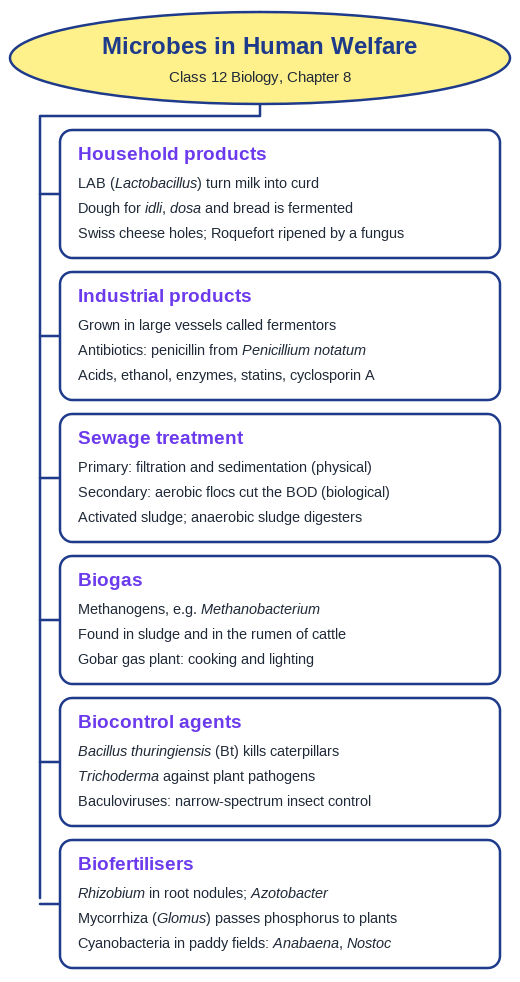
Not all microbes cause disease; many are useful. The chapter shows how microbes make household products such as curd, idli and dosa dough, bread and cheese; industrial products such as fermented beverages, antibiotics, organic acids, enzymes and other bioactive molecules; how they clean sewage in sewage treatment plants; how methanogens produce biogas; and how they act as biocontrol agents and biofertilisers.
What is this chapter about?
Chapter 7, Human Health and Disease, showed that many diseases are caused by microbes. This chapter, the second of Unit VIII, Biology in Human Welfare, looks at the other side: a large number of microbes are useful to people, at home, in industry, in cleaning waste water, in making fuel and on farms.
Three topic pages go deeper: microbes in household products and industry, sewage treatment and biogas, and biocontrol agents and biofertilisers. All 15 exercises are answered in the NCERT solutions.
What are microbes, and where are they found?
Besides the plants and animals we can see, microbes are a major part of the living world. The chapter lists many kinds: protozoa, bacteria, fungi, microscopic plant and animal viruses, viroids, and prions, which are infectious agents made of protein.
They live in soil, water and air, and inside the bodies of animals and plants. They even live where no other life form could: deep inside geysers (thermal vents), where it can be as hot as 100 °C, far down in the soil, beneath snow many metres deep, and in very acidic surroundings.
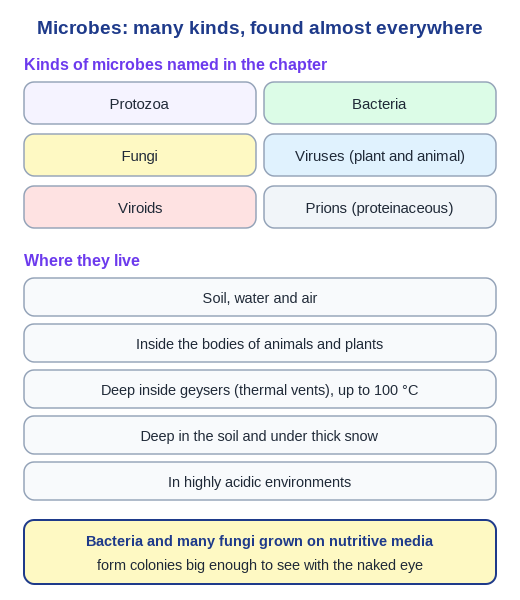
On nutritive media, bacteria and many fungi grow into colonies large enough to see with the naked eye. Such cultures are used to study micro-organisms. (Growing cultures is laboratory work: do it only with a teacher.)
How do microbes help in household products?
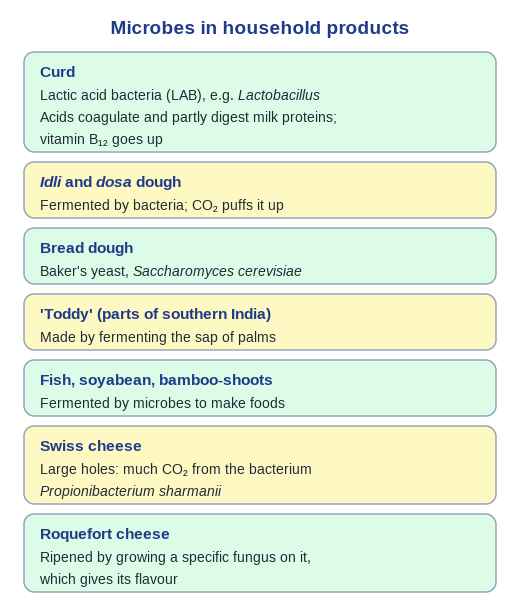
- Curd. Lactobacillus and other lactic acid bacteria (LAB) grow in milk. The acids they make coagulate and partly digest the milk proteins. A little curd added to fresh milk works as an inoculum or starter: it carries millions of LAB, which multiply at a suitable temperature. Curd also gains vitamin B₁₂, so its nutritional quality improves. In our stomach, too, LAB help to check disease-causing microbes.
- Idli and dosa. The dough is fermented by bacteria; it looks puffed up because CO₂ is produced.
- Bread. The dough is fermented by baker’s yeast, Saccharomyces cerevisiae.
- Traditional foods and drinks. In parts of southern India, fermented palm sap gives a traditional drink called ‘toddy’. Fish, soyabean and bamboo-shoots are also fermented by microbes to make foods.
- Cheese, one of the oldest foods made with microbes. Each variety’s texture, flavour and taste come from its particular microbes. The large holes in Swiss cheese come from a lot of CO₂ made by the bacterium Propionibacterium sharmanii. Roquefort cheese is ripened by growing a specific fungus on it, which gives it its flavour.
How are microbes used in industry?
To make products on an industrial scale, microbes are grown in very large vessels called fermentors.
Fermented beverages
Yeasts have long been used in industry to make beverages. The same Saccharomyces cerevisiae used for bread, here called brewer’s yeast, turns malted cereals and fruit juices into ethanol by fermentation. The kind of drink depends on the raw material and on the processing:
| Processing | Products named in the book |
|---|---|
| Without distillation | Wine, beer |
| With distillation of the fermented broth | Whisky, brandy, rum |
For the exam, this is an example of industrial fermentation: yeast converting sugars to ethanol in large fermentors.
Antibiotics
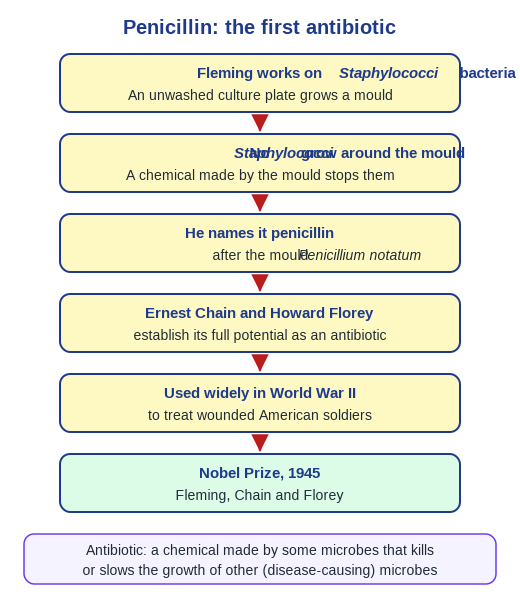
Antibiotics are chemicals made by some microbes that kill, or slow the growth of, other disease-causing microbes. The word means ‘against life’, but for human beings they are ‘pro life’. The chapter ranks them among the great discoveries of the 1900s.
Penicillin was the first antibiotic, and it was found by chance. Alexander Fleming, working on Staphylococci bacteria, noticed a mould on an unwashed culture plate, and no Staphylococci grew around it. A chemical from the mould was responsible; he called it penicillin, from the name of the mould, Penicillium notatum. Ernest Chain and Howard Florey later established its full potential. It was used widely to treat wounded American soldiers in World War II, and the three scientists received the Nobel Prize in 1945.
Other antibiotics were later purified from other microbes. Thanks to antibiotics we can now treat once-deadly diseases: plague, whooping cough (kali khansi), diphtheria (gal ghotu) and leprosy (kusht rog).
Chemicals, enzymes and other bioactive molecules
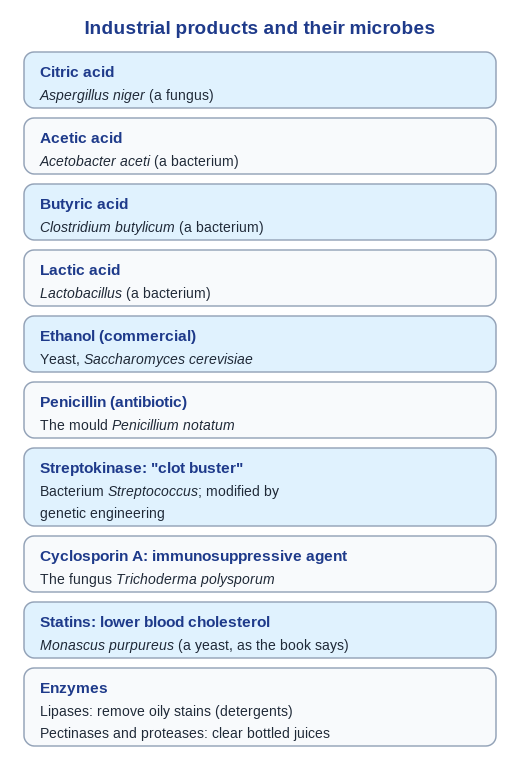
| Product | Microbe (as printed in the book) | Use |
|---|---|---|
| Citric acid | Aspergillus niger (a fungus) | Organic acid |
| Acetic acid | Acetobacter aceti (a bacterium) | Organic acid |
| Butyric acid | Clostridium butylicum (a bacterium) | Organic acid |
| Lactic acid | Lactobacillus (a bacterium) | Organic acid |
| Ethanol | Yeast, Saccharomyces cerevisiae | Commercial alcohol |
| Lipases | Microbial enzymes | Detergents: remove oily stains from laundry |
| Pectinases and proteases | Microbial enzymes | Make bottled fruit juices clear |
| Streptokinase | Bacterium Streptococcus, modified by genetic engineering | ‘Clot buster’: removes clots from blood vessels of patients who had a myocardial infarction (heart attack) |
| Cyclosporin A | Fungus Trichoderma polysporum | Immunosuppressive agent for organ-transplant patients |
| Statins | Yeast Monascus purpureus (as the book calls it) | Lower blood cholesterol by competitively inhibiting the enzyme that makes cholesterol |
The details, including why bottled juice is clearer than juice made at home, are in microbes in household products and industry.
How do microbes treat sewage?
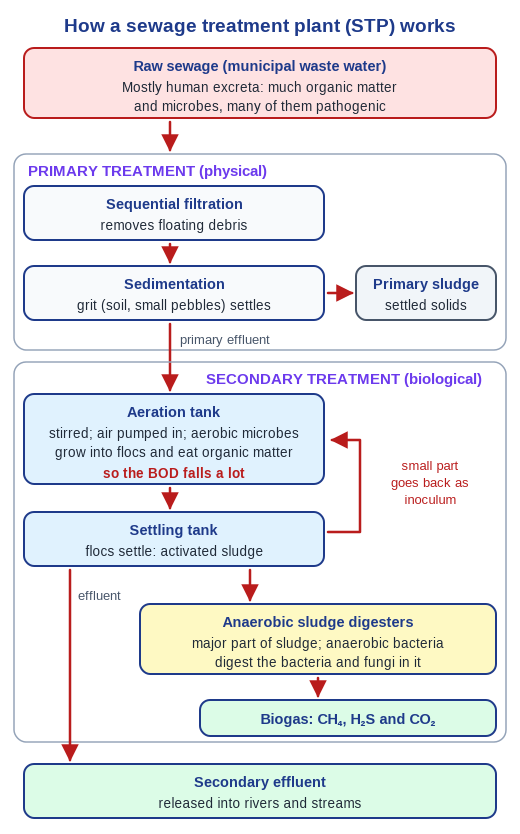
Cities and towns produce huge amounts of waste water every day. Its major component is human excreta. This municipal waste water, sewage, contains a lot of organic matter and microbes, many of them pathogenic, so it cannot be released straight into rivers and streams. It is first treated in sewage treatment plants (STPs) by the heterotrophic microbes that are naturally present in it, in two stages.
Primary treatment (physical). Particles, large and small, are removed by filtration and sedimentation. Floating debris is removed first by sequential filtration; then grit (soil and small pebbles) settles out. The settled solids form the primary sludge; the liquid above (the supernatant) is the effluent, which goes on to secondary treatment.
Secondary treatment (biological). The primary effluent goes into large aeration tanks, where it is stirred mechanically and air is pumped in. Useful aerobic microbes grow fast into flocs: masses of bacteria joined with fungal filaments in a mesh. As they grow, they consume most of the organic matter, which lowers the BOD a great deal.
- BOD (biochemical oxygen demand) is the amount of oxygen that would be used up if all the organic matter in one litre of water were oxidised by bacteria. The BOD test measures how fast micro-organisms in a sample take up oxygen, so it is an indirect measure of the organic matter present. The higher the BOD, the more polluting the water.
- When the BOD has fallen enough, the effluent goes to a settling tank, where the flocs settle. This sediment is the activated sludge. A small part is pumped back into the aeration tank as inoculum; the major part goes to large anaerobic sludge digesters, where anaerobic bacteria digest the bacteria and fungi in the sludge, giving off methane, hydrogen sulphide and CO₂. These gases form biogas, which burns and can be used as a source of energy.
- The effluent from secondary treatment is usually released into rivers and streams.
The chapter notes that this method has been used for more than a century, in almost all parts of the world, and that no man-made technology has yet matched microbial treatment of sewage. But cities now produce far more sewage than before, and the number of STPs has not kept up, so untreated sewage often reaches rivers, causing pollution and more water-borne diseases. To protect two major rivers, the Ministry of Environment and Forests started the Ganga Action Plan and the Yamuna Action Plan, under which many sewage treatment plants are to be built so that only treated sewage reaches these rivers.
How do microbes produce biogas?
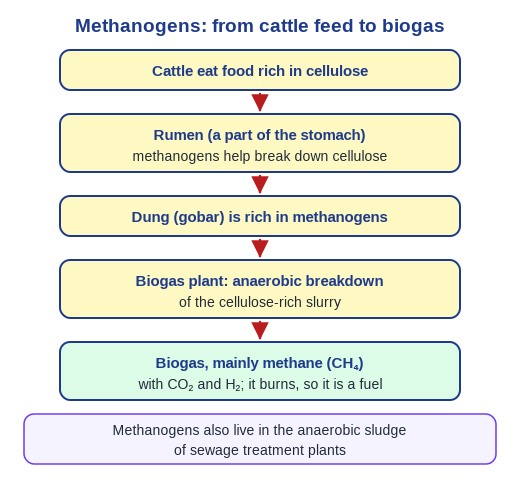
Biogas is a mixture of gases, mostly methane, made by microbial activity, and it can be used as fuel. The gas a microbe gives off depends on the microbe and on what it feeds on. In dough, cheese and beverages the main gas is CO₂. But some bacteria that grow anaerobically on cellulose-rich material give off a lot of methane along with CO₂ and H₂. They are called methanogens; a common one is Methanobacterium.
- Methanogens live in the anaerobic sludge of sewage treatment plants.
- They also live in the rumen (a part of the stomach) of cattle, where they help break down the cellulose in the cattle’s food and so help cattle nutrition. Cattle dung, gobar, is therefore rich in methanogens, and the biogas made from it is called gobar gas.
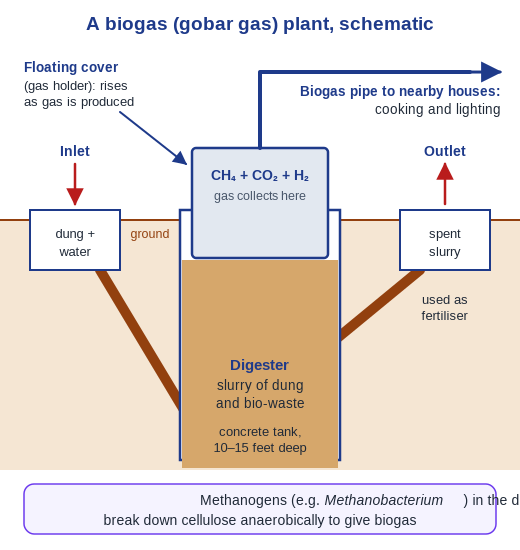
The biogas plant. A concrete tank 10–15 feet deep collects bio-wastes and is fed a slurry of dung. A floating cover over the slurry rises as microbes produce gas. One outlet connects to a pipe that supplies biogas to nearby houses for cooking and lighting; the spent slurry is taken out from a second outlet and can serve as fertiliser. Because cattle dung is plentiful in villages, biogas plants are built more often in rural areas. In India, the technology was developed mainly through the efforts of the Indian Agricultural Research Institute (IARI) and the Khadi and Village Industries Commission (KVIC).
The full sewage and biogas story is in sewage treatment and biogas.
How do microbes act as biocontrol agents?
Biocontrol means using biological methods to control plant diseases and pests. Chemical insecticides, pesticides and weedicides are toxic, harm people and animals, and pollute soil, ground water, fruits, vegetables and crops.
The chapter describes the organic farmer’s view: biodiversity furthers health. Instead of wiping out pests, the farmer keeps them at manageable levels through natural checks and balances, because predatory and parasitic insects that are useful depend on them. Knowing the field’s predators and pests, their life cycles, feeding patterns and preferred habitats helps choose suitable biocontrol.
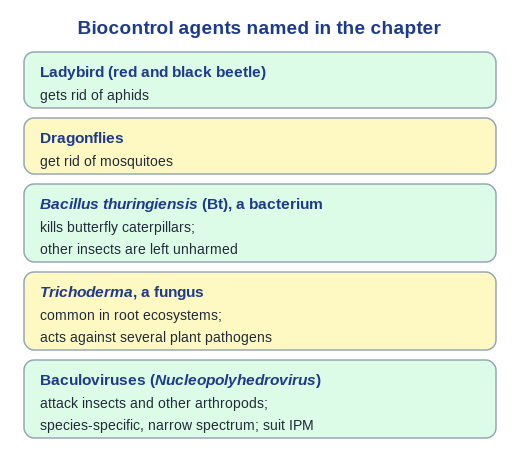
- The ladybird (red and black beetle) and dragonflies help get rid of aphids and mosquitoes respectively.
- Bacillus thuringiensis (Bt), a bacterium, controls butterfly caterpillars. Its dried spores are mixed with water and sprayed on plants such as brassicas and fruit trees; caterpillars eat them, the toxin is released in their gut, and they die, while other insects are unharmed. Bt toxin genes have also been put into plants, such as Bt-cotton, making them resistant to insect pests (Chapter 10).
- The fungus Trichoderma, a free-living fungus very common in root ecosystems, is an effective biocontrol agent of several plant pathogens.
- Baculoviruses, mostly of the genus Nucleopolyhedrovirus, attack insects and other arthropods. They are species-specific and narrow-spectrum, with no reported harm to plants, mammals, birds, fish or non-target insects, which suits integrated pest management (IPM) and ecologically sensitive areas.
How do microbes act as biofertilisers?
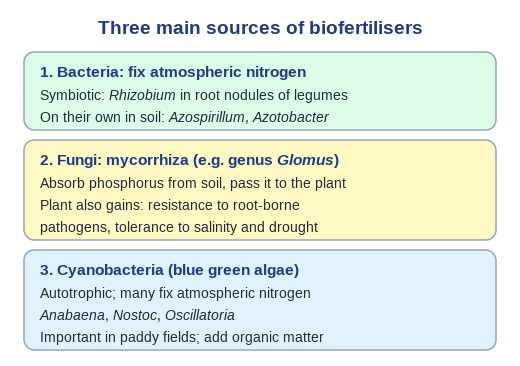
Overuse of chemical fertilisers has added to pollution, so there is pressure to switch to organic farming, using biofertilisers: living organisms that make the soil richer in nutrients. Their main sources are bacteria, fungi and cyanobacteria.
- Bacteria. Rhizobium forms root nodules on leguminous plants in a symbiotic association and fixes atmospheric nitrogen into organic forms the plant uses. Azospirillum and Azotobacter fix nitrogen while free-living in the soil.
- Fungi. Many species of the genus Glomus live with plant roots as mycorrhiza. The fungus absorbs phosphorus from the soil and passes it to the plant. Such plants also resist root-borne pathogens, tolerate salinity and drought, and grow better overall.
- Cyanobacteria. These autotrophic microbes of water and land, such as Anabaena, Nostoc and Oscillatoria, fix atmospheric nitrogen. They are an important biofertiliser in paddy fields, and blue green algae enrich the soil with organic matter too.
Many biofertilisers are now sold in India, and farmers use them to replenish soil nutrients and depend less on chemical fertilisers. More in biocontrol agents and biofertilisers.
Before we move on
This chapter builds on Chapter 7, Human Health and Disease (microbes as pathogens), and leads into Chapter 10, Biotechnology and its Applications (Bt crops). Learn every product–microbe pair with the binomial exactly as printed, be able to draw the sewage-treatment flow and a labelled biogas plant, and know what BOD means and why it falls during secondary treatment. All 15 exercises are answered in the NCERT solutions for Chapter 8.
Key terms
| Term | Meaning |
|---|---|
| Lactic acid bacteria (LAB) | Bacteria such as Lactobacillus that grow in milk and turn it into curd. The acids they make coagulate and partly digest the milk proteins, and the curd gains vitamin B₁₂. |
| Fermentor | A very large vessel in which microbes are grown to make a product on an industrial scale. |
| Antibiotic | A chemical substance produced by some microbes that can kill, or slow the growth of, other disease-causing microbes. Penicillin was the first to be discovered. |
| Sewage | Municipal waste water from cities and towns. Its main component is human excreta, so it holds much organic matter and many microbes, a lot of them pathogenic. |
| Flocs | Masses of bacteria joined with fungal filaments into mesh-like structures. They grow in the aeration tanks during secondary treatment and consume organic matter. |
| BOD (biochemical oxygen demand) | The amount of oxygen that would be used up if all the organic matter in one litre of water were oxidised by bacteria. The higher the BOD, the more polluting the water. |
| Activated sludge | The sediment of bacterial flocs in the settling tank after secondary treatment. A small part goes back to the aeration tank as inoculum; most goes to anaerobic sludge digesters. |
| Methanogens | Bacteria that grow anaerobically on cellulose-rich material and give off large amounts of methane with CO₂ and H₂, for example Methanobacterium. |
| Biocontrol | Using biological methods, instead of toxic chemicals, to control plant diseases and pests. |
| Biofertilisers | Living organisms that make the soil richer in nutrients. Their main sources are bacteria, fungi and cyanobacteria. |
| Mycorrhiza | A symbiotic association of a fungus, such as members of the genus Glomus, with a plant root. The fungus absorbs phosphorus from the soil and passes it to the plant. |
Topics in this chapter
Practice
-
Which microbe is responsible for the large holes in Swiss cheese?
Show answer
Answer: (b) Propionibacterium sharmanii
-
Citric acid is produced commercially by:
Show answer
Answer: (c) Aspergillus niger
-
Which treatment stage of sewage uses aerobic microbes that grow into flocs?
Show answer
Answer: (b) Secondary treatment
-
A common methanogen named in the chapter is:
Show answer
Answer: (a) Methanobacterium
-
Bt, used against butterfly caterpillars, is a:
Show answer
Answer: (c) bacterium
-
The fungal partner in mycorrhiza mainly helps the plant by absorbing:
Show answer
Answer: (b) phosphorus
Questions students ask
What are the main topics of Class 12 Biology Chapter 8?
Microbes in household products, microbes in industrial products (fermented beverages, antibiotics, and chemicals, enzymes and other bioactive molecules), microbes in sewage treatment, microbes in the production of biogas, microbes as biocontrol agents, and microbes as biofertilisers.
Is Microbes in Human Welfare in the 2026-27 NCERT Class 12 Biology book?
Yes. It is Chapter 8, the second chapter of Unit VIII, Biology in Human Welfare, in the Class 12 Biology textbook marked Reprint 2026-27, on pages 149 to 160. It has 15 end-of-chapter exercises.
Which product–microbe pairs should I learn from this chapter?
Curd and LAB (Lactobacillus); bread and Saccharomyces cerevisiae; Swiss cheese and Propionibacterium sharmanii; citric acid and Aspergillus niger; acetic acid and Acetobacter aceti; butyric acid and Clostridium butylicum; lactic acid and Lactobacillus; ethanol and Saccharomyces cerevisiae; penicillin and Penicillium notatum; streptokinase and Streptococcus; cyclosporin A and Trichoderma polysporum; statins and Monascus purpureus.
Why is the BOD of sewage reduced before it is released?
BOD indirectly measures the organic matter in water. Sewage with a high BOD has a high polluting potential. During secondary treatment, microbes in the flocs consume most of the organic matter, so the BOD falls significantly before the effluent goes into rivers and streams.
Stuck on a question?
Take a photo and Lagnever AI explains it step by step. Try it for 7 days for ₹2.
Get it on Google Play Open in browser
For parents: after the trial, the plan renews monthly by UPI or card autopay. You can cancel anytime in the app.