
How do microbes treat sewage and produce biogas?
Answer in short
Sewage is treated in two stages. Primary treatment removes particles physically by filtration and sedimentation. Secondary treatment is biological: aerobic flocs in aeration tanks consume organic matter and lower the BOD; the settled activated sludge is digested anaerobically to give biogas. Methanogens such as Methanobacterium, found in sludge and cattle dung, make biogas, mostly methane, in biogas plants.
Stuck on a question? Take a photo and Lagnever AI explains it step by step. Try it for 7 days for ₹2. Get it on Google Play
Why can’t sewage go straight into a river?
Every day, cities and towns produce enormous volumes of waste water, made up mostly of human excreta. This municipal waste water is called sewage. It is full of organic matter and microbes, many of them pathogenic. Released untreated, it would pollute rivers and spread water-borne diseases.
That is why sewage first goes to sewage treatment plants (STPs), which make it far less polluting before it is let out. The work is done by heterotrophic microbes already present in the sewage. This page covers sections 8.3 and 8.4 of the chapter; the Chapter 8 notes give the whole chapter in short.
What happens in primary treatment?
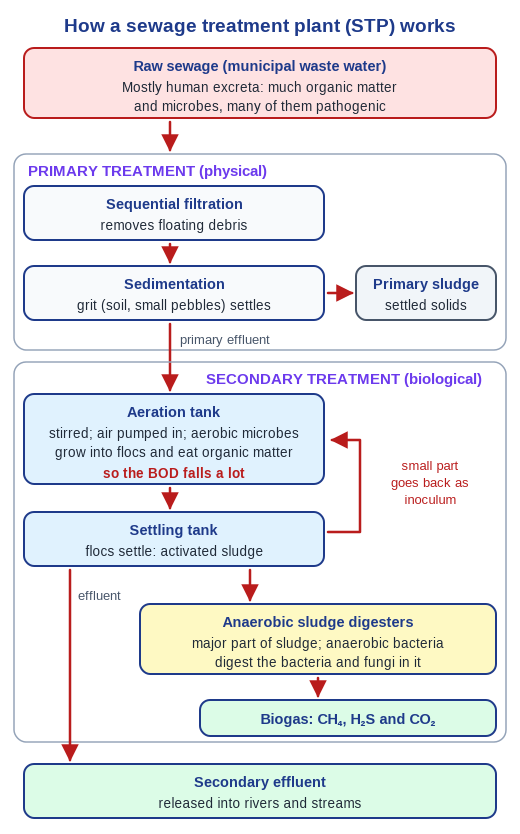
Primary treatment is physical. Particles, both large and small, are removed in stages:
- Sequential filtration removes the floating debris.
- Sedimentation removes the grit (soil and small pebbles).
All the solids that settle form the primary sludge. The liquid above them, the supernatant, is the effluent. This primary effluent is then sent for secondary treatment.
What happens in secondary (biological) treatment?
- Aeration tanks. The primary effluent flows into big aeration tanks, where machines keep stirring it and air is pumped through it.
- Flocs. Useful aerobic microbes multiply fast and form flocs: clumps of bacteria held together with fungal threads in a mesh.
- Organic matter is consumed. While growing, the flocs use up most of the organic matter in the effluent, so the BOD falls significantly. The sewage is treated until the BOD has been reduced.
- Settling tank. The effluent then goes to a settling tank, where the flocs settle. This sediment is the activated sludge.
- Recycling the sludge. Some of the activated sludge, a small part, is returned to the aeration tank to act as inoculum. The major part goes to large tanks called anaerobic sludge digesters.
- Digesters. Here a different set of bacteria, living anaerobically (without oxygen), break down the bacteria and fungi in the sludge. They give off a mixture of gases, methane, hydrogen sulphide and carbon dioxide, which forms biogas. Biogas burns, so it can be used as a source of energy.
- Release. The effluent from secondary treatment is generally released into natural water bodies such as rivers and streams.
| Primary treatment | Secondary treatment | |
|---|---|---|
| Nature | Physical | Biological |
| How | Filtration and sedimentation | Aerobic microbes (flocs) in aeration tanks |
| Removes | Floating debris, grit and other particles | Most of the organic matter |
| Product | Primary sludge and primary effluent | Activated sludge and secondary effluent; biogas from the digesters |
What is BOD, and why does it matter?
BOD (biochemical oxygen demand) is the oxygen needed for bacteria to oxidise all the organic matter present in one litre of water.
- The BOD test measures the rate at which micro-organisms in a water sample take up oxygen.
- So BOD is an indirect measure of organic matter in the water.
- Higher BOD means waste water that can pollute more.
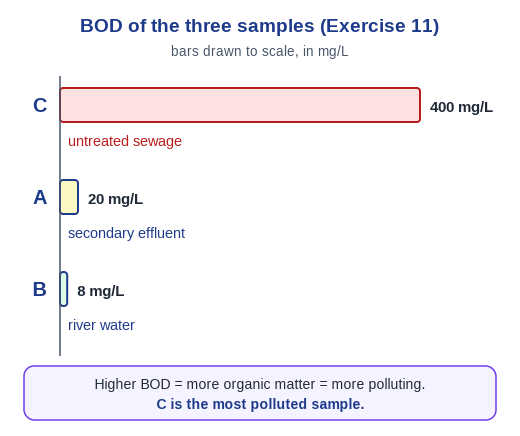
Exercise 11 of the chapter uses this idea to sort three unlabelled samples; it is worked out in the NCERT solutions.
Is microbial sewage treatment still used, and is it enough?
The chapter points out that microbes treat millions of gallons of waste water every day across the world, that the method has been in use for more than a century, and that no man-made technology has yet matched it.
But with growing urbanisation, much more sewage is produced than before, while the number of STPs has not risen enough. Untreated sewage often goes straight into rivers, polluting them and increasing water-borne diseases.
To protect two of the country’s major rivers from pollution, the Ministry of Environment and Forests launched the Ganga Action Plan and the Yamuna Action Plan. Under these plans, many sewage treatment plants are to be built so that only treated sewage is discharged into the rivers.
What are methanogens?
Biogas is a mixture of gases, mostly methane, made by microbial activity and usable as fuel. The gas a microbe gives off depends on the microbe and on the organic substrate it uses: in dough, cheese making and beverages, the main gas is CO₂.
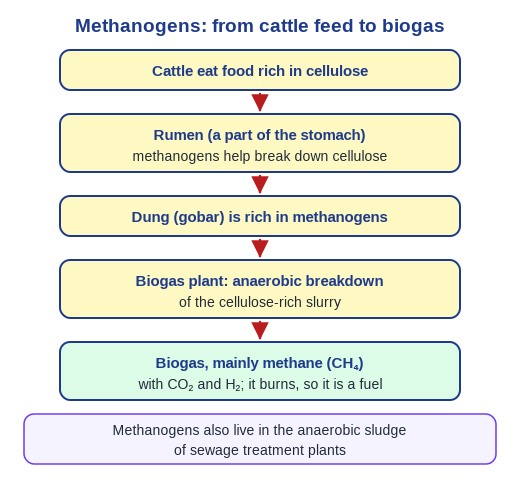
Some bacteria grow anaerobically on cellulose-rich material and give off large amounts of methane, along with CO₂ and H₂. They are called methanogens; a common one is Methanobacterium.
- They are common in the anaerobic sludge of sewage treatment.
- They live in the rumen, a part of the stomach of cattle. Cattle food contains a lot of cellulose; in the rumen the methanogens help break it down, which is important for the nutrition of cattle.
- So cattle dung (gobar) is rich in methanogens, and it can be used to make biogas, called gobar gas.
How does a biogas plant work?
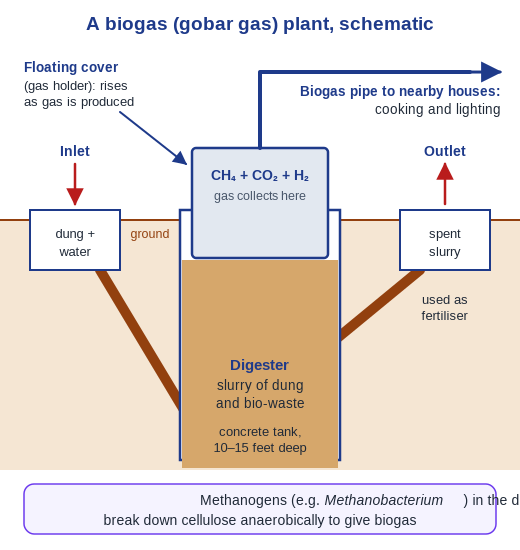
| Part | What it does |
|---|---|
| Concrete tank (digester), 10–15 feet deep | Bio-wastes are collected in it and a slurry of dung is fed in |
| Floating cover (gas holder) | Placed over the slurry; it keeps rising as microbes produce gas |
| Gas outlet and pipe | Supplies biogas to nearby houses |
| Second outlet | Removes the spent slurry, which may be used as fertiliser |
- Uses: cooking and lighting.
- Where: more often in rural areas, because cattle dung is available there in large quantities.
- Who developed it in India: mainly the Indian Agricultural Research Institute (IARI) and the Khadi and Village Industries Commission (KVIC).
The book suggests visiting a nearby biogas plant or sewage treatment plant to learn from the people who run it. Make such a visit only as a school visit with your teacher.
Quick check
- Primary = physical; secondary = biological.
- Flocs: aerobic; sludge digesters: anaerobic.
- BOD falls during secondary treatment; high BOD = more polluted.
- Methanogen: Methanobacterium; biogas: mainly methane.
Next: how microbes replace toxic chemicals on farms, in biocontrol agents and biofertilisers.
Practice
-
Grit is removed from sewage by:
Show answer
Answer: (b) sedimentation
-
The sediment of bacterial flocs in the settling tank is called:
Show answer
Answer: (b) activated sludge
-
Methanogens are commonly found in:
Show answer
Answer: (a) the rumen of cattle
-
Why is part of the activated sludge pumped back into the aeration tank?
Show answer
Answer: It serves as the inoculum: it adds a ready population of the useful aerobic microbes (flocs) to the fresh primary effluent, so they start consuming the organic matter quickly.
-
Why are biogas plants built more often in rural areas?
Show answer
Answer: Biogas plants run on cattle dung, which is available in large quantities in villages where cattle are kept for many purposes. The gas is then used for cooking and lighting in nearby houses.
Questions students ask
What is the key difference between primary and secondary sewage treatment?
Primary treatment is physical: it removes particles by filtration and sedimentation. Secondary treatment is biological: aerobic microbes in aeration tanks consume the organic matter and lower the BOD.
What does the BOD test measure?
It measures the rate at which micro-organisms in a water sample take up oxygen. Since that oxygen is used to oxidise organic matter, BOD is an indirect measure of the organic matter in the water.
Why is cattle dung good for making biogas?
Methanogens live in the rumen of cattle, where they help break down cellulose. So cattle dung, gobar, is rich in these bacteria, and in a biogas plant they break down the cellulose-rich slurry anaerobically, giving off methane.
Can I visit a sewage treatment plant or a biogas plant?
The book suggests both visits as learning experiences. Go only as part of a school visit arranged by your teacher, and follow the instructions of the people who run the plant.
Stuck on a question?
Take a photo and Lagnever AI explains it step by step. Try it for 7 days for ₹2.
Get it on Google Play Open in browser
For parents: after the trial, the plan renews monthly by UPI or card autopay. You can cancel anytime in the app.