
How do microbes help in household products and industry?
Answer in short
At home, lactic acid bacteria turn milk into curd, bacteria ferment idli and dosa dough, baker's yeast ferments bread dough, and specific microbes give cheeses their holes and flavour. In industry, microbes grown in fermentors make ethanol and fermented beverages, antibiotics such as penicillin, organic acids, enzymes like lipases and streptokinase, and bioactive molecules such as cyclosporin A and statins.
Stuck on a question? Take a photo and Lagnever AI explains it step by step. Try it for 7 days for ₹2. Get it on Google Play
Do we really use microbes every day?
Yes. Many foods in an Indian kitchen are made with the help of microbes, and many medicines and chemicals come from microbes grown in factories. This page covers sections 8.1 and 8.2 of the chapter. The short notes for the whole chapter are on the Chapter 8 notes page.
How is curd made from milk?
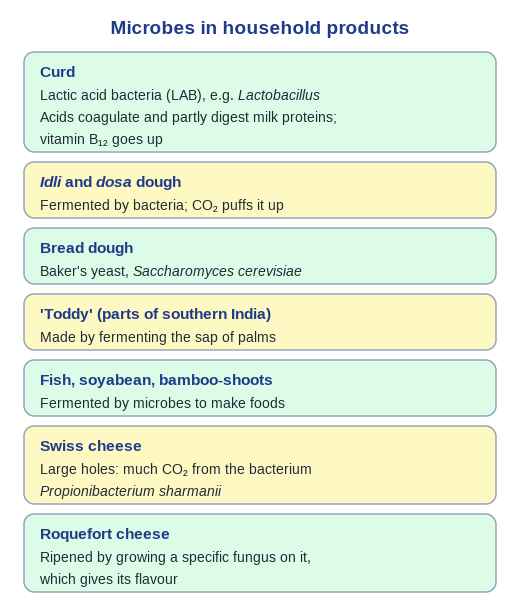
- A small amount of curd is added to fresh milk. This is the inoculum or starter, and it contains millions of lactic acid bacteria (LAB), such as Lactobacillus.
- At a suitable temperature the LAB multiply in the milk.
- As they grow, they produce acids, which coagulate the milk proteins and partly digest them. The milk sets into curd.
Curd is more nutritious than milk in one way the book names: it has more vitamin B₁₂. LAB also play a useful role in our stomach by keeping disease-causing microbes in check.
How do idli, dosa and bread dough rise?
- Idli and dosa dough is fermented by bacteria. The dough looks puffed up because the bacteria give off CO₂ gas.
- Bread dough is fermented with baker’s yeast, Saccharomyces cerevisiae.
The chapter asks two questions here: which metabolic pathway produces the CO₂, and where the bacteria come from. Both are answered on the NCERT solutions page, with the other questions the text asks.
Which other foods use microbes?
- ‘Toddy’ is a traditional drink in parts of southern India, obtained by fermenting palm sap.
- Fish, soyabean and bamboo-shoots are fermented by microbes to make foods.
- Cheese has been made with microbes for a very long time, longer than most foods. Its texture, flavour and taste depend on the microbes used:
- Swiss cheese has large holes because the bacterium Propionibacterium sharmanii produces a large amount of CO₂.
- Roquefort cheese is ripened by growing a specific fungus on it, which gives its particular flavour.
Why are microbes grown in fermentors?
Making a product in a kitchen needs a little curd or a little yeast. Making it for a whole country needs very large amounts of microbes, grown under controlled conditions. In industry, microbes are therefore grown in very large vessels called fermentors. The book shows photographs of fermentors and of a fermentation plant (Figures 8.4 and 8.5).
How are fermented beverages produced in industry?
Yeasts have been used for a very long time in the industrial production of beverages. The yeast is the same Saccharomyces cerevisiae used for bread; in this role it is called brewer’s yeast. It ferments malted cereals and fruit juices and produces ethanol.
The product depends on two things: the raw material fermented, and whether the fermented broth is distilled:
- Without distillation: wine and beer.
- With distillation of the fermented broth: whisky, brandy and rum.
The chapter treats these only as examples of industrial fermentation; the biology to learn is that yeast converts sugars to ethanol (the metabolic reactions are asked about in the NCERT solutions).
What are antibiotics?
Anti is Greek for ‘against’ and bio means ‘life’, so antibiotic means ‘against life’, meaning against disease-causing organisms. For human beings they are ‘pro life’. Antibiotics are chemical substances produced by some microbes that can kill, or slow the growth of, other disease-causing microbes.
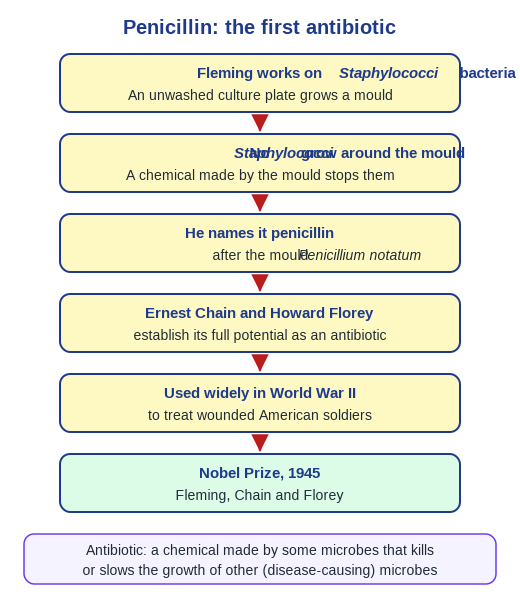
Penicillin was the first antibiotic discovered, by chance:
- Alexander Fleming was working on Staphylococci bacteria.
- On one of his unwashed culture plates, a mould grew, and Staphylococci could not grow around it.
- He showed that a chemical made by the mould was the reason and called it penicillin, from the name of the mould, Penicillium notatum.
- Ernest Chain and Howard Florey later established its full potential as an antibiotic.
- In World War II it was widely used on wounded American soldiers.
- Fleming, Chain and Florey received the Nobel Prize in 1945.
Later, other antibiotics were purified from other microbes. With antibiotics, diseases that once killed millions worldwide can now be treated: plague, whooping cough (kali khansi), diphtheria (gal ghotu) and leprosy (kusht rog).
Which chemicals, enzymes and bioactive molecules come from microbes?
Organic acids and alcohol
| Product | Producer | Type of microbe |
|---|---|---|
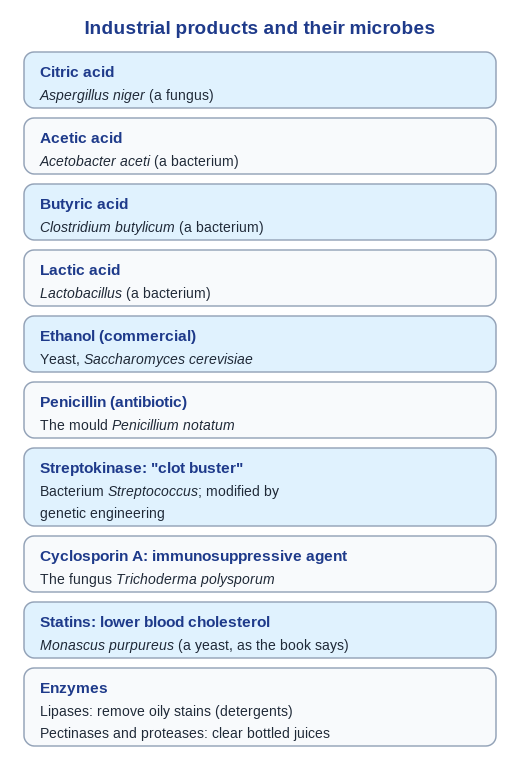
| Citric acid | Aspergillus niger | Fungus |
| Acetic acid | Acetobacter aceti | Bacterium |
| Butyric acid | Clostridium butylicum | Bacterium |
| Lactic acid | Lactobacillus | Bacterium |
| Ethanol (commercial production) | Saccharomyces cerevisiae | Yeast |
Enzymes
- Lipases are used in detergents and help remove oily stains from laundry.
- Pectinases and proteases clarify bottled fruit juices. That is why juice from the market is clearer than juice made at home.
- Streptokinase comes from the bacterium Streptococcus and is altered by genetic engineering. It works as a ‘clot buster’, dissolving clots in the blood vessels of patients after a myocardial infarction (heart attack).
Other bioactive molecules
- Cyclosporin A, produced by the fungus Trichoderma polysporum, is an immunosuppressive agent used for organ-transplant patients.
- Statins, produced by Monascus purpureus (the book calls it a yeast), are sold as agents that lower blood cholesterol. They work by competitively inhibiting the enzyme that makes cholesterol.
Extra: most textbooks of microbiology describe Monascus purpureus as a mould (a filamentous fungus). For the exam, write the organism’s name as the book prints it; ask your teacher which description to use.
Quick check
- Curd: LAB. Bread: baker’s yeast. Swiss cheese: Propionibacterium sharmanii.
- Citric acid: Aspergillus niger. Acetic acid: Acetobacter aceti. Butyric acid: Clostridium butylicum. Lactic acid: Lactobacillus.
- Penicillin: Penicillium notatum. Cyclosporin A: Trichoderma polysporum. Statins: Monascus purpureus. Streptokinase: Streptococcus.
Next: how microbes clean waste water and make fuel, in sewage treatment and biogas.
Practice
-
Which vitamin increases when milk turns into curd?
Show answer
Answer: (b) Vitamin B₁₂
-
Penicillin was named after the mould:
Show answer
Answer: (b) Penicillium notatum
-
Bottled fruit juices are clarified using:
Show answer
Answer: (c) pectinases and proteases
-
Why does a little curd added to warm milk turn the milk into curd?
Show answer
Answer: The curd acts as an inoculum or starter. It carries millions of lactic acid bacteria, which multiply at a suitable temperature. The acids they produce coagulate and partly digest the milk proteins, so the milk sets into curd.
-
How do statins lower blood cholesterol?
Show answer
Answer: Statins, produced by Monascus purpureus, competitively inhibit the enzyme responsible for synthesising cholesterol, so less cholesterol is made in the body.
Questions students ask
What is a fermentor?
A very large vessel in which microbes are grown so that a product, such as ethanol, an antibiotic or an enzyme, can be made on an industrial scale.
Who discovered penicillin, and how?
Alexander Fleming, by chance. While working on Staphylococci bacteria, he saw that they could not grow around a mould on an unwashed culture plate. The mould, Penicillium notatum, made a chemical he named penicillin. Ernest Chain and Howard Florey later established its full potential, and all three received the Nobel Prize in 1945.
What is streptokinase used for?
Streptokinase comes from the bacterium Streptococcus and is altered by genetic engineering. Doctors use it as a 'clot buster' to dissolve clots in the blood vessels of patients after a myocardial infarction (heart attack).
Why are lipases added to detergents?
Lipases are enzymes made by microbes that break down fats and oils, so they help remove oily stains from laundry.
Stuck on a question?
Take a photo and Lagnever AI explains it step by step. Try it for 7 days for ₹2.
Get it on Google Play Open in browser
For parents: after the trial, the plan renews monthly by UPI or card autopay. You can cancel anytime in the app.