
How do microbes act as biocontrol agents and biofertilisers?
Answer in short
Biocontrol controls plant pests and diseases by biological means instead of toxic chemicals: Bacillus thuringiensis kills butterfly caterpillars, Trichoderma acts against plant pathogens, and baculoviruses attack insects species-specifically. Biofertilisers enrich soil nutrients: nitrogen-fixing bacteria such as Rhizobium, Azospirillum and Azotobacter, mycorrhizal fungi such as Glomus, and cyanobacteria such as Anabaena, Nostoc and Oscillatoria.
Stuck on a question? Take a photo and Lagnever AI explains it step by step. Try it for 7 days for ₹2. Get it on Google Play
Why look for alternatives to farm chemicals?
Modern farming has relied more and more on chemicals: insecticides and pesticides against pests, weedicides against weeds, and chemical fertilisers for nutrients. The chapter says these pesticides are toxic and very harmful to people and animals alike, and that they end up polluting the soil, the ground water and even our crops, fruits and vegetables. Overuse of chemical fertilisers adds to pollution as well.
Microbes offer two alternatives, covered in sections 8.5 and 8.6: biocontrol agents in place of pesticides, and biofertilisers in place of chemical fertilisers. For the whole chapter in short, see the Chapter 8 notes.
What is biocontrol?
Biocontrol is the use of biological methods to control plant diseases and pests. In agriculture, one such method relies on natural predation instead of introduced chemicals.
The book describes how an organic farmer thinks:
- Biodiversity furthers health. The more varied a landscape, the more sustainable it is.
- Pests are not eradicated but kept at manageable levels by natural checks and balances in a living ecosystem. Conventional chemical methods, by contrast, kill useful and harmful organisms alike.
- Wiping out pests is not desirable, because the beneficial predatory and parasitic insects that feed on them or use them as hosts would not survive without them.
- The farmer gets to know the field’s predators and pests, their life cycles, feeding patterns and preferred habitats, so that suitable biocontrol can be chosen.
Biocontrol measures therefore greatly reduce dependence on toxic chemicals and pesticides.
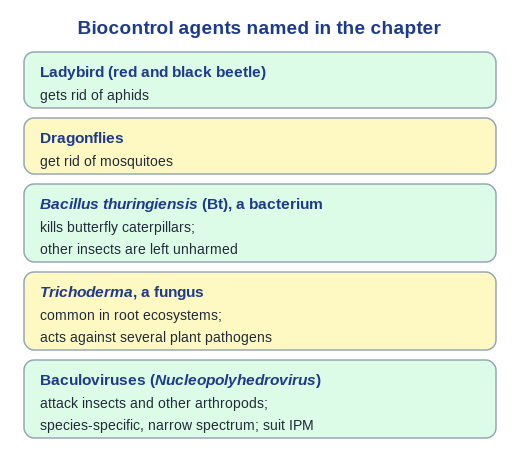
Which biocontrol agents does the chapter name?
| Agent | Type | Controls |
|---|---|---|
| Ladybird (beetle with red and black markings) | Insect | Aphids |
| Dragonflies | Insect | Mosquitoes |
| Bacillus thuringiensis (Bt) | Bacterium | Butterfly caterpillars |
| Trichoderma | Fungus | Several plant pathogens |
| Baculoviruses (mostly genus Nucleopolyhedrovirus) | Virus | Insects and other arthropods |
The last three are microbial biocontrol agents.
How does Bacillus thuringiensis work?
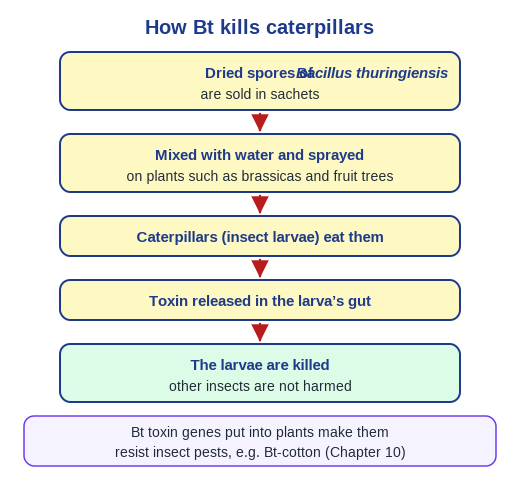
- Bt is available in sachets as dried spores.
- The spores are stirred into water and sprayed on crops that caterpillars attack, for example brassicas and fruit trees.
- The insect larvae (caterpillars) eat them.
- Inside the larval gut the toxin is let out, and it kills the larvae.
- The bacterial disease kills the caterpillars but leaves other insects unharmed.
With genetic engineering, scientists have also put B. thuringiensis toxin genes into plants, so the plants themselves can resist insect pests. Bt-cotton, an example of such a plant, is grown in some states of India. You will study it in Chapter 10, Biotechnology and its Applications.
What do Trichoderma and baculoviruses do?
- Trichoderma species are free-living fungi, very common in root ecosystems. Scientists are developing them as a biological treatment for plant disease, because they keep many plant pathogens in check.
- Baculoviruses infect and kill insects and other arthropods. Most of those used in biological control belong to the genus Nucleopolyhedrovirus. They are ideal for species-specific, narrow-spectrum insecticidal use. The book records that they have been found harmless to plants, mammals, birds and fish, and even to the non-target insects. This matters when beneficial insects are being conserved as part of integrated pest management (IPM), or when an ecologically sensitive area is treated.
What are biofertilisers?
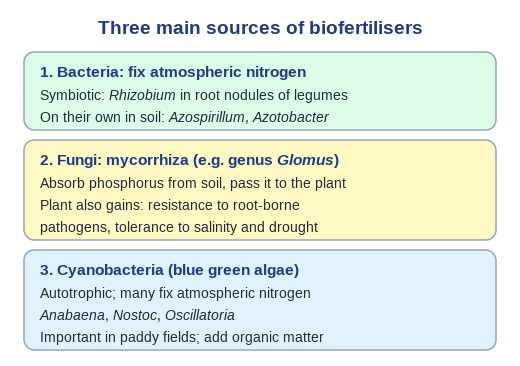
Biofertilisers are living organisms that make the soil richer in nutrients. Using them is part of organic farming. Their main sources are bacteria, fungi and cyanobacteria.
Bacteria
- Rhizobium forms nodules on the roots of leguminous plants in a symbiotic association. It fixes atmospheric nitrogen into organic forms, which the plant uses as a nutrient.
- Azospirillum and Azotobacter are free-living in the soil; they fix nitrogen from the air and so add to the soil’s nitrogen.
Fungi: mycorrhiza
A fungus living in symbiosis with a plant root forms a mycorrhiza. The genus Glomus has many species that do this.
- The fungus takes up phosphorus from the soil and hands it on to the plant.
- Plants with mycorrhiza also resist root-borne pathogens, tolerate drought and salinity, and show better overall growth and development.
The chapter asks what the fungus gains from this partnership; the answer is on the NCERT solutions page.
Cyanobacteria
- Cyanobacteria are autotrophic microbes found widely in water and on land. Many fix atmospheric nitrogen, for example Anabaena, Nostoc, Oscillatoria.
- In paddy fields, cyanobacteria are an important biofertiliser.
- Blue green algae enrich the soil with organic matter too, which makes it more fertile.
Many biofertilisers are now on sale in India; farmers use them in their fields to restore nutrients and to rely less on chemical fertilisers.
| Biofertiliser | Group | How it helps |
|---|---|---|
| Rhizobium | Bacterium (symbiotic) | Fixes nitrogen in root nodules of legumes |
| Azospirillum, Azotobacter | Bacteria (free-living) | Fix nitrogen in the soil |
| Glomus (mycorrhiza) | Fungus (symbiotic) | Absorbs phosphorus for the plant |
| Anabaena, Nostoc, Oscillatoria | Cyanobacteria | Fix nitrogen; add organic matter (paddy fields) |
Quick check
- Bt: bacterium, butterfly caterpillars. Trichoderma: fungus, plant pathogens. Baculoviruses: insects, narrow spectrum.
- Nitrogen: Rhizobium, Azospirillum, Azotobacter, cyanobacteria. Phosphorus: mycorrhiza (Glomus).
All the end-of-chapter questions on these topics (Exercises 10 and 15) are answered in the NCERT solutions.
Practice
-
Which biocontrol agent is used against butterfly caterpillars?
Show answer
Answer: (b) Bacillus thuringiensis
-
Most baculoviruses used in biological control belong to the genus:
Show answer
Answer: (b) Nucleopolyhedrovirus
-
Which of these is a cyanobacterium used as a biofertiliser in paddy fields?
Show answer
Answer: (b) Anabaena
-
Why are baculoviruses suited to integrated pest management (IPM)?
Show answer
Answer: They are species-specific and narrow in spectrum, and the book says no harm to plants, mammals, birds or fish, or even to insects they are not aimed at, has been seen. So beneficial insects are conserved, which IPM needs, and they can be used in ecologically sensitive areas.
-
Name two benefits, other than phosphorus, that plants with mycorrhiza get.
Show answer
Answer: Any two of: resistance to root-borne pathogens, tolerance to salinity, tolerance to drought, and better growth of the plant as a whole.
Questions students ask
Why does the organic farmer not try to eradicate pests?
Because the beneficial predatory and parasitic insects depend on the pests as food or hosts. Without the pests, those useful insects could not survive. The farmer instead keeps pests at manageable levels through a system of checks and balances in the ecosystem.
How does Bt kill caterpillars?
Dried spores of Bacillus thuringiensis, sold in sachets, are stirred into water and sprayed on crops like brassicas and fruit trees. Caterpillars feed on them, a toxin is let out inside their gut, and they die.
What is the difference between Rhizobium and Azotobacter?
Both fix atmospheric nitrogen. Rhizobium lives in a symbiotic association in the root nodules of leguminous plants; Azotobacter (like Azospirillum) is free-living in the soil and fixes nitrogen there.
Can biofertilisers be bought by farmers?
Yes. The book says many biofertilisers are available commercially in India and farmers use them to restore soil nutrients and cut their use of chemical fertilisers.
Stuck on a question?
Take a photo and Lagnever AI explains it step by step. Try it for 7 days for ₹2.
Get it on Google Play Open in browser
For parents: after the trial, the plan renews monthly by UPI or card autopay. You can cancel anytime in the app.