
What are carbohydrates, and how was the structure of glucose worked out?
Answer in short
Carbohydrates are optically active polyhydroxy aldehydes or ketones, or compounds that give them on hydrolysis. Glucose, an aldohexose, has a straight six-carbon chain with a –CHO group and five –OH groups, but it mostly exists as two six-membered rings, the α and β anomers. Glycosidic links join sugar units into disaccharides and polysaccharides.
Stuck on a question? Take a photo and Lagnever AI explains it step by step. Try it for 7 days for ₹2. Get it on Google Play
What counts as a carbohydrate?
The old name, “hydrate of carbon”, came from the formula Cx(H₂O)y that many sugars fit. The modern definition rests on their functional groups: carbohydrates are optically active polyhydroxy aldehydes or ketones, or substances that give such units on hydrolysis. They are also called saccharides, from a Greek word for sugar.
| Class | Hydrolysis gives | Examples |
|---|---|---|
| Monosaccharide | nothing simpler | glucose, fructose, ribose |
| Oligosaccharide | 2 to 10 units | sucrose, maltose, lactose (disaccharides) |
| Polysaccharide | very many units | starch, cellulose, glycogen, gums |
A sugar that reduces Fehling’s solution and Tollens’ reagent is a reducing sugar. A monosaccharide is named from its group and its carbon count: glucose is an aldohexose, fructose a ketohexose, ribose an aldopentose.
Building the open-chain structure of glucose
Glucose is made from sucrose by boiling with dilute acid in alcoholic solution, C₁₂H₂₂O₁₁ + H₂O → C₆H₁₂O₆ + C₆H₁₂O₆, or commercially from starch with dilute H₂SO₄ at 393 K and 2–3 atm. Its structure was pieced together like a puzzle:
- Formula C₆H₁₂O₆.
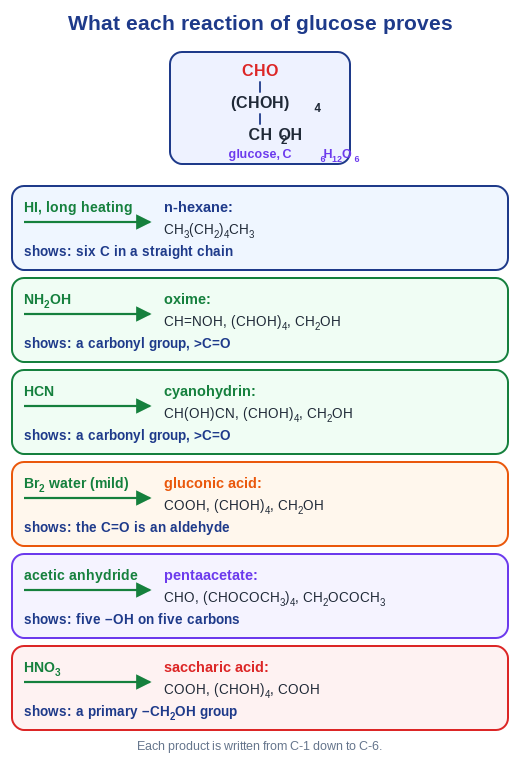
- Long heating with HI gives n-hexane: the six carbons form a straight chain.
- Hydroxylamine gives an oxime and HCN a cyanohydrin: there is a carbonyl group.
- Bromine water, a mild oxidant, gives gluconic acid with six carbons: the carbonyl is an aldehyde, –CHO → –COOH.
- Acetic anhydride gives a stable pentaacetate: five –OH groups, each on a different carbon.
- Nitric acid turns glucose, and gluconic acid, into saccharic acid, a dicarboxylic acid: the other end is a primary –CH₂OH.
Result: CHO–(CHOH)₄–CH₂OH.
D, L and (+)
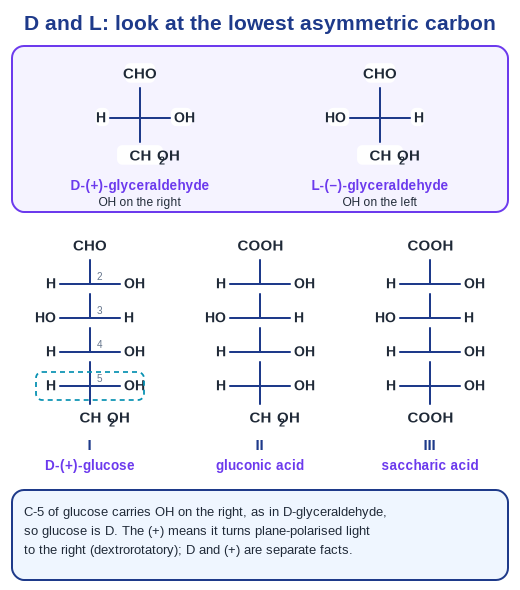
Glucose has four asymmetric carbons (C-2 to C-5). Fischer fixed their arrangement. To say whether a sugar is D or L, draw it with the most oxidised carbon (–CHO) at the top and look only at the lowest asymmetric carbon. If its –OH is on the right, as in D-(+)-glyceraldehyde, the sugar is D; if on the left, L. The sign in brackets is a separate, measured fact: glucose is dextrorotatory, so it is D-(+)-glucose; fructose is D-(–)-fructose.
Why glucose is really a ring
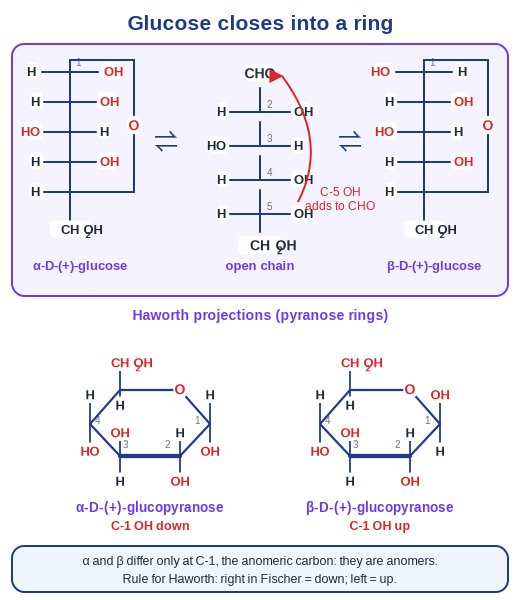
The open chain cannot explain three facts: no Schiff’s test and no NaHSO₃ addition product; a pentaacetate that does not react with hydroxylamine; and two crystalline forms, α (m.p. 419 K) and β (m.p. 423 K). The –OH on C-5 adds to the –CHO group to form a cyclic hemiacetal, a six-membered pyranose ring. C-1 becomes asymmetric, so there are two forms differing only at C-1, the anomeric carbon: these are the anomers. In a Haworth drawing, groups on the right of the Fischer projection point down; α-D-glucopyranose has its C-1 –OH down and β up. Both rings stay in equilibrium through a small amount of open chain.
Fructose
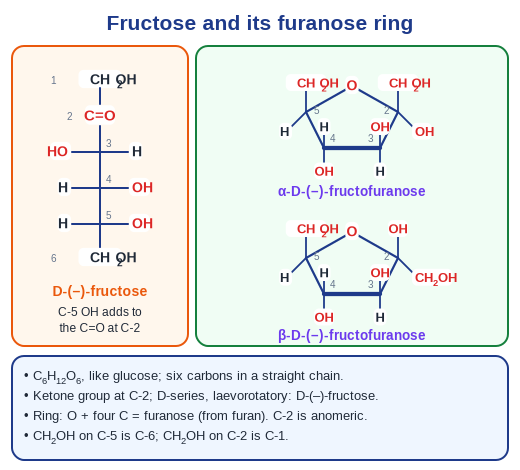
Fructose has the same formula, a keto group at C-2 and a straight six-carbon chain. The –OH on C-5 adds to C-2, giving a five-membered furanose ring (after furan) in α and β forms; C-2 is the anomeric carbon.
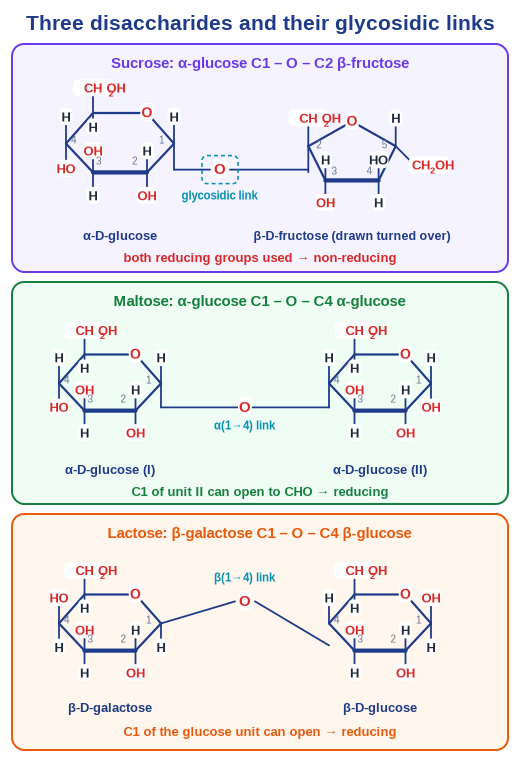
Joining sugars: glycosidic links
| Sugar | Units | Link | Reducing? |
|---|---|---|---|
| Sucrose | α-D-glucose + β-D-fructose | C1 (glucose)–C2 (fructose) | no |
| Maltose | two α-D-glucose | C1–C4 | yes |
| Lactose | β-D-galactose + β-D-glucose | C1 (galactose)–C4 (glucose) | yes |
In sucrose both reducing carbons are tied up in the link, so no ring can open. Hydrolysis of sucrose gives invert sugar: glucose (+52.5°) plus fructose (–92.4°) is laevorotatory overall.
Polysaccharides
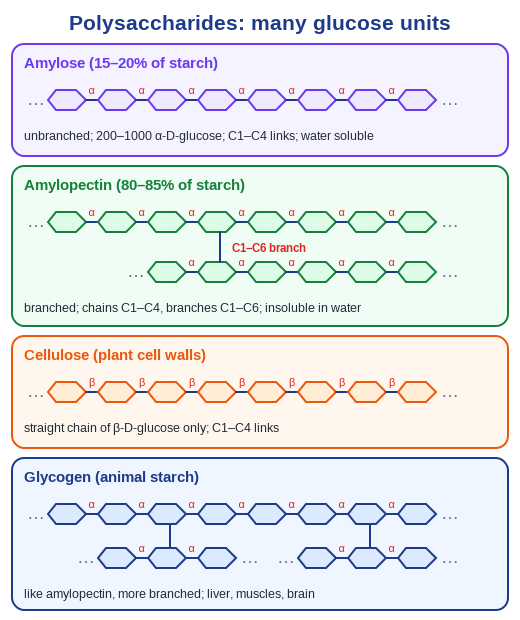
Starch is the storage form in plants: amylose (15–20%, unbranched, 200–1000 α-glucose units, C1–C4, water soluble) and amylopectin (80–85%, C1–C4 chains branched through C1–C6, insoluble). Cellulose is a straight chain of β-glucose units joined C1–C4 and builds plant cell walls. Glycogen, the animal store in liver, muscles and brain, is like amylopectin but more branched.
Lab safety
Sugar tests with Fehling’s solution, Tollens’ reagent or acids are done only in the school laboratory with your teacher, never at home. Do not taste any sample used in a test.
Back to the Chapter 10 notes, or see the NCERT solutions.
Practice
-
Which reagent shows that the carbonyl group of glucose is an aldehyde?
Show answer
Answer: (c) bromine water
-
Which of these is a ketohexose?
Show answer
Answer: (b) fructose
-
Amylopectin is branched because of:
Show answer
Answer: (b) α C1–C6 links
-
Why does glucose pentaacetate not react with hydroxylamine?
Show answer
Answer: In the pentaacetate glucose is locked in its ring form: the –OH on C-1 is acetylated, so the ring cannot open to give an open –CHO group, and there is no carbonyl group for hydroxylamine to attack.
-
Hydrolysis of sucrose turns a dextrorotatory solution laevorotatory. Explain using the book’s values.
Show answer
Answer: Sucrose gives equal amounts of glucose (+52.5°) and fructose (–92.4°). The laevorotation of fructose is larger, so the mixture turns light to the left. The sign changes from + to –, and the mixture is called invert sugar.
Questions students ask
Why is glucose called D-(+)-glucose?
D tells the configuration: in the Fischer drawing the –OH on C-5, the lowest asymmetric carbon, is on the right, as in D-(+)-glyceraldehyde. (+) tells the observed rotation: glucose turns plane-polarised light to the right.
What is a pyranose ring?
A six-membered ring of five carbon atoms and one oxygen atom, named after pyran. Glucose forms it when the –OH on C-5 adds to the –CHO on C-1. Fructose instead forms a five-membered furanose ring.
How is cellulose different from starch if both are made of glucose?
Starch is made of α-D-glucose units (amylose unbranched, amylopectin branched at C1–C6). Cellulose is a straight chain of β-D-glucose units joined C1–C4. The α or β link is the basic difference.
Stuck on a question?
Take a photo and Lagnever AI explains it step by step. Try it for 7 days for ₹2.
Get it on Google Play Open in browser
For parents: after the trial, the plan renews monthly by UPI or card autopay. You can cancel anytime in the app.