
What are vitamins and hormones, chemically?
Answer in short
Vitamins are organic compounds needed in small amounts in the diet; fat-soluble ones (A, D, E, K) are stored in the body, water-soluble ones (B group, C) are excreted and, except B₁₂, not stored. Hormones are chemical messengers carried by the blood: steroids, polypeptides or amino acid derivatives, such as insulin and thyroxine.
Stuck on a question? Take a photo and Lagnever AI explains it step by step. Try it for 7 days for ₹2. Get it on Google Play
This page explains what the chapter says about vitamins and hormones as chemistry. It is not health advice: for any question about food, supplements or illness, ask a doctor.
What is a vitamin?
Some organic compounds are needed in the diet only in small amounts, yet their absence causes particular diseases. These are vitamins. Our body cannot make most of them, but plants make almost all of them and the bacteria in our gut make some, so they are treated as essential food factors. They belong to many different chemical families, so they are defined by what they do rather than by a common structure: organic compounds needed in small amounts for specific biological functions, for normal growth and health.
They are named by capital letters, A, B, C, D and so on, and some groups have numbered members: B₁, B₂, B₆, B₁₂. The original word was vitamine (vital + amine), because the first ones found carried amino groups. Most turned out to have none, so the final e was dropped.
Two groups by solubility
| Group | Vitamins | In the body |
|---|---|---|
| Fat soluble | A, D, E, K | dissolve in fats and oils, not in water; stored in the liver and adipose (fat-storing) tissue |
| Water soluble | B group, C | dissolve in water; leave the body easily in urine; not stored, except B₁₂, so needed regularly |
The solubility explains a common exam answer: vitamin C must be supplied regularly because it is water soluble and leaves the body in urine.
The book’s table of sources and deficiency diseases
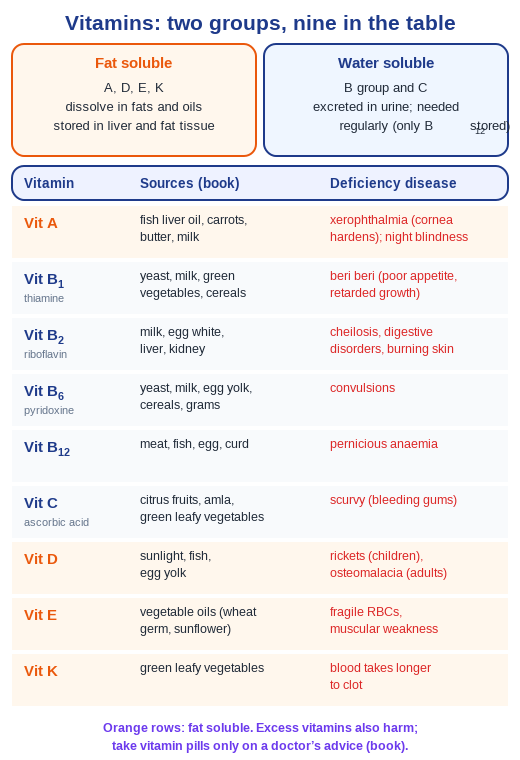
Table 10.3 of the book lists nine vitamins with their sources and the diseases caused by their lack:
| Vitamin | Sources (book) | Deficiency disease (book) |
|---|---|---|
| A | fish liver oil, carrots, butter, milk | xerophthalmia (hardening of the cornea), night blindness |
| B₁ (thiamine) | yeast, milk, green vegetables, cereals | beri beri (loss of appetite, retarded growth) |
| B₂ (riboflavin) | milk, egg white, liver, kidney | cheilosis (cracks at the corners of the mouth and lips), digestive disorders, burning skin |
| B₆ (pyridoxine) | yeast, milk, egg yolk, cereals, grams | convulsions |
| B₁₂ | meat, fish, egg, curd | pernicious anaemia (red cells short of haemoglobin) |
| C (ascorbic acid) | citrus fruits, amla, green leafy vegetables | scurvy (bleeding gums) |
| D | sunlight, fish, egg yolk | rickets (bone deformities in children), osteomalacia (soft bones and joint pain in adults) |
| E | vegetable oils such as wheat germ and sunflower oil | fragile red blood cells, muscular weakness |
| K | green leafy vegetables | blood takes longer to clot |
The book adds two cautions: too much of a vitamin is also harmful, and vitamin pills are to be taken only on a doctor’s advice.
What is a hormone?
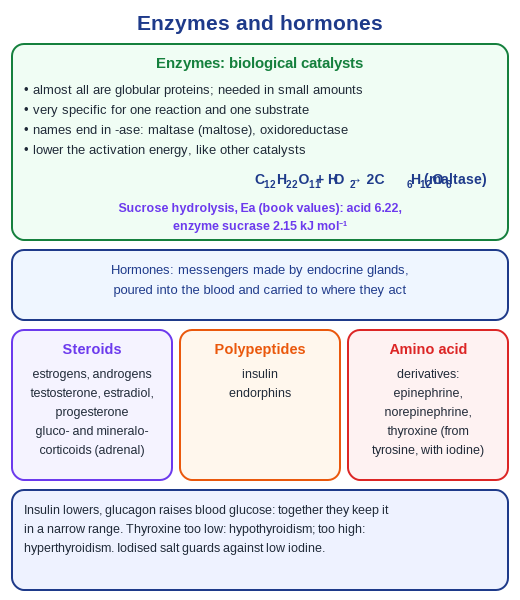
Hormones are molecules that carry messages between cells. Endocrine glands make them and release them directly into the blood, which carries them to the place where they act.
By chemical nature, hormones fall into three groups:
- Steroids: estrogens and androgens; the hormones of the adrenal cortex and of the gonads (testes and ovaries) are steroids.
- Polypeptides: insulin and endorphins.
- Amino acid derivatives: epinephrine and norepinephrine; thyroxine, made in the thyroid gland, is the amino acid tyrosine with iodine built in (an iodinated derivative).
What hormones do
Hormones keep the body’s activities in balance. The book’s examples:
- Blood glucose: insulin is released when blood glucose rises quickly; glucagon tends to raise blood glucose. Together they keep it within a narrow range.
- Responses to the outside world: epinephrine and norepinephrine carry them.
- Growth and development: growth hormones and sex hormones.
- Thyroxine: too little causes hypothyroidism, marked by tiredness (lethargy) and obesity; too much causes hyperthyroidism. A diet low in iodine can lead to hypothyroidism and an enlarged thyroid gland, which iodised salt (table salt with sodium iodide added) is used to prevent.
- Adrenal cortex: glucocorticoids control carbohydrate metabolism, modulate inflammation and take part in the response to stress; mineralocorticoids control how much water and salt the kidneys excrete. When the adrenal cortex fails, the result can be Addison’s disease, which needs medical treatment.
- Gonads: testosterone, the main male sex hormone, and estradiol, the main female sex hormone, are responsible for the secondary sex characteristics; estradiol also takes part in controlling the menstrual cycle, and progesterone prepares the uterus for a fertilised egg.
Link to the rest of the chapter
Two hormone types connect to earlier sections: insulin is a protein made of amino acids (51 of them), and thyroxine is built from tyrosine, one of the amino acids in Table 10.2. Vitamins, by contrast, are small molecules, not polymers.
Back to the Chapter 10 notes, or see the NCERT solutions.
Practice
-
Which vitamin is linked to blood clotting?
Show answer
Answer: (d) vitamin K
-
Which group contains only fat-soluble vitamins?
Show answer
Answer: (a) A, D, E, K
-
Thyroxine is chemically:
Show answer
Answer: (c) an iodinated derivative of tyrosine
-
Why must water-soluble vitamins be supplied regularly?
Show answer
Answer: They dissolve in water, leave the body easily in urine and are not kept in store (except B₁₂), so the body cannot keep a reserve of them.
-
Name the three chemical types of hormones with one example of each.
Show answer
Answer: Steroids, such as estrogens; polypeptides, such as insulin; and amino acid derivatives, such as epinephrine.
Questions students ask
Where does the word vitamin come from?
From vitamine, vital + amine, because the first ones found had amino groups. Most turned out to have none, so the final e was dropped.
Can too much of a vitamin be harmful?
Yes. The book warns that too much of a vitamin also harms, and that vitamin pills are for taking only on a doctor’s advice. Fat-soluble vitamins are stored in the body, which is one reason the warning matters.
How do insulin and glucagon work together?
Insulin is released when blood glucose rises quickly and brings it down; glucagon tends to raise it. Together they keep blood glucose within a narrow range, an example of hormones keeping the body’s activities in balance.
Stuck on a question?
Take a photo and Lagnever AI explains it step by step. Try it for 7 days for ₹2.
Get it on Google Play Open in browser
For parents: after the trial, the plan renews monthly by UPI or card autopay. You can cancel anytime in the app.