
NCERT Solutions Class 12 Maths Chapter 7: Integrals
Answers to every question of Exercises 7.1 to 7.10 and the Miscellaneous Exercise, and to all 42 worked examples, of Chapter 7, Integrals, of Mathematics Part II, the Class 12 NCERT textbook. Page numbers follow the 2026-27 reprint (pages 225–291). The exercise questions are quoted from the book; the examples are restated in short and labelled by number and page. Every anti derivative below was checked by differentiating it with a computer algebra script (the derivative minus the integrand simplifies to 0), and every definite integral was checked numerically. The answers agree with the book’s answer key except in two places, marked where they come. Short notes: Chapter 7 notes.
How the maths is typed here. C is the constant of integration. log is the natural logarithm (base e), as in the book. Fractions use a slash, so 1/(x + 1) is one over (x + 1), and powers such as x3/2 are written x^(3/2) where superscripts are hard to read. A definite integral from a to b is typed ∫(a→b) f(x) dx, and [F(x)] (a→b) means F(b) − F(a). sin⁻¹, cos⁻¹ and tan⁻¹ are the inverse trigonometric functions. The quoted questions use the same layout.
Words used. An anti derivative (or integral) of f is a function whose derivative is f. The integrand is the function inside the integral sign. In integration by parts we choose a first function (we differentiate it) and a second function (we integrate it). Partial fractions means breaking one fraction into a sum of simpler fractions. A function is even if f(−x) = f(x) and odd if f(−x) = −f(x). P0 to P7 are the properties of definite integrals listed before Exercise 7.10. Long answers are split into numbered steps, and the final result is shown in bold as Answer: ….
Five facts carry most of the answers:
- ∫xⁿ dx = xⁿ⁺¹/(n + 1) + C (n ≠ −1), ∫dx/x = log|x| + C, ∫eˣ dx = eˣ + C.
- Substitution: t = g(x), dt = g′(x) dx; ∫f′(x)/f(x) dx = log|f(x)| + C.
- Special integrals: ∫dx/(x² + a²) = (1/a) tan⁻¹(x/a) + C, ∫dx/√(a² − x²) = sin⁻¹(x/a) + C, ∫dx/√(x² ± a²) = log|x + √(x² ± a²)| + C, ∫dx/(x² − a²) = (1/2a) log|(x − a)/(x + a)| + C.
- By parts: ∫f g dx = f∫g dx − ∫[f′∫g dx] dx; ∫eˣ[f(x) + f′(x)] dx = eˣ f(x) + C.
- ∫(a→b) f(x) dx = F(b) − F(a); P3: ∫(a→b) f(x) dx = ∫(a→b) f(a + b − x) dx; P7: odd functions on [−a, a] give 0.
Examples 1 to 4: integration by inspection (pages 231–234)
Example 1 (page 231): an anti derivative of (i) cos 2x, (ii) 3x² + 4x³, (iii) 1/x. (i) d/dx (sin 2x) = 2 cos 2x, so (1/2) sin 2x. (ii) d/dx (x³ + x⁴) = 3x² + 4x³, so x³ + x⁴. (iii) d/dx log|x| = 1/x for x ≠ 0, so log|x|.
Example 2 (page 232): (i) ∫(x³ − 1)/x² dx, (ii) ∫(x^(2/3) + 1) dx, (iii) ∫(x^(3/2) + 2eˣ − 1/x) dx. (i) ∫(x − x⁻²) dx = x²/2 + 1/x + C. (ii) (3/5)x^(5/3) + x + C. (iii) (2/5)x^(5/2) + 2eˣ − log|x| + C.
Example 3 (page 233): (i) ∫(sin x + cos x) dx, (ii) ∫cosec x(cosec x + cot x) dx, (iii) ∫(1 − sin x)/cos² x dx. (i) −cos x + sin x + C. (ii) ∫(cosec² x + cosec x cot x) dx = −cot x − cosec x + C. (iii) ∫(sec² x − tan x sec x) dx = tan x − sec x + C.
Example 4 (page 233): the anti derivative F of f(x) = 4x³ − 6 with F(0) = 3. F(x) = x⁴ − 6x + C, and F(0) = C = 3. So F(x) = x⁴ − 6x + 3.
Exercise 7.1 (pages 234–235)
The book’s instruction for Questions 1 to 5: “Find an anti derivative (or integral) of the following functions by the method of inspection.” For Questions 6 to 20: “Find the following integrals”.
1. “sin 2x” d/dx (cos 2x) = −2 sin 2x, so an anti derivative is −(1/2) cos 2x.
2. “cos 3x” d/dx (sin 3x) = 3 cos 3x, so (1/3) sin 3x.
3. “e²ˣ” d/dx (e²ˣ) = 2e²ˣ, so (1/2) e²ˣ.
4. “(ax + b)²” d/dx (ax + b)³ = 3a(ax + b)², so (1/(3a))(ax + b)³.
5. “sin 2x – 4 e³ˣ” −(1/2) cos 2x − (4/3) e³ˣ, since d/dx of that is sin 2x − 4e³ˣ.
6. “∫(4 e³ˣ + 1) dx” = 4(e³ˣ/3) + x + C = (4/3)e³ˣ + x + C.
7. “∫x²(1 − 1/x²) dx” = ∫(x² − 1) dx = x³/3 − x + C.
8. “∫(ax² + bx + c) dx” = ax³/3 + bx²/2 + cx + C.
9. “∫(2x² + eˣ) dx” = (2/3)x³ + eˣ + C.
10. “∫(√x − 1/√x)² dx” (√x − 1/√x)² = x − 2 + 1/x, so the integral is x²/2 − 2x + log|x| + C.
11. “∫(x³ + 5x² − 4)/x² dx” = ∫(x + 5 − 4x⁻²) dx = x²/2 + 5x + 4/x + C.
12. “∫(x³ + 3x + 4)/√x dx” = ∫(x^(5/2) + 3x^(1/2) + 4x^(−1/2)) dx = (2/7)x^(7/2) + 2x^(3/2) + 8√x + C.
13. “∫(x³ − x² + x − 1)/(x − 1) dx” x³ − x² + x − 1 = x²(x − 1) + (x − 1) = (x − 1)(x² + 1). So the integral is ∫(x² + 1) dx = x³/3 + x + C.
14. “∫(1 − x)√x dx” = ∫(x^(1/2) − x^(3/2)) dx = (2/3)x^(3/2) − (2/5)x^(5/2) + C.
15. “∫√x(3x² + 2x + 3) dx” = ∫(3x^(5/2) + 2x^(3/2) + 3x^(1/2)) dx = (6/7)x^(7/2) + (4/5)x^(5/2) + 2x^(3/2) + C.
16. “∫(2x − 3cos x + eˣ) dx” = x² − 3 sin x + eˣ + C.
17. “∫(2x² − 3sin x + 5√x) dx” = (2/3)x³ + 3 cos x + (10/3)x^(3/2) + C.
18. “∫sec x (sec x + tan x) dx” = ∫(sec² x + sec x tan x) dx = tan x + sec x + C.
19. “∫sec² x/cosec² x dx” sec² x/cosec² x = sin² x/cos² x = tan² x = sec² x − 1. So the integral is tan x − x + C.
20. “∫(2 − 3sin x)/cos² x dx” = ∫(2 sec² x − 3 sec x tan x) dx = 2 tan x − 3 sec x + C.
21. “The anti derivative of (√x + 1/√x) equals (A) (1/3)x^(1/3) + 2x^(1/2) + C (B) (2/3)x^(2/3) + (1/2)x² + C (C) (2/3)x^(3/2) + 2x^(1/2) + C (D) (3/2)x^(3/2) + (1/2)x^(1/2) + C”
∫(x^(1/2) + x^(−1/2)) dx = (2/3)x^(3/2) + 2x^(1/2) + C. Answer (C).
22. “If d/dx f(x) = 4x³ − 3/x⁴ such that f(2) = 0. Then f(x) is (A) x⁴ + 1/x³ − 129/8 (B) x³ + 1/x⁴ + 129/8 (C) x⁴ + 1/x³ + 129/8 (D) x³ + 1/x⁴ − 129/8”
f(x) = ∫(4x³ − 3x⁻⁴) dx = x⁴ + x⁻³ + C. f(2) = 16 + 1/8 + C = 0 gives C = −129/8. Answer (A).
Examples 5 and 6: integration by substitution (pages 236–240)
Example 5 (page 236): integrate (i) sin mx, (ii) 2x sin(x² + 1), (iii) tan⁴√x sec²√x/√x, (iv) sin(tan⁻¹x)/(1 + x²). (i) t = mx: −(1/m) cos mx + C. (ii) t = x² + 1, dt = 2x dx: −cos(x² + 1) + C. (iii) t = √x, dx = 2t dt gives 2∫tan⁴t sec²t dt; then u = tan t gives 2u⁵/5, so (2/5) tan⁵√x + C. (iv) t = tan⁻¹x: −cos(tan⁻¹x) + C.
Standard results (pages 237–238). With t = cos x, ∫tan x dx = −log|cos x| = log|sec x| + C. With t = sin x, ∫cot x dx = log|sin x| + C. Multiplying top and bottom by sec x + tan x and putting t = sec x + tan x, ∫sec x dx = log|sec x + tan x| + C. In the same way, ∫cosec x dx = −log|cosec x + cot x| = log|cosec x − cot x| + C.
Example 6 (page 238): (i) ∫sin³x cos² x dx, (ii) ∫sin x/sin(x + a) dx, (iii) ∫dx/(1 + tan x). (i) Write sin³x = (1 − cos² x) sin x and put t = cos x: −∫(t² − t⁴) dt = −(1/3)cos³x + (1/5)cos⁵x + C. (ii) Put t = x + a: sin(t − a)/sin t = cos a − sin a cot t, so the integral is t cos a − sin a log|sin t|; dropping the constant a cos a into C, it is x cos a − sin a log|sin(x + a)| + C. (iii) dx/(1 + tan x) = cos x dx/(cos x + sin x) = (1/2)[1 + (cos x − sin x)/(cos x + sin x)] dx, so the integral is x/2 + (1/2) log|cos x + sin x| + C.
Exercise 7.2 (pages 240–241)
The book’s instruction for Questions 1 to 37: “Integrate the functions in Exercises 1 to 37:”
1. “2x/(1 + x²)” The top is the derivative of 1 + x². Put t = 1 + x²: ∫dt/t = log(1 + x²) + C (1 + x² > 0).
2. “(log x)²/x” t = log x, dt = dx/x: ∫t² dt = (1/3)(log x)³ + C. (The answer key writes log|x|; for x > 0 it is the same.)
3. “1/(x + x log x)” = 1/(x(1 + log x)). t = 1 + log x, dt = dx/x: log|1 + log x| + C.
4. “sin x sin (cos x)” t = cos x, dt = −sin x dx: −∫sin t dt = cos t + C = cos(cos x) + C.
5. “sin (ax + b) cos (ax + b)” = (1/2) sin 2(ax + b). Its integral is −(1/(4a)) cos 2(ax + b) + C.
6. “√(ax + b)” t = ax + b, dx = dt/a: (1/a)(2/3)t^(3/2), so (2/(3a))(ax + b)^(3/2) + C.
7. “x √(x + 2)” t = x + 2, x = t − 2: ∫(t − 2)√t dt = (2/5)t^(5/2) − (4/3)t^(3/2). Answer: (2/5)(x + 2)^(5/2) − (4/3)(x + 2)^(3/2) + C.
8. “x √(1 + 2x²)” t = 1 + 2x², dt = 4x dx: (1/4)∫√t dt = (1/4)(2/3)t^(3/2) = (1/6)(1 + 2x²)^(3/2) + C.
9. “(4x + 2) √(x² + x + 1)” t = x² + x + 1, dt = (2x + 1) dx, and 4x + 2 = 2(2x + 1): 2∫√t dt = (4/3)(x² + x + 1)^(3/2) + C.
10. “1/(x − √x)” = 1/(√x(√x − 1)). t = √x − 1, dt = dx/(2√x): 2∫dt/t = 2 log|√x − 1| + C.
11. “x/√(x + 4), x > 0” t = x + 4: ∫(t − 4)t^(−1/2) dt = (2/3)t^(3/2) − 8t^(1/2) = (2/3)√t (t − 12). Answer: (2/3)√(x + 4) (x − 8) + C.
12. “(x³ − 1)^(1/3) x⁵” t = x³ − 1, dt = 3x² dx, x³ = t + 1: (1/3)∫(t + 1)t^(1/3) dt = (1/3)[(3/7)t^(7/3) + (3/4)t^(4/3)]. Answer: (1/7)(x³ − 1)^(7/3) + (1/4)(x³ − 1)^(4/3) + C.
13. “x²/(2 + 3x³)³” t = 2 + 3x³, dt = 9x² dx: (1/9)∫t⁻³ dt = −1/(18t²). Answer: −1/(18(2 + 3x³)²) + C.
14. “1/(x (log x)ᵐ), x > 0, m ≠ 1” t = log x: ∫t⁻ᵐ dt = (log x)^(1 − m)/(1 − m) + C.
15. “x/(9 − 4x²)” t = 9 − 4x², dt = −8x dx: −(1/8) log|9 − 4x²| + C.
16. “e^(2x + 3)” (1/2) e^(2x + 3) + C.
17. “x/e^(x²)” = x e^(−x²). t = −x², dt = −2x dx: −(1/2)eᵗ = −1/(2e^(x²)) + C.
18. “e^(tan⁻¹ x)/(1 + x²)” t = tan⁻¹x: e^(tan⁻¹x) + C.
19. “(e²ˣ − 1)/(e²ˣ + 1)” Divide top and bottom by eˣ: (eˣ − e⁻ˣ)/(eˣ + e⁻ˣ). The top is the derivative of the bottom, so the answer is log(eˣ + e⁻ˣ) + C.
20. “(e²ˣ − e⁻²ˣ)/(e²ˣ + e⁻²ˣ)” The derivative of e²ˣ + e⁻²ˣ is 2(e²ˣ − e⁻²ˣ). So the answer is (1/2) log(e²ˣ + e⁻²ˣ) + C.
21. “tan² (2x – 3)” = sec²(2x − 3) − 1. Answer: (1/2) tan(2x − 3) − x + C.
22. “sec² (7 – 4x)” −(1/4) tan(7 − 4x) + C.
23. “sin⁻¹x/√(1 − x²)” t = sin⁻¹x, dt = dx/√(1 − x²): (1/2)(sin⁻¹x)² + C.
24. “(2cos x – 3sin x)/(6cos x + 4sin x)” The derivative of 6 cos x + 4 sin x is −6 sin x + 4 cos x = 2(2 cos x − 3 sin x). So the integral is (1/2) log|6 cos x + 4 sin x| + C, which is also (1/2) log|2 sin x + 3 cos x| + C (the two differ by the constant (1/2) log 2; the key prints the second).
25. “1/(cos²x (1 – tan x)²)” t = 1 − tan x, dt = −sec² x dx: −∫t⁻² dt = 1/t. Answer: 1/(1 − tan x) + C.
26. “cos √x/√x” t = √x, dx = 2t dt: 2∫cos t dt = 2 sin √x + C.
27. “√(sin 2x) cos 2x” t = sin 2x, dt = 2 cos 2x dx: (1/2)(2/3)t^(3/2) = (1/3)(sin 2x)^(3/2) + C.
28. “cos x/√(1 + sin x)” t = 1 + sin x: ∫t^(−1/2) dt = 2√(1 + sin x) + C.
29. “cot x log sin x” t = log sin x, dt = cot x dx: (1/2)(log sin x)² + C.
30. “sin x/(1 + cos x)” t = 1 + cos x, dt = −sin x dx: −log|1 + cos x| + C.
31. “sin x/(1 + cos x)²” t = 1 + cos x: −∫t⁻² dt = 1/t = 1/(1 + cos x) + C.
32. “1/(1 + cot x)” = sin x/(sin x + cos x) = (1/2)[1 − (cos x − sin x)/(sin x + cos x)]. Answer: x/2 − (1/2) log|cos x + sin x| + C.
33. “1/(1 − tan x)” = cos x/(cos x − sin x) = (1/2)[1 + (cos x + sin x)/(cos x − sin x)]. The derivative of cos x − sin x is −(sin x + cos x), so the answer is x/2 − (1/2) log|cos x − sin x| + C.
34. “√(tan x)/(sin x cos x)” √tan x/(sin x cos x) = √tan x · sec² x/tan x = sec² x/√tan x. t = tan x: ∫t^(−1/2) dt = 2√(tan x) + C.
35. “(1 + log x)²/x” t = 1 + log x: (1/3)(1 + log x)³ + C.
36. “(x + 1)(x + log x)²/x” t = x + log x, dt = (1 + 1/x) dx = ((x + 1)/x) dx: (1/3)(x + log x)³ + C.
37. “x³ sin (tan⁻¹ x⁴)/(1 + x⁸)” t = tan⁻¹(x⁴), dt = 4x³ dx/(1 + x⁸): (1/4)∫sin t dt = −(1/4) cos(tan⁻¹x⁴) + C.
38. “∫(10x⁹ + 10ˣ logₑ10) dx/(x¹⁰ + 10ˣ) equals (A) 10ˣ – x¹⁰ + C (B) 10ˣ + x¹⁰ + C (C) (10ˣ – x¹⁰)⁻¹ + C (D) log (10ˣ + x¹⁰) + C”
The top is the derivative of x¹⁰ + 10ˣ, so the integral is log(10ˣ + x¹⁰) + C. Answer (D).
39. “∫dx/(sin²x cos²x) equals (A) tan x + cot x + C (B) tan x – cot x + C (C) tan x cot x + C (D) tan x – cot 2x + C”
1/(sin² x cos² x) = (sin² x + cos² x)/(sin² x cos² x) = sec² x + cosec² x, whose integral is tan x − cot x + C. Answer (B).
Example 7: trigonometric identities (pages 241–242)
Example 7 (page 241): (i) ∫cos² x dx, (ii) ∫sin 2x cos 3x dx, (iii) ∫sin³x dx. (i) cos² x = (1 + cos 2x)/2: x/2 + (1/4) sin 2x + C. (ii) sin 2x cos 3x = (1/2)(sin 5x − sin x): −(1/10) cos 5x + (1/2) cos x + C. (iii) sin³x = (3 sin x − sin 3x)/4: −(3/4) cos x + (1/12) cos 3x + C; with t = cos x instead, −cos x + (1/3)cos³x + C. The two differ by a constant.
Exercise 7.3 (page 243)
The book’s instruction for Questions 1 to 22: “Find the integrals of the functions in Exercises 1 to 22:”
1. “sin² (2x + 5)” = (1 − cos(4x + 10))/2. Answer: x/2 − (1/8) sin(4x + 10) + C.
2. “sin 3x cos 4x” = (1/2)[sin 7x + sin(−x)] = (1/2)(sin 7x − sin x). Answer: −(1/14) cos 7x + (1/2) cos x + C.
3. “cos 2x cos 4x cos 6x” cos 2x cos 4x = (1/2)(cos 6x + cos 2x). Multiplying by cos 6x: (1/2)(cos² 6x + cos 2x cos 6x) = (1/4)(1 + cos 12x + cos 8x + cos 4x). Answer: (1/4)[x + (1/4) sin 4x + (1/8) sin 8x + (1/12) sin 12x] + C.
4. “sin³ (2x + 1)” Write sin³ = (1 − cos²) sin and put t = cos(2x + 1), dt = −2 sin(2x + 1) dx: −(1/2)∫(1 − t²) dt. Answer: −(1/2) cos(2x + 1) + (1/6) cos³(2x + 1) + C.
5. “sin³ x cos³ x” Write sin³x = (1 − cos² x) sin x and put t = cos x: −∫(t³ − t⁵) dt = −t⁴/4 + t⁶/6. Answer: (1/6)cos⁶x − (1/4)cos⁴x + C.
6. “sin x sin 2x sin 3x” sin x sin 3x = (1/2)(cos 2x − cos 4x). Times sin 2x: (1/2)(sin 2x cos 2x − sin 2x cos 4x) = (1/4)(sin 4x − sin 6x + sin 2x). Answer: (1/4)[(1/6) cos 6x − (1/4) cos 4x − (1/2) cos 2x] + C.
7. “sin 4x sin 8x” = (1/2)(cos 4x − cos 12x). Answer: (1/2)[(1/4) sin 4x − (1/12) sin 12x] + C.
8. “(1 – cos x)/(1 + cos x)” = 2 sin²(x/2)/(2 cos²(x/2)) = tan²(x/2) = sec²(x/2) − 1. Answer: 2 tan(x/2) − x + C.
9. “cos x/(1 + cos x)” = 1 − 1/(1 + cos x) = 1 − (1/2) sec²(x/2). Answer: x − tan(x/2) + C.
10. “sin⁴ x” sin⁴x = ((1 − cos 2x)/2)² = (1/4)(1 − 2 cos 2x + cos² 2x) = (1/4)(3/2 − 2 cos 2x + (1/2) cos 4x). Answer: (3/8)x − (1/4) sin 2x + (1/32) sin 4x + C.
11. “cos⁴ 2x” In the same way, cos⁴2x = (1/4)(3/2 + 2 cos 4x + (1/2) cos 8x). Answer: (3/8)x + (1/8) sin 4x + (1/64) sin 8x + C.
12. “sin² x/(1 + cos x)” = (1 − cos² x)/(1 + cos x) = 1 − cos x. Answer: x − sin x + C.
13. “(cos 2x – cos 2α)/(cos x – cos α)” cos 2x − cos 2α = 2(cos² x − cos² α) = 2(cos x − cos α)(cos x + cos α). So the integrand is 2(cos x + cos α), and the answer is 2(sin x + x cos α) + C.
14. “(cos x – sin x)/(1 + sin 2x)” 1 + sin 2x = (sin x + cos x)². t = sin x + cos x, dt = (cos x − sin x) dx: ∫t⁻² dt = −1/t. Answer: −1/(cos x + sin x) + C.
15. “tan³ 2x sec 2x” = (sec² 2x − 1) sec 2x tan 2x. t = sec 2x, dt = 2 sec 2x tan 2x dx: (1/2)∫(t² − 1) dt. Answer: (1/6) sec³2x − (1/2) sec 2x + C.
16. “tan⁴x” tan⁴x = tan² x(sec² x − 1) = tan² x sec² x − sec² x + 1. Answer: (1/3) tan³x − tan x + x + C.
17. “(sin³ x + cos³ x)/(sin² x cos² x)” = sin x/cos² x + cos x/sin² x = sec x tan x + cosec x cot x. Answer: sec x − cosec x + C.
18. “(cos 2x + 2sin²x)/cos² x” cos 2x + 2 sin² x = 1, so the integrand is sec² x. Answer: tan x + C.
19. “1/(sin x cos³x)” Write 1 = sin² x + cos² x: the integrand is sin x/cos³x + 1/(sin x cos x) = tan x sec² x + sec² x/tan x. Answer: log|tan x| + (1/2) tan² x + C.
20. “cos 2x/(cos x + sin x)²” cos 2x = (cos x − sin x)(cos x + sin x), so the integrand is (cos x − sin x)/(cos x + sin x). Answer: log|cos x + sin x| + C.
21. “sin⁻¹ (cos x)” For 0 ≤ x ≤ π, cos x = sin(π/2 − x) with π/2 − x in [−π/2, π/2], so sin⁻¹(cos x) = π/2 − x. Answer: πx/2 − x²/2 + C (on 0 ≤ x ≤ π).
22. “1/(cos (x – a) cos (x – b))”
- Multiply and divide by sin(a − b). Since a − b = (x − b) − (x − a), sin(a − b) = sin(x − b) cos(x − a) − cos(x − b) sin(x − a).
- Divide this by cos(x − a) cos(x − b). It becomes tan(x − b) − tan(x − a).
- So the integrand is (1/sin(a − b))[tan(x − b) − tan(x − a)].
- ∫tan u du = −log|cos u|. So the integral is (1/sin(a − b))[log|cos(x − a)| − log|cos(x − b)|].
Answer: (1/sin(a − b)) log|cos(x − a)/cos(x − b)| + C
23. “∫(sin²x − cos²x)/(sin²x cos²x) dx is equal to (A) tan x + cot x + C (B) tan x + cosec x + C (C) – tan x + cot x + C (D) tan x + sec x + C”
The integrand is 1/cos² x − 1/sin² x = sec² x − cosec² x, whose integral is tan x + cot x + C. Answer (A).
24. “∫eˣ(1 + x)/cos²(eˣx) dx equals (A) – cot (exˣ) + C (B) tan (xeˣ) + C (C) tan (eˣ) + C (D) cot (eˣ) + C”
t = x eˣ, dt = eˣ(1 + x) dx: ∫sec² t dt = tan(xeˣ) + C. Answer (B).
Examples 8 to 10: integrals of some particular functions (pages 247–251)
The six special integrals of section 7.4 (pages 243–246) are: ∫dx/(x² − a²) = (1/2a) log|(x − a)/(x + a)| + C, ∫dx/(a² − x²) = (1/2a) log|(a + x)/(a − x)| + C, ∫dx/(x² + a²) = (1/a) tan⁻¹(x/a) + C, ∫dx/√(x² − a²) = log|x + √(x² − a²)| + C, ∫dx/√(a² − x²) = sin⁻¹(x/a) + C and ∫dx/√(x² + a²) = log|x + √(x² + a²)| + C.
Example 8 (page 247): (i) ∫dx/(x² − 16), (ii) ∫dx/√(2x − x²). (i) a = 4: (1/8) log|(x − 4)/(x + 4)| + C. (ii) 2x − x² = 1 − (x − 1)²: sin⁻¹(x − 1) + C.
Example 9 (page 247): (i) ∫dx/(x² − 6x + 13), (ii) ∫dx/(3x² + 13x − 10), (iii) ∫dx/√(5x² − 2x). (i) (x − 3)² + 2²: (1/2) tan⁻¹((x − 3)/2) + C. (ii) 3x² + 13x − 10 = 3[(x + 13/6)² − (17/6)²], so the integral is (1/3)(1/(2·17/6)) log|(x + 13/6 − 17/6)/(x + 13/6 + 17/6)| = (1/17) log|(3x − 2)/(x + 5)| + C. (iii) 5x² − 2x = 5[(x − 1/5)² − (1/5)²]: (1/√5) log|x − 1/5 + √(x² − 2x/5)| + C.
Example 10 (page 249): (i) ∫(x + 2)/(2x² + 6x + 5) dx, (ii) ∫(x + 3)/√(5 − 4x − x²) dx. (i) x + 2 = (1/4)(4x + 6) + 1/2. The first part gives (1/4) log|2x² + 6x + 5|; the second, (1/2)∫dx/(2x² + 6x + 5) = (1/4)∫dx/((x + 3/2)² + 1/4) = (1/2) tan⁻¹(2x + 3). Answer: (1/4) log|2x² + 6x + 5| + (1/2) tan⁻¹(2x + 3) + C. (ii) x + 3 = −(1/2)(−4 − 2x) + 1, and 5 − 4x − x² = 9 − (x + 2)². Answer: −√(5 − 4x − x²) + sin⁻¹((x + 2)/3) + C.
Exercise 7.4 (pages 251–252)
The book’s instruction for Questions 1 to 23: “Integrate the functions in Exercises 1 to 23.”
1. “3x²/(x⁶ + 1)” t = x³, dt = 3x² dx: ∫dt/(t² + 1) = tan⁻¹(x³) + C.
2. “1/√(1 + 4x²)” t = 2x: (1/2)∫dt/√(1 + t²) = (1/2) log|2x + √(1 + 4x²)| + C.
3. “1/√((2 − x)² + 1)” t = 2 − x, dt = −dx: −∫dt/√(t² + 1) = −log|2 − x + √(x² − 4x + 5)| + C, which is log|1/(2 − x + √(x² − 4x + 5))| + C.
4. “1/√(9 − 25x²)” t = 5x: (1/5)∫dt/√(3² − t²) = (1/5) sin⁻¹(5x/3) + C.
5. “3x/(1 + 2x⁴)” t = √2 x², dt = 2√2 x dx, so 3x dx = 3dt/(2√2): (3/(2√2))∫dt/(1 + t²) = (3/(2√2)) tan⁻¹(√2 x²) + C.
6. “x²/(1 − x⁶)” t = x³: (1/3)∫dt/(1 − t²) = (1/3)(1/2) log|(1 + t)/(1 − t)| = (1/6) log|(1 + x³)/(1 − x³)| + C.
7. “(x − 1)/√(x² − 1)” = x/√(x² − 1) − 1/√(x² − 1). Answer: √(x² − 1) − log|x + √(x² − 1)| + C.
8. “x²/√(x⁶ + a⁶)” t = x³, dt = 3x² dx: (1/3)∫dt/√(t² + (a³)²) = (1/3) log|x³ + √(x⁶ + a⁶)| + C.
9. “sec²x/√(tan²x + 4)” t = tan x: ∫dt/√(t² + 2²) = log|tan x + √(tan² x + 4)| + C.
10. “1/√(x² + 2x + 2)” x² + 2x + 2 = (x + 1)² + 1. Answer: log|x + 1 + √(x² + 2x + 2)| + C.
11. “1/(9x² + 6x + 5)” 9x² + 6x + 5 = (3x + 1)² + 2². With t = 3x + 1, dt = 3 dx: (1/3)(1/2) tan⁻¹(t/2). Answer: (1/6) tan⁻¹((3x + 1)/2) + C.
12. “1/√(7 − 6x − x²)” 7 − 6x − x² = 16 − (x + 3)². Answer: sin⁻¹((x + 3)/4) + C.
13. “1/√((x − 1)(x − 2))” (x − 1)(x − 2) = x² − 3x + 2 = (x − 3/2)² − (1/2)². Answer: log|x − 3/2 + √(x² − 3x + 2)| + C.
14. “1/√(8 + 3x − x²)” 8 + 3x − x² = 41/4 − (x − 3/2)² = (√41/2)² − (x − 3/2)². Answer: sin⁻¹((x − 3/2)/(√41/2)) = sin⁻¹((2x − 3)/√41) + C.
15. “1/√((x − a)(x − b))” (x − a)(x − b) = (x − (a + b)/2)² − ((a − b)/2)². Answer: log|x − (a + b)/2 + √((x − a)(x − b))| + C.
16. “(4x + 1)/√(2x² + x − 3)” 4x + 1 is the derivative of 2x² + x − 3. With t = 2x² + x − 3: ∫t^(−1/2) dt. Answer: 2√(2x² + x − 3) + C.
17. “(x + 2)/√(x² − 1)” = x/√(x² − 1) + 2/√(x² − 1). Answer: √(x² − 1) + 2 log|x + √(x² − 1)| + C.
18. “(5x − 2)/(1 + 2x + 3x²)”
- Make the top a multiple of the derivative of the bottom. The derivative of 3x² + 2x + 1 is 6x + 2, and 5x − 2 = (5/6)(6x + 2) − 11/3.
- First part: (5/6)∫(6x + 2)/(3x² + 2x + 1) dx = (5/6) log|3x² + 2x + 1|.
- Second part: complete the square. 3x² + 2x + 1 = 3[(x + 1/3)² + (√2/3)²].
- So ∫dx/(3x² + 2x + 1) = (1/3)(3/√2) tan⁻¹((x + 1/3)/(√2/3)) = (1/√2) tan⁻¹((3x + 1)/√2). Multiply it by −11/3.
Answer: (5/6) log|3x² + 2x + 1| − (11/(3√2)) tan⁻¹((3x + 1)/√2) + C
19. “(6x + 7)/√((x − 5)(x − 4))”
- (x − 5)(x − 4) = x² − 9x + 20. Its derivative is 2x − 9.
- Split the top: 6x + 7 = 3(2x − 9) + 34.
- First part: 3∫(2x − 9)/√(x² − 9x + 20) dx = 3 · 2√(x² − 9x + 20) = 6√(x² − 9x + 20).
- Second part: complete the square, x² − 9x + 20 = (x − 9/2)² − (1/2)². The formula for ∫dx/√(x² − a²) gives 34 log|x − 9/2 + √(x² − 9x + 20)|.
Answer: 6√(x² − 9x + 20) + 34 log|x − 9/2 + √(x² − 9x + 20)| + C
20. “(x + 2)/√(4x − x²)” The derivative of 4x − x² is 4 − 2x. x + 2 = −(1/2)(4 − 2x) + 4, and 4x − x² = 4 − (x − 2)². Answer: −√(4x − x²) + 4 sin⁻¹((x − 2)/2) + C.
21. “(x + 2)/√(x² + 2x + 3)” x + 2 = (1/2)(2x + 2) + 1, and x² + 2x + 3 = (x + 1)² + 2. Answer: √(x² + 2x + 3) + log|x + 1 + √(x² + 2x + 3)| + C.
22. “(x + 3)/(x² − 2x − 5)”
- The derivative of x² − 2x − 5 is 2x − 2. Write x + 3 = (1/2)(2x − 2) + 4.
- First part: (1/2)∫(2x − 2)/(x² − 2x − 5) dx = (1/2) log|x² − 2x − 5|.
- Second part: x² − 2x − 5 = (x − 1)² − (√6)². The formula for ∫dx/(x² − a²) gives 4 · (1/(2√6)) log|(x − 1 − √6)/(x − 1 + √6)| = (2/√6) log|(x − 1 − √6)/(x − 1 + √6)|.
Answer: (1/2) log|x² − 2x − 5| + (2/√6) log|(x − 1 − √6)/(x − 1 + √6)| + C
23. “(5x + 3)/√(x² + 4x + 10)” 5x + 3 = (5/2)(2x + 4) − 7, and x² + 4x + 10 = (x + 2)² + 6. Answer: 5√(x² + 4x + 10) − 7 log|x + 2 + √(x² + 4x + 10)| + C.
24. “∫dx/(x² + 2x + 2) equals (A) x tan⁻¹ (x + 1) + C (B) tan⁻¹ (x + 1) + C (C) (x + 1) tan⁻¹x + C (D) tan⁻¹x + C”
x² + 2x + 2 = (x + 1)² + 1, so the integral is tan⁻¹(x + 1) + C. Answer (B).
25. “∫dx/√(9x − 4x²) equals (A) (1/9) sin⁻¹((9x − 8)/8) + C (B) (1/2) sin⁻¹((8x − 9)/9) + C (C) (1/3) sin⁻¹((9x − 8)/8) + C (D) (1/2) sin⁻¹((9x − 8)/9) + C”
9x − 4x² = 4[(9/8)² − (x − 9/8)²]. So the integral is (1/2)∫dx/√((9/8)² − (x − 9/8)²) = (1/2) sin⁻¹((x − 9/8)/(9/8)) = (1/2) sin⁻¹((8x − 9)/9) + C. Answer (B).
Examples 11 to 16: partial fractions (pages 254–258)
Example 11 (page 254): ∫dx/((x + 1)(x + 2)). 1 = A(x + 2) + B(x + 1) gives A = 1, B = −1. Answer: log|(x + 1)/(x + 2)| + C.
Example 12 (page 254): ∫(x² + 1)/(x² − 5x + 6) dx. Divide: 1 + (5x − 5)/((x − 2)(x − 3)) = 1 − 5/(x − 2) + 10/(x − 3). Answer: x − 5 log|x − 2| + 10 log|x − 3| + C.
Example 13 (page 255): ∫(3x − 2)/((x + 1)²(x + 3)) dx. A/(x + 1) + B/(x + 1)² + C/(x + 3) with A = 11/4, B = −5/2, C = −11/4. Answer: (11/4) log|(x + 1)/(x + 3)| + 5/(2(x + 1)) + C.
Example 14 (page 256): ∫x²/((x² + 1)(x² + 4)) dx. With y = x² (only for the splitting): y/((y + 1)(y + 4)) = −(1/3)/(y + 1) + (4/3)/(y + 4). Answer: −(1/3) tan⁻¹x + (2/3) tan⁻¹(x/2) + C.
Example 15 (page 256): ∫(3 sin φ − 2) cos φ/(5 − cos² φ − 4 sin φ) dφ. y = sin φ turns it into ∫(3y − 2)/(y − 2)² dy = ∫[3/(y − 2) + 4/(y − 2)²] dy. Answer: 3 log(2 − sin φ) + 4/(2 − sin φ) + C (2 − sin φ is always positive).
Example 16 (page 257): ∫(x² + x + 1)/((x + 2)(x² + 1)) dx. A/(x + 2) + (Bx + C)/(x² + 1) with A = 3/5, B = 2/5, C = 1/5. Answer: (3/5) log|x + 2| + (1/5) log(x² + 1) + (1/5) tan⁻¹x + C.
Exercise 7.5 (pages 258–259)
The book’s instruction for Questions 1 to 21: “Integrate the rational functions in Exercises 1 to 21.” In each, the constants come from the identity obtained by clearing denominators, by putting in the roots of the factors or by comparing coefficients.
1. “x/((x + 1)(x + 2))” = A/(x + 1) + B/(x + 2): x = −1 gives A = −1, x = −2 gives B = 2. Answer: −log|x + 1| + 2 log|x + 2| = log((x + 2)²/|x + 1|) + C.
2. “1/(x² − 9)” = (1/6)[1/(x − 3) − 1/(x + 3)]. Answer: (1/6) log|(x − 3)/(x + 3)| + C.
3. “(3x − 1)/((x − 1)(x − 2)(x − 3))” A = 2/((−1)(−2)) = 1, B = 5/((1)(−1)) = −5, C = 8/((2)(1)) = 4. Answer: log|x − 1| − 5 log|x − 2| + 4 log|x − 3| + C.
4. “x/((x − 1)(x − 2)(x − 3))” A = 1/2, B = 2/((1)(−1)) = −2, C = 3/((2)(1)) = 3/2. Answer: (1/2) log|x − 1| − 2 log|x − 2| + (3/2) log|x − 3| + C.
5. “2x/(x² + 3x + 2)” = 2x/((x + 1)(x + 2)) = −2/(x + 1) + 4/(x + 2). Answer: 4 log|x + 2| − 2 log|x + 1| + C.
6. “(1 − x²)/(x(1 − 2x))”
- Top and bottom both have degree 2, so the fraction is improper (the top’s degree is not smaller). Divide first. The bottom is x − 2x², and 1 − x² = (1/2)(x − 2x²) + (1 − x/2).
- So the integrand is 1/2 + (1 − x/2)/(x(1 − 2x)).
- Partial fractions: (1 − x/2)/(x(1 − 2x)) = A/x + B/(1 − 2x). Put x = 0: A = 1. Put x = 1/2: B = (3/4)/(1/2) = 3/2.
- Integrate each part: ∫(1/2) dx = x/2, ∫dx/x = log|x|, and ∫(3/2)/(1 − 2x) dx = −(3/4) log|1 − 2x|.
Answer: x/2 + log|x| − (3/4) log|1 − 2x| + C
7. “x/((x² + 1)(x − 1))” = A/(x − 1) + (Bx + C)/(x² + 1): A = 1/2, then x² terms give B = −1/2 and the constants give C = 1/2. Answer: (1/2) log|x − 1| − (1/4) log(x² + 1) + (1/2) tan⁻¹x + C.
8. “x/((x − 1)² (x + 2))” = A/(x − 1) + B/(x − 1)² + C/(x + 2): x = 1 gives B = 1/3, x = −2 gives C = −2/9, and the x² terms give A = 2/9. Answer: (2/9) log|(x − 1)/(x + 2)| − 1/(3(x − 1)) + C.
9. “(3x + 5)/(x³ − x² − x + 1)” x³ − x² − x + 1 = (x − 1)²(x + 1). With A/(x − 1) + B/(x − 1)² + C/(x + 1): B = 8/2 = 4, C = 2/4 = 1/2, A = −1/2. Answer: (1/2) log|(x + 1)/(x − 1)| − 4/(x − 1) + C.
10. “(2x − 3)/((x² − 1)(2x + 3))”
- x² − 1 = (x − 1)(x + 1). Write the fraction as A/(x − 1) + B/(x + 1) + C/(2x + 3).
- Put x = 1 (the root of x − 1) in the rest of the fraction: A = (−1)/((2)(5)) = −1/10.
- Put x = −1: B = (−5)/((−2)(1)) = 5/2.
- Put x = −3/2: C = (−6)/((−5/2)(−1/2)) = −24/5.
- ∫C/(2x + 3) dx = (C/2) log|2x + 3| = −(12/5) log|2x + 3|.
Answer: (5/2) log|x + 1| − (1/10) log|x − 1| − (12/5) log|2x + 3| + C
11. “5x/((x + 1)(x² − 4))” = A/(x + 1) + B/(x − 2) + C/(x + 2): A = −5/((−3)(1)) = 5/3, B = 10/((3)(4)) = 5/6, C = −10/((−1)(−4)) = −5/2. Answer: (5/3) log|x + 1| − (5/2) log|x + 2| + (5/6) log|x − 2| + C.
12. “(x³ + x + 1)/(x² − 1)” Divide: x + (2x + 1)/(x² − 1), and (2x + 1)/((x − 1)(x + 1)) = (3/2)/(x − 1) + (1/2)/(x + 1). Answer: x²/2 + (1/2) log|x + 1| + (3/2) log|x − 1| + C.
13. “2/((1 − x)(1 + x²))” = A/(1 − x) + (Bx + C)/(1 + x²): A = 1, B = 1, C = 1. Answer: −log|x − 1| + (1/2) log(1 + x²) + tan⁻¹x + C.
14. “(3x − 1)/(x + 2)²” = 3/(x + 2) − 7/(x + 2)². Answer: 3 log|x + 2| + 7/(x + 2) + C.
15. “1/(x⁴ − 1)” = 1/((x − 1)(x + 1)(x² + 1)) = (1/4)/(x − 1) − (1/4)/(x + 1) − (1/2)/(x² + 1). Answer: (1/4) log|(x − 1)/(x + 1)| − (1/2) tan⁻¹x + C.
16. “1/(x(xⁿ + 1)) [Hint: multiply numerator and denominator by xⁿ⁻¹ and put xⁿ = t]” The integrand becomes xⁿ⁻¹/(xⁿ(xⁿ + 1)); with t = xⁿ, dt = n xⁿ⁻¹ dx: (1/n)∫dt/(t(t + 1)) = (1/n) log|t/(t + 1)|. Answer: (1/n) log|xⁿ/(xⁿ + 1)| + C.
17. “cos x/((1 − sin x)(2 − sin x)) [Hint : Put sin x = t]” ∫dt/((1 − t)(2 − t)) = ∫[1/(1 − t) − 1/(2 − t)] dt = −log|1 − t| + log|2 − t|. Answer: log|(2 − sin x)/(1 − sin x)| + C.
18. “(x² + 1)(x² + 2)/((x² + 3)(x² + 4))” With y = x²: (y + 1)(y + 2)/((y + 3)(y + 4)) = 1 − (4y + 10)/((y + 3)(y + 4)) = 1 + 2/(y + 3) − 6/(y + 4). Answer: x + (2/√3) tan⁻¹(x/√3) − 3 tan⁻¹(x/2) + C.
19. “2x/((x² + 1)(x² + 3))” t = x², dt = 2x dx: ∫dt/((t + 1)(t + 3)) = (1/2) log|(t + 1)/(t + 3)|. Answer: (1/2) log((x² + 1)/(x² + 3)) + C.
20. “1/(x(x⁴ − 1))” Multiply top and bottom by x³ and put t = x⁴, dt = 4x³ dx: (1/4)∫dt/(t(t − 1)) = (1/4) log|(t − 1)/t|. Answer: (1/4) log|(x⁴ − 1)/x⁴| + C.
21. “1/(eˣ − 1) [Hint : Put eˣ = t]” dx = dt/t: ∫dt/(t(t − 1)) = ∫[1/(t − 1) − 1/t] dt. Answer: log|(eˣ − 1)/eˣ| + C.
22. “∫x dx/((x − 1)(x − 2)) equals (A) log|(x − 1)²/(x − 2)| + C (B) log|(x − 2)²/(x − 1)| + C (C) log|((x − 1)/(x − 2))²| + C (D) log|(x − 1)(x − 2)| + C”
x/((x − 1)(x − 2)) = −1/(x − 1) + 2/(x − 2), so the integral is log|(x − 2)²/(x − 1)| + C. Answer (B).
23. “∫dx/(x(x² + 1)) equals (A) log|x| − (1/2)log (x² + 1) + C (B) log|x| + (1/2)log (x² + 1) + C (C) −log|x| + (1/2)log (x² + 1) + C (D) (1/2)log|x| + log (x² + 1) + C”
1/(x(x² + 1)) = 1/x − x/(x² + 1). Answer (A).
Examples 17 to 22: integration by parts (pages 260–263)
Example 17 (page 260): ∫x cos x dx. First function x: x sin x − ∫sin x dx = x sin x + cos x + C. (Taking cos x first leads to a harder integral, as the book shows.)
Example 18 (page 261): ∫log x dx. First function log x, second 1: x log x − ∫x(1/x) dx = x log x − x + C.
Example 19 (page 261): ∫x eˣ dx. x eˣ − eˣ + C.
Example 20 (page 261): ∫x sin⁻¹x/√(1 − x²) dx. First function sin⁻¹x; ∫x/√(1 − x²) dx = −√(1 − x²). So the integral is −√(1 − x²) sin⁻¹x + ∫dx = x − √(1 − x²) sin⁻¹x + C.
Example 21 (page 262): ∫eˣ sin x dx. Parts twice: I = −eˣ cos x + eˣ sin x − I. Answer: (eˣ/2)(sin x − cos x) + C.
Section 7.6.1 (page 262). Parts on ∫eˣ f(x) dx shows that ∫eˣ[f(x) + f′(x)] dx = eˣ f(x) + C.
Example 22 (page 263): (i) ∫eˣ(tan⁻¹x + 1/(1 + x²)) dx, (ii) ∫(x² + 1)eˣ/(x + 1)² dx. (i) f = tan⁻¹x: eˣ tan⁻¹x + C. (ii) (x² + 1)/(x + 1)² = (x − 1)/(x + 1) + 2/(x + 1)², and the second is the derivative of the first. Answer: ((x − 1)/(x + 1)) eˣ + C.
Exercise 7.6 (pages 263–264)
The book’s instruction for Questions 1 to 22: “Integrate the functions in Exercises 1 to 22.”
1. “x sin x” First function x: −x cos x + ∫cos x dx = −x cos x + sin x + C.
2. “x sin 3x” −(x/3) cos 3x + (1/3)∫cos 3x dx = −(x/3) cos 3x + (1/9) sin 3x + C.
3. “x² eˣ” x² eˣ − 2∫x eˣ dx = x² eˣ − 2(x eˣ − eˣ). Answer: eˣ(x² − 2x + 2) + C.
4. “x log x” First function log x: (x²/2) log x − ∫(1/x)(x²/2) dx = (x²/2) log x − x²/4 + C.
5. “x log 2x” (x²/2) log 2x − ∫(1/x)(x²/2) dx = (x²/2) log 2x − x²/4 + C.
6. “x² log x” (x³/3) log x − ∫(1/x)(x³/3) dx = (x³/3) log x − x³/9 + C.
7. “x sin⁻¹x”
- By parts, with sin⁻¹x as the first function and x as the second: (x²/2) sin⁻¹x − (1/2)∫x²/√(1 − x²) dx.
- Write x²/√(1 − x²) = 1/√(1 − x²) − √(1 − x²).
- ∫dx/√(1 − x²) = sin⁻¹x and ∫√(1 − x²) dx = (x/2)√(1 − x²) + (1/2) sin⁻¹x (section 7.6.2). So ∫x²/√(1 − x²) dx = (1/2) sin⁻¹x − (x/2)√(1 − x²).
- Put this back: (x²/2) sin⁻¹x − (1/4) sin⁻¹x + (x/4)√(1 − x²).
Answer: (1/4)(2x² − 1) sin⁻¹x + (x/4)√(1 − x²) + C
8. “x tan⁻¹ x” (x²/2) tan⁻¹x − (1/2)∫x²/(1 + x²) dx = (x²/2) tan⁻¹x − (1/2)(x − tan⁻¹x). Answer: (x²/2) tan⁻¹x − x/2 + (1/2) tan⁻¹x + C.
9. “x cos⁻¹ x”
- By parts, with cos⁻¹x first and x second. The derivative of cos⁻¹x is −1/√(1 − x²), so I = (x²/2) cos⁻¹x + (1/2)∫x²/√(1 − x²) dx.
- From Q7, ∫x²/√(1 − x²) dx = (1/2) sin⁻¹x − (x/2)√(1 − x²).
- So I = (x²/2) cos⁻¹x + (1/4) sin⁻¹x − (x/4)√(1 − x²).
- Put sin⁻¹x = π/2 − cos⁻¹x. The π/8 that appears is a constant, so it goes into C.
Answer: (2x² − 1)(cos⁻¹x)/4 − (x/4)√(1 − x²) + C
10. “(sin⁻¹x)²”
- By parts, with (sin⁻¹x)² first and 1 second: x(sin⁻¹x)² − ∫x · 2 sin⁻¹x/√(1 − x²) dx.
- By Example 20, ∫x sin⁻¹x/√(1 − x²) dx = x − √(1 − x²) sin⁻¹x.
- So I = x(sin⁻¹x)² − 2[x − √(1 − x²) sin⁻¹x].
Answer: x(sin⁻¹x)² + 2√(1 − x²) sin⁻¹x − 2x + C
11. “x cos⁻¹x/√(1 − x²)” First function cos⁻¹x; ∫x/√(1 − x²) dx = −√(1 − x²). So the integral is −√(1 − x²) cos⁻¹x − ∫(−√(1 − x²))(−1/√(1 − x²)) dx = −√(1 − x²) cos⁻¹x − ∫1 dx. Answer: −√(1 − x²) cos⁻¹x − x + C.
Note on the answer key. The key prints −√(1 − x²) cos⁻¹x + x + C. Differentiating that gives the integrand plus 2, so the sign of x in the key is a misprint; −x is right.
12. “x sec² x” x tan x − ∫tan x dx = x tan x + log|cos x| + C.
13. “tan⁻¹x” First function tan⁻¹x, second 1: x tan⁻¹x − ∫x/(1 + x²) dx = x tan⁻¹x − (1/2) log(1 + x²) + C.
14. “x (log x)²” (x²/2)(log x)² − ∫(2 log x/x)(x²/2) dx = (x²/2)(log x)² − ∫x log x dx. Using Q4: (x²/2)(log x)² − (x²/2) log x + x²/4 + C.
15. “(x² + 1) log x” (x³/3 + x) log x − ∫(1/x)(x³/3 + x) dx = (x³/3 + x) log x − x³/9 − x + C.
16. “eˣ (sinx + cosx)” f = sin x, f′ = cos x: eˣ sin x + C.
17. “x eˣ/(1 + x)²” x/(1 + x)² = 1/(1 + x) − 1/(1 + x)², and the second is the derivative of the first. Answer: eˣ/(1 + x) + C.
18. “eˣ ((1 + sin x)/(1 + cos x))” (1 + sin x)/(1 + cos x) = (1 + 2 sin(x/2) cos(x/2))/(2 cos²(x/2)) = (1/2) sec²(x/2) + tan(x/2). With f = tan(x/2), f′ = (1/2) sec²(x/2): eˣ tan(x/2) + C.
19. “eˣ (1/x − 1/x²)” f = 1/x, f′ = −1/x²: eˣ/x + C.
20. “(x − 3) eˣ/(x − 1)³” (x − 3)/(x − 1)³ = 1/(x − 1)² − 2/(x − 1)³; with f = 1/(x − 1)², f′ = −2/(x − 1)³: eˣ/(x − 1)² + C.
21. “e²ˣ sin x” Parts twice with e²ˣ as the first function: I = −e²ˣ cos x + 2[e²ˣ sin x − 2I], so 5I = e²ˣ(2 sin x − cos x). Answer: (e²ˣ/5)(2 sin x − cos x) + C.
22. “sin⁻¹(2x/(1 + x²))” With x = tan θ (for |x| ≤ 1), 2x/(1 + x²) = sin 2θ, so the integrand is 2θ = 2 tan⁻¹x. By Q13: 2x tan⁻¹x − log(1 + x²) + C.
23. “∫x² e^(x³) dx equals (A) (1/3) e^(x³) + C (B) (1/3) e^(x²) + C (C) (1/2) e^(x³) + C (D) (1/2) e^(x²) + C”
t = x³, dt = 3x² dx: (1/3)∫eᵗ dt = (1/3)e^(x³) + C. Answer (A).
24. “∫eˣ sec x (1 + tan x) dx equals (A) eˣ cos x + C (B) eˣ sec x + C (C) eˣ sin x + C (D) eˣ tan x + C”
eˣ(sec x + sec x tan x) has f = sec x, f′ = sec x tan x, so the integral is eˣ sec x + C. Answer (B).
Section 7.6.2 and Examples 23, 24 (pages 264–266)
The three results (page 264). Parts with 1 as the second function give ∫√(x² − a²) dx = (x/2)√(x² − a²) − (a²/2) log|x + √(x² − a²)| + C, ∫√(x² + a²) dx = (x/2)√(x² + a²) + (a²/2) log|x + √(x² + a²)| + C and ∫√(a² − x²) dx = (x/2)√(a² − x²) + (a²/2) sin⁻¹(x/a) + C.
Example 23 (page 265): ∫√(x² + 2x + 5) dx. (x + 1)² + 2²: ((x + 1)/2)√(x² + 2x + 5) + 2 log|x + 1 + √(x² + 2x + 5)| + C.
Example 24 (page 265): ∫√(3 − 2x − x²) dx. 4 − (x + 1)²: ((x + 1)/2)√(3 − 2x − x²) + 2 sin⁻¹((x + 1)/2) + C.
Exercise 7.7 (page 266)
The book’s instruction for Questions 1 to 9: “Integrate the functions in Exercises 1 to 9.”
1. “√(4 − x²)” a = 2: (x/2)√(4 − x²) + 2 sin⁻¹(x/2) + C.
2. “√(1 − 4x²)” = 2√((1/2)² − x²). With a = 1/2: 2[(x/2)√(1/4 − x²) + (1/8) sin⁻¹(2x)]. Answer: (1/4) sin⁻¹2x + (x/2)√(1 − 4x²) + C.
3. “√(x² + 4x + 6)” (x + 2)² + (√2)²: ((x + 2)/2)√(x² + 4x + 6) + log|x + 2 + √(x² + 4x + 6)| + C.
4. “√(x² + 4x + 1)” (x + 2)² − (√3)²: ((x + 2)/2)√(x² + 4x + 1) − (3/2) log|x + 2 + √(x² + 4x + 1)| + C.
5. “√(1 − 4x − x²)” 5 − (x + 2)²: (5/2) sin⁻¹((x + 2)/√5) + ((x + 2)/2)√(1 − 4x − x²) + C.
6. “√(x² + 4x − 5)” (x + 2)² − 3²: ((x + 2)/2)√(x² + 4x − 5) − (9/2) log|x + 2 + √(x² + 4x − 5)| + C.
7. “√(1 + 3x − x²)” 13/4 − (x − 3/2)²: ((2x − 3)/4)√(1 + 3x − x²) + (13/8) sin⁻¹((2x − 3)/√13) + C.
8. “√(x² + 3x)” (x + 3/2)² − (3/2)²: ((2x + 3)/4)√(x² + 3x) − (9/8) log|x + 3/2 + √(x² + 3x)| + C.
9. “√(1 + x²/9)” = (1/3)√(x² + 3²): (1/3)[(x/2)√(x² + 9) + (9/2) log|x + √(x² + 9)|]. Answer: (x/6)√(x² + 9) + (3/2) log|x + √(x² + 9)| + C.
10. “∫√(1 + x²) dx is equal to (A) (x/2)√(1 + x²) + (1/2) log|(x + √(1 + x²))| + C (B) (2/3)(1 + x²)^(3/2) + C (C) (2/3)x(1 + x²)^(3/2) + C (D) (x²/2)√(1 + x²) + (1/2)x² log|x + √(1 + x²)| + C”
The second √ form with a = 1 gives (A). Answer (A).
11. “∫√(x² − 8x + 7) dx is equal to (A) (1/2)(x − 4)√(x² − 8x + 7) + 9log|x − 4 + √(x² − 8x + 7)| + C (B) (1/2)(x + 4)√(x² − 8x + 7) + 9log|x + 4 + √(x² − 8x + 7)| + C (C) (1/2)(x − 4)√(x² − 8x + 7) − 3√2 log|x − 4 + √(x² − 8x + 7)| + C (D) (1/2)(x − 4)√(x² − 8x + 7) − (9/2) log|x − 4 + √(x² − 8x + 7)| + C”
x² − 8x + 7 = (x − 4)² − 3², so the first √ form with a = 3 gives (D). Answer (D).
Example 25: the fundamental theorem (pages 267–270)
Sections 7.7 and 7.8 define ∫(a→b) f(x) dx, the area function A(x) = ∫(a→x) f(x) dx with A′(x) = f(x) (Theorem 1), and the rule ∫(a→b) f(x) dx = F(b) − F(a) for any anti derivative F (Theorem 2). No constant is needed: it cancels.
Example 25 (page 269): (i) ∫(2→3) x² dx, (ii) ∫(4→9) √x/(30 − x^(3/2))² dx, (iii) ∫(1→2) x/((x + 1)(x + 2)) dx, (iv) ∫(0→π/4) sin³2t cos 2t dt. (i) [x³/3] (2→3) = 19/3. (ii) With t = 30 − x^(3/2), F(x) = (2/3)/(30 − x^(3/2)); F(9) − F(4) = (2/3)(1/3 − 1/22) = 19/99. (iii) F(x) = −log|x + 1| + 2 log|x + 2|; F(2) − F(1) = log(32/27). (iv) F(t) = (1/8) sin⁴2t; F(π/4) − F(0) = 1/8.
Exercise 7.8 (pages 270–271)
The book’s instruction for Questions 1 to 20: “Evaluate the definite integrals in Exercises 1 to 20.”
1. “∫(−1→1) (x + 1) dx” [x²/2 + x] (−1→1) = (1/2 + 1) − (1/2 − 1) = 2.
2. “∫(2→3) (1/x) dx” [log x] (2→3) = log(3/2).
3. “∫(1→2) (4x³ − 5x² + 6x + 9) dx” F(x) = x⁴ − (5/3)x³ + 3x² + 9x. F(2) = 16 − 40/3 + 12 + 18 = 98/3, F(1) = 1 − 5/3 + 3 + 9 = 34/3. Answer: 64/3.
4. “∫(0→π/4) sin 2x dx” [−(1/2) cos 2x] (0→π/4) = −(1/2)(0 − 1) = 1/2.
5. “∫(0→π/2) cos 2x dx” [(1/2) sin 2x] (0→π/2) = (1/2)(sin π − 0) = 0.
6. “∫(4→5) eˣ dx” e⁵ − e⁴ = e⁴(e − 1).
7. “∫(0→π/4) tan x dx” [log|sec x|] (0→π/4) = log √2 = (1/2) log 2.
8. “∫(π/6→π/4) cosec x dx” [log|cosec x − cot x|] (π/6→π/4) = log(√2 − 1) − log(2 − √3) = log((√2 − 1)/(2 − √3)).
9. “∫(0→1) dx/√(1 − x²)” [sin⁻¹x] (0→1) = π/2.
10. “∫(0→1) dx/(1 + x²)” [tan⁻¹x] (0→1) = π/4.
11. “∫(2→3) dx/(x² − 1)” [(1/2) log|(x − 1)/(x + 1)|] (2→3) = (1/2)[log(1/2) − log(1/3)] = (1/2) log(3/2).
12. “∫(0→π/2) cos² x dx” [x/2 + (1/4) sin 2x] (0→π/2) = π/4.
13. “∫(2→3) x dx/(x² + 1)” [(1/2) log(x² + 1)] (2→3) = (1/2) log(10/5) = (1/2) log 2.
14. “∫(0→1) (2x + 3)/(5x² + 1) dx” 2x + 3 = (1/5)(10x) + 3, so F(x) = (1/5) log(5x² + 1) + (3/√5) tan⁻¹(√5 x). Answer: (1/5) log 6 + (3/√5) tan⁻¹√5.
15. “∫(0→1) x e^(x²) dx” [(1/2)e^(x²)] (0→1) = (1/2)(e − 1).
16. “∫(1→2) 5x²/(x² + 4x + 3) dx” 5x²/(x² + 4x + 3) = 5 − (20x + 15)/((x + 1)(x + 3)) = 5 + (5/2)/(x + 1) − (45/2)/(x + 3). So the integral is 5 + (5/2) log(3/2) − (45/2) log(5/4) = 5 − (5/2)[9 log(5/4) − log(3/2)].
17. “∫(0→π/4) (2sec² x + x³ + 2) dx” [2 tan x + x⁴/4 + 2x] (0→π/4) = 2 + π⁴/1024 + π/2. Answer: π⁴/1024 + π/2 + 2.
18. “∫(0→π) (sin² (x/2) − cos² (x/2)) dx” The integrand is −cos x, so the value is [−sin x] (0→π) = 0.
19. “∫(0→2) (6x + 3)/(x² + 4) dx” = 3∫2x/(x² + 4) dx + 3∫dx/(x² + 4) = [3 log(x² + 4) + (3/2) tan⁻¹(x/2)] (0→2) = 3 log 2 + (3/2)(π/4). Answer: 3 log 2 + 3π/8.
20. “∫(0→1) (x eˣ + sin (πx/4)) dx” [x eˣ − eˣ − (4/π) cos(πx/4)] (0→1) = (0 − (4/π)(1/√2)) − (−1 − 4/π) = 1 + 4/π − 2√2/π.
21. “∫(1→√3) dx/(1 + x²) equals (A) π/3 (B) 2π/3 (C) π/6 (D) π/12”
tan⁻¹√3 − tan⁻¹1 = π/3 − π/4 = π/12. Answer (D).
22. “∫(0→2/3) dx/(4 + 9x²) equals (A) π/6 (B) π/12 (C) π/24 (D) π/4”
∫dx/(4 + 9x²) = (1/9)∫dx/(x² + (2/3)²) = (1/6) tan⁻¹(3x/2). At 2/3: (1/6)(π/4) = π/24. Answer (C).
Examples 26 and 27: substitution in definite integrals (pages 272–273)
Example 26 (page 272): ∫(−1→1) 5x⁴√(x⁵ + 1) dx. t = x⁵ + 1 runs from 0 to 2: ∫(0→2) √t dt = (2/3)·2^(3/2) = 4√2/3.
Example 27 (page 272): ∫(0→1) tan⁻¹x/(1 + x²) dx. t = tan⁻¹x runs from 0 to π/4: [t²/2] (0→π/4) = π²/32.
Exercise 7.9 (page 273)
The book’s instruction for Questions 1 to 8: “Evaluate the integrals in Exercises 1 to 8 using substitution.”
1. “∫(0→1) x/(x² + 1) dx” t = x² + 1 runs from 1 to 2: (1/2)∫(1→2) dt/t = (1/2) log 2.
2. “∫(0→π/2) √(sin φ) cos⁵ φ dφ” cos⁵φ = (1 − sin² φ)² cos φ. t = sin φ runs from 0 to 1: ∫(0→1) t^(1/2)(1 − 2t² + t⁴) dt = 2/3 − 4/7 + 2/11 = 64/231.
3. “∫(0→1) sin⁻¹(2x/(1 + x²)) dx”
- For 0 ≤ x ≤ 1 put x = tan θ (θ from 0 to π/4). Then 2x/(1 + x²) = 2 tan θ/(1 + tan² θ) = sin 2θ.
- 2θ lies between 0 and π/2, so sin⁻¹(sin 2θ) = 2θ = 2 tan⁻¹x.
- By Exercise 7.6 Q13, ∫tan⁻¹x dx = x tan⁻¹x − (1/2) log(1 + x²).
- So the value is 2[x tan⁻¹x − (1/2) log(1 + x²)] (0→1) = 2(π/4 − (1/2) log 2).
Answer: π/2 − log 2
4. “∫(0→2) x√(x + 2) dx (Put x + 2 = t²)”
- Put x + 2 = t². Then x = t² − 2 and dx = 2t dt. When x = 0, t = √2; when x = 2, t = 2.
- x√(x + 2) dx = (t² − 2) · t · 2t dt = (2t⁴ − 4t²) dt.
- The integral is [2t⁵/5 − 4t³/3] (√2→2).
- At t = 2: 64/5 − 32/3 = 32/15. At t = √2: t⁵ = 4√2 and t³ = 2√2, so 8√2/5 − 8√2/3 = −16√2/15.
- Value = 32/15 + 16√2/15 = (16√2/15)(√2 + 1).
Answer: (16√2/15)(√2 + 1)
5. “∫(0→π/2) sin x/(1 + cos² x) dx” t = cos x runs from 1 to 0: ∫(0→1) dt/(1 + t²) = π/4.
6. “∫(0→2) dx/(x + 4 − x²)”
- Complete the square: x + 4 − x² = 17/4 − (x − 1/2)². Let t = x − 1/2 (t goes from −1/2 to 3/2) and a = √17/2.
- ∫dt/(a² − t²) = (1/(2a)) log|(a + t)/(a − t)|, and 1/(2a) = 1/√17.
- At t = 3/2, (a + t)/(a − t) = (√17 + 3)/(√17 − 3). At t = −1/2, it is (√17 − 1)/(√17 + 1).
- So the value is (1/√17) log[(√17 + 3)(√17 + 1)/((√17 − 3)(√17 − 1))].
- Multiply out: (20 + 4√17)/(20 − 4√17) = (5 + √17)/(5 − √17). Multiply top and bottom by 5 + √17: (42 + 10√17)/8 = (21 + 5√17)/4.
Answer: (1/√17) log((21 + 5√17)/4)
7. “∫(−1→1) dx/(x² + 2x + 5)” (x + 1)² + 2²; t = x + 1 runs from 0 to 2: [(1/2) tan⁻¹(t/2)] (0→2) = π/8.
8. “∫(1→2) (1/x − 1/(2x²)) e²ˣ dx” t = 2x runs from 2 to 4, and the integrand becomes (1/t − 1/t²)eᵗ dt, which is eᵗ[f + f′] with f = 1/t. So the value is [eᵗ/t] (2→4) = e⁴/4 − e²/2 = e²(e² − 2)/4.
9. “The value of the integral ∫(1/3→1) (x − x³)^(1/3)/x⁴ dx is (A) 6 (B) 0 (C) 3 (D) 4”
- Take x out of the cube root: (x − x³)^(1/3) = (x³(1/x² − 1))^(1/3) = x(1/x² − 1)^(1/3). So the integrand is (1/x² − 1)^(1/3)/x³.
- Put t = 1/x² − 1. Then dt = −2 dx/x³, so dx/x³ = −dt/2. When x = 1/3, t = 8; when x = 1, t = 0.
- The integral is −(1/2)∫(8→0) t^(1/3) dt = (1/2)∫(0→8) t^(1/3) dt = (1/2)(3/4)[t^(4/3)] (0→8) = (3/8)(16) = 6.
Answer (A).
Note on the answer key. The key gives (D), which is 4. The integral is 6, option (A); a numerical check confirms 6.000.
10. “If f(x) = ∫(0→x) t sin t dt, then f′(x) is (A) cos x + x sin x (B) x sin x (C) x cos x (D) sin x + x cos x”
By the first fundamental theorem, f′(x) = x sin x. Answer (B).
Examples 28 to 34: properties of definite integrals (pages 273–279)
The properties (pages 273–274): P0 ∫(a→b) f(x) dx = ∫(a→b) f(t) dt; P1 ∫(a→b) f = −∫(b→a) f, and ∫(a→a) f = 0; P2 ∫(a→b) f = ∫(a→c) f + ∫(c→b) f; P3 ∫(a→b) f(x) dx = ∫(a→b) f(a + b − x) dx; P4 ∫(0→a) f(x) dx = ∫(0→a) f(a − x) dx; P5 ∫(0→2a) f(x) dx = ∫(0→a) f(x) dx + ∫(0→a) f(2a − x) dx; P6 ∫(0→2a) f = 2∫(0→a) f if f(2a − x) = f(x), and 0 if f(2a − x) = −f(x); P7 ∫(−a→a) f = 2∫(0→a) f if f is even, and 0 if f is odd. The book proves each by a substitution and P2.
Example 28 (page 276): ∫(−1→2) |x³ − x| dx. x³ − x ≥ 0 on [−1, 0], ≤ 0 on [0, 1], ≥ 0 on [1, 2]. The three pieces give 1/4 + 1/4 + 9/4 = 11/4.
Example 29 (page 276): ∫(−π/4→π/4) sin² x dx. Even: 2∫(0→π/4) (1 − cos 2x)/2 dx = [x − (1/2) sin 2x] (0→π/4) = π/4 − 1/2.
Example 30 (page 277): ∫(0→π) x sin x/(1 + cos² x) dx. By P4, 2I = π∫(0→π) sin x/(1 + cos² x) dx; with t = cos x this is π∫(−1→1) dt/(1 + t²) = π(π/2). So I = π²/4.
Example 31 (page 277): ∫(−1→1) sin⁵x cos⁴x dx. The integrand is odd, so by P7 the value is 0.
Example 32 (page 278): ∫(0→π/2) sin⁴x/(sin⁴x + cos⁴x) dx. By P4 it equals the same integral with cos⁴x on top; adding, 2I = π/2, so I = π/4.
Example 33 (page 278): ∫(π/6→π/3) dx/(1 + √tan x). Write it as √cos x/(√cos x + √sin x); by P3 (a + b = π/2) it also equals √sin x/(√sin x + √cos x). Adding, 2I = π/3 − π/6, so I = π/12.
Example 34 (page 279): ∫(0→π/2) log sin x dx. By P4, I = ∫(0→π/2) log cos x dx. Adding, 2I = ∫(0→π/2) log(sin 2x/2) dx = ∫(0→π/2) log sin 2x dx − (π/2) log 2. With t = 2x and P6, the first integral equals I. So I = −(π/2) log 2.
Exercise 7.10 (page 280)
The book’s instruction for Questions 1 to 19: “By using the properties of definite integrals, evaluate the integrals in Exercises 1 to 19.”
1. “∫(0→π/2) cos² x dx” By P4, I = ∫(0→π/2) sin² x dx. Adding, 2I = ∫(0→π/2) 1 dx = π/2. Answer: π/4.
2. “∫(0→π/2) √(sin x)/(√(sin x) + √(cos x)) dx” By P4 the same integral equals ∫(0→π/2) √cos x/(√cos x + √sin x) dx. Adding, 2I = π/2. Answer: π/4.
3. “∫(0→π/2) sin^(3/2) x dx/(sin^(3/2) x + cos^(3/2) x)” The same way: π/4.
4. “∫(0→π/2) cos⁵ x dx/(sin⁵ x + cos⁵ x)” The same way: π/4.
5. “∫(−5→5) |x + 2| dx” Split at −2 (P2): ∫(−5→−2) −(x + 2) dx + ∫(−2→5) (x + 2) dx = 9/2 + 49/2 = 29.
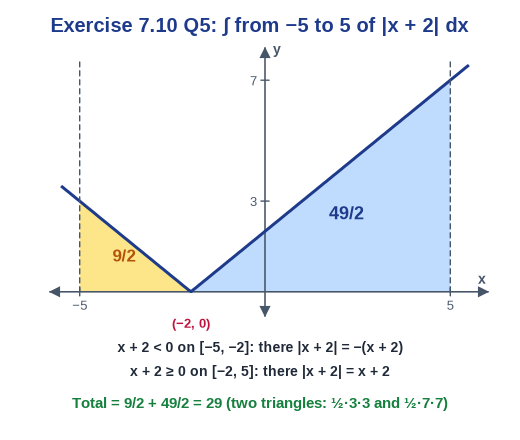
6. “∫(2→8) |x − 5| dx” ∫(2→5) (5 − x) dx + ∫(5→8) (x − 5) dx = 9/2 + 9/2 = 9.
7. “∫(0→1) x(1 − x)ⁿ dx” By P4, = ∫(0→1) (1 − x)xⁿ dx = 1/(n + 1) − 1/(n + 2) = 1/((n + 1)(n + 2)).
8. “∫(0→π/4) log (1 + tan x) dx”
- Use P4: replace x by π/4 − x. tan(π/4 − x) = (1 − tan x)/(1 + tan x), so 1 + tan(π/4 − x) = 2/(1 + tan x).
- So I = ∫(0→π/4) log(2/(1 + tan x)) dx = ∫(0→π/4) [log 2 − log(1 + tan x)] dx = (π/4) log 2 − I.
- So 2I = (π/4) log 2.
Answer: (π/8) log 2
9. “∫(0→2) x√(2 − x) dx” By P4, = ∫(0→2) (2 − x)√x dx = [(4/3)x^(3/2) − (2/5)x^(5/2)] (0→2) = (8√2/3) − (8√2/5) = 16√2/15.
10. “∫(0→π/2) (2log sin x − log sin 2x) dx”
- log sin 2x = log(2 sin x cos x) = log 2 + log sin x + log cos x.
- So 2 log sin x − log sin 2x = log sin x − log cos x − log 2.
- By P4, ∫(0→π/2) log sin x dx = ∫(0→π/2) log cos x dx, so these two parts cancel.
- What is left is −∫(0→π/2) log 2 dx = −(π/2) log 2.
Answer: (π/2) log(1/2), which is the same as −(π/2) log 2
11. “∫(−π/2→π/2) sin² x dx” Even: 2∫(0→π/2) sin² x dx = 2(π/4) = π/2.
12. “∫(0→π) x dx/(1 + sin x)”
- Use P4: replace x by π − x. sin(π − x) = sin x, so I = ∫(0→π) (π − x)/(1 + sin x) dx.
- Add this to the first form: 2I = π∫(0→π) dx/(1 + sin x).
- 1/(1 + sin x) = (1 − sin x)/cos² x = sec² x − sec x tan x. An anti derivative is tan x − sec x, which equals −cos x/(1 + sin x); this second form has no trouble at x = π/2.
- At x = π, −cos x/(1 + sin x) = 1; at x = 0 it is −1. So ∫(0→π) dx/(1 + sin x) = 1 − (−1) = 2.
- So 2I = 2π.
Answer: π
13. “∫(−π/2→π/2) sin⁷ x dx” sin⁷x is odd: 0.
14. “∫(0→2π) cos⁵ x dx”
- Use P6 with 2a = 2π: cos⁵(2π − x) = cos⁵x, so I = 2∫(0→π) cos⁵x dx.
- Use P6 again with 2a = π: cos⁵(π − x) = −cos⁵x, so ∫(0→π) cos⁵x dx = 0.
Answer: 0
15. “∫(0→π/2) (sin x − cos x)/(1 + sin x cos x) dx” By P4 the integrand becomes (cos x − sin x)/(1 + cos x sin x), the negative of itself. So I = −I. Answer: 0.
16. “∫(0→π) log (1 + cos x) dx”
- Use P4: replace x by π − x. cos(π − x) = −cos x, so I = ∫(0→π) log(1 − cos x) dx.
- Add the two forms: 2I = ∫(0→π) log[(1 + cos x)(1 − cos x)] dx = ∫(0→π) log sin² x dx = 2∫(0→π) log sin x dx.
- sin(π − x) = sin x, so by P6, ∫(0→π) log sin x dx = 2∫(0→π/2) log sin x dx = 2(−(π/2) log 2) = −π log 2 (Example 34).
- So 2I = 2(−π log 2).
Answer: −π log 2
17. “∫(0→a) √x/(√x + √(a − x)) dx” By P4 it equals ∫(0→a) √(a − x)/(√(a − x) + √x) dx. Adding, 2I = a. Answer: a/2.
18. “∫(0→4) |x − 1| dx” ∫(0→1) (1 − x) dx + ∫(1→4) (x − 1) dx = 1/2 + 9/2 = 5.
19. “Show that ∫(0→a) f(x)g(x) dx = 2∫(0→a) f(x) dx, if f and g are defined as f(x) = f(a − x) and g(x) + g(a − x) = 4”
Let I = ∫(0→a) f(x)g(x) dx. By P4, I = ∫(0→a) f(a − x)g(a − x) dx = ∫(0→a) f(x)[4 − g(x)] dx = 4∫(0→a) f(x) dx − I. So 2I = 4∫(0→a) f(x) dx and I = 2∫(0→a) f(x) dx.
20. “The value of ∫(−π/2→π/2) (x³ + x cos x + tan⁵ x + 1) dx is (A) 0 (B) 2 (C) π (D) 1”
x³, x cos x and tan⁵x are odd, so they give 0. What is left is ∫(−π/2→π/2) 1 dx = π. Answer (C).
21. “The value of ∫(0→π/2) log((4 + 3sin x)/(4 + 3cos x)) dx is (A) 2 (B) 3/4 (C) 0 (D) −2”
By P4 the integrand becomes log((4 + 3 cos x)/(4 + 3 sin x)), its own negative. So I = −I = 0. Answer (C).
Miscellaneous Examples 35 to 42 (pages 281–285)
Example 35 (page 281): ∫cos 6x √(1 + sin 6x) dx. t = 1 + sin 6x, dt = 6 cos 6x dx: (1/6)(2/3)t^(3/2) = (1/9)(1 + sin 6x)^(3/2) + C.
Example 36 (page 281): ∫(x⁴ − x)^(1/4)/x⁵ dx. = ∫(1 − 1/x³)^(1/4)/x⁴ dx; t = 1 − x⁻³, dt = 3x⁻⁴ dx: (1/3)(4/5)t^(5/4) = (4/15)(1 − 1/x³)^(5/4) + C.
Example 37 (page 281): ∫x⁴/((x − 1)(x² + 1)) dx. x⁴/((x − 1)(x² + 1)) = (x + 1) + 1/((x − 1)(x² + 1)) = (x + 1) + 1/(2(x − 1)) − x/(2(x² + 1)) − 1/(2(x² + 1)). Answer: x²/2 + x + (1/2) log|x − 1| − (1/4) log(x² + 1) − (1/2) tan⁻¹x + C. (In the last two lines of this example the book prints x² + x + 1 where x² + 1 is meant.)
Example 38 (page 282): ∫[log(log x) + 1/(log x)²] dx. Parts on log(log x) with 1 as the second function gives x log(log x) − ∫dx/log x, and parts again gives ∫dx/log x = x/log x + ∫dx/(log x)². The (log x)⁻² terms cancel. Answer: x log(log x) − x/log x + C.
Example 39 (page 283): ∫[√cot x + √tan x] dx. = ∫√tan x (1 + cot x) dx. With tan x = t², dx = 2t dt/(1 + t⁴), it becomes 2∫(1 + 1/t²) dt/((t − 1/t)² + 2), and y = t − 1/t gives √2 tan⁻¹(y/√2). Answer: √2 tan⁻¹((tan x − 1)/(√2 √tan x)) + C.
Example 40 (page 283): ∫sin 2x cos 2x/√(9 − cos⁴2x) dx. t = cos² 2x, dt = −4 sin 2x cos 2x dx: −(1/4)∫dt/√(9 − t²). Answer: −(1/4) sin⁻¹((1/3) cos² 2x) + C.
Example 41 (page 284): ∫(−1→3/2) |x sin πx| dx. x sin πx ≥ 0 on [−1, 1] and ≤ 0 on [1, 3/2]. With F(x) = −x cos πx/π + sin πx/π², the value is [F] (−1→1) − [F] (1→3/2) = 2/π − (−1/π² − 1/π) = 3/π + 1/π².
Example 42 (page 284): ∫(0→π) x dx/(a² cos² x + b² sin² x). By P4, 2I = π∫(0→π) dx/(a² cos² x + b² sin² x) = 2π∫(0→π/2) of the same (P6). Splitting at π/4 and putting tan x = t and cot x = u gives π²/(2ab).
Miscellaneous Exercise on Chapter 7 (pages 285–287)
The book’s instruction for Questions 1 to 23: “Integrate the functions in Exercises 1 to 23.”
1. “1/(x − x³)” = 1/(x(1 − x²)) = 1/x + x/(1 − x²). Answer: log|x| − (1/2) log|1 − x²| = (1/2) log|x²/(1 − x²)| + C.
2. “1/(√(x + a) + √(x + b))” Multiply by √(x + a) − √(x + b): the integrand is (√(x + a) − √(x + b))/(a − b). Answer: (2/(3(a − b)))[(x + a)^(3/2) − (x + b)^(3/2)] + C.
3. “1/(x√(ax − x²)) [Hint: Put x = a/t]”
- Put x = a/t. Then dx = −(a/t²) dt.
- ax − x² = a²/t − a²/t² = (a²/t²)(t − 1), so √(ax − x²) = (a/t)√(t − 1).
- So x√(ax − x²) = (a/t)(a/t)√(t − 1) = (a²/t²)√(t − 1).
- The integrand times dx is −(a/t²) dt ÷ [(a²/t²)√(t − 1)] = −(1/a) dt/√(t − 1).
- ∫(t − 1)^(−1/2) dt = 2√(t − 1), so the integral is −(2/a)√(t − 1).
- Put back t = a/x. Then t − 1 = (a − x)/x.
Answer: −(2/a)√((a − x)/x) + C
4. “1/(x²(x⁴ + 1)^(3/4))” = 1/(x⁵(1 + x⁻⁴)^(3/4)). t = 1 + x⁻⁴, dt = −4x⁻⁵ dx: −(1/4)∫t^(−3/4) dt = −t^(1/4). Answer: −(1 + 1/x⁴)^(1/4) + C.
5. “1/(x^(1/2) + x^(1/3)) [Hint: 1/(x^(1/2) + x^(1/3)) = 1/(x^(1/3)(1 + x^(1/6))), put x = t⁶]”
- Put x = t⁶. Then dx = 6t⁵ dt, x^(1/2) = t³ and x^(1/3) = t².
- The bottom is t³ + t² = t²(t + 1). So the integrand times dx is 6t⁵ dt/(t²(t + 1)) = 6t³/(t + 1) dt.
- Divide: t³/(t + 1) = t² − t + 1 − 1/(t + 1).
- Integrate: 6[t³/3 − t²/2 + t − log|t + 1|] = 2t³ − 3t² + 6t − 6 log|1 + t|.
- Put back t = x^(1/6), so t³ = √x and t² = x^(1/3).
Answer: 2√x − 3x^(1/3) + 6x^(1/6) − 6 log(1 + x^(1/6)) + C
6. “5x/((x + 1)(x² + 9))” = A/(x + 1) + (Bx + C)/(x² + 9): A = −1/2, B = 1/2, C = 9/2. Answer: −(1/2) log|x + 1| + (1/4) log(x² + 9) + (3/2) tan⁻¹(x/3) + C.
7. “sin x/sin (x − a)” t = x − a: sin(t + a)/sin t = cos a + sin a cot t. Answer: sin a log|sin(x − a)| + x cos a + C.
8. “(e^(5 log x) − e^(4 log x))/(e^(3 log x) − e^(2 log x))” e^(k log x) = xᵏ, so the integrand is (x⁵ − x⁴)/(x³ − x²) = x². Answer: x³/3 + C.
9. “cos x/√(4 − sin²x)” t = sin x: ∫dt/√(2² − t²). Answer: sin⁻¹((sin x)/2) + C.
10. “(sin⁸ x − cos⁸ x)/(1 − 2sin² x cos² x)” sin⁸ − cos⁸ = (sin⁴ − cos⁴)(sin⁴ + cos⁴) = (sin² x − cos² x)(sin⁴x + cos⁴x), and 1 − 2 sin² x cos² x = sin⁴x + cos⁴x. So the integrand is sin² x − cos² x = −cos 2x. Answer: −(1/2) sin 2x + C.
11. “1/(cos (x + a) cos (x + b))” As in Exercise 7.3 Q22, with sin(a − b) = sin[(x + a) − (x + b)]: the integrand is (1/sin(a − b))[tan(x + a) − tan(x + b)]. Answer: (1/sin(a − b)) log|cos(x + b)/cos(x + a)| + C.
12. “x³/√(1 − x⁸)” t = x⁴, dt = 4x³ dx: (1/4)∫dt/√(1 − t²). Answer: (1/4) sin⁻¹(x⁴) + C.
13. “eˣ/((1 + eˣ)(2 + eˣ))” t = eˣ: ∫dt/((1 + t)(2 + t)) = ∫[1/(1 + t) − 1/(2 + t)] dt. Answer: log((1 + eˣ)/(2 + eˣ)) + C.
14. “1/((x² + 1)(x² + 4))” = (1/3)[1/(x² + 1) − 1/(x² + 4)]. Answer: (1/3) tan⁻¹x − (1/6) tan⁻¹(x/2) + C.
15. “cos³x e^(log sinx)” e^(log sin x) = sin x, so the integrand is cos³x sin x. t = cos x: −(1/4) cos⁴x + C.
16. “e^(3 log x) (x⁴ + 1)⁻¹” = x³/(x⁴ + 1). Answer: (1/4) log(x⁴ + 1) + C.
17. “f′(ax + b) [f(ax + b)]ⁿ” t = f(ax + b), dt = a f′(ax + b) dx: (1/a)∫tⁿ dt. Answer, for n ≠ −1: [f(ax + b)]ⁿ⁺¹/(a(n + 1)) + C.
18. “1/√(sin³x sin (x + α))”
- sin(x + α) = sin x cos α + cos x sin α = sin x (cos α + cot x sin α).
- So sin³x sin(x + α) = sin⁴x (cos α + cot x sin α), and its square root is sin² x √(cos α + cot x sin α).
- Put t = cos α + cot x sin α. Then dt = −sin α cosec² x dx, so dx/sin² x = −dt/sin α.
- The integral is −(1/sin α)∫t^(−1/2) dt = −(2/sin α)√t.
- By step 1, t = sin(x + α)/sin x.
Answer: −(2/sin α)√(sin(x + α)/sin x) + C
19. “√((1 − √x)/(1 + √x))”
- Put x = cos² θ (θ between 0 and π/2). Then √x = cos θ and dx = −2 sin θ cos θ dθ.
- (1 − cos θ)/(1 + cos θ) = tan²(θ/2), so the square root is tan(θ/2).
- tan(θ/2) · sin θ = 1 − cos θ (because sin θ = 2 sin(θ/2) cos(θ/2) and 1 − cos θ = 2 sin²(θ/2)).
- So the integral is ∫tan(θ/2)(−2 sin θ cos θ) dθ = −2∫cos θ(1 − cos θ) dθ = −2∫cos θ dθ + ∫(1 + cos 2θ) dθ = −2 sin θ + θ + sin θ cos θ.
- Put back cos θ = √x, sin θ = √(1 − x), θ = cos⁻¹√x and sin θ cos θ = √(x − x²).
Answer: −2√(1 − x) + cos⁻¹√x + √(x − x²) + C
20. “(2 + sin 2x) eˣ/(1 + cos 2x)” (2 + 2 sin x cos x)/(2 cos² x) = sec² x + tan x, and sec² x is the derivative of tan x. Answer: eˣ tan x + C.
21. “(x² + x + 1)/((x + 1)² (x + 2))” = A/(x + 1) + B/(x + 1)² + C/(x + 2): B = 1, C = 3, A = −2. Answer: −2 log|x + 1| − 1/(x + 1) + 3 log|x + 2| + C.
22. “tan⁻¹ √((1 − x)/(1 + x))”
- Put x = cos θ (θ between 0 and π). Then (1 − x)/(1 + x) = (1 − cos θ)/(1 + cos θ) = tan²(θ/2), so the square root is tan(θ/2).
- θ/2 lies between 0 and π/2, so tan⁻¹(tan(θ/2)) = θ/2 = (1/2) cos⁻¹x.
- By parts, ∫cos⁻¹x dx = x cos⁻¹x − √(1 − x²).
Answer: (1/2)[x cos⁻¹x − √(1 − x²)] + C
23. “√(x² + 1) [log (x² + 1) − 2 log x]/x⁴”
- log(x² + 1) − 2 log x = log((x² + 1)/x²) = log(1 + 1/x²).
- √(x² + 1)/x⁴ = x√(1 + 1/x²)/x⁴ = √(1 + 1/x²)/x³ (for x > 0).
- Put t = 1 + 1/x². Then dt = −2 dx/x³, so dx/x³ = −dt/2. The integral becomes −(1/2)∫√t log t dt.
- By parts, with log t first and √t second: ∫√t log t dt = (2/3)t^(3/2) log t − ∫(1/t)(2/3)t^(3/2) dt = (2/3)t^(3/2) log t − (4/9)t^(3/2).
- Multiply by −1/2: −(1/3)t^(3/2) log t + (2/9)t^(3/2) = −(1/3)t^(3/2)[log t − 2/3].
Answer: −(1/3)(1 + 1/x²)^(3/2)[log(1 + 1/x²) − 2/3] + C
The book’s instruction for Questions 24 to 31: “Evaluate the definite integrals in Exercises 24 to 31.”
24. “∫(π/2→π) eˣ ((1 − sin x)/(1 − cos x)) dx”
- 1 − cos x = 2 sin²(x/2) and sin x = 2 sin(x/2) cos(x/2). So (1 − sin x)/(1 − cos x) = 1/(2 sin²(x/2)) − cot(x/2) = (1/2) cosec²(x/2) − cot(x/2).
- Take f(x) = −cot(x/2). Then f′(x) = (1/2) cosec²(x/2), so the integrand is eˣ[f(x) + f′(x)].
- So an anti derivative is eˣ f(x) = −eˣ cot(x/2).
- At x = π, cot(π/2) = 0, so it is 0. At x = π/2, cot(π/4) = 1, so it is −e^(π/2).
- Value = 0 − (−e^(π/2)) = e^(π/2).
Answer: e^(π/2)
25. “∫(0→π/4) sin x cos x/(cos⁴ x + sin⁴ x) dx” Divide top and bottom by cos⁴x: tan x sec² x/(1 + tan⁴x). t = tan² x runs from 0 to 1, dt = 2 tan x sec² x dx: (1/2)∫(0→1) dt/(1 + t²) = π/8.
26. “∫(0→π/2) cos² x dx/(cos² x + 4 sin² x)”
- Divide top and bottom by cos² x. The integrand becomes 1/(1 + 4 tan² x).
- Put t = tan x. Then dt = sec² x dx = (1 + t²) dx, so dx = dt/(1 + t²). As x goes from 0 to π/2, t goes from 0 to ∞.
- The integral becomes ∫(0→∞) dt/((1 + t²)(1 + 4t²)).
- Partial fractions: 1/((1 + t²)(1 + 4t²)) = (1/3)[4/(1 + 4t²) − 1/(1 + t²)].
- ∫(0→∞) 4/(1 + 4t²) dt = [2 tan⁻¹2t] (0→∞) = π, and ∫(0→∞) dt/(1 + t²) = π/2.
- Value = (1/3)(π − π/2) = π/6.
Answer: π/6
27. “∫(π/6→π/3) (sin x + cos x)/√(sin 2x) dx”
- (sin x − cos x)² = 1 − sin 2x, so sin 2x = 1 − (sin x − cos x)².
- Put t = sin x − cos x. Then dt = (cos x + sin x) dx. At x = π/6, t = (1 − √3)/2; at x = π/3, t = (√3 − 1)/2.
- The integral is ∫dt/√(1 − t²) = sin⁻¹((√3 − 1)/2) − sin⁻¹((1 − √3)/2).
- sin⁻¹(−u) = −sin⁻¹u, so this is 2 sin⁻¹((√3 − 1)/2).
Answer: 2 sin⁻¹((√3 − 1)/2)
28. “∫(0→1) dx/(√(1 + x) − √x)” Multiply by √(1 + x) + √x; the bottom becomes 1. [(2/3)(1 + x)^(3/2) + (2/3)x^(3/2)] (0→1) = (2/3)(2√2 + 1 − 1) = 4√2/3.
29. “∫(0→π/4) (sin x + cos x)/(9 + 16 sin 2x) dx”
- As in Q27, sin 2x = 1 − (sin x − cos x)². Put t = sin x − cos x, dt = (cos x + sin x) dx. t goes from −1 (at x = 0) to 0 (at x = π/4).
- The bottom is 9 + 16(1 − t²) = 25 − 16t² = 16[(5/4)² − t²].
- So the integral is (1/16)∫(−1→0) dt/((5/4)² − t²). Use ∫dt/(a² − t²) = (1/(2a)) log|(a + t)/(a − t)| with a = 5/4, so 1/(2a) = 2/5.
- Value = (1/16)(2/5)[log|(5/4 + t)/(5/4 − t)|] (−1→0) = (1/40)[log 1 − log((1/4)/(9/4))] = (1/40)[0 − log(1/9)] = (1/40) log 9.
Answer: (1/40) log 9
30. “∫(0→π/2) sin 2x tan⁻¹ (sin x) dx”
- Put t = sin x (t from 0 to 1). Then sin 2x dx = 2 sin x cos x dx = 2t dt.
- The integral becomes ∫(0→1) 2t tan⁻¹t dt.
- By parts, with tan⁻¹t first and 2t second: [t² tan⁻¹t] (0→1) − ∫(0→1) t²/(1 + t²) dt.
- [t² tan⁻¹t] (0→1) = π/4. And t²/(1 + t²) = 1 − 1/(1 + t²), so its integral from 0 to 1 is 1 − π/4.
- Value = π/4 − (1 − π/4) = π/2 − 1.
Answer: π/2 − 1
31. “∫(1→4) [|x − 1| + |x − 2| + |x − 3|] dx” ∫(1→4)|x − 1| dx = 9/2; ∫(1→4)|x − 2| dx = 1/2 + 2 = 5/2; ∫(1→4)|x − 3| dx = 2 + 1/2 = 5/2. Total: 19/2.
The book’s instruction for Questions 32 to 37: “Prove the following (Exercises 32 to 37)”
32. “∫(1→3) dx/(x²(x + 1)) = 2/3 + log (2/3)” 1/(x²(x + 1)) = −1/x + 1/x² + 1/(x + 1). So the integral is [−log x − 1/x + log(x + 1)] (1→3) = (−log 3 − 1/3 + log 4) − (−1 + log 2) = 2/3 + log(4/6) = 2/3 + log(2/3). Proved.
33. “∫(0→1) x eˣ dx = 1” [x eˣ − eˣ] (0→1) = 0 − (−1) = 1. Proved.
34. “∫(−1→1) x¹⁷ cos⁴ x dx = 0” x¹⁷ cos⁴x is odd, so by P7 the value is 0. Proved.
35. “∫(0→π/2) sin³ x dx = 2/3” sin³x = (1 − cos² x) sin x; t = cos x runs from 1 to 0: ∫(0→1)(1 − t²) dt = 2/3. Proved.
36. “∫(0→π/4) 2 tan³ x dx = 1 − log 2” tan³x = tan x sec² x − tan x, so ∫2 tan³x dx = tan² x − 2 log|sec x|. From 0 to π/4: 1 − 2 log √2 = 1 − log 2. Proved.
37. “∫(0→1) sin⁻¹ x dx = π/2 − 1” [x sin⁻¹x + √(1 − x²)] (0→1) = (π/2 + 0) − (0 + 1) = π/2 − 1. Proved.
38. “∫dx/(eˣ + e⁻ˣ) is equal to (A) tan⁻¹ (eˣ) + C (B) tan⁻¹ (e⁻ˣ) + C (C) log (eˣ − e⁻ˣ) + C (D) log (eˣ + e⁻ˣ) + C”
= ∫eˣ dx/(e²ˣ + 1); t = eˣ gives ∫dt/(t² + 1) = tan⁻¹(eˣ) + C. Answer (A).
39. “∫cos 2x/(sin x + cos x)² dx is equal to (A) −1/(sin x + cos x) + C (B) log|sin x + cos x| + C (C) log|sin x − cos x| + C (D) 1/(sin x + cos x)² + C”
cos 2x/(sin x + cos x)² = (cos x − sin x)/(cos x + sin x), whose integral is log|sin x + cos x| + C. Answer (B).
40. “If f(a + b − x) = f(x), then ∫(a→b) x f(x) dx is equal to (A) ((a + b)/2) ∫(a→b) f(b − x) dx (B) ((a + b)/2) ∫(a→b) f(b + x) dx (C) ((b − a)/2) ∫(a→b) f(x) dx (D) ((a + b)/2) ∫(a→b) f(x) dx”
Let I = ∫(a→b) x f(x) dx. By P3, I = ∫(a→b) (a + b − x) f(a + b − x) dx = ∫(a→b) (a + b − x) f(x) dx = (a + b)∫(a→b) f(x) dx − I. So I = ((a + b)/2)∫(a→b) f(x) dx. Answer (D).
Notes on the book
- Exercise 7.6 Q11. The answer key prints −√(1 − x²) cos⁻¹x + x + C. The correct anti derivative is −√(1 − x²) cos⁻¹x − x + C; differentiating the key’s version gives the integrand plus 2.
- Exercise 7.9 Q9. The key gives option (D), 4. The integral works out to 6, option (A), and a numerical evaluation gives 6.000.
- Example 37. In its last two lines the book writes the denominator as (x − 1)(x² + x + 1); it should be (x − 1)(x² + 1), as at the start of the example.
- Example 16 refers to “Table 2.2(5)”; the table meant is Table 7.2, row 5.
- Equivalent forms: in several places the key’s answer differs from the one here by a constant (Exercise 7.2 Q24, Exercise 7.4 Q3 written with a reciprocal inside the log). Both forms are right; differentiating either gives the integrand.
- Exercise 7.3 Q21 and Exercise 7.6 Q22 use sin⁻¹(cos x) = π/2 − x and sin⁻¹(2x/(1 + x²)) = 2 tan⁻¹x, which hold only on 0 ≤ x ≤ π and |x| ≤ 1 respectively; the answers are stated for those ranges.
Practice
-
∫(3x² + 4) dx equals:
Show answer
Answer: (b) x³ + 4x + C
-
∫cos x/(1 + sin x) dx equals:
Show answer
Answer: (a) log|1 + sin x| + C
-
∫ from 0 to π/2 of sin x dx equals:
Show answer
Answer: (b) 1
-
Find ∫x log x dx.
Show answer
Answer: By parts with log x as the first function and x as the second: ∫x log x dx = (x²/2) log x − ∫(1/x)(x²/2) dx = (x²/2) log x − x²/4 + C.
-
Evaluate ∫ from −2 to 2 of (x³ + 3x² + x) dx.
Show answer
Answer: x³ and x are odd, so their parts give 0 (P7). 3x² is even: 2∫ from 0 to 2 of 3x² dx = 2[x³] from 0 to 2 = 16. The value is 16.
Stuck on a question?
Take a photo and Lagnever AI explains it step by step. Try it for 7 days for ₹2.
Get it on Google Play Open in browser
For parents: after the trial, the plan renews monthly by UPI or card autopay. You can cancel anytime in the app.