
Class 12 Maths Chapter 7 NCERT Solutions Hinglish mein: Integrals
Class 12 ki NCERT textbook Mathematics Part II ke Chapter 7, Integrals, ki Exercise 7.1 se 7.10 aur Miscellaneous Exercise ke har sawal ke jawab, aur saare 42 worked examples. Page numbers 2026-27 reprint ke hisaab se hain (pages 225–291). Exercises ke sawal Hinglish mein diye hain; examples chhote mein apne shabdon mein, number aur page ke saath likhe hain. Neeche ka har anti derivative ek computer algebra script ne differentiate karke jaancha (derivative minus integrand simplify hokar 0 aata hai), aur har definite integral numerically jaancha gaya. Jawab book ki answer key se milte hain, sirf do jagah chhodkar, jo wahin mark ki gayi hain. Chhote notes: Chapter 7 ke notes.
Is page par maths kaise likha hai. C constant of integration hai. log natural logarithm (base e) hai, jaise book mein. Fractions slash se likhe hain, to 1/(x + 1) matlab ek bata (x + 1), aur x3/2 jaisi powers, jahan superscript padhna mushkil ho, x^(3/2) likhi hain. a se b tak ka definite integral ∫(a→b) f(x) dx likha hai, aur [F(x)] (a→b) matlab F(b) − F(a). sin⁻¹, cos⁻¹ aur tan⁻¹ inverse trigonometric functions hain. Sawal bhi isi layout mein likhe hain.
Shabd jo use hue hain. f ka anti derivative (ya integral) wo function hai jiska derivative f ho. Integrand integral sign ke andar wala function hai. By parts integration mein ek first function chunte hain (jise differentiate karte hain) aur ek second function (jise integrate karte hain). Partial fractions matlab ek fraction ko simple fractions ke jod mein todna. Function even hai agar f(−x) = f(x), aur odd hai agar f(−x) = −f(x). P0 se P7 definite integrals ki properties hain, jo Exercise 7.10 se pehle di gayi hain. Lambe jawab numbered steps mein tode gaye hain, aur aakhri jawab bold mein Jawab: … likha hai.
Zyadatar jawab paanch baaton par chalte hain:
- ∫xⁿ dx = xⁿ⁺¹/(n + 1) + C (n ≠ −1), ∫dx/x = log|x| + C, ∫eˣ dx = eˣ + C.
- Substitution: t = g(x), dt = g′(x) dx; ∫f′(x)/f(x) dx = log|f(x)| + C.
- Special integrals: ∫dx/(x² + a²) = (1/a) tan⁻¹(x/a) + C, ∫dx/√(a² − x²) = sin⁻¹(x/a) + C, ∫dx/√(x² ± a²) = log|x + √(x² ± a²)| + C, ∫dx/(x² − a²) = (1/2a) log|(x − a)/(x + a)| + C.
- By parts: ∫f g dx = f∫g dx − ∫[f′∫g dx] dx; ∫eˣ[f(x) + f′(x)] dx = eˣ f(x) + C.
- ∫(a→b) f(x) dx = F(b) − F(a); P3: ∫(a→b) f(x) dx = ∫(a→b) f(a + b − x) dx; P7: [−a, a] par odd functions 0 dete hain.
Examples 1 se 4: inspection se integration (pages 231–234)
Example 1 (page 231): (i) cos 2x, (ii) 3x² + 4x³, (iii) 1/x ka ek anti derivative. (i) d/dx (sin 2x) = 2 cos 2x, to (1/2) sin 2x. (ii) d/dx (x³ + x⁴) = 3x² + 4x³, to x³ + x⁴. (iii) x ≠ 0 ke liye d/dx log|x| = 1/x, to log|x|.
Example 2 (page 232): (i) ∫(x³ − 1)/x² dx, (ii) ∫(x^(2/3) + 1) dx, (iii) ∫(x^(3/2) + 2eˣ − 1/x) dx. (i) ∫(x − x⁻²) dx = x²/2 + 1/x + C. (ii) (3/5)x^(5/3) + x + C. (iii) (2/5)x^(5/2) + 2eˣ − log|x| + C.
Example 3 (page 233): (i) ∫(sin x + cos x) dx, (ii) ∫cosec x(cosec x + cot x) dx, (iii) ∫(1 − sin x)/cos² x dx. (i) −cos x + sin x + C. (ii) ∫(cosec² x + cosec x cot x) dx = −cot x − cosec x + C. (iii) ∫(sec² x − tan x sec x) dx = tan x − sec x + C.
Example 4 (page 233): f(x) = 4x³ − 6 ka wo anti derivative F jiske liye F(0) = 3. F(x) = x⁴ − 6x + C, aur F(0) = C = 3. To F(x) = x⁴ − 6x + 3.
Exercise 7.1 (pages 234–235)
Questions 1 se 5 ke liye book ka nirdesh: Neeche diye functions ka anti derivative (ya integral) inspection ke method se nikaalo. Questions 6 se 20 ke liye: Neeche diye integrals nikaalo.
1. sin 2x d/dx (cos 2x) = −2 sin 2x, to ek anti derivative −(1/2) cos 2x hai.
2. cos 3x d/dx (sin 3x) = 3 cos 3x, to (1/3) sin 3x.
3. e²ˣ d/dx (e²ˣ) = 2e²ˣ, to (1/2) e²ˣ.
4. (ax + b)² d/dx (ax + b)³ = 3a(ax + b)², to (1/(3a))(ax + b)³.
5. sin 2x – 4 e³ˣ −(1/2) cos 2x − (4/3) e³ˣ, kyunki iska d/dx sin 2x − 4e³ˣ hai.
6. ∫(4 e³ˣ + 1) dx = 4(e³ˣ/3) + x + C = (4/3)e³ˣ + x + C.
7. ∫x²(1 − 1/x²) dx = ∫(x² − 1) dx = x³/3 − x + C.
8. ∫(ax² + bx + c) dx = ax³/3 + bx²/2 + cx + C.
9. ∫(2x² + eˣ) dx = (2/3)x³ + eˣ + C.
10. ∫(√x − 1/√x)² dx (√x − 1/√x)² = x − 2 + 1/x, to integral x²/2 − 2x + log|x| + C hai.
11. ∫(x³ + 5x² − 4)/x² dx = ∫(x + 5 − 4x⁻²) dx = x²/2 + 5x + 4/x + C.
12. ∫(x³ + 3x + 4)/√x dx = ∫(x^(5/2) + 3x^(1/2) + 4x^(−1/2)) dx = (2/7)x^(7/2) + 2x^(3/2) + 8√x + C.
13. ∫(x³ − x² + x − 1)/(x − 1) dx x³ − x² + x − 1 = x²(x − 1) + (x − 1) = (x − 1)(x² + 1). To integral ∫(x² + 1) dx = x³/3 + x + C hai.
14. ∫(1 − x)√x dx = ∫(x^(1/2) − x^(3/2)) dx = (2/3)x^(3/2) − (2/5)x^(5/2) + C.
15. ∫√x(3x² + 2x + 3) dx = ∫(3x^(5/2) + 2x^(3/2) + 3x^(1/2)) dx = (6/7)x^(7/2) + (4/5)x^(5/2) + 2x^(3/2) + C.
16. ∫(2x − 3cos x + eˣ) dx = x² − 3 sin x + eˣ + C.
17. ∫(2x² − 3sin x + 5√x) dx = (2/3)x³ + 3 cos x + (10/3)x^(3/2) + C.
18. ∫sec x (sec x + tan x) dx = ∫(sec² x + sec x tan x) dx = tan x + sec x + C.
19. ∫sec² x/cosec² x dx sec² x/cosec² x = sin² x/cos² x = tan² x = sec² x − 1. To integral tan x − x + C hai.
20. ∫(2 − 3sin x)/cos² x dx = ∫(2 sec² x − 3 sec x tan x) dx = 2 tan x − 3 sec x + C.
21. (√x + 1/√x) ka anti derivative barabar hai (A) (1/3)x^(1/3) + 2x^(1/2) + C (B) (2/3)x^(2/3) + (1/2)x² + C (C) (2/3)x^(3/2) + 2x^(1/2) + C (D) (3/2)x^(3/2) + (1/2)x^(1/2) + C
∫(x^(1/2) + x^(−1/2)) dx = (2/3)x^(3/2) + 2x^(1/2) + C. Jawab (C).
22. Agar d/dx f(x) = 4x³ − 3/x⁴ aisa ho ki f(2) = 0, to f(x) hai (A) x⁴ + 1/x³ − 129/8 (B) x³ + 1/x⁴ + 129/8 (C) x⁴ + 1/x³ + 129/8 (D) x³ + 1/x⁴ − 129/8
f(x) = ∫(4x³ − 3x⁻⁴) dx = x⁴ + x⁻³ + C. f(2) = 16 + 1/8 + C = 0 se C = −129/8. Jawab (A).
Examples 5 aur 6: substitution se integration (pages 236–240)
Example 5 (page 236): (i) sin mx, (ii) 2x sin(x² + 1), (iii) tan⁴√x sec²√x/√x, (iv) sin(tan⁻¹x)/(1 + x²) ko integrate karo. (i) t = mx: −(1/m) cos mx + C. (ii) t = x² + 1, dt = 2x dx: −cos(x² + 1) + C. (iii) t = √x, dx = 2t dt se 2∫tan⁴t sec²t dt milta hai; phir u = tan t se 2u⁵/5, to (2/5) tan⁵√x + C. (iv) t = tan⁻¹x: −cos(tan⁻¹x) + C.
Standard results (pages 237–238). t = cos x rakhne par ∫tan x dx = −log|cos x| = log|sec x| + C. t = sin x rakhne par ∫cot x dx = log|sin x| + C. Upar aur neeche ko sec x + tan x se multiply karke aur t = sec x + tan x rakhkar, ∫sec x dx = log|sec x + tan x| + C. Isi tarah, ∫cosec x dx = −log|cosec x + cot x| = log|cosec x − cot x| + C.
Example 6 (page 238): (i) ∫sin³x cos² x dx, (ii) ∫sin x/sin(x + a) dx, (iii) ∫dx/(1 + tan x). (i) sin³x = (1 − cos² x) sin x likho aur t = cos x rakho: −∫(t² − t⁴) dt = −(1/3)cos³x + (1/5)cos⁵x + C. (ii) t = x + a rakho: sin(t − a)/sin t = cos a − sin a cot t, to integral t cos a − sin a log|sin t| hai; constant a cos a ko C mein daalkar ye x cos a − sin a log|sin(x + a)| + C hai. (iii) dx/(1 + tan x) = cos x dx/(cos x + sin x) = (1/2)[1 + (cos x − sin x)/(cos x + sin x)] dx, to integral x/2 + (1/2) log|cos x + sin x| + C hai.
Exercise 7.2 (pages 240–241)
Questions 1 se 37 ke liye book ka nirdesh: Exercises 1 se 37 ke functions ko integrate karo:
1. 2x/(1 + x²) Upar wala hissa 1 + x² ka derivative hai. t = 1 + x² rakho: ∫dt/t = log(1 + x²) + C (1 + x² > 0).
2. (log x)²/x t = log x, dt = dx/x: ∫t² dt = (1/3)(log x)³ + C. (Answer key log|x| likhti hai; x > 0 ke liye dono same hain.)
3. 1/(x + x log x) = 1/(x(1 + log x)). t = 1 + log x, dt = dx/x: log|1 + log x| + C.
4. sin x sin (cos x) t = cos x, dt = −sin x dx: −∫sin t dt = cos t + C = cos(cos x) + C.
5. sin (ax + b) cos (ax + b) = (1/2) sin 2(ax + b). Iska integral −(1/(4a)) cos 2(ax + b) + C hai.
6. √(ax + b) t = ax + b, dx = dt/a: (1/a)(2/3)t^(3/2), to (2/(3a))(ax + b)^(3/2) + C.
7. x √(x + 2) t = x + 2, x = t − 2: ∫(t − 2)√t dt = (2/5)t^(5/2) − (4/3)t^(3/2). Jawab: (2/5)(x + 2)^(5/2) − (4/3)(x + 2)^(3/2) + C.
8. x √(1 + 2x²) t = 1 + 2x², dt = 4x dx: (1/4)∫√t dt = (1/4)(2/3)t^(3/2) = (1/6)(1 + 2x²)^(3/2) + C.
9. (4x + 2) √(x² + x + 1) t = x² + x + 1, dt = (2x + 1) dx, aur 4x + 2 = 2(2x + 1): 2∫√t dt = (4/3)(x² + x + 1)^(3/2) + C.
10. 1/(x − √x) = 1/(√x(√x − 1)). t = √x − 1, dt = dx/(2√x): 2∫dt/t = 2 log|√x − 1| + C.
11. x/√(x + 4), x > 0 t = x + 4: ∫(t − 4)t^(−1/2) dt = (2/3)t^(3/2) − 8t^(1/2) = (2/3)√t (t − 12). Jawab: (2/3)√(x + 4) (x − 8) + C.
12. (x³ − 1)^(1/3) x⁵ t = x³ − 1, dt = 3x² dx, x³ = t + 1: (1/3)∫(t + 1)t^(1/3) dt = (1/3)[(3/7)t^(7/3) + (3/4)t^(4/3)]. Jawab: (1/7)(x³ − 1)^(7/3) + (1/4)(x³ − 1)^(4/3) + C.
13. x²/(2 + 3x³)³ t = 2 + 3x³, dt = 9x² dx: (1/9)∫t⁻³ dt = −1/(18t²). Jawab: −1/(18(2 + 3x³)²) + C.
14. 1/(x (log x)ᵐ), x > 0, m ≠ 1 t = log x: ∫t⁻ᵐ dt = (log x)^(1 − m)/(1 − m) + C.
15. x/(9 − 4x²) t = 9 − 4x², dt = −8x dx: −(1/8) log|9 − 4x²| + C.
16. e^(2x + 3) (1/2) e^(2x + 3) + C.
17. x/e^(x²) = x e^(−x²). t = −x², dt = −2x dx: −(1/2)eᵗ = −1/(2e^(x²)) + C.
18. e^(tan⁻¹ x)/(1 + x²) t = tan⁻¹x: e^(tan⁻¹x) + C.
19. (e²ˣ − 1)/(e²ˣ + 1) Upar aur neeche ko eˣ se divide karo: (eˣ − e⁻ˣ)/(eˣ + e⁻ˣ). Upar wala hissa neeche wale ka derivative hai, to jawab log(eˣ + e⁻ˣ) + C hai.
20. (e²ˣ − e⁻²ˣ)/(e²ˣ + e⁻²ˣ) e²ˣ + e⁻²ˣ ka derivative 2(e²ˣ − e⁻²ˣ) hai. To jawab (1/2) log(e²ˣ + e⁻²ˣ) + C hai.
21. tan² (2x – 3) = sec²(2x − 3) − 1. Jawab: (1/2) tan(2x − 3) − x + C.
22. sec² (7 – 4x) −(1/4) tan(7 − 4x) + C.
23. sin⁻¹x/√(1 − x²) t = sin⁻¹x, dt = dx/√(1 − x²): (1/2)(sin⁻¹x)² + C.
24. (2cos x – 3sin x)/(6cos x + 4sin x) 6 cos x + 4 sin x ka derivative −6 sin x + 4 cos x = 2(2 cos x − 3 sin x) hai. To integral (1/2) log|6 cos x + 4 sin x| + C hai, jo (1/2) log|2 sin x + 3 cos x| + C bhi hai (dono mein constant (1/2) log 2 ka fark hai; key doosra form deti hai).
25. 1/(cos²x (1 – tan x)²) t = 1 − tan x, dt = −sec² x dx: −∫t⁻² dt = 1/t. Jawab: 1/(1 − tan x) + C.
26. cos √x/√x t = √x, dx = 2t dt: 2∫cos t dt = 2 sin √x + C.
27. √(sin 2x) cos 2x t = sin 2x, dt = 2 cos 2x dx: (1/2)(2/3)t^(3/2) = (1/3)(sin 2x)^(3/2) + C.
28. cos x/√(1 + sin x) t = 1 + sin x: ∫t^(−1/2) dt = 2√(1 + sin x) + C.
29. cot x log sin x t = log sin x, dt = cot x dx: (1/2)(log sin x)² + C.
30. sin x/(1 + cos x) t = 1 + cos x, dt = −sin x dx: −log|1 + cos x| + C.
31. sin x/(1 + cos x)² t = 1 + cos x: −∫t⁻² dt = 1/t = 1/(1 + cos x) + C.
32. 1/(1 + cot x) = sin x/(sin x + cos x) = (1/2)[1 − (cos x − sin x)/(sin x + cos x)]. Jawab: x/2 − (1/2) log|cos x + sin x| + C.
33. 1/(1 − tan x) = cos x/(cos x − sin x) = (1/2)[1 + (cos x + sin x)/(cos x − sin x)]. cos x − sin x ka derivative −(sin x + cos x) hai, to jawab x/2 − (1/2) log|cos x − sin x| + C hai.
34. √(tan x)/(sin x cos x) √tan x/(sin x cos x) = √tan x · sec² x/tan x = sec² x/√tan x. t = tan x: ∫t^(−1/2) dt = 2√(tan x) + C.
35. (1 + log x)²/x t = 1 + log x: (1/3)(1 + log x)³ + C.
36. (x + 1)(x + log x)²/x t = x + log x, dt = (1 + 1/x) dx = ((x + 1)/x) dx: (1/3)(x + log x)³ + C.
37. x³ sin (tan⁻¹ x⁴)/(1 + x⁸) t = tan⁻¹(x⁴), dt = 4x³ dx/(1 + x⁸): (1/4)∫sin t dt = −(1/4) cos(tan⁻¹x⁴) + C.
38. ∫(10x⁹ + 10ˣ logₑ10) dx/(x¹⁰ + 10ˣ) barabar hai (A) 10ˣ – x¹⁰ + C (B) 10ˣ + x¹⁰ + C (C) (10ˣ – x¹⁰)⁻¹ + C (D) log (10ˣ + x¹⁰) + C
Upar wala hissa x¹⁰ + 10ˣ ka derivative hai, to integral log(10ˣ + x¹⁰) + C hai. Jawab (D).
39. ∫dx/(sin²x cos²x) barabar hai (A) tan x + cot x + C (B) tan x – cot x + C (C) tan x cot x + C (D) tan x – cot 2x + C
1/(sin² x cos² x) = (sin² x + cos² x)/(sin² x cos² x) = sec² x + cosec² x, jiska integral tan x − cot x + C hai. Jawab (B).
Example 7: trigonometric identities (pages 241–242)
Example 7 (page 241): (i) ∫cos² x dx, (ii) ∫sin 2x cos 3x dx, (iii) ∫sin³x dx. (i) cos² x = (1 + cos 2x)/2: x/2 + (1/4) sin 2x + C. (ii) sin 2x cos 3x = (1/2)(sin 5x − sin x): −(1/10) cos 5x + (1/2) cos x + C. (iii) sin³x = (3 sin x − sin 3x)/4: −(3/4) cos x + (1/12) cos 3x + C; iski jagah t = cos x se −cos x + (1/3)cos³x + C. Dono mein sirf ek constant ka fark hai.
Exercise 7.3 (page 243)
Questions 1 se 22 ke liye book ka nirdesh: Exercises 1 se 22 ke functions ke integrals nikaalo:
1. sin² (2x + 5) = (1 − cos(4x + 10))/2. Jawab: x/2 − (1/8) sin(4x + 10) + C.
2. sin 3x cos 4x = (1/2)[sin 7x + sin(−x)] = (1/2)(sin 7x − sin x). Jawab: −(1/14) cos 7x + (1/2) cos x + C.
3. cos 2x cos 4x cos 6x cos 2x cos 4x = (1/2)(cos 6x + cos 2x). cos 6x se multiply karne par: (1/2)(cos² 6x + cos 2x cos 6x) = (1/4)(1 + cos 12x + cos 8x + cos 4x). Jawab: (1/4)[x + (1/4) sin 4x + (1/8) sin 8x + (1/12) sin 12x] + C.
4. sin³ (2x + 1) sin³ = (1 − cos²) sin likho aur t = cos(2x + 1), dt = −2 sin(2x + 1) dx rakho: −(1/2)∫(1 − t²) dt. Jawab: −(1/2) cos(2x + 1) + (1/6) cos³(2x + 1) + C.
5. sin³ x cos³ x sin³x = (1 − cos² x) sin x likho aur t = cos x rakho: −∫(t³ − t⁵) dt = −t⁴/4 + t⁶/6. Jawab: (1/6)cos⁶x − (1/4)cos⁴x + C.
6. sin x sin 2x sin 3x sin x sin 3x = (1/2)(cos 2x − cos 4x). sin 2x se guna: (1/2)(sin 2x cos 2x − sin 2x cos 4x) = (1/4)(sin 4x − sin 6x + sin 2x). Jawab: (1/4)[(1/6) cos 6x − (1/4) cos 4x − (1/2) cos 2x] + C.
7. sin 4x sin 8x = (1/2)(cos 4x − cos 12x). Jawab: (1/2)[(1/4) sin 4x − (1/12) sin 12x] + C.
8. (1 – cos x)/(1 + cos x) = 2 sin²(x/2)/(2 cos²(x/2)) = tan²(x/2) = sec²(x/2) − 1. Jawab: 2 tan(x/2) − x + C.
9. cos x/(1 + cos x) = 1 − 1/(1 + cos x) = 1 − (1/2) sec²(x/2). Jawab: x − tan(x/2) + C.
10. sin⁴ x sin⁴x = ((1 − cos 2x)/2)² = (1/4)(1 − 2 cos 2x + cos² 2x) = (1/4)(3/2 − 2 cos 2x + (1/2) cos 4x). Jawab: (3/8)x − (1/4) sin 2x + (1/32) sin 4x + C.
11. cos⁴ 2x Isi tarah, cos⁴2x = (1/4)(3/2 + 2 cos 4x + (1/2) cos 8x). Jawab: (3/8)x + (1/8) sin 4x + (1/64) sin 8x + C.
12. sin² x/(1 + cos x) = (1 − cos² x)/(1 + cos x) = 1 − cos x. Jawab: x − sin x + C.
13. (cos 2x – cos 2α)/(cos x – cos α) cos 2x − cos 2α = 2(cos² x − cos² α) = 2(cos x − cos α)(cos x + cos α). To integrand 2(cos x + cos α) hai, aur jawab 2(sin x + x cos α) + C hai.
14. (cos x – sin x)/(1 + sin 2x) 1 + sin 2x = (sin x + cos x)². t = sin x + cos x, dt = (cos x − sin x) dx: ∫t⁻² dt = −1/t. Jawab: −1/(cos x + sin x) + C.
15. tan³ 2x sec 2x = (sec² 2x − 1) sec 2x tan 2x. t = sec 2x, dt = 2 sec 2x tan 2x dx: (1/2)∫(t² − 1) dt. Jawab: (1/6) sec³2x − (1/2) sec 2x + C.
16. tan⁴x tan⁴x = tan² x(sec² x − 1) = tan² x sec² x − sec² x + 1. Jawab: (1/3) tan³x − tan x + x + C.
17. (sin³ x + cos³ x)/(sin² x cos² x) = sin x/cos² x + cos x/sin² x = sec x tan x + cosec x cot x. Jawab: sec x − cosec x + C.
18. (cos 2x + 2sin²x)/cos² x cos 2x + 2 sin² x = 1, to integrand sec² x hai. Jawab: tan x + C.
19. 1/(sin x cos³x) 1 = sin² x + cos² x likho: integrand sin x/cos³x + 1/(sin x cos x) = tan x sec² x + sec² x/tan x ban jaata hai. Jawab: log|tan x| + (1/2) tan² x + C.
20. cos 2x/(cos x + sin x)² cos 2x = (cos x − sin x)(cos x + sin x), to integrand (cos x − sin x)/(cos x + sin x) hai. Jawab: log|cos x + sin x| + C.
21. sin⁻¹ (cos x) 0 ≤ x ≤ π ke liye cos x = sin(π/2 − x), jahan π/2 − x [−π/2, π/2] mein hai, to sin⁻¹(cos x) = π/2 − x. Jawab: πx/2 − x²/2 + C (0 ≤ x ≤ π par).
22. 1/(cos (x – a) cos (x – b))
- sin(a − b) se multiply aur divide karo. Kyunki a − b = (x − b) − (x − a), sin(a − b) = sin(x − b) cos(x − a) − cos(x − b) sin(x − a).
- Isko cos(x − a) cos(x − b) se divide karo. Ye tan(x − b) − tan(x − a) ban jaata hai.
- To integrand (1/sin(a − b))[tan(x − b) − tan(x − a)] hai.
- ∫tan u du = −log|cos u|. To integral (1/sin(a − b))[log|cos(x − a)| − log|cos(x − b)|] hai.
Jawab: (1/sin(a − b)) log|cos(x − a)/cos(x − b)| + C
23. ∫(sin²x − cos²x)/(sin²x cos²x) dx barabar hai (A) tan x + cot x + C (B) tan x + cosec x + C (C) – tan x + cot x + C (D) tan x + sec x + C
Integrand 1/cos² x − 1/sin² x = sec² x − cosec² x hai, jiska integral tan x + cot x + C hai. Jawab (A).
24. ∫eˣ(1 + x)/cos²(eˣx) dx barabar hai (A) – cot (exˣ) + C (B) tan (xeˣ) + C (C) tan (eˣ) + C (D) cot (eˣ) + C
t = x eˣ, dt = eˣ(1 + x) dx: ∫sec² t dt = tan(xeˣ) + C. Jawab (B).
Examples 8 se 10: kuch khaas functions ke integrals (pages 247–251)
Section 7.4 (pages 243–246) ke chhe special integrals ye hain: ∫dx/(x² − a²) = (1/2a) log|(x − a)/(x + a)| + C, ∫dx/(a² − x²) = (1/2a) log|(a + x)/(a − x)| + C, ∫dx/(x² + a²) = (1/a) tan⁻¹(x/a) + C, ∫dx/√(x² − a²) = log|x + √(x² − a²)| + C, ∫dx/√(a² − x²) = sin⁻¹(x/a) + C aur ∫dx/√(x² + a²) = log|x + √(x² + a²)| + C.
Example 8 (page 247): (i) ∫dx/(x² − 16), (ii) ∫dx/√(2x − x²). (i) a = 4: (1/8) log|(x − 4)/(x + 4)| + C. (ii) 2x − x² = 1 − (x − 1)²: sin⁻¹(x − 1) + C.
Example 9 (page 247): (i) ∫dx/(x² − 6x + 13), (ii) ∫dx/(3x² + 13x − 10), (iii) ∫dx/√(5x² − 2x). (i) (x − 3)² + 2²: (1/2) tan⁻¹((x − 3)/2) + C. (ii) 3x² + 13x − 10 = 3[(x + 13/6)² − (17/6)²], to integral (1/3)(1/(2·17/6)) log|(x + 13/6 − 17/6)/(x + 13/6 + 17/6)| = (1/17) log|(3x − 2)/(x + 5)| + C hai. (iii) 5x² − 2x = 5[(x − 1/5)² − (1/5)²]: (1/√5) log|x − 1/5 + √(x² − 2x/5)| + C.
Example 10 (page 249): (i) ∫(x + 2)/(2x² + 6x + 5) dx, (ii) ∫(x + 3)/√(5 − 4x − x²) dx. (i) x + 2 = (1/4)(4x + 6) + 1/2. Pehla hissa (1/4) log|2x² + 6x + 5| deta hai; doosra, (1/2)∫dx/(2x² + 6x + 5) = (1/4)∫dx/((x + 3/2)² + 1/4) = (1/2) tan⁻¹(2x + 3). Jawab: (1/4) log|2x² + 6x + 5| + (1/2) tan⁻¹(2x + 3) + C. (ii) x + 3 = −(1/2)(−4 − 2x) + 1, aur 5 − 4x − x² = 9 − (x + 2)². Jawab: −√(5 − 4x − x²) + sin⁻¹((x + 2)/3) + C.
Exercise 7.4 (pages 251–252)
Questions 1 se 23 ke liye book ka nirdesh: Exercises 1 se 23 ke functions ko integrate karo.
1. 3x²/(x⁶ + 1) t = x³, dt = 3x² dx: ∫dt/(t² + 1) = tan⁻¹(x³) + C.
2. 1/√(1 + 4x²) t = 2x: (1/2)∫dt/√(1 + t²) = (1/2) log|2x + √(1 + 4x²)| + C.
3. 1/√((2 − x)² + 1) t = 2 − x, dt = −dx: −∫dt/√(t² + 1) = −log|2 − x + √(x² − 4x + 5)| + C, jo log|1/(2 − x + √(x² − 4x + 5))| + C hai.
4. 1/√(9 − 25x²) t = 5x: (1/5)∫dt/√(3² − t²) = (1/5) sin⁻¹(5x/3) + C.
5. 3x/(1 + 2x⁴) t = √2 x², dt = 2√2 x dx, to 3x dx = 3dt/(2√2): (3/(2√2))∫dt/(1 + t²) = (3/(2√2)) tan⁻¹(√2 x²) + C.
6. x²/(1 − x⁶) t = x³: (1/3)∫dt/(1 − t²) = (1/3)(1/2) log|(1 + t)/(1 − t)| = (1/6) log|(1 + x³)/(1 − x³)| + C.
7. (x − 1)/√(x² − 1) = x/√(x² − 1) − 1/√(x² − 1). Jawab: √(x² − 1) − log|x + √(x² − 1)| + C.
8. x²/√(x⁶ + a⁶) t = x³, dt = 3x² dx: (1/3)∫dt/√(t² + (a³)²) = (1/3) log|x³ + √(x⁶ + a⁶)| + C.
9. sec²x/√(tan²x + 4) t = tan x: ∫dt/√(t² + 2²) = log|tan x + √(tan² x + 4)| + C.
10. 1/√(x² + 2x + 2) x² + 2x + 2 = (x + 1)² + 1. Jawab: log|x + 1 + √(x² + 2x + 2)| + C.
11. 1/(9x² + 6x + 5) 9x² + 6x + 5 = (3x + 1)² + 2². t = 3x + 1, dt = 3 dx ke saath: (1/3)(1/2) tan⁻¹(t/2). Jawab: (1/6) tan⁻¹((3x + 1)/2) + C.
12. 1/√(7 − 6x − x²) 7 − 6x − x² = 16 − (x + 3)². Jawab: sin⁻¹((x + 3)/4) + C.
13. 1/√((x − 1)(x − 2)) (x − 1)(x − 2) = x² − 3x + 2 = (x − 3/2)² − (1/2)². Jawab: log|x − 3/2 + √(x² − 3x + 2)| + C.
14. 1/√(8 + 3x − x²) 8 + 3x − x² = 41/4 − (x − 3/2)² = (√41/2)² − (x − 3/2)². Jawab: sin⁻¹((x − 3/2)/(√41/2)) = sin⁻¹((2x − 3)/√41) + C.
15. 1/√((x − a)(x − b)) (x − a)(x − b) = (x − (a + b)/2)² − ((a − b)/2)². Jawab: log|x − (a + b)/2 + √((x − a)(x − b))| + C.
16. (4x + 1)/√(2x² + x − 3) 4x + 1, 2x² + x − 3 ka derivative hai. t = 2x² + x − 3 ke saath: ∫t^(−1/2) dt. Jawab: 2√(2x² + x − 3) + C.
17. (x + 2)/√(x² − 1) = x/√(x² − 1) + 2/√(x² − 1). Jawab: √(x² − 1) + 2 log|x + √(x² − 1)| + C.
18. (5x − 2)/(1 + 2x + 3x²)
- Upar wale ko neeche wale ke derivative ka multiple banao. 3x² + 2x + 1 ka derivative 6x + 2 hai, aur 5x − 2 = (5/6)(6x + 2) − 11/3.
- Pehla hissa: (5/6)∫(6x + 2)/(3x² + 2x + 1) dx = (5/6) log|3x² + 2x + 1|.
- Doosra hissa: square complete karo. 3x² + 2x + 1 = 3[(x + 1/3)² + (√2/3)²].
- To ∫dx/(3x² + 2x + 1) = (1/3)(3/√2) tan⁻¹((x + 1/3)/(√2/3)) = (1/√2) tan⁻¹((3x + 1)/√2). Isko −11/3 se multiply karo.
Jawab: (5/6) log|3x² + 2x + 1| − (11/(3√2)) tan⁻¹((3x + 1)/√2) + C
19. (6x + 7)/√((x − 5)(x − 4))
- (x − 5)(x − 4) = x² − 9x + 20. Iska derivative 2x − 9 hai.
- Upar wale ko todo: 6x + 7 = 3(2x − 9) + 34.
- Pehla hissa: 3∫(2x − 9)/√(x² − 9x + 20) dx = 3 · 2√(x² − 9x + 20) = 6√(x² − 9x + 20).
- Doosra hissa: square complete karo, x² − 9x + 20 = (x − 9/2)² − (1/2)². ∫dx/√(x² − a²) ka formula 34 log|x − 9/2 + √(x² − 9x + 20)| deta hai.
Jawab: 6√(x² − 9x + 20) + 34 log|x − 9/2 + √(x² − 9x + 20)| + C
20. (x + 2)/√(4x − x²) 4x − x² ka derivative 4 − 2x hai. x + 2 = −(1/2)(4 − 2x) + 4, aur 4x − x² = 4 − (x − 2)². Jawab: −√(4x − x²) + 4 sin⁻¹((x − 2)/2) + C.
21. (x + 2)/√(x² + 2x + 3) x + 2 = (1/2)(2x + 2) + 1, aur x² + 2x + 3 = (x + 1)² + 2. Jawab: √(x² + 2x + 3) + log|x + 1 + √(x² + 2x + 3)| + C.
22. (x + 3)/(x² − 2x − 5)
- x² − 2x − 5 ka derivative 2x − 2 hai. x + 3 = (1/2)(2x − 2) + 4 likho.
- Pehla hissa: (1/2)∫(2x − 2)/(x² − 2x − 5) dx = (1/2) log|x² − 2x − 5|.
- Doosra hissa: x² − 2x − 5 = (x − 1)² − (√6)². ∫dx/(x² − a²) ka formula 4 · (1/(2√6)) log|(x − 1 − √6)/(x − 1 + √6)| = (2/√6) log|(x − 1 − √6)/(x − 1 + √6)| deta hai.
Jawab: (1/2) log|x² − 2x − 5| + (2/√6) log|(x − 1 − √6)/(x − 1 + √6)| + C
23. (5x + 3)/√(x² + 4x + 10) 5x + 3 = (5/2)(2x + 4) − 7, aur x² + 4x + 10 = (x + 2)² + 6. Jawab: 5√(x² + 4x + 10) − 7 log|x + 2 + √(x² + 4x + 10)| + C.
24. ∫dx/(x² + 2x + 2) barabar hai (A) x tan⁻¹ (x + 1) + C (B) tan⁻¹ (x + 1) + C (C) (x + 1) tan⁻¹x + C (D) tan⁻¹x + C
x² + 2x + 2 = (x + 1)² + 1, to integral tan⁻¹(x + 1) + C hai. Jawab (B).
25. ∫dx/√(9x − 4x²) barabar hai (A) (1/9) sin⁻¹((9x − 8)/8) + C (B) (1/2) sin⁻¹((8x − 9)/9) + C (C) (1/3) sin⁻¹((9x − 8)/8) + C (D) (1/2) sin⁻¹((9x − 8)/9) + C
9x − 4x² = 4[(9/8)² − (x − 9/8)²]. To integral (1/2)∫dx/√((9/8)² − (x − 9/8)²) = (1/2) sin⁻¹((x − 9/8)/(9/8)) = (1/2) sin⁻¹((8x − 9)/9) + C hai. Jawab (B).
Examples 11 se 16: partial fractions (pages 254–258)
Example 11 (page 254): ∫dx/((x + 1)(x + 2)). 1 = A(x + 2) + B(x + 1) se A = 1, B = −1. Jawab: log|(x + 1)/(x + 2)| + C.
Example 12 (page 254): ∫(x² + 1)/(x² − 5x + 6) dx. Divide karo: 1 + (5x − 5)/((x − 2)(x − 3)) = 1 − 5/(x − 2) + 10/(x − 3). Jawab: x − 5 log|x − 2| + 10 log|x − 3| + C.
Example 13 (page 255): ∫(3x − 2)/((x + 1)²(x + 3)) dx. A/(x + 1) + B/(x + 1)² + C/(x + 3), jahan A = 11/4, B = −5/2, C = −11/4. Jawab: (11/4) log|(x + 1)/(x + 3)| + 5/(2(x + 1)) + C.
Example 14 (page 256): ∫x²/((x² + 1)(x² + 4)) dx. y = x² ke saath (sirf todne ke liye): y/((y + 1)(y + 4)) = −(1/3)/(y + 1) + (4/3)/(y + 4). Jawab: −(1/3) tan⁻¹x + (2/3) tan⁻¹(x/2) + C.
Example 15 (page 256): ∫(3 sin φ − 2) cos φ/(5 − cos² φ − 4 sin φ) dφ. y = sin φ ise ∫(3y − 2)/(y − 2)² dy = ∫[3/(y − 2) + 4/(y − 2)²] dy bana deta hai. Jawab: 3 log(2 − sin φ) + 4/(2 − sin φ) + C (2 − sin φ hamesha positive hai).
Example 16 (page 257): ∫(x² + x + 1)/((x + 2)(x² + 1)) dx. A/(x + 2) + (Bx + C)/(x² + 1), jahan A = 3/5, B = 2/5, C = 1/5. Jawab: (3/5) log|x + 2| + (1/5) log(x² + 1) + (1/5) tan⁻¹x + C.
Exercise 7.5 (pages 258–259)
Questions 1 se 21 ke liye book ka nirdesh: Exercises 1 se 21 ke rational functions ko integrate karo. Har sawal mein constants us identity se aate hain jo denominators hatane par milti hai, factors ke roots rakhkar ya coefficients compare karke.
1. x/((x + 1)(x + 2)) = A/(x + 1) + B/(x + 2): x = −1 se A = −1, x = −2 se B = 2. Jawab: −log|x + 1| + 2 log|x + 2| = log((x + 2)²/|x + 1|) + C.
2. 1/(x² − 9) = (1/6)[1/(x − 3) − 1/(x + 3)]. Jawab: (1/6) log|(x − 3)/(x + 3)| + C.
3. (3x − 1)/((x − 1)(x − 2)(x − 3)) A = 2/((−1)(−2)) = 1, B = 5/((1)(−1)) = −5, C = 8/((2)(1)) = 4. Jawab: log|x − 1| − 5 log|x − 2| + 4 log|x − 3| + C.
4. x/((x − 1)(x − 2)(x − 3)) A = 1/2, B = 2/((1)(−1)) = −2, C = 3/((2)(1)) = 3/2. Jawab: (1/2) log|x − 1| − 2 log|x − 2| + (3/2) log|x − 3| + C.
5. 2x/(x² + 3x + 2) = 2x/((x + 1)(x + 2)) = −2/(x + 1) + 4/(x + 2). Jawab: 4 log|x + 2| − 2 log|x + 1| + C.
6. (1 − x²)/(x(1 − 2x))
- Upar aur neeche dono ki degree 2 hai, to fraction improper hai (upar ki degree chhoti nahi hai). Pehle divide karo. Neeche x − 2x² hai, aur 1 − x² = (1/2)(x − 2x²) + (1 − x/2).
- To integrand 1/2 + (1 − x/2)/(x(1 − 2x)) hai.
- Partial fractions: (1 − x/2)/(x(1 − 2x)) = A/x + B/(1 − 2x). x = 0 rakho: A = 1. x = 1/2 rakho: B = (3/4)/(1/2) = 3/2.
- Har hissa integrate karo: ∫(1/2) dx = x/2, ∫dx/x = log|x|, aur ∫(3/2)/(1 − 2x) dx = −(3/4) log|1 − 2x|.
Jawab: x/2 + log|x| − (3/4) log|1 − 2x| + C
7. x/((x² + 1)(x − 1)) = A/(x − 1) + (Bx + C)/(x² + 1): A = 1/2, phir x² terms se B = −1/2 aur constants se C = 1/2. Jawab: (1/2) log|x − 1| − (1/4) log(x² + 1) + (1/2) tan⁻¹x + C.
8. x/((x − 1)² (x + 2)) = A/(x − 1) + B/(x − 1)² + C/(x + 2): x = 1 se B = 1/3, x = −2 se C = −2/9, aur x² terms se A = 2/9. Jawab: (2/9) log|(x − 1)/(x + 2)| − 1/(3(x − 1)) + C.
9. (3x + 5)/(x³ − x² − x + 1) x³ − x² − x + 1 = (x − 1)²(x + 1). A/(x − 1) + B/(x − 1)² + C/(x + 1) ke saath: B = 8/2 = 4, C = 2/4 = 1/2, A = −1/2. Jawab: (1/2) log|(x + 1)/(x − 1)| − 4/(x − 1) + C.
10. (2x − 3)/((x² − 1)(2x + 3))
- x² − 1 = (x − 1)(x + 1). Fraction ko A/(x − 1) + B/(x + 1) + C/(2x + 3) likho.
- Baaki fraction mein x = 1 (x − 1 ka root) rakho: A = (−1)/((2)(5)) = −1/10.
- x = −1 rakho: B = (−5)/((−2)(1)) = 5/2.
- x = −3/2 rakho: C = (−6)/((−5/2)(−1/2)) = −24/5.
- ∫C/(2x + 3) dx = (C/2) log|2x + 3| = −(12/5) log|2x + 3|.
Jawab: (5/2) log|x + 1| − (1/10) log|x − 1| − (12/5) log|2x + 3| + C
11. 5x/((x + 1)(x² − 4)) = A/(x + 1) + B/(x − 2) + C/(x + 2): A = −5/((−3)(1)) = 5/3, B = 10/((3)(4)) = 5/6, C = −10/((−1)(−4)) = −5/2. Jawab: (5/3) log|x + 1| − (5/2) log|x + 2| + (5/6) log|x − 2| + C.
12. (x³ + x + 1)/(x² − 1) Divide karo: x + (2x + 1)/(x² − 1), aur (2x + 1)/((x − 1)(x + 1)) = (3/2)/(x − 1) + (1/2)/(x + 1). Jawab: x²/2 + (1/2) log|x + 1| + (3/2) log|x − 1| + C.
13. 2/((1 − x)(1 + x²)) = A/(1 − x) + (Bx + C)/(1 + x²): A = 1, B = 1, C = 1. Jawab: −log|x − 1| + (1/2) log(1 + x²) + tan⁻¹x + C.
14. (3x − 1)/(x + 2)² = 3/(x + 2) − 7/(x + 2)². Jawab: 3 log|x + 2| + 7/(x + 2) + C.
15. 1/(x⁴ − 1) = 1/((x − 1)(x + 1)(x² + 1)) = (1/4)/(x − 1) − (1/4)/(x + 1) − (1/2)/(x² + 1). Jawab: (1/4) log|(x − 1)/(x + 1)| − (1/2) tan⁻¹x + C.
16. 1/(x(xⁿ + 1)) [Hint: numerator aur denominator ko xⁿ⁻¹ se multiply karo aur xⁿ = t rakho] Integrand xⁿ⁻¹/(xⁿ(xⁿ + 1)) ban jaata hai; t = xⁿ, dt = n xⁿ⁻¹ dx ke saath: (1/n)∫dt/(t(t + 1)) = (1/n) log|t/(t + 1)|. Jawab: (1/n) log|xⁿ/(xⁿ + 1)| + C.
17. cos x/((1 − sin x)(2 − sin x)) [Hint : sin x = t rakho] ∫dt/((1 − t)(2 − t)) = ∫[1/(1 − t) − 1/(2 − t)] dt = −log|1 − t| + log|2 − t|. Jawab: log|(2 − sin x)/(1 − sin x)| + C.
18. (x² + 1)(x² + 2)/((x² + 3)(x² + 4)) y = x² ke saath: (y + 1)(y + 2)/((y + 3)(y + 4)) = 1 − (4y + 10)/((y + 3)(y + 4)) = 1 + 2/(y + 3) − 6/(y + 4). Jawab: x + (2/√3) tan⁻¹(x/√3) − 3 tan⁻¹(x/2) + C.
19. 2x/((x² + 1)(x² + 3)) t = x², dt = 2x dx: ∫dt/((t + 1)(t + 3)) = (1/2) log|(t + 1)/(t + 3)|. Jawab: (1/2) log((x² + 1)/(x² + 3)) + C.
20. 1/(x(x⁴ − 1)) Upar aur neeche ko x³ se multiply karo aur t = x⁴, dt = 4x³ dx rakho: (1/4)∫dt/(t(t − 1)) = (1/4) log|(t − 1)/t|. Jawab: (1/4) log|(x⁴ − 1)/x⁴| + C.
21. 1/(eˣ − 1) [Hint : eˣ = t rakho] dx = dt/t: ∫dt/(t(t − 1)) = ∫[1/(t − 1) − 1/t] dt. Jawab: log|(eˣ − 1)/eˣ| + C.
22. ∫x dx/((x − 1)(x − 2)) barabar hai (A) log|(x − 1)²/(x − 2)| + C (B) log|(x − 2)²/(x − 1)| + C (C) log|((x − 1)/(x − 2))²| + C (D) log|(x − 1)(x − 2)| + C
x/((x − 1)(x − 2)) = −1/(x − 1) + 2/(x − 2), to integral log|(x − 2)²/(x − 1)| + C hai. Jawab (B).
23. ∫dx/(x(x² + 1)) barabar hai (A) log|x| − (1/2)log (x² + 1) + C (B) log|x| + (1/2)log (x² + 1) + C (C) −log|x| + (1/2)log (x² + 1) + C (D) (1/2)log|x| + log (x² + 1) + C
1/(x(x² + 1)) = 1/x − x/(x² + 1). Jawab (A).
Examples 17 se 22: integration by parts (pages 260–263)
Example 17 (page 260): ∫x cos x dx. First function x: x sin x − ∫sin x dx = x sin x + cos x + C. (cos x ko first lene se integral aur mushkil ho jaata hai, jaisa book dikhati hai.)
Example 18 (page 261): ∫log x dx. First function log x, second 1: x log x − ∫x(1/x) dx = x log x − x + C.
Example 19 (page 261): ∫x eˣ dx. x eˣ − eˣ + C.
Example 20 (page 261): ∫x sin⁻¹x/√(1 − x²) dx. First function sin⁻¹x; ∫x/√(1 − x²) dx = −√(1 − x²). To integral −√(1 − x²) sin⁻¹x + ∫dx = x − √(1 − x²) sin⁻¹x + C hai.
Example 21 (page 262): ∫eˣ sin x dx. Do baar parts: I = −eˣ cos x + eˣ sin x − I. Jawab: (eˣ/2)(sin x − cos x) + C.
Section 7.6.1 (page 262). ∫eˣ f(x) dx par parts lagane se dikhta hai ki ∫eˣ[f(x) + f′(x)] dx = eˣ f(x) + C.
Example 22 (page 263): (i) ∫eˣ(tan⁻¹x + 1/(1 + x²)) dx, (ii) ∫(x² + 1)eˣ/(x + 1)² dx. (i) f = tan⁻¹x: eˣ tan⁻¹x + C. (ii) (x² + 1)/(x + 1)² = (x − 1)/(x + 1) + 2/(x + 1)², aur doosra pehle ka derivative hai. Jawab: ((x − 1)/(x + 1)) eˣ + C.
Exercise 7.6 (pages 263–264)
Questions 1 se 22 ke liye book ka nirdesh: Exercises 1 se 22 ke functions ko integrate karo.
1. x sin x First function x: −x cos x + ∫cos x dx = −x cos x + sin x + C.
2. x sin 3x −(x/3) cos 3x + (1/3)∫cos 3x dx = −(x/3) cos 3x + (1/9) sin 3x + C.
3. x² eˣ x² eˣ − 2∫x eˣ dx = x² eˣ − 2(x eˣ − eˣ). Jawab: eˣ(x² − 2x + 2) + C.
4. x log x First function log x: (x²/2) log x − ∫(1/x)(x²/2) dx = (x²/2) log x − x²/4 + C.
5. x log 2x (x²/2) log 2x − ∫(1/x)(x²/2) dx = (x²/2) log 2x − x²/4 + C.
6. x² log x (x³/3) log x − ∫(1/x)(x³/3) dx = (x³/3) log x − x³/9 + C.
7. x sin⁻¹x
- By parts, sin⁻¹x ko first function aur x ko second lekar: (x²/2) sin⁻¹x − (1/2)∫x²/√(1 − x²) dx.
- x²/√(1 − x²) = 1/√(1 − x²) − √(1 − x²) likho.
- ∫dx/√(1 − x²) = sin⁻¹x aur ∫√(1 − x²) dx = (x/2)√(1 − x²) + (1/2) sin⁻¹x (section 7.6.2). To ∫x²/√(1 − x²) dx = (1/2) sin⁻¹x − (x/2)√(1 − x²).
- Ise wapas rakho: (x²/2) sin⁻¹x − (1/4) sin⁻¹x + (x/4)√(1 − x²).
Jawab: (1/4)(2x² − 1) sin⁻¹x + (x/4)√(1 − x²) + C
8. x tan⁻¹ x (x²/2) tan⁻¹x − (1/2)∫x²/(1 + x²) dx = (x²/2) tan⁻¹x − (1/2)(x − tan⁻¹x). Jawab: (x²/2) tan⁻¹x − x/2 + (1/2) tan⁻¹x + C.
9. x cos⁻¹ x
- By parts, cos⁻¹x first aur x second. cos⁻¹x ka derivative −1/√(1 − x²) hai, to I = (x²/2) cos⁻¹x + (1/2)∫x²/√(1 − x²) dx.
- Q7 se, ∫x²/√(1 − x²) dx = (1/2) sin⁻¹x − (x/2)√(1 − x²).
- To I = (x²/2) cos⁻¹x + (1/4) sin⁻¹x − (x/4)√(1 − x²).
- sin⁻¹x = π/2 − cos⁻¹x rakho. Jo π/8 aata hai wo constant hai, isliye C mein chala jaata hai.
Jawab: (2x² − 1)(cos⁻¹x)/4 − (x/4)√(1 − x²) + C
10. (sin⁻¹x)²
- By parts, (sin⁻¹x)² first aur 1 second: x(sin⁻¹x)² − ∫x · 2 sin⁻¹x/√(1 − x²) dx.
- Example 20 se, ∫x sin⁻¹x/√(1 − x²) dx = x − √(1 − x²) sin⁻¹x.
- To I = x(sin⁻¹x)² − 2[x − √(1 − x²) sin⁻¹x].
Jawab: x(sin⁻¹x)² + 2√(1 − x²) sin⁻¹x − 2x + C
11. x cos⁻¹x/√(1 − x²) First function cos⁻¹x; ∫x/√(1 − x²) dx = −√(1 − x²). To integral −√(1 − x²) cos⁻¹x − ∫(−√(1 − x²))(−1/√(1 − x²)) dx = −√(1 − x²) cos⁻¹x − ∫1 dx hai. Jawab: −√(1 − x²) cos⁻¹x − x + C.
Answer key par note. Key −√(1 − x²) cos⁻¹x + x + C deti hai. Use differentiate karne par integrand plus 2 aata hai, to key mein x ka sign misprint hai; −x sahi hai.
12. x sec² x x tan x − ∫tan x dx = x tan x + log|cos x| + C.
13. tan⁻¹x First function tan⁻¹x, second 1: x tan⁻¹x − ∫x/(1 + x²) dx = x tan⁻¹x − (1/2) log(1 + x²) + C.
14. x (log x)² (x²/2)(log x)² − ∫(2 log x/x)(x²/2) dx = (x²/2)(log x)² − ∫x log x dx. Q4 lagakar: (x²/2)(log x)² − (x²/2) log x + x²/4 + C.
15. (x² + 1) log x (x³/3 + x) log x − ∫(1/x)(x³/3 + x) dx = (x³/3 + x) log x − x³/9 − x + C.
16. eˣ (sinx + cosx) f = sin x, f′ = cos x: eˣ sin x + C.
17. x eˣ/(1 + x)² x/(1 + x)² = 1/(1 + x) − 1/(1 + x)², aur doosra pehle ka derivative hai. Jawab: eˣ/(1 + x) + C.
18. eˣ ((1 + sin x)/(1 + cos x)) (1 + sin x)/(1 + cos x) = (1 + 2 sin(x/2) cos(x/2))/(2 cos²(x/2)) = (1/2) sec²(x/2) + tan(x/2). f = tan(x/2), f′ = (1/2) sec²(x/2) ke saath: eˣ tan(x/2) + C.
19. eˣ (1/x − 1/x²) f = 1/x, f′ = −1/x²: eˣ/x + C.
20. (x − 3) eˣ/(x − 1)³ (x − 3)/(x − 1)³ = 1/(x − 1)² − 2/(x − 1)³; f = 1/(x − 1)², f′ = −2/(x − 1)³ ke saath: eˣ/(x − 1)² + C.
21. e²ˣ sin x e²ˣ ko first function lekar do baar parts: I = −e²ˣ cos x + 2[e²ˣ sin x − 2I], to 5I = e²ˣ(2 sin x − cos x). Jawab: (e²ˣ/5)(2 sin x − cos x) + C.
22. sin⁻¹(2x/(1 + x²)) x = tan θ (|x| ≤ 1 ke liye) rakhne par 2x/(1 + x²) = sin 2θ, to integrand 2θ = 2 tan⁻¹x hai. Q13 se: 2x tan⁻¹x − log(1 + x²) + C.
23. ∫x² e^(x³) dx barabar hai (A) (1/3) e^(x³) + C (B) (1/3) e^(x²) + C (C) (1/2) e^(x³) + C (D) (1/2) e^(x²) + C
t = x³, dt = 3x² dx: (1/3)∫eᵗ dt = (1/3)e^(x³) + C. Jawab (A).
24. ∫eˣ sec x (1 + tan x) dx barabar hai (A) eˣ cos x + C (B) eˣ sec x + C (C) eˣ sin x + C (D) eˣ tan x + C
eˣ(sec x + sec x tan x) mein f = sec x, f′ = sec x tan x hai, to integral eˣ sec x + C hai. Jawab (B).
Section 7.6.2 aur Examples 23, 24 (pages 264–266)
Teen results (page 264). 1 ko second function lekar parts lagane se ∫√(x² − a²) dx = (x/2)√(x² − a²) − (a²/2) log|x + √(x² − a²)| + C, ∫√(x² + a²) dx = (x/2)√(x² + a²) + (a²/2) log|x + √(x² + a²)| + C aur ∫√(a² − x²) dx = (x/2)√(a² − x²) + (a²/2) sin⁻¹(x/a) + C milte hain.
Example 23 (page 265): ∫√(x² + 2x + 5) dx. (x + 1)² + 2²: ((x + 1)/2)√(x² + 2x + 5) + 2 log|x + 1 + √(x² + 2x + 5)| + C.
Example 24 (page 265): ∫√(3 − 2x − x²) dx. 4 − (x + 1)²: ((x + 1)/2)√(3 − 2x − x²) + 2 sin⁻¹((x + 1)/2) + C.
Exercise 7.7 (page 266)
Questions 1 se 9 ke liye book ka nirdesh: Exercises 1 se 9 ke functions ko integrate karo.
1. √(4 − x²) a = 2: (x/2)√(4 − x²) + 2 sin⁻¹(x/2) + C.
2. √(1 − 4x²) = 2√((1/2)² − x²). a = 1/2 ke saath: 2[(x/2)√(1/4 − x²) + (1/8) sin⁻¹(2x)]. Jawab: (1/4) sin⁻¹2x + (x/2)√(1 − 4x²) + C.
3. √(x² + 4x + 6) (x + 2)² + (√2)²: ((x + 2)/2)√(x² + 4x + 6) + log|x + 2 + √(x² + 4x + 6)| + C.
4. √(x² + 4x + 1) (x + 2)² − (√3)²: ((x + 2)/2)√(x² + 4x + 1) − (3/2) log|x + 2 + √(x² + 4x + 1)| + C.
5. √(1 − 4x − x²) 5 − (x + 2)²: (5/2) sin⁻¹((x + 2)/√5) + ((x + 2)/2)√(1 − 4x − x²) + C.
6. √(x² + 4x − 5) (x + 2)² − 3²: ((x + 2)/2)√(x² + 4x − 5) − (9/2) log|x + 2 + √(x² + 4x − 5)| + C.
7. √(1 + 3x − x²) 13/4 − (x − 3/2)²: ((2x − 3)/4)√(1 + 3x − x²) + (13/8) sin⁻¹((2x − 3)/√13) + C.
8. √(x² + 3x) (x + 3/2)² − (3/2)²: ((2x + 3)/4)√(x² + 3x) − (9/8) log|x + 3/2 + √(x² + 3x)| + C.
9. √(1 + x²/9) = (1/3)√(x² + 3²): (1/3)[(x/2)√(x² + 9) + (9/2) log|x + √(x² + 9)|]. Jawab: (x/6)√(x² + 9) + (3/2) log|x + √(x² + 9)| + C.
10. ∫√(1 + x²) dx barabar hai (A) (x/2)√(1 + x²) + (1/2) log|(x + √(1 + x²))| + C (B) (2/3)(1 + x²)^(3/2) + C (C) (2/3)x(1 + x²)^(3/2) + C (D) (x²/2)√(1 + x²) + (1/2)x² log|x + √(1 + x²)| + C
Doosra √ form, a = 1 ke saath, (A) deta hai. Jawab (A).
11. ∫√(x² − 8x + 7) dx barabar hai (A) (1/2)(x − 4)√(x² − 8x + 7) + 9log|x − 4 + √(x² − 8x + 7)| + C (B) (1/2)(x + 4)√(x² − 8x + 7) + 9log|x + 4 + √(x² − 8x + 7)| + C (C) (1/2)(x − 4)√(x² − 8x + 7) − 3√2 log|x − 4 + √(x² − 8x + 7)| + C (D) (1/2)(x − 4)√(x² − 8x + 7) − (9/2) log|x − 4 + √(x² − 8x + 7)| + C
x² − 8x + 7 = (x − 4)² − 3², to pehla √ form, a = 3 ke saath, (D) deta hai. Jawab (D).
Example 25: fundamental theorem (pages 267–270)
Sections 7.7 aur 7.8 ∫(a→b) f(x) dx ko define karte hain, area function A(x) = ∫(a→x) f(x) dx jiske liye A′(x) = f(x) (Theorem 1), aur rule ∫(a→b) f(x) dx = F(b) − F(a), kisi bhi anti derivative F ke liye (Theorem 2). Koi constant nahi chahiye: wo cancel ho jaata hai.
Example 25 (page 269): (i) ∫(2→3) x² dx, (ii) ∫(4→9) √x/(30 − x^(3/2))² dx, (iii) ∫(1→2) x/((x + 1)(x + 2)) dx, (iv) ∫(0→π/4) sin³2t cos 2t dt. (i) [x³/3] (2→3) = 19/3. (ii) t = 30 − x^(3/2) ke saath, F(x) = (2/3)/(30 − x^(3/2)); F(9) − F(4) = (2/3)(1/3 − 1/22) = 19/99. (iii) F(x) = −log|x + 1| + 2 log|x + 2|; F(2) − F(1) = log(32/27). (iv) F(t) = (1/8) sin⁴2t; F(π/4) − F(0) = 1/8.
Exercise 7.8 (pages 270–271)
Questions 1 se 20 ke liye book ka nirdesh: Exercises 1 se 20 ke definite integrals ki value nikaalo.
1. ∫(−1→1) (x + 1) dx [x²/2 + x] (−1→1) = (1/2 + 1) − (1/2 − 1) = 2.
2. ∫(2→3) (1/x) dx [log x] (2→3) = log(3/2).
3. ∫(1→2) (4x³ − 5x² + 6x + 9) dx F(x) = x⁴ − (5/3)x³ + 3x² + 9x. F(2) = 16 − 40/3 + 12 + 18 = 98/3, F(1) = 1 − 5/3 + 3 + 9 = 34/3. Jawab: 64/3.
4. ∫(0→π/4) sin 2x dx [−(1/2) cos 2x] (0→π/4) = −(1/2)(0 − 1) = 1/2.
5. ∫(0→π/2) cos 2x dx [(1/2) sin 2x] (0→π/2) = (1/2)(sin π − 0) = 0.
6. ∫(4→5) eˣ dx e⁵ − e⁴ = e⁴(e − 1).
7. ∫(0→π/4) tan x dx [log|sec x|] (0→π/4) = log √2 = (1/2) log 2.
8. ∫(π/6→π/4) cosec x dx [log|cosec x − cot x|] (π/6→π/4) = log(√2 − 1) − log(2 − √3) = log((√2 − 1)/(2 − √3)).
9. ∫(0→1) dx/√(1 − x²) [sin⁻¹x] (0→1) = π/2.
10. ∫(0→1) dx/(1 + x²) [tan⁻¹x] (0→1) = π/4.
11. ∫(2→3) dx/(x² − 1) [(1/2) log|(x − 1)/(x + 1)|] (2→3) = (1/2)[log(1/2) − log(1/3)] = (1/2) log(3/2).
12. ∫(0→π/2) cos² x dx [x/2 + (1/4) sin 2x] (0→π/2) = π/4.
13. ∫(2→3) x dx/(x² + 1) [(1/2) log(x² + 1)] (2→3) = (1/2) log(10/5) = (1/2) log 2.
14. ∫(0→1) (2x + 3)/(5x² + 1) dx 2x + 3 = (1/5)(10x) + 3, to F(x) = (1/5) log(5x² + 1) + (3/√5) tan⁻¹(√5 x). Jawab: (1/5) log 6 + (3/√5) tan⁻¹√5.
15. ∫(0→1) x e^(x²) dx [(1/2)e^(x²)] (0→1) = (1/2)(e − 1).
16. ∫(1→2) 5x²/(x² + 4x + 3) dx 5x²/(x² + 4x + 3) = 5 − (20x + 15)/((x + 1)(x + 3)) = 5 + (5/2)/(x + 1) − (45/2)/(x + 3). To integral 5 + (5/2) log(3/2) − (45/2) log(5/4) = 5 − (5/2)[9 log(5/4) − log(3/2)] hai.
17. ∫(0→π/4) (2sec² x + x³ + 2) dx [2 tan x + x⁴/4 + 2x] (0→π/4) = 2 + π⁴/1024 + π/2. Jawab: π⁴/1024 + π/2 + 2.
18. ∫(0→π) (sin² (x/2) − cos² (x/2)) dx Integrand −cos x hai, to value [−sin x] (0→π) = 0 hai.
19. ∫(0→2) (6x + 3)/(x² + 4) dx = 3∫2x/(x² + 4) dx + 3∫dx/(x² + 4) = [3 log(x² + 4) + (3/2) tan⁻¹(x/2)] (0→2) = 3 log 2 + (3/2)(π/4). Jawab: 3 log 2 + 3π/8.
20. ∫(0→1) (x eˣ + sin (πx/4)) dx [x eˣ − eˣ − (4/π) cos(πx/4)] (0→1) = (0 − (4/π)(1/√2)) − (−1 − 4/π) = 1 + 4/π − 2√2/π.
21. ∫(1→√3) dx/(1 + x²) barabar hai (A) π/3 (B) 2π/3 (C) π/6 (D) π/12
tan⁻¹√3 − tan⁻¹1 = π/3 − π/4 = π/12. Jawab (D).
22. ∫(0→2/3) dx/(4 + 9x²) barabar hai (A) π/6 (B) π/12 (C) π/24 (D) π/4
∫dx/(4 + 9x²) = (1/9)∫dx/(x² + (2/3)²) = (1/6) tan⁻¹(3x/2). 2/3 par: (1/6)(π/4) = π/24. Jawab (C).
Examples 26 aur 27: definite integrals mein substitution (pages 272–273)
Example 26 (page 272): ∫(−1→1) 5x⁴√(x⁵ + 1) dx. t = x⁵ + 1, 0 se 2 tak chalta hai: ∫(0→2) √t dt = (2/3)·2^(3/2) = 4√2/3.
Example 27 (page 272): ∫(0→1) tan⁻¹x/(1 + x²) dx. t = tan⁻¹x, 0 se π/4 tak chalta hai: [t²/2] (0→π/4) = π²/32.
Exercise 7.9 (page 273)
Questions 1 se 8 ke liye book ka nirdesh: Exercises 1 se 8 ke integrals ki value substitution se nikaalo.
1. ∫(0→1) x/(x² + 1) dx t = x² + 1, 1 se 2 tak chalta hai: (1/2)∫(1→2) dt/t = (1/2) log 2.
2. ∫(0→π/2) √(sin φ) cos⁵ φ dφ cos⁵φ = (1 − sin² φ)² cos φ. t = sin φ, 0 se 1 tak chalta hai: ∫(0→1) t^(1/2)(1 − 2t² + t⁴) dt = 2/3 − 4/7 + 2/11 = 64/231.
3. ∫(0→1) sin⁻¹(2x/(1 + x²)) dx
- 0 ≤ x ≤ 1 ke liye x = tan θ rakho (θ 0 se π/4 tak). Tab 2x/(1 + x²) = 2 tan θ/(1 + tan² θ) = sin 2θ.
- 2θ 0 aur π/2 ke beech hai, to sin⁻¹(sin 2θ) = 2θ = 2 tan⁻¹x.
- Exercise 7.6 Q13 se, ∫tan⁻¹x dx = x tan⁻¹x − (1/2) log(1 + x²).
- To value 2[x tan⁻¹x − (1/2) log(1 + x²)] (0→1) = 2(π/4 − (1/2) log 2) hai.
Jawab: π/2 − log 2
4. ∫(0→2) x√(x + 2) dx (x + 2 = t² rakho)
- x + 2 = t² rakho. Tab x = t² − 2 aur dx = 2t dt. Jab x = 0, t = √2; jab x = 2, t = 2.
- x√(x + 2) dx = (t² − 2) · t · 2t dt = (2t⁴ − 4t²) dt.
- Integral [2t⁵/5 − 4t³/3] (√2→2) hai.
- t = 2 par: 64/5 − 32/3 = 32/15. t = √2 par: t⁵ = 4√2 aur t³ = 2√2, to 8√2/5 − 8√2/3 = −16√2/15.
- Value = 32/15 + 16√2/15 = (16√2/15)(√2 + 1).
Jawab: (16√2/15)(√2 + 1)
5. ∫(0→π/2) sin x/(1 + cos² x) dx t = cos x, 1 se 0 tak chalta hai: ∫(0→1) dt/(1 + t²) = π/4.
6. ∫(0→2) dx/(x + 4 − x²)
- Square complete karo: x + 4 − x² = 17/4 − (x − 1/2)². t = x − 1/2 lo (t −1/2 se 3/2 tak) aur a = √17/2.
- ∫dt/(a² − t²) = (1/(2a)) log|(a + t)/(a − t)|, aur 1/(2a) = 1/√17.
- t = 3/2 par (a + t)/(a − t) = (√17 + 3)/(√17 − 3). t = −1/2 par ye (√17 − 1)/(√17 + 1) hai.
- To value (1/√17) log[(√17 + 3)(√17 + 1)/((√17 − 3)(√17 − 1))] hai.
- Multiply karo: (20 + 4√17)/(20 − 4√17) = (5 + √17)/(5 − √17). Upar aur neeche 5 + √17 se multiply karo: (42 + 10√17)/8 = (21 + 5√17)/4.
Jawab: (1/√17) log((21 + 5√17)/4)
7. ∫(−1→1) dx/(x² + 2x + 5) (x + 1)² + 2²; t = x + 1, 0 se 2 tak chalta hai: [(1/2) tan⁻¹(t/2)] (0→2) = π/8.
8. ∫(1→2) (1/x − 1/(2x²)) e²ˣ dx t = 2x, 2 se 4 tak chalta hai, aur integrand (1/t − 1/t²)eᵗ dt ban jaata hai, jo f = 1/t ke saath eᵗ[f + f′] hai. To value [eᵗ/t] (2→4) = e⁴/4 − e²/2 = e²(e² − 2)/4 hai.
9. Integral ∫(1/3→1) (x − x³)^(1/3)/x⁴ dx ki value hai (A) 6 (B) 0 (C) 3 (D) 4
- Cube root se x bahar nikaalo: (x − x³)^(1/3) = (x³(1/x² − 1))^(1/3) = x(1/x² − 1)^(1/3). To integrand (1/x² − 1)^(1/3)/x³ hai.
- t = 1/x² − 1 rakho. Tab dt = −2 dx/x³, to dx/x³ = −dt/2. Jab x = 1/3, t = 8; jab x = 1, t = 0.
- Integral −(1/2)∫(8→0) t^(1/3) dt = (1/2)∫(0→8) t^(1/3) dt = (1/2)(3/4)[t^(4/3)] (0→8) = (3/8)(16) = 6 hai.
Jawab (A).
Answer key par note. Key (D) deti hai, jo 4 hai. Integral 6 hai, option (A); numerical check bhi 6.000 deta hai.
10. Agar f(x) = ∫(0→x) t sin t dt, to f′(x) hai (A) cos x + x sin x (B) x sin x (C) x cos x (D) sin x + x cos x
First fundamental theorem se, f′(x) = x sin x. Jawab (B).
Examples 28 se 34: definite integrals ki properties (pages 273–279)
Properties (pages 273–274): P0 ∫(a→b) f(x) dx = ∫(a→b) f(t) dt; P1 ∫(a→b) f = −∫(b→a) f, aur ∫(a→a) f = 0; P2 ∫(a→b) f = ∫(a→c) f + ∫(c→b) f; P3 ∫(a→b) f(x) dx = ∫(a→b) f(a + b − x) dx; P4 ∫(0→a) f(x) dx = ∫(0→a) f(a − x) dx; P5 ∫(0→2a) f(x) dx = ∫(0→a) f(x) dx + ∫(0→a) f(2a − x) dx; P6 ∫(0→2a) f = 2∫(0→a) f agar f(2a − x) = f(x), aur 0 agar f(2a − x) = −f(x); P7 ∫(−a→a) f = 2∫(0→a) f agar f even hai, aur 0 agar f odd hai. Book har ek ko ek substitution aur P2 se siddh karti hai.
Example 28 (page 276): ∫(−1→2) |x³ − x| dx. [−1, 0] par x³ − x ≥ 0, [0, 1] par ≤ 0, [1, 2] par ≥ 0. Teen hisse 1/4 + 1/4 + 9/4 = 11/4 dete hain.
Example 29 (page 276): ∫(−π/4→π/4) sin² x dx. Even: 2∫(0→π/4) (1 − cos 2x)/2 dx = [x − (1/2) sin 2x] (0→π/4) = π/4 − 1/2.
Example 30 (page 277): ∫(0→π) x sin x/(1 + cos² x) dx. P4 se, 2I = π∫(0→π) sin x/(1 + cos² x) dx; t = cos x ke saath ye π∫(−1→1) dt/(1 + t²) = π(π/2) hai. To I = π²/4.
Example 31 (page 277): ∫(−1→1) sin⁵x cos⁴x dx. Integrand odd hai, to P7 se value 0 hai.
Example 32 (page 278): ∫(0→π/2) sin⁴x/(sin⁴x + cos⁴x) dx. P4 se ye wahi integral hai jismein upar cos⁴x ho; jodne par 2I = π/2, to I = π/4.
Example 33 (page 278): ∫(π/6→π/3) dx/(1 + √tan x). Ise √cos x/(√cos x + √sin x) likho; P3 (a + b = π/2) se ye √sin x/(√sin x + √cos x) ke barabar bhi hai. Jodne par 2I = π/3 − π/6, to I = π/12.
Example 34 (page 279): ∫(0→π/2) log sin x dx. P4 se, I = ∫(0→π/2) log cos x dx. Jodne par 2I = ∫(0→π/2) log(sin 2x/2) dx = ∫(0→π/2) log sin 2x dx − (π/2) log 2. t = 2x aur P6 se pehla integral I ke barabar hai. To I = −(π/2) log 2.
Exercise 7.10 (page 280)
Questions 1 se 19 ke liye book ka nirdesh: Definite integrals ki properties use karke Exercises 1 se 19 ke integrals ki value nikaalo.
1. ∫(0→π/2) cos² x dx P4 se, I = ∫(0→π/2) sin² x dx. Jodne par 2I = ∫(0→π/2) 1 dx = π/2. Jawab: π/4.
2. ∫(0→π/2) √(sin x)/(√(sin x) + √(cos x)) dx P4 se yahi integral ∫(0→π/2) √cos x/(√cos x + √sin x) dx ke barabar hai. Jodne par 2I = π/2. Jawab: π/4.
3. ∫(0→π/2) sin^(3/2) x dx/(sin^(3/2) x + cos^(3/2) x) Isi tarah: π/4.
4. ∫(0→π/2) cos⁵ x dx/(sin⁵ x + cos⁵ x) Isi tarah: π/4.
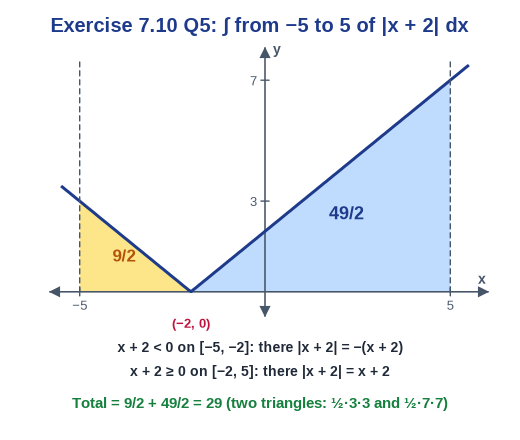
5. ∫(−5→5) |x + 2| dx −2 par todo (P2): ∫(−5→−2) −(x + 2) dx + ∫(−2→5) (x + 2) dx = 9/2 + 49/2 = 29.
6. ∫(2→8) |x − 5| dx ∫(2→5) (5 − x) dx + ∫(5→8) (x − 5) dx = 9/2 + 9/2 = 9.
7. ∫(0→1) x(1 − x)ⁿ dx P4 se, = ∫(0→1) (1 − x)xⁿ dx = 1/(n + 1) − 1/(n + 2) = 1/((n + 1)(n + 2)).
8. ∫(0→π/4) log (1 + tan x) dx
- P4 lagao: x ki jagah π/4 − x rakho. tan(π/4 − x) = (1 − tan x)/(1 + tan x), to 1 + tan(π/4 − x) = 2/(1 + tan x).
- To I = ∫(0→π/4) log(2/(1 + tan x)) dx = ∫(0→π/4) [log 2 − log(1 + tan x)] dx = (π/4) log 2 − I.
- To 2I = (π/4) log 2.
Jawab: (π/8) log 2
9. ∫(0→2) x√(2 − x) dx P4 se, = ∫(0→2) (2 − x)√x dx = [(4/3)x^(3/2) − (2/5)x^(5/2)] (0→2) = (8√2/3) − (8√2/5) = 16√2/15.
10. ∫(0→π/2) (2log sin x − log sin 2x) dx
- log sin 2x = log(2 sin x cos x) = log 2 + log sin x + log cos x.
- To 2 log sin x − log sin 2x = log sin x − log cos x − log 2.
- P4 se, ∫(0→π/2) log sin x dx = ∫(0→π/2) log cos x dx, to ye do hisse cancel ho jaate hain.
- Bachta hai −∫(0→π/2) log 2 dx = −(π/2) log 2.
Jawab: (π/2) log(1/2), jo −(π/2) log 2 ke barabar hai
11. ∫(−π/2→π/2) sin² x dx Even: 2∫(0→π/2) sin² x dx = 2(π/4) = π/2.
12. ∫(0→π) x dx/(1 + sin x)
- P4 lagao: x ki jagah π − x rakho. sin(π − x) = sin x, to I = ∫(0→π) (π − x)/(1 + sin x) dx.
- Ise pehle wale form mein jodo: 2I = π∫(0→π) dx/(1 + sin x).
- 1/(1 + sin x) = (1 − sin x)/cos² x = sec² x − sec x tan x. Iska anti derivative tan x − sec x hai, jo −cos x/(1 + sin x) ke barabar hai; is doosre form mein x = π/2 par koi dikkat nahi.
- x = π par −cos x/(1 + sin x) = 1; x = 0 par ye −1 hai. To ∫(0→π) dx/(1 + sin x) = 1 − (−1) = 2.
- To 2I = 2π.
Jawab: π
13. ∫(−π/2→π/2) sin⁷ x dx sin⁷x odd hai: 0.
14. ∫(0→2π) cos⁵ x dx
- P6 lagao, 2a = 2π: cos⁵(2π − x) = cos⁵x, to I = 2∫(0→π) cos⁵x dx.
- P6 phir se lagao, 2a = π: cos⁵(π − x) = −cos⁵x, to ∫(0→π) cos⁵x dx = 0.
Jawab: 0
15. ∫(0→π/2) (sin x − cos x)/(1 + sin x cos x) dx P4 se integrand (cos x − sin x)/(1 + cos x sin x) ban jaata hai, jo khud ka negative hai. To I = −I. Jawab: 0.
16. ∫(0→π) log (1 + cos x) dx
- P4 lagao: x ki jagah π − x rakho. cos(π − x) = −cos x, to I = ∫(0→π) log(1 − cos x) dx.
- Dono forms jodo: 2I = ∫(0→π) log[(1 + cos x)(1 − cos x)] dx = ∫(0→π) log sin² x dx = 2∫(0→π) log sin x dx.
- sin(π − x) = sin x, to P6 se ∫(0→π) log sin x dx = 2∫(0→π/2) log sin x dx = 2(−(π/2) log 2) = −π log 2 (Example 34).
- To 2I = 2(−π log 2).
Jawab: −π log 2
17. ∫(0→a) √x/(√x + √(a − x)) dx P4 se ye ∫(0→a) √(a − x)/(√(a − x) + √x) dx ke barabar hai. Jodne par 2I = a. Jawab: a/2.
18. ∫(0→4) |x − 1| dx ∫(0→1) (1 − x) dx + ∫(1→4) (x − 1) dx = 1/2 + 9/2 = 5.
19. Dikhao ki ∫(0→a) f(x)g(x) dx = 2∫(0→a) f(x) dx, agar f aur g aise define hain ki f(x) = f(a − x) aur g(x) + g(a − x) = 4
Maano I = ∫(0→a) f(x)g(x) dx. P4 se, I = ∫(0→a) f(a − x)g(a − x) dx = ∫(0→a) f(x)[4 − g(x)] dx = 4∫(0→a) f(x) dx − I. To 2I = 4∫(0→a) f(x) dx aur I = 2∫(0→a) f(x) dx.
20. ∫(−π/2→π/2) (x³ + x cos x + tan⁵ x + 1) dx ki value hai (A) 0 (B) 2 (C) π (D) 1
x³, x cos x aur tan⁵x odd hain, to ye 0 dete hain. Bacha hua ∫(−π/2→π/2) 1 dx = π hai. Jawab (C).
21. ∫(0→π/2) log((4 + 3sin x)/(4 + 3cos x)) dx ki value hai (A) 2 (B) 3/4 (C) 0 (D) −2
P4 se integrand log((4 + 3 cos x)/(4 + 3 sin x)) ban jaata hai, jo khud ka negative hai. To I = −I = 0. Jawab (C).
Miscellaneous Examples 35 se 42 (pages 281–285)
Example 35 (page 281): ∫cos 6x √(1 + sin 6x) dx. t = 1 + sin 6x, dt = 6 cos 6x dx: (1/6)(2/3)t^(3/2) = (1/9)(1 + sin 6x)^(3/2) + C.
Example 36 (page 281): ∫(x⁴ − x)^(1/4)/x⁵ dx. = ∫(1 − 1/x³)^(1/4)/x⁴ dx; t = 1 − x⁻³, dt = 3x⁻⁴ dx: (1/3)(4/5)t^(5/4) = (4/15)(1 − 1/x³)^(5/4) + C.
Example 37 (page 281): ∫x⁴/((x − 1)(x² + 1)) dx. x⁴/((x − 1)(x² + 1)) = (x + 1) + 1/((x − 1)(x² + 1)) = (x + 1) + 1/(2(x − 1)) − x/(2(x² + 1)) − 1/(2(x² + 1)). Jawab: x²/2 + x + (1/2) log|x − 1| − (1/4) log(x² + 1) − (1/2) tan⁻¹x + C. (Is example ki aakhri do lines mein book x² + 1 ki jagah x² + x + 1 chhaapti hai.)
Example 38 (page 282): ∫[log(log x) + 1/(log x)²] dx. log(log x) par 1 ko second function lekar parts lagane se x log(log x) − ∫dx/log x milta hai, aur phir se parts se ∫dx/log x = x/log x + ∫dx/(log x)². (log x)⁻² wale terms cancel ho jaate hain. Jawab: x log(log x) − x/log x + C.
Example 39 (page 283): ∫[√cot x + √tan x] dx. = ∫√tan x (1 + cot x) dx. tan x = t², dx = 2t dt/(1 + t⁴) ke saath ye 2∫(1 + 1/t²) dt/((t − 1/t)² + 2) ban jaata hai, aur y = t − 1/t se √2 tan⁻¹(y/√2) milta hai. Jawab: √2 tan⁻¹((tan x − 1)/(√2 √tan x)) + C.
Example 40 (page 283): ∫sin 2x cos 2x/√(9 − cos⁴2x) dx. t = cos² 2x, dt = −4 sin 2x cos 2x dx: −(1/4)∫dt/√(9 − t²). Jawab: −(1/4) sin⁻¹((1/3) cos² 2x) + C.
Example 41 (page 284): ∫(−1→3/2) |x sin πx| dx. [−1, 1] par x sin πx ≥ 0 aur [1, 3/2] par ≤ 0. F(x) = −x cos πx/π + sin πx/π² ke saath value [F] (−1→1) − [F] (1→3/2) = 2/π − (−1/π² − 1/π) = 3/π + 1/π² hai.
Example 42 (page 284): ∫(0→π) x dx/(a² cos² x + b² sin² x). P4 se, 2I = π∫(0→π) dx/(a² cos² x + b² sin² x) = 2π∫(0→π/2) yahi (P6). π/4 par todkar aur tan x = t aur cot x = u rakhkar π²/(2ab) milta hai.
Miscellaneous Exercise on Chapter 7 (pages 285–287)
Questions 1 se 23 ke liye book ka nirdesh: Exercises 1 se 23 ke functions ko integrate karo.
1. 1/(x − x³) = 1/(x(1 − x²)) = 1/x + x/(1 − x²). Jawab: log|x| − (1/2) log|1 − x²| = (1/2) log|x²/(1 − x²)| + C.
2. 1/(√(x + a) + √(x + b)) √(x + a) − √(x + b) se multiply karo: integrand (√(x + a) − √(x + b))/(a − b) hai. Jawab: (2/(3(a − b)))[(x + a)^(3/2) − (x + b)^(3/2)] + C.
3. 1/(x√(ax − x²)) [Hint: x = a/t rakho]
- x = a/t rakho. Tab dx = −(a/t²) dt.
- ax − x² = a²/t − a²/t² = (a²/t²)(t − 1), to √(ax − x²) = (a/t)√(t − 1).
- To x√(ax − x²) = (a/t)(a/t)√(t − 1) = (a²/t²)√(t − 1).
- Integrand times dx = −(a/t²) dt ÷ [(a²/t²)√(t − 1)] = −(1/a) dt/√(t − 1).
- ∫(t − 1)^(−1/2) dt = 2√(t − 1), to integral −(2/a)√(t − 1) hai.
- t = a/x wapas rakho. Tab t − 1 = (a − x)/x.
Jawab: −(2/a)√((a − x)/x) + C
4. 1/(x²(x⁴ + 1)^(3/4)) = 1/(x⁵(1 + x⁻⁴)^(3/4)). t = 1 + x⁻⁴, dt = −4x⁻⁵ dx: −(1/4)∫t^(−3/4) dt = −t^(1/4). Jawab: −(1 + 1/x⁴)^(1/4) + C.
5. 1/(x^(1/2) + x^(1/3)) [Hint: 1/(x^(1/2) + x^(1/3)) = 1/(x^(1/3)(1 + x^(1/6))), x = t⁶ rakho]
- x = t⁶ rakho. Tab dx = 6t⁵ dt, x^(1/2) = t³ aur x^(1/3) = t².
- Neeche wala hissa t³ + t² = t²(t + 1) hai. To integrand times dx = 6t⁵ dt/(t²(t + 1)) = 6t³/(t + 1) dt.
- Divide karo: t³/(t + 1) = t² − t + 1 − 1/(t + 1).
- Integrate karo: 6[t³/3 − t²/2 + t − log|t + 1|] = 2t³ − 3t² + 6t − 6 log|1 + t|.
- t = x^(1/6) wapas rakho, to t³ = √x aur t² = x^(1/3).
Jawab: 2√x − 3x^(1/3) + 6x^(1/6) − 6 log(1 + x^(1/6)) + C
6. 5x/((x + 1)(x² + 9)) = A/(x + 1) + (Bx + C)/(x² + 9): A = −1/2, B = 1/2, C = 9/2. Jawab: −(1/2) log|x + 1| + (1/4) log(x² + 9) + (3/2) tan⁻¹(x/3) + C.
7. sin x/sin (x − a) t = x − a: sin(t + a)/sin t = cos a + sin a cot t. Jawab: sin a log|sin(x − a)| + x cos a + C.
8. (e^(5 log x) − e^(4 log x))/(e^(3 log x) − e^(2 log x)) e^(k log x) = xᵏ, to integrand (x⁵ − x⁴)/(x³ − x²) = x² hai. Jawab: x³/3 + C.
9. cos x/√(4 − sin²x) t = sin x: ∫dt/√(2² − t²). Jawab: sin⁻¹((sin x)/2) + C.
10. (sin⁸ x − cos⁸ x)/(1 − 2sin² x cos² x) sin⁸ − cos⁸ = (sin⁴ − cos⁴)(sin⁴ + cos⁴) = (sin² x − cos² x)(sin⁴x + cos⁴x), aur 1 − 2 sin² x cos² x = sin⁴x + cos⁴x. To integrand sin² x − cos² x = −cos 2x hai. Jawab: −(1/2) sin 2x + C.
11. 1/(cos (x + a) cos (x + b)) Exercise 7.3 Q22 ki tarah, sin(a − b) = sin[(x + a) − (x + b)] ke saath: integrand (1/sin(a − b))[tan(x + a) − tan(x + b)] hai. Jawab: (1/sin(a − b)) log|cos(x + b)/cos(x + a)| + C.
12. x³/√(1 − x⁸) t = x⁴, dt = 4x³ dx: (1/4)∫dt/√(1 − t²). Jawab: (1/4) sin⁻¹(x⁴) + C.
13. eˣ/((1 + eˣ)(2 + eˣ)) t = eˣ: ∫dt/((1 + t)(2 + t)) = ∫[1/(1 + t) − 1/(2 + t)] dt. Jawab: log((1 + eˣ)/(2 + eˣ)) + C.
14. 1/((x² + 1)(x² + 4)) = (1/3)[1/(x² + 1) − 1/(x² + 4)]. Jawab: (1/3) tan⁻¹x − (1/6) tan⁻¹(x/2) + C.
15. cos³x e^(log sinx) e^(log sin x) = sin x, to integrand cos³x sin x hai. t = cos x: −(1/4) cos⁴x + C.
16. e^(3 log x) (x⁴ + 1)⁻¹ = x³/(x⁴ + 1). Jawab: (1/4) log(x⁴ + 1) + C.
17. f′(ax + b) [f(ax + b)]ⁿ t = f(ax + b), dt = a f′(ax + b) dx: (1/a)∫tⁿ dt. Jawab, n ≠ −1 ke liye: [f(ax + b)]ⁿ⁺¹/(a(n + 1)) + C.
18. 1/√(sin³x sin (x + α))
- sin(x + α) = sin x cos α + cos x sin α = sin x (cos α + cot x sin α).
- To sin³x sin(x + α) = sin⁴x (cos α + cot x sin α), aur iska square root sin² x √(cos α + cot x sin α) hai.
- t = cos α + cot x sin α rakho. Tab dt = −sin α cosec² x dx, to dx/sin² x = −dt/sin α.
- Integral −(1/sin α)∫t^(−1/2) dt = −(2/sin α)√t hai.
- Step 1 se, t = sin(x + α)/sin x.
Jawab: −(2/sin α)√(sin(x + α)/sin x) + C
19. √((1 − √x)/(1 + √x))
- x = cos² θ rakho (θ 0 aur π/2 ke beech). Tab √x = cos θ aur dx = −2 sin θ cos θ dθ.
- (1 − cos θ)/(1 + cos θ) = tan²(θ/2), to square root tan(θ/2) hai.
- tan(θ/2) · sin θ = 1 − cos θ (kyunki sin θ = 2 sin(θ/2) cos(θ/2) aur 1 − cos θ = 2 sin²(θ/2)).
- To integral ∫tan(θ/2)(−2 sin θ cos θ) dθ = −2∫cos θ(1 − cos θ) dθ = −2∫cos θ dθ + ∫(1 + cos 2θ) dθ = −2 sin θ + θ + sin θ cos θ hai.
- Wapas rakho: cos θ = √x, sin θ = √(1 − x), θ = cos⁻¹√x aur sin θ cos θ = √(x − x²).
Jawab: −2√(1 − x) + cos⁻¹√x + √(x − x²) + C
20. (2 + sin 2x) eˣ/(1 + cos 2x) (2 + 2 sin x cos x)/(2 cos² x) = sec² x + tan x, aur sec² x, tan x ka derivative hai. Jawab: eˣ tan x + C.
21. (x² + x + 1)/((x + 1)² (x + 2)) = A/(x + 1) + B/(x + 1)² + C/(x + 2): B = 1, C = 3, A = −2. Jawab: −2 log|x + 1| − 1/(x + 1) + 3 log|x + 2| + C.
22. tan⁻¹ √((1 − x)/(1 + x))
- x = cos θ rakho (θ 0 aur π ke beech). Tab (1 − x)/(1 + x) = (1 − cos θ)/(1 + cos θ) = tan²(θ/2), to square root tan(θ/2) hai.
- θ/2 0 aur π/2 ke beech hai, to tan⁻¹(tan(θ/2)) = θ/2 = (1/2) cos⁻¹x.
- By parts, ∫cos⁻¹x dx = x cos⁻¹x − √(1 − x²).
Jawab: (1/2)[x cos⁻¹x − √(1 − x²)] + C
23. √(x² + 1) [log (x² + 1) − 2 log x]/x⁴
- log(x² + 1) − 2 log x = log((x² + 1)/x²) = log(1 + 1/x²).
- √(x² + 1)/x⁴ = x√(1 + 1/x²)/x⁴ = √(1 + 1/x²)/x³ (x > 0 ke liye).
- t = 1 + 1/x² rakho. Tab dt = −2 dx/x³, to dx/x³ = −dt/2. Integral −(1/2)∫√t log t dt ban jaata hai.
- By parts, log t first aur √t second: ∫√t log t dt = (2/3)t^(3/2) log t − ∫(1/t)(2/3)t^(3/2) dt = (2/3)t^(3/2) log t − (4/9)t^(3/2).
- −1/2 se multiply karo: −(1/3)t^(3/2) log t + (2/9)t^(3/2) = −(1/3)t^(3/2)[log t − 2/3].
Jawab: −(1/3)(1 + 1/x²)^(3/2)[log(1 + 1/x²) − 2/3] + C
Questions 24 se 31 ke liye book ka nirdesh: Exercises 24 se 31 ke definite integrals ki value nikaalo.
24. ∫(π/2→π) eˣ ((1 − sin x)/(1 − cos x)) dx
- 1 − cos x = 2 sin²(x/2) aur sin x = 2 sin(x/2) cos(x/2). To (1 − sin x)/(1 − cos x) = 1/(2 sin²(x/2)) − cot(x/2) = (1/2) cosec²(x/2) − cot(x/2).
- f(x) = −cot(x/2) lo. Tab f′(x) = (1/2) cosec²(x/2), to integrand eˣ[f(x) + f′(x)] hai.
- To anti derivative eˣ f(x) = −eˣ cot(x/2) hai.
- x = π par cot(π/2) = 0, to ye 0 hai. x = π/2 par cot(π/4) = 1, to ye −e^(π/2) hai.
- Value = 0 − (−e^(π/2)) = e^(π/2).
Jawab: e^(π/2)
25. ∫(0→π/4) sin x cos x/(cos⁴ x + sin⁴ x) dx Upar aur neeche ko cos⁴x se divide karo: tan x sec² x/(1 + tan⁴x). t = tan² x, 0 se 1 tak chalta hai, dt = 2 tan x sec² x dx: (1/2)∫(0→1) dt/(1 + t²) = π/8.
26. ∫(0→π/2) cos² x dx/(cos² x + 4 sin² x)
- Upar aur neeche ko cos² x se divide karo. Integrand 1/(1 + 4 tan² x) ban jaata hai.
- t = tan x rakho. Tab dt = sec² x dx = (1 + t²) dx, to dx = dt/(1 + t²). Jab x 0 se π/2 tak jaata hai, t 0 se ∞ tak jaata hai.
- Integral ∫(0→∞) dt/((1 + t²)(1 + 4t²)) ban jaata hai.
- Partial fractions: 1/((1 + t²)(1 + 4t²)) = (1/3)[4/(1 + 4t²) − 1/(1 + t²)].
- ∫(0→∞) 4/(1 + 4t²) dt = [2 tan⁻¹2t] (0→∞) = π, aur ∫(0→∞) dt/(1 + t²) = π/2.
- Value = (1/3)(π − π/2) = π/6.
Jawab: π/6
27. ∫(π/6→π/3) (sin x + cos x)/√(sin 2x) dx
- (sin x − cos x)² = 1 − sin 2x, to sin 2x = 1 − (sin x − cos x)².
- t = sin x − cos x rakho. Tab dt = (cos x + sin x) dx. x = π/6 par t = (1 − √3)/2; x = π/3 par t = (√3 − 1)/2.
- Integral ∫dt/√(1 − t²) = sin⁻¹((√3 − 1)/2) − sin⁻¹((1 − √3)/2) hai.
- sin⁻¹(−u) = −sin⁻¹u, to ye 2 sin⁻¹((√3 − 1)/2) hai.
Jawab: 2 sin⁻¹((√3 − 1)/2)
28. ∫(0→1) dx/(√(1 + x) − √x) √(1 + x) + √x se multiply karo; neeche wala hissa 1 ban jaata hai. [(2/3)(1 + x)^(3/2) + (2/3)x^(3/2)] (0→1) = (2/3)(2√2 + 1 − 1) = 4√2/3.
29. ∫(0→π/4) (sin x + cos x)/(9 + 16 sin 2x) dx
- Q27 ki tarah, sin 2x = 1 − (sin x − cos x)². t = sin x − cos x, dt = (cos x + sin x) dx rakho. t −1 (x = 0 par) se 0 (x = π/4 par) tak jaata hai.
- Neeche wala hissa 9 + 16(1 − t²) = 25 − 16t² = 16[(5/4)² − t²] hai.
- To integral (1/16)∫(−1→0) dt/((5/4)² − t²) hai. ∫dt/(a² − t²) = (1/(2a)) log|(a + t)/(a − t)| lagao, a = 5/4, to 1/(2a) = 2/5.
- Value = (1/16)(2/5)[log|(5/4 + t)/(5/4 − t)|] (−1→0) = (1/40)[log 1 − log((1/4)/(9/4))] = (1/40)[0 − log(1/9)] = (1/40) log 9.
Jawab: (1/40) log 9
30. ∫(0→π/2) sin 2x tan⁻¹ (sin x) dx
- t = sin x rakho (t 0 se 1 tak). Tab sin 2x dx = 2 sin x cos x dx = 2t dt.
- Integral ∫(0→1) 2t tan⁻¹t dt ban jaata hai.
- By parts, tan⁻¹t first aur 2t second: [t² tan⁻¹t] (0→1) − ∫(0→1) t²/(1 + t²) dt.
- [t² tan⁻¹t] (0→1) = π/4. Aur t²/(1 + t²) = 1 − 1/(1 + t²), to 0 se 1 tak iska integral 1 − π/4 hai.
- Value = π/4 − (1 − π/4) = π/2 − 1.
Jawab: π/2 − 1
31. ∫(1→4) [|x − 1| + |x − 2| + |x − 3|] dx ∫(1→4)|x − 1| dx = 9/2; ∫(1→4)|x − 2| dx = 1/2 + 2 = 5/2; ∫(1→4)|x − 3| dx = 2 + 1/2 = 5/2. Kul: 19/2.
Questions 32 se 37 ke liye book ka nirdesh: Neeche diye results siddh karo (Exercises 32 se 37)
32. ∫(1→3) dx/(x²(x + 1)) = 2/3 + log (2/3) 1/(x²(x + 1)) = −1/x + 1/x² + 1/(x + 1). To integral [−log x − 1/x + log(x + 1)] (1→3) = (−log 3 − 1/3 + log 4) − (−1 + log 2) = 2/3 + log(4/6) = 2/3 + log(2/3) hai. Siddh hua.
33. ∫(0→1) x eˣ dx = 1 [x eˣ − eˣ] (0→1) = 0 − (−1) = 1. Siddh hua.
34. ∫(−1→1) x¹⁷ cos⁴ x dx = 0 x¹⁷ cos⁴x odd hai, to P7 se value 0 hai. Siddh hua.
35. ∫(0→π/2) sin³ x dx = 2/3 sin³x = (1 − cos² x) sin x; t = cos x, 1 se 0 tak chalta hai: ∫(0→1)(1 − t²) dt = 2/3. Siddh hua.
36. ∫(0→π/4) 2 tan³ x dx = 1 − log 2 tan³x = tan x sec² x − tan x, to ∫2 tan³x dx = tan² x − 2 log|sec x|. 0 se π/4 tak: 1 − 2 log √2 = 1 − log 2. Siddh hua.
37. ∫(0→1) sin⁻¹ x dx = π/2 − 1 [x sin⁻¹x + √(1 − x²)] (0→1) = (π/2 + 0) − (0 + 1) = π/2 − 1. Siddh hua.
38. ∫dx/(eˣ + e⁻ˣ) barabar hai (A) tan⁻¹ (eˣ) + C (B) tan⁻¹ (e⁻ˣ) + C (C) log (eˣ − e⁻ˣ) + C (D) log (eˣ + e⁻ˣ) + C
= ∫eˣ dx/(e²ˣ + 1); t = eˣ se ∫dt/(t² + 1) = tan⁻¹(eˣ) + C. Jawab (A).
39. ∫cos 2x/(sin x + cos x)² dx barabar hai (A) −1/(sin x + cos x) + C (B) log|sin x + cos x| + C (C) log|sin x − cos x| + C (D) 1/(sin x + cos x)² + C
cos 2x/(sin x + cos x)² = (cos x − sin x)/(cos x + sin x), jiska integral log|sin x + cos x| + C hai. Jawab (B).
40. Agar f(a + b − x) = f(x), to ∫(a→b) x f(x) dx barabar hai (A) ((a + b)/2) ∫(a→b) f(b − x) dx (B) ((a + b)/2) ∫(a→b) f(b + x) dx (C) ((b − a)/2) ∫(a→b) f(x) dx (D) ((a + b)/2) ∫(a→b) f(x) dx
Maano I = ∫(a→b) x f(x) dx. P3 se, I = ∫(a→b) (a + b − x) f(a + b − x) dx = ∫(a→b) (a + b − x) f(x) dx = (a + b)∫(a→b) f(x) dx − I. To I = ((a + b)/2)∫(a→b) f(x) dx. Jawab (D).
Book ke baare mein notes
- Exercise 7.6 Q11. Answer key −√(1 − x²) cos⁻¹x + x + C deti hai. Sahi anti derivative −√(1 − x²) cos⁻¹x − x + C hai; key wale ko differentiate karne par integrand plus 2 aata hai.
- Exercise 7.9 Q9. Key option (D), 4, deti hai. Integral 6 aata hai, option (A), aur numerical evaluation 6.000 deta hai.
- Example 37. Aakhri do lines mein book denominator ko (x − 1)(x² + x + 1) likhti hai; ye (x − 1)(x² + 1) hona chahiye, jaisa example ke shuru mein hai.
- Example 16 “Table 2.2(5)” ka hawala deta hai; matlab Table 7.2, row 5 hai.
- Barabar forms: kai jagah key ka jawab yahan ke jawab se ek constant se alag hai (Exercise 7.2 Q24, Exercise 7.4 Q3 jo log ke andar reciprocal ke saath likha hai). Dono forms sahi hain; kisi ko bhi differentiate karo, integrand aata hai.
- Exercise 7.3 Q21 aur Exercise 7.6 Q22 sin⁻¹(cos x) = π/2 − x aur sin⁻¹(2x/(1 + x²)) = 2 tan⁻¹x use karte hain, jo kramashah sirf 0 ≤ x ≤ π aur |x| ≤ 1 par sahi hain; jawab inhi ranges ke liye diye gaye hain.
Practice karo
-
∫(3x² + 4) dx barabar hai:
Jawab dekho
Jawab: (b) x³ + 4x + C
-
∫cos x/(1 + sin x) dx barabar hai:
Jawab dekho
Jawab: (a) log|1 + sin x| + C
-
0 se π/2 tak ∫ sin x dx barabar hai:
Jawab dekho
Jawab: (b) 1
-
∫x log x dx nikaalo.
Jawab dekho
Jawab: By parts, log x ko first function aur x ko second function lekar: ∫x log x dx = (x²/2) log x − ∫(1/x)(x²/2) dx = (x²/2) log x − x²/4 + C.
-
−2 se 2 tak ∫(x³ + 3x² + x) dx ki value nikaalo.
Jawab dekho
Jawab: x³ aur x odd hain, to unke hisse 0 dete hain (P7). 3x² even hai: 2 × (0 se 2 tak ∫3x² dx) = 2[x³] (0 se 2) = 16. Value 16 hai.
Koi sawal atak gaya?
Photo lo, Lagnever AI step-by-step samjhayega. 7 din ka trial sirf ₹2.
Google Play se app lo Browser mein kholo
Parents ke liye: trial ke baad plan har mahine UPI ya card autopay se renew hota hai. App mein kabhi bhi cancel kar sakte hain.