
Class 12 Maths Chapter 7: Integrals Notes Hinglish mein
Ye chapter 5 lines mein
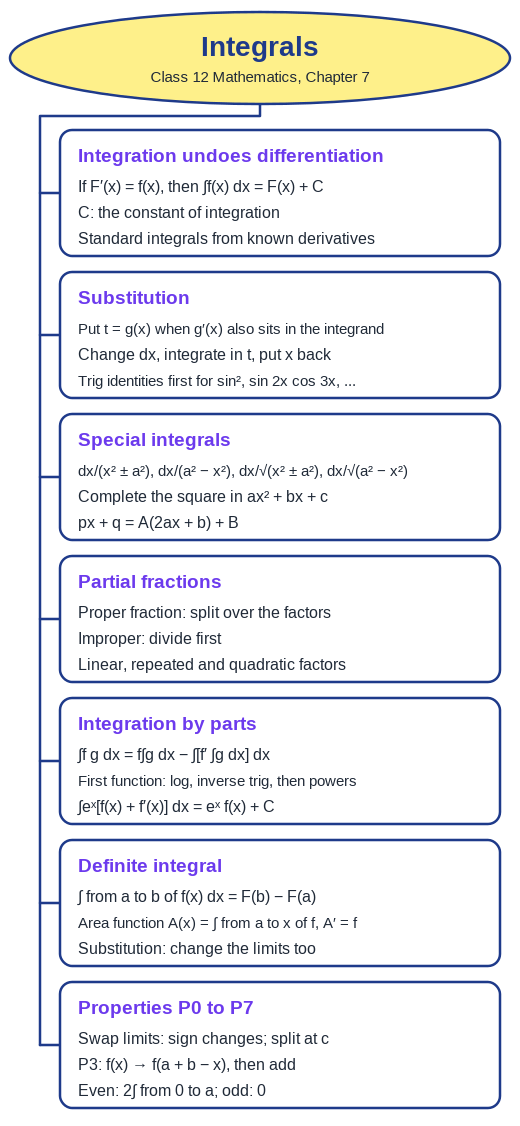
Integration differentiation ka ulta hai: agar F′(x) = f(x), to ∫f(x) dx = F(x) + C. Naye integrals ko substitution, trigonometric identities, partial fractions ya integration by parts se standard table tak laate hain. a se b tak ka definite integral F(b) − F(a) hai, aur P3, P7 jaisi properties kaam chhota karti hain.
Ye chapter kis baare mein hai?
Chapter 5 aur 6 mein derivatives nikaale aur use kiye. Ye chapter process ko ulta chalata hai. Kisi function ka derivative diya ho, to kya function nikaal sakte hain? Agar kisi cheez ki velocity har pal pata ho, to kya uski position nikaal sakte hain? Ye ulta kadam integration hai, aur iska doosra kaam, curve ke neeche ka area nikaalna, definite integral deta hai. Fundamental theorem of calculus dono ko jodta hai. Ye chapter Mathematics Part II ki shuruaat hai aur 67 pages (225–291) ke saath us book ka sabse lamba chapter hai.
Integration, differentiation ka ulta
Kyunki d/dx (sin x) = cos x, hum kehte hain sin x, cos x ka ek anti derivative (ya integral) hai. sin x + 5 ya sin x − 2 bhi hai, kyunki constant ka derivative 0 hota hai. Poori family aise likhte hain:
∫cos x dx = sin x + C
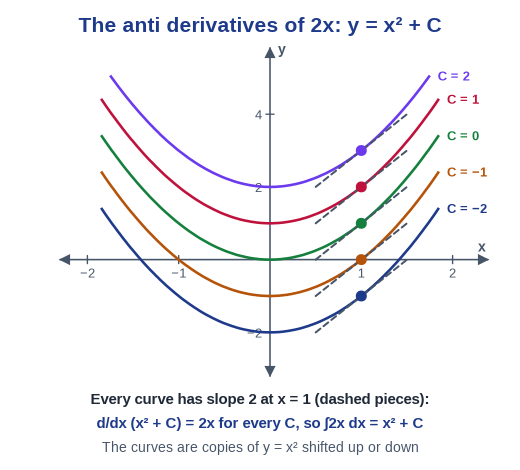
jahan C, constant of integration, koi bhi real number ho sakta hai. Ek interval par same derivative wale do functions sirf ek constant se alag hote hain, isliye family F + C mein saare anti derivatives aa jaate hain. Graph mein curves y = F(x) + C ek hi curve ki copies hain jo upar ya neeche khiski hain, aur kisi bhi x par sabka slope same hai.
Har derivative formula se ek integral formula milta hai. Main formulas: n ≠ −1 ke liye ∫xⁿ dx = xⁿ⁺¹/(n + 1) + C, ∫cos x dx = sin x + C, ∫sin x dx = −cos x + C, ∫sec² x dx = tan x + C, ∫cosec² x dx = −cot x + C, ∫sec x tan x dx = sec x + C, ∫cosec x cot x dx = −cosec x + C, ∫dx/√(1 − x²) = sin⁻¹x + C, ∫dx/(1 + x²) = tan⁻¹x + C, ∫eˣ dx = eˣ + C, ∫(1/x) dx = log|x| + C aur ∫aˣ dx = aˣ/log a + C.
Do rules se table jod par lagti hai: ∫[f(x) ± g(x)] dx = ∫f dx ± ∫g dx, aur constant k ke liye ∫k f(x) dx = k∫f(x) dx. Jaise ∫(3x² + 2eˣ − 1/x) dx = x³ + 2eˣ − log|x| + C. Sahi derivative wala function andaaze se dhoondh kar integral nikaalna method of inspection kehlata hai.
Integration ke methods
Zyadatar integrands table mein nahi hote. Teen methods unhe wahan laate hain.
- Substitution. Jab g′(x) bhi ho, t = g(x) rakho: ∫2x sin(x² + 1) dx ban jaata hai ∫sin t dt = −cos(x² + 1) + C. Isi se ∫tan x dx = log|sec x| + C aur cot x, sec x, cosec x ke formulas bhi siddh hote hain. cos² x = (1 + cos 2x)/2 jaisi trigonometric identities sines aur cosines ki powers aur products ko pehle jod mein badalti hain.
- Partial fractions. Proper rational function aasaan fractions mein tootta hai: 1/((x + 1)(x + 2)) = 1/(x + 1) − 1/(x + 2), to uska integral log|(x + 1)/(x + 2)| + C hai.
- Integration by parts. Product ke liye ∫f g dx = f∫g dx − ∫[f′∫g dx] dx. To ∫x cos x dx = x sin x + cos x + C.
Kaise chunein, worked examples ke saath: integration ke methods.
Kuch particular functions ke integrals
Chhe results quadratics sambhaalte hain: ∫dx/(x² − a²) = (1/2a) log|(x − a)/(x + a)| + C, ∫dx/(a² − x²) = (1/2a) log|(a + x)/(a − x)| + C, ∫dx/(x² + a²) = (1/a) tan⁻¹(x/a) + C, ∫dx/√(x² − a²) = log|x + √(x² − a²)| + C, ∫dx/√(a² − x²) = sin⁻¹(x/a) + C aur ∫dx/√(x² + a²) = log|x + √(x² + a²)| + C. General ax² + bx + c ke liye pehle square complete karo. By parts se teen aur milte hain: ∫√(a² − x²) dx aur uske do saathi. Poori list examples ke saath: special integrals ke formulas.
Definite integrals aur fundamental theorem
Definite integral ∫ a se b tak f(x) dx ek number hai. f > 0 ho to ye y = f(x), x-axis aur lines x = a, x = b ke beech ka area hai. Area function A(x) = ∫ a se x tak f(t) dt chalte point x tak ka area naapta hai.
- Pehla fundamental theorem: agar f, [a, b] par continuous hai, to A′(x) = f(x).
- Doosra fundamental theorem: agar F, f ka koi bhi anti derivative hai, to ∫ a se b tak f(x) dx = F(b) − F(a).
To ∫ 2 se 3 tak x² dx = 27/3 − 8/3 = 19/3. Substitution mein variable ke saath limits bhi badlo: ∫ 0 se 1 tak tan⁻¹x/(1 + x²) dx mein t = tan⁻¹x, 0 se π/4 tak chalta hai, aur jawab π²/32 aata hai.
Definite integrals ki properties
Book aath properties deti hai, P0 se P7. Sabse zyada kaam aane wali: limits badalne se sign badalta hai (P1); integral ko kisi bhi point c par tod sakte hain (P2), jisse |x| aur doosre piecewise functions sambhalte hain; ∫ a se b tak f(x) dx = ∫ a se b tak f(a + b − x) dx (P3, aur P4 iska a = 0 wala case); aur [−a, a] par even function 0 se a tak ke integral ka do guna deta hai jabki odd function 0 deta hai (P7). Jaise ∫ 0 se π/2 tak sin⁴x/(sin⁴x + cos⁴x) dx = π/4, kyunki integral ko uski P4 form se jodne par ∫ 0 se π/2 tak 1 dx = π/2 milta hai. Saari aath, proofs aur examples ke saath: definite integrals ki properties.
Aage badhne se pehle
Ye rationalised book hai (Reprint 2026-27 likhi hui). Isme Exercise 7.1 (22 sawal), 7.2 (39), 7.3 (24), 7.4 (25), 7.5 (23), 7.6 (24), 7.7 (11), 7.8 (22), 7.9 (10), 7.10 (21) aur 40 sawalon ki Miscellaneous Exercise hai, saath mein 42 worked examples. Is book mein log ka matlab hamesha natural logarithm hai, base e. Har example aur exercise ka sawal Chapter 7 ke NCERT solutions mein hal kiya gaya hai. Agla chapter, Application of Integrals, definite integrals se area nikaalta hai.
Key terms (zaroori shabd)
| Term | Matlab |
|---|---|
| Anti derivative (primitive) | Aisa function F jiske liye interval par F′(x) = f(x). Agar F ek hai, to har constant C ke liye F + C bhi hai. |
| Indefinite integral | ∫f(x) dx = F(x) + C, f ke saare anti derivatives ki family. f(x) integrand hai aur x variable of integration. |
| Constant of integration | Koi bhi real number C. Ek hi function ke do anti derivatives sirf ek constant se alag hote hain. |
| Integration by substitution | Variable badalna, aksar t = g(x) aur dt = g′(x) dx, taaki integral standard ban jaaye. |
| Partial fractions | Proper rational function ko aasaan fractions ke jod mein likhna (Table 7.2), jo log aur tan⁻¹ terms mein integrate hote hain. |
| Integration by parts | ∫f(x) g(x) dx = f(x)∫g(x) dx − ∫[f′(x)∫g(x) dx] dx, do functions ke product ke liye; f first function hai. |
| Definite integral | ∫ a se b tak f(x) dx, ek number. a lower limit hai aur b upper limit. |
| Area function | A(x) = ∫ a se x tak f(t) dt, y = f ke neeche a se x tak ka area (f > 0 ho to). |
| Fundamental theorem of calculus | Pehla: A′(x) = f(x). Doosra: continuous f ke kisi bhi anti derivative F ke liye ∫ a se b tak f(x) dx = F(b) − F(a). |
| Even aur odd functions | f even hai agar f(−x) = f(x), odd agar f(−x) = −f(x). [−a, a] par even f se 2∫ 0 se a tak f milta hai, odd f se 0. |
Is chapter ke topics
Practice karo
-
x ≠ 0 ke liye ∫(1/x) dx barabar hai:
Jawab dekho
Jawab: (b) log|x| + C
-
∫2x cos(x²) dx barabar hai:
Jawab dekho
Jawab: (a) sin(x²) + C
-
∫x eˣ dx barabar hai:
Jawab dekho
Jawab: (c) (x − 1)eˣ + C
-
∫ 0 se 1 tak 3x² dx barabar hai:
Jawab dekho
Jawab: (b) 1
-
∫ −2 se 2 tak x³ cos x dx barabar hai:
Jawab dekho
Jawab: (a) 0
Students ke sawal
Class 12 Maths Chapter 7 ke main topics kya hain?
Integration differentiation ke ulte process ke roop mein aur standard integrals, integration ke methods (substitution, trigonometric identities, partial fractions, by parts), kuch particular functions ke integrals, definite integral aur fundamental theorem of calculus, substitution se evaluation, aur properties P0 se P7. Isme Exercise 7.1 se 7.10 aur ek Miscellaneous Exercise hai.
Kya limit of a sum wala definite integral 2026-27 ki book mein hai?
Nahi. Section 7.7 ab sirf definite integral ki definition deta hai aur kehta hai ki uski value F(b) − F(a) hai. Limit of a sum wala lamba section aur uski exercise rationalised book mein nahi hain, isliye ye notes use nahi padhate.
Indefinite integral mein C kyon jodte hain, definite mein kyon nahi?
F mein koi bhi constant jodne se uska derivative nahi badalta, isliye indefinite integral poori family F + C hai. Definite integral mein C kat jaata hai: [F(b) + C] − [F(a) + C] = F(b) − F(a).
Mera jawab book se alag dikhta hai. Kya galat hai?
Hamesha nahi. Do sahi jawab ek constant se alag ho sakte hain, jaise ∫sin x cos x dx ke liye −(1/2)cos²x aur (1/2)sin²x. Apna jawab differentiate karo: integrand wapas mile to jawab sahi hai.
Koi sawal atak gaya?
Photo lo, Lagnever AI step-by-step samjhayega. 7 din ka trial sirf ₹2.
Google Play se app lo Browser mein kholo
Parents ke liye: trial ke baad plan har mahine UPI ya card autopay se renew hota hai. App mein kabhi bhi cancel kar sakte hain.