
Substitution, partial fractions aur by parts se integrate kaise karein?
Short mein jawab
Jab andar wale function ka derivative bhi integrand mein ho, substitution lagao: t = g(x) rakho. Proper rational function ko partial fractions mein todo. x eˣ ya log x jaise product ke liye by parts lagao: ∫f g dx = f∫g dx − ∫[f′∫g dx] dx. Har jawab differentiate karke check karo.
Koi sawal atak gaya? Photo lo, Lagnever AI step-by-step samjhayega. 7 din ka trial sirf ₹2. Google Play se app lo
Methods ki zaroorat kyon?
Standard integrals ki table sirf sabse aasaan functions sambhalti hai. Baaki ke liye hum integral ko aisa banane ki koshish karte hain jo table mein ho. Book teen methods deti hai: substitution, partial fractions aur integration by parts. Raaste mein trigonometric identities madad karti hain.
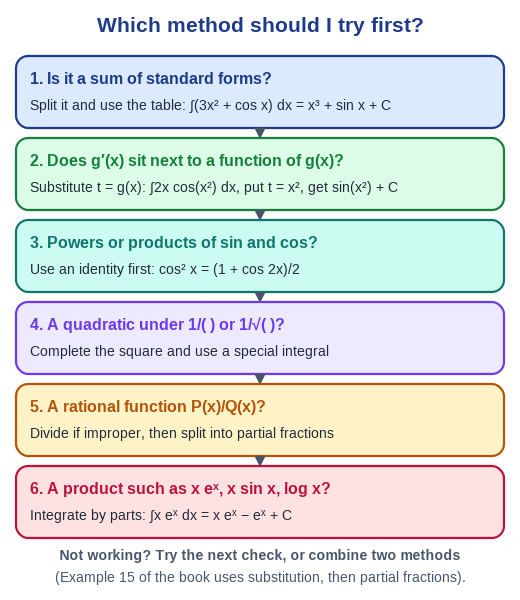
Substitution se integration
Agar x = g(t), to dx = g′(t) dt aur ∫f(x) dx = ∫f(g(t)) g′(t) dt. Practice mein aksar ulta chalte hain: jab integrand mein koi g(x) aur uska derivative g′(x) ho, t = g(x) aur dt = g′(x) dx rakho.
- ∫2x sin(x² + 1) dx: t = x² + 1 rakho, to dt = 2x dx. Integral ∫sin t dt = −cos t + C = −cos(x² + 1) + C hai.
- ∫sin(tan⁻¹x)/(1 + x²) dx: t = tan⁻¹x, dt = dx/(1 + x²). Jawab −cos(tan⁻¹x) + C hai.
- ∫tan x dx = ∫sin x/cos x dx: t = cos x, dt = −sin x dx rakho, to −log|cos x| + C = log|sec x| + C.
Isi tarah ∫cot x dx = log|sin x| + C, ∫sec x dx = log|sec x + tan x| + C (upar neeche sec x + tan x se multiply karo) aur ∫cosec x dx = log|cosec x − cot x| + C milte hain.
Ek kaam ka special case: jab upar neeche wale ka derivative ho, ∫f′(x)/f(x) dx = log|f(x)| + C.
Trigonometric identities ka use
Sines aur cosines ki powers aur products ko pehle jod mein likhte hain.
- cos² x = (1 + cos 2x)/2, to ∫cos² x dx = x/2 + (1/4) sin 2x + C.
- sin 2x cos 3x = (1/2)[sin 5x − sin x], to iska integral −(1/10) cos 5x + (1/2) cos x + C hai.
- sin³x = (3 sin x − sin 3x)/4, to ∫sin³x dx = −(3/4) cos x + (1/12) cos 3x + C. sin³x = (1 − cos² x) sin x likhkar t = cos x rakhne se −cos x + (1/3)cos³x + C milta hai; dono jawab sirf ek constant se alag hain.
Partial fractions se integration
Rational function P(x)/Q(x) proper hai agar P ki degree Q ki degree se kam ho. Improper ho to pehle divide karke polynomial plus proper fraction banao. Phir proper fraction ko Q ke factors ke hisaab se todo (book ki Table 7.2):
- Do alag linear factors: (px + q)/((x − a)(x − b)) = A/(x − a) + B/(x − b).
- Repeated factor: (px + q)/(x − a)² = A/(x − a) + B/(x − a)².
- Teen linear factors, ya ek repeated aur ek aur: har factor ki har power ka ek term.
- Aisa quadratic jo factor na ho: A/(x − a) + (Bx + C)/(x² + bx + c).
Example: 1/((x + 1)(x + 2)) = A/(x + 1) + B/(x + 2) se 1 = A(x + 2) + B(x + 1). x = −1 rakhne se A = 1, aur x = −2 se B = −1. To integral log|x + 1| − log|x + 2| + C = log|(x + 1)/(x + 2)| + C hai.
Substitution aur partial fractions aksar saath chalte hain. t = sin φ ke saath integrand (3 sin φ − 2) cos φ/(5 − cos² φ − 4 sin φ) ban jaata hai (3t − 2)/(t − 2)², jo 3/(t − 2) + 4/(t − 2)² mein tootta hai.
Integration by parts
Product rule (uv)′ = uv′ + vu′ ko integrate karne par do functions ke product ka rule milta hai:
∫f(x) g(x) dx = f(x)∫g(x) dx − ∫[f′(x)∫g(x) dx] dx
Shabdon mein: first function × second ka integral, minus (first ka derivative × second ka integral) ka integral. Choice zaroori hai. ∫x cos x dx ke liye f = x lo: jawab x sin x − ∫sin x dx = x sin x + cos x + C. cos x ko pehle lene se x² wala integral aata hai, jo mushkil hai.
- ∫log x dx: log x first function aur 1 second. Jawab x log x − x + C.
- ∫x eˣ dx = x eˣ − eˣ + C.
- ∫eˣ sin x dx: rule do baar lagao to original integral wapas aata hai. Solve karne par I = (eˣ/2)(sin x − cos x) + C.
Parts se ek special pattern nikalta hai: ∫eˣ[f(x) + f′(x)] dx = eˣ f(x) + C. Jaise ∫eˣ(tan⁻¹x + 1/(1 + x²)) dx = eˣ tan⁻¹x + C, kyunki 1/(1 + x²), tan⁻¹x ka derivative hai.
Differentiate karke check karo
Is chapter ka har jawab check ho sakta hai: use differentiate karo, integrand wapas milna chahiye. NCERT exercises par practice karo, aur standard integrals ke liye chapter ke notes dekho.
Practice karo
-
∫sin x cos x dx substitution se nikaalne ke liye accha choice hai:
Jawab dekho
Jawab: (b) t = sin x
-
Partial fractions mein 1/((x − 1)(x + 1)) barabar hai:
Jawab dekho
Jawab: (b) (1/2)[1/(x − 1) − 1/(x + 1)]
-
∫x sin x dx nikaalo.
Jawab dekho
Jawab: By parts, x first function aur sin x second: ∫x sin x dx = x(−cos x) − ∫1·(−cos x) dx = −x cos x + sin x + C. Check: d/dx(−x cos x + sin x) = −cos x + x sin x + cos x = x sin x.
-
∫(2x + 3)/(x² + 3x + 2) dx nikaalo.
Jawab dekho
Jawab: Upar neeche wale ka derivative hai. t = x² + 3x + 2 rakho, to dt = (2x + 3) dx aur integral ∫dt/t = log|t| + C = log|x² + 3x + 2| + C.
Students ke sawal
Kaunsa substitution karna hai, kaise pata chale?
Aisa function dhoondho jiska derivative bhi maujood ho. ∫tan⁻¹x/(1 + x²) dx mein 1/(1 + x²), tan⁻¹x ka derivative hai, to t = tan⁻¹x rakho. ∫cos x/(1 + sin x) dx mein t = 1 + sin x rakho.
Integration by parts mein first function chunne ka kram kya hai?
Book ka rule: x ki power ya polynomial ko first function lo, siwaay jab doosra function logarithmic ya inverse trigonometric ho; tab use pehle lo. Kai students ise logarithm, inverse trig, algebraic, trig, exponential ke kram se yaad rakhte hain (Extra: ye yaad rakhne ka tareeka book mein nahi hai).
Kya har product par integration by parts lagta hai?
Nahi. Second function integrate hona chahiye aur naya integral aasaan hona chahiye. Book ka example: ∫√x sin x dx par ye kaam nahi karta.
Second function integrate karte waqt constant kyon nahi jodte?
Wo kat jaata hai. Agar ∫cos x dx = sin x + k likho, to ∫x cos x dx = x(sin x + k) − ∫(sin x + k) dx = x sin x + cos x + C, wahi jawab.
Koi sawal atak gaya?
Photo lo, Lagnever AI step-by-step samjhayega. 7 din ka trial sirf ₹2.
Google Play se app lo Browser mein kholo
Parents ke liye: trial ke baad plan har mahine UPI ya card autopay se renew hota hai. App mein kabhi bhi cancel kar sakte hain.