
How do you integrate by substitution, partial fractions and by parts?
Answer in short
Use substitution when the derivative of an inner function also sits in the integrand: put t = g(x). Split a proper rational function into partial fractions. For a product such as x eˣ or log x, integrate by parts: ∫f g dx = f∫g dx − ∫[f′∫g dx] dx. Check every answer by differentiating it.
Stuck on a question? Take a photo and Lagnever AI explains it step by step. Try it for 7 days for ₹2. Get it on Google Play
Why do we need methods?
The table of standard integrals covers only the simplest functions. For anything else we try to change the integral into one that is in the table. The book gives three methods: substitution, partial fractions and integration by parts. Trigonometric identities help along the way.
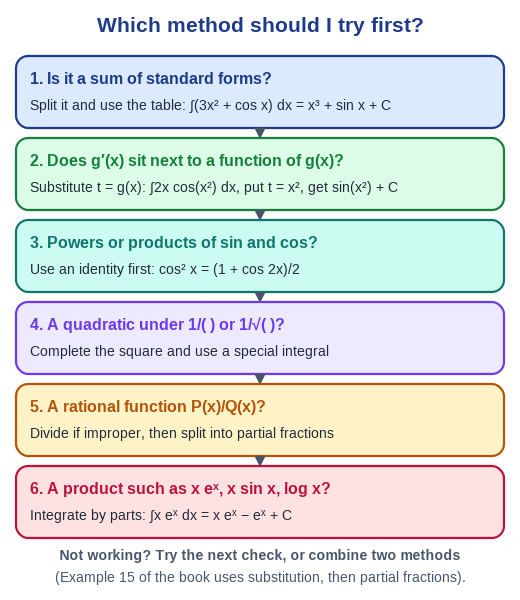
Integration by substitution
If x = g(t), then dx = g′(t) dt and ∫f(x) dx = ∫f(g(t)) g′(t) dt. In practice we usually go the other way: when the integrand has some function g(x) and its derivative g′(x), put t = g(x) and dt = g′(x) dx.
- ∫2x sin(x² + 1) dx: put t = x² + 1, so dt = 2x dx. The integral is ∫sin t dt = −cos t + C = −cos(x² + 1) + C.
- ∫sin(tan⁻¹x)/(1 + x²) dx: put t = tan⁻¹x, dt = dx/(1 + x²). The answer is −cos(tan⁻¹x) + C.
- ∫tan x dx = ∫sin x/cos x dx: put t = cos x, dt = −sin x dx, giving −log|cos x| + C = log|sec x| + C.
The same idea gives ∫cot x dx = log|sin x| + C, ∫sec x dx = log|sec x + tan x| + C (multiply top and bottom by sec x + tan x) and ∫cosec x dx = log|cosec x − cot x| + C.
A useful special case: when the top is the derivative of the bottom, ∫f′(x)/f(x) dx = log|f(x)| + C.
Using trigonometric identities
Powers and products of sines and cosines are first rewritten as sums.
- cos² x = (1 + cos 2x)/2, so ∫cos² x dx = x/2 + (1/4) sin 2x + C.
- sin 2x cos 3x = (1/2)[sin 5x − sin x], so its integral is −(1/10) cos 5x + (1/2) cos x + C.
- sin³x = (3 sin x − sin 3x)/4, so ∫sin³x dx = −(3/4) cos x + (1/12) cos 3x + C. Writing sin³x = (1 − cos² x) sin x and putting t = cos x gives −cos x + (1/3)cos³x + C instead; the two answers differ only by a constant.
Integration by partial fractions
A rational function P(x)/Q(x) is proper if the degree of P is less than the degree of Q. If it is improper, divide first to get a polynomial plus a proper fraction. A proper fraction is then split according to the factors of Q (Table 7.2 of the book):
- Two different linear factors: (px + q)/((x − a)(x − b)) = A/(x − a) + B/(x − b).
- A repeated factor: (px + q)/(x − a)² = A/(x − a) + B/(x − a)².
- Three linear factors, or one repeated with another: one term for each power of each factor.
- A quadratic that will not factorise: A/(x − a) + (Bx + C)/(x² + bx + c).
Example: 1/((x + 1)(x + 2)) = A/(x + 1) + B/(x + 2) gives 1 = A(x + 2) + B(x + 1). Putting x = −1 gives A = 1, and x = −2 gives B = −1. So the integral is log|x + 1| − log|x + 2| + C = log|(x + 1)/(x + 2)| + C.
Substitution and partial fractions often work together. With t = sin φ, the integrand (3 sin φ − 2) cos φ/(5 − cos² φ − 4 sin φ) becomes (3t − 2)/(t − 2)², which splits as 3/(t − 2) + 4/(t − 2)².
Integration by parts
The product rule (uv)′ = uv′ + vu′, integrated, gives the rule for a product of two functions:
∫f(x) g(x) dx = f(x)∫g(x) dx − ∫[f′(x)∫g(x) dx] dx
In words: first function × integral of the second, minus the integral of (derivative of the first × integral of the second). The choice matters. For ∫x cos x dx, take f = x: the answer is x sin x − ∫sin x dx = x sin x + cos x + C. Taking cos x first gives an integral with x² in it, which is harder.
- ∫log x dx: take log x as the first function and 1 as the second. The answer is x log x − x + C.
- ∫x eˣ dx = x eˣ − eˣ + C.
- ∫eˣ sin x dx: apply the rule twice and the original integral comes back. Solving, I = (eˣ/2)(sin x − cos x) + C.
A special pattern follows from parts: ∫eˣ[f(x) + f′(x)] dx = eˣ f(x) + C. For example, ∫eˣ(tan⁻¹x + 1/(1 + x²)) dx = eˣ tan⁻¹x + C, because 1/(1 + x²) is the derivative of tan⁻¹x.
Check by differentiating
Every answer in this chapter can be checked: differentiate it and you must get the integrand back. Practice on the NCERT exercises, and see the chapter notes for the standard integrals.
Practice
-
To find ∫sin x cos x dx by substitution, a good choice is:
Show answer
Answer: (b) t = sin x
-
In partial fractions, 1/((x − 1)(x + 1)) equals:
Show answer
Answer: (b) (1/2)[1/(x − 1) − 1/(x + 1)]
-
Find ∫x sin x dx.
Show answer
Answer: By parts with x as the first function and sin x as the second: ∫x sin x dx = x(−cos x) − ∫1·(−cos x) dx = −x cos x + sin x + C. Check: d/dx(−x cos x + sin x) = −cos x + x sin x + cos x = x sin x.
-
Find ∫(2x + 3)/(x² + 3x + 2) dx.
Show answer
Answer: The top is the derivative of the bottom. Put t = x² + 3x + 2, so dt = (2x + 3) dx and the integral is ∫dt/t = log|t| + C = log|x² + 3x + 2| + C.
Questions students ask
How do I know which substitution to make?
Look for a function whose derivative is also present. In ∫tan⁻¹x/(1 + x²) dx, 1/(1 + x²) is the derivative of tan⁻¹x, so put t = tan⁻¹x. In ∫cos x/(1 + sin x) dx, put t = 1 + sin x.
What is the order for choosing the first function in integration by parts?
The book's rule: take a power of x or a polynomial as the first function, except when the other function is logarithmic or inverse trigonometric; then take that one first. Many students remember it as logarithm, inverse trig, algebraic, trig, exponential, in that order (Extra: this memory aid is not in the book).
Can integration by parts be used for every product?
No. It needs the second function to be integrable and the new integral to be simpler. The book's example: it does not work for ∫√x sin x dx.
Why do we not add a constant when integrating the second function?
It would cancel. If ∫cos x dx is written sin x + k, then ∫x cos x dx = x(sin x + k) − ∫(sin x + k) dx = x sin x + cos x + C, the same answer.
Stuck on a question?
Take a photo and Lagnever AI explains it step by step. Try it for 7 days for ₹2.
Get it on Google Play Open in browser
For parents: after the trial, the plan renews monthly by UPI or card autopay. You can cancel anytime in the app.