
Class 12 Maths Chapter 7: Integrals Notes
This chapter in five lines
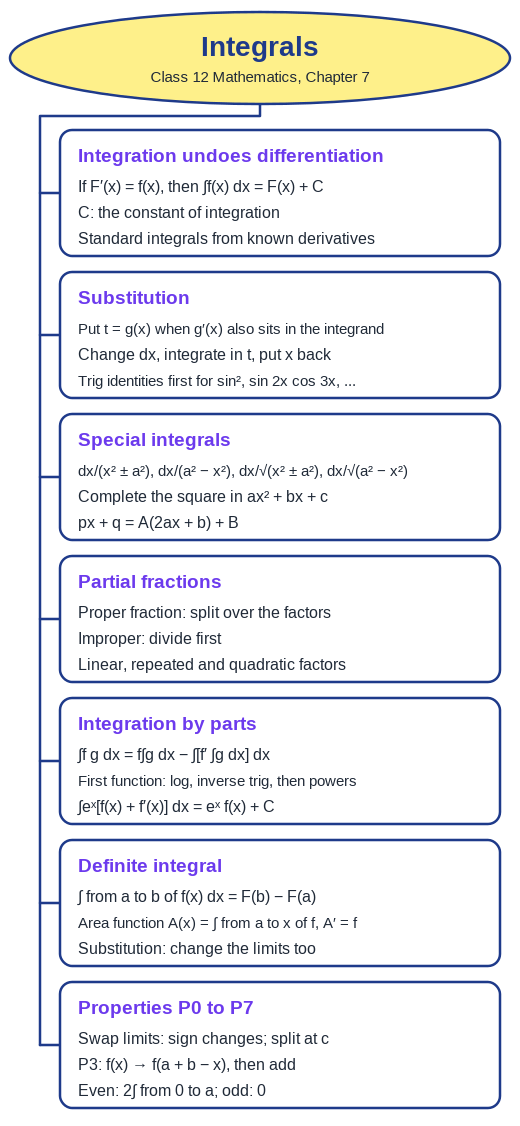
Integration reverses differentiation: if F′(x) = f(x), then ∫f(x) dx = F(x) + C. New integrals are reduced to the standard table by substitution, trigonometric identities, partial fractions or integration by parts. A definite integral from a to b equals F(b) − F(a), and properties such as P3 and P7 shorten the work.
What is this chapter about?
Chapters 5 and 6 found derivatives and used them. This chapter runs the process backwards. Given the derivative of a function, can we find the function? If we know an object’s velocity at every instant, can we find where it is? That reverse step is integration, and its second use, finding the area under a curve, gives the definite integral. The fundamental theorem of calculus links the two. This chapter opens Mathematics Part II and, at 67 pages (225–291), is the longest chapter of that book.
Integration as the inverse of differentiation
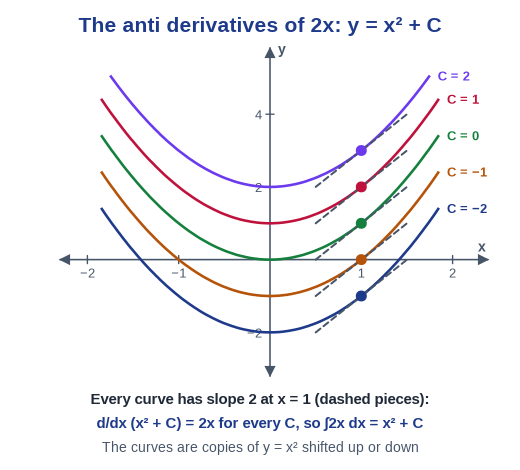
Since d/dx (sin x) = cos x, we say sin x is an anti derivative (or integral) of cos x. So is sin x + 5, or sin x − 2, because a constant has derivative 0. We write the whole family as
∫cos x dx = sin x + C
where C, the constant of integration, can be any real number. Two functions with the same derivative on an interval differ only by a constant, so the family F + C contains every anti derivative. Graphically, the curves y = F(x) + C are copies of one curve moved up or down, and they all have the same slope at any given x.
Every derivative formula gives an integral formula. The main ones: ∫xⁿ dx = xⁿ⁺¹/(n + 1) + C for n ≠ −1, ∫cos x dx = sin x + C, ∫sin x dx = −cos x + C, ∫sec² x dx = tan x + C, ∫cosec² x dx = −cot x + C, ∫sec x tan x dx = sec x + C, ∫cosec x cot x dx = −cosec x + C, ∫dx/√(1 − x²) = sin⁻¹x + C, ∫dx/(1 + x²) = tan⁻¹x + C, ∫eˣ dx = eˣ + C, ∫(1/x) dx = log|x| + C and ∫aˣ dx = aˣ/log a + C.
Two rules let us use the table on sums: ∫[f(x) ± g(x)] dx = ∫f dx ± ∫g dx, and ∫k f(x) dx = k∫f(x) dx for a constant k. For example, ∫(3x² + 2eˣ − 1/x) dx = x³ + 2eˣ − log|x| + C. Finding an integral by guessing a function with the right derivative is called the method of inspection.
Methods of integration
Most integrands are not in the table. Three methods bring them there.
- Substitution. Put t = g(x) when g′(x) also appears: ∫2x sin(x² + 1) dx becomes ∫sin t dt = −cos(x² + 1) + C. This also proves ∫tan x dx = log|sec x| + C and the formulas for cot x, sec x and cosec x. Trigonometric identities such as cos² x = (1 + cos 2x)/2 turn powers and products of sines and cosines into sums first.
- Partial fractions. A proper rational function splits into simple fractions: 1/((x + 1)(x + 2)) = 1/(x + 1) − 1/(x + 2), so its integral is log|(x + 1)/(x + 2)| + C.
- Integration by parts. For a product, ∫f g dx = f∫g dx − ∫[f′∫g dx] dx. So ∫x cos x dx = x sin x + cos x + C.
How to choose, with worked examples: methods of integration.
Integrals of some particular functions
Six results handle quadratics: ∫dx/(x² − a²) = (1/2a) log|(x − a)/(x + a)| + C, ∫dx/(a² − x²) = (1/2a) log|(a + x)/(a − x)| + C, ∫dx/(x² + a²) = (1/a) tan⁻¹(x/a) + C, ∫dx/√(x² − a²) = log|x + √(x² − a²)| + C, ∫dx/√(a² − x²) = sin⁻¹(x/a) + C and ∫dx/√(x² + a²) = log|x + √(x² + a²)| + C. For a general ax² + bx + c, complete the square first. Three more, found by parts, give ∫√(a² − x²) dx and its two partners. Full list with examples: integrals of some particular functions.
Definite integrals and the fundamental theorem
The definite integral ∫ from a to b of f(x) dx is a number. For f > 0 it is the area between y = f(x), the x-axis and the lines x = a and x = b. The area function A(x) = ∫ from a to x of f(t) dt measures that area up to a moving point x.
- First fundamental theorem: if f is continuous on [a, b], then A′(x) = f(x).
- Second fundamental theorem: if F is any anti derivative of f, then ∫ from a to b of f(x) dx = F(b) − F(a).
So ∫ from 2 to 3 of x² dx = 27/3 − 8/3 = 19/3. With substitution, change the limits along with the variable: in ∫ from 0 to 1 of tan⁻¹x/(1 + x²) dx, t = tan⁻¹x runs from 0 to π/4, giving π²/32.
Properties of definite integrals
The book lists eight properties, P0 to P7. The ones used most: swapping the limits changes the sign (P1); an integral can be split at any point c (P2), which handles |x| and other piecewise functions; ∫ from a to b of f(x) dx = ∫ from a to b of f(a + b − x) dx (P3, with P4 its case a = 0); and on [−a, a] an even function gives twice the integral from 0 to a while an odd function gives 0 (P7). For example, ∫ from 0 to π/2 of sin⁴x/(sin⁴x + cos⁴x) dx = π/4, because adding the integral to its P4 form gives ∫ from 0 to π/2 of 1 dx = π/2. All eight with proofs and examples: properties of definite integrals.
Before we move on
This is the rationalised book (marked Reprint 2026-27). It has Exercise 7.1 (22 questions), 7.2 (39), 7.3 (24), 7.4 (25), 7.5 (23), 7.6 (24), 7.7 (11), 7.8 (22), 7.9 (10), 7.10 (21) and a Miscellaneous Exercise of 40 questions, with 42 worked examples. In this book log always means the natural logarithm, to base e. Every example and exercise question is worked out in the NCERT solutions for Chapter 7. The next chapter, Application of Integrals, uses definite integrals to find areas.
Key terms
| Term | Meaning |
|---|---|
| Anti derivative (primitive) | A function F with F′(x) = f(x) on an interval. If F is one, so is F + C for every constant C. |
| Indefinite integral | ∫f(x) dx = F(x) + C, the whole family of anti derivatives of f. f(x) is the integrand and x the variable of integration. |
| Constant of integration | The arbitrary real number C. Two anti derivatives of the same function differ only by a constant. |
| Integration by substitution | Changing the variable, often t = g(x) with dt = g′(x) dx, so that the integral becomes a standard one. |
| Partial fractions | Writing a proper rational function as a sum of simpler fractions (Table 7.2) that integrate to logs and tan⁻¹ terms. |
| Integration by parts | ∫f(x) g(x) dx = f(x)∫g(x) dx − ∫[f′(x)∫g(x) dx] dx, for a product of two functions; f is the first function. |
| Definite integral | ∫ from a to b of f(x) dx, a single number. a is the lower limit and b the upper limit. |
| Area function | A(x) = ∫ from a to x of f(t) dt, the area under y = f from a up to x (for f > 0). |
| Fundamental theorem of calculus | First: A′(x) = f(x). Second: ∫ from a to b of f(x) dx = F(b) − F(a) for any anti derivative F of a continuous f. |
| Even and odd functions | f is even if f(−x) = f(x) and odd if f(−x) = −f(x). On [−a, a] an even f gives 2∫ from 0 to a of f, an odd f gives 0. |
Topics in this chapter
Practice
-
∫(1/x) dx, for x ≠ 0, equals:
Show answer
Answer: (b) log|x| + C
-
∫2x cos(x²) dx equals:
Show answer
Answer: (a) sin(x²) + C
-
∫x eˣ dx equals:
Show answer
Answer: (c) (x − 1)eˣ + C
-
∫ from 0 to 1 of 3x² dx equals:
Show answer
Answer: (b) 1
-
∫ from −2 to 2 of x³ cos x dx equals:
Show answer
Answer: (a) 0
Questions students ask
What are the main topics of Class 12 Maths Chapter 7?
Integration as the inverse of differentiation and the standard integrals, the methods of integration (substitution, trigonometric identities, partial fractions, by parts), integrals of some particular functions, the definite integral and the fundamental theorem of calculus, evaluation by substitution, and the properties P0 to P7. It has Exercises 7.1 to 7.10 and a Miscellaneous Exercise.
Is the definite integral as the limit of a sum in the 2026-27 book?
No. Section 7.7 now only defines the definite integral and says its value is F(b) − F(a). The longer limit-of-a-sum section and its exercise are not in the rationalised book, so these notes do not teach it.
Why do we add C to an indefinite integral but not to a definite one?
Adding any constant to F does not change its derivative, so the indefinite integral is a whole family F + C. In a definite integral the C cancels: [F(b) + C] − [F(a) + C] = F(b) − F(a).
My answer looks different from the book's. Is it wrong?
Not always. Two correct answers can differ by a constant, for example −(1/2)cos²x and (1/2)sin²x for ∫sin x cos x dx. Differentiate your answer: if you get the integrand back, it is right.
Stuck on a question?
Take a photo and Lagnever AI explains it step by step. Try it for 7 days for ₹2.
Get it on Google Play Open in browser
For parents: after the trial, the plan renews monthly by UPI or card autopay. You can cancel anytime in the app.