
How do you evaluate definite integrals and use their properties?
Answer in short
Find an anti derivative F of f and compute F(b) − F(a); no constant is needed. With a substitution, change the limits too. The properties shorten hard cases: split at c, replace x by a + b − x and add, and on [−a, a] an even function gives 2∫ from 0 to a, an odd one 0.
Stuck on a question? Take a photo and Lagnever AI explains it step by step. Try it for 7 days for ₹2. Get it on Google Play
What is a definite integral?
∫ from a to b of f(x) dx is a single number. a is the lower limit and b the upper limit. When f(x) > 0 on [a, b], it is the area of the region between the curve y = f(x), the x-axis and the lines x = a and x = b.
The area function and the fundamental theorem
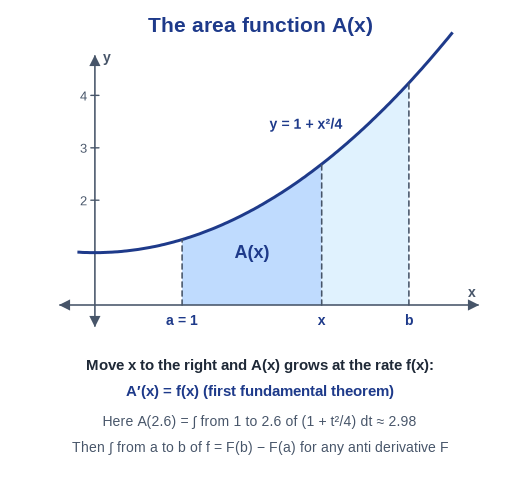
Fix a and let x move along [a, b]. The area from a up to x is a function of x, called the area function:
A(x) = ∫ from a to x of f(t) dt
The book states two theorems without proof:
- First fundamental theorem. If f is continuous on [a, b], then A′(x) = f(x) for every x in [a, b]. The area grows at a rate equal to the height of the curve.
- Second fundamental theorem. If F is any anti derivative of f, then ∫ from a to b of f(x) dx = [F(x)] from a to b = F(b) − F(a).
So a definite integral needs only an anti derivative. There is no need to keep C, since [F(b) + C] − [F(a) + C] = F(b) − F(a).
Examples: ∫ from 2 to 3 of x² dx = 27/3 − 8/3 = 19/3. ∫ from 1 to 2 of x/((x + 1)(x + 2)) dx: partial fractions give F(x) = −log|x + 1| + 2 log|x + 2|, and F(2) − F(1) = log(32/27).
The first theorem also gives derivatives of integrals directly: if f(x) = ∫ from 0 to x of t sin t dt, then f′(x) = x sin x.
Evaluating by substitution
There are two ways. Either find the indefinite integral in the new variable, put x back and use the old limits; or, quicker, change the limits along with the variable and never go back to x.
∫ from −1 to 1 of 5x⁴√(x⁵ + 1) dx: put t = x⁵ + 1, dt = 5x⁴ dx. When x = −1, t = 0; when x = 1, t = 2. The integral is ∫ from 0 to 2 of √t dt = (2/3)·2^(3/2) = 4√2/3.
Properties P0 to P7
- P0: the letter does not matter: ∫ from a to b of f(x) dx = ∫ from a to b of f(t) dt.
- P1: ∫ from a to b of f = −∫ from b to a of f; in particular ∫ from a to a of f = 0.
- P2: ∫ from a to b of f = ∫ from a to c of f + ∫ from c to b of f.
- P3: ∫ from a to b of f(x) dx = ∫ from a to b of f(a + b − x) dx.
- P4: ∫ from 0 to a of f(x) dx = ∫ from 0 to a of f(a − x) dx.
- P5: ∫ from 0 to 2a of f(x) dx = ∫ from 0 to a of f(x) dx + ∫ from 0 to a of f(2a − x) dx.
- P6: ∫ from 0 to 2a of f = 2∫ from 0 to a of f if f(2a − x) = f(x), and 0 if f(2a − x) = −f(x).
- P7: ∫ from −a to a of f = 2∫ from 0 to a of f if f is even, and 0 if f is odd.
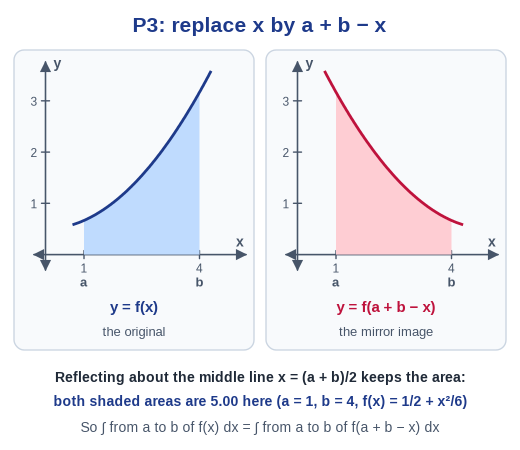
P3 reflects the region in the middle line x = (a + b)/2, so the area does not change. The trick that uses it: call the integral I, write it again with x replaced by a + b − x, and add.
- ∫ from 0 to π/2 of sin⁴x/(sin⁴x + cos⁴x) dx: by P4 the same integral equals ∫ from 0 to π/2 of cos⁴x/(cos⁴x + sin⁴x) dx. Adding, 2I = π/2, so I = π/4.
- ∫ from 0 to π/2 of log sin x dx = −(π/2) log 2, by P4, P6 and a substitution (Example 34 of the book).
P2 handles absolute values. For ∫ from −1 to 2 of |x³ − x| dx, x³ − x is ≥ 0 on [−1, 0], ≤ 0 on [0, 1] and ≥ 0 on [1, 2]. Splitting there gives 1/4 + 1/4 + 9/4 = 11/4.
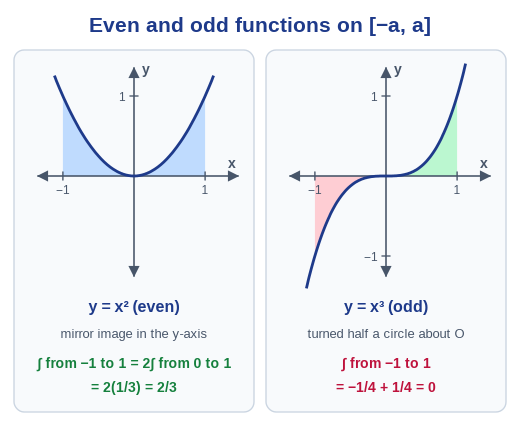
P7 saves the most time. sin⁵x cos⁴x is odd, so ∫ from −1 to 1 of it is 0 without any integration. sin² x is even, so ∫ from −π/4 to π/4 of sin² x dx = 2∫ from 0 to π/4 of sin² x dx = π/4 − 1/2.
Practice
Exercises 7.8 to 7.10 and the definite integrals of the Miscellaneous Exercise are all solved in the NCERT solutions. The anti derivatives needed come from the methods of integration.
Practice
-
∫ from 1 to 2 of 2x dx equals:
Show answer
Answer: (c) 3
-
∫ from −1 to 1 of x⁵ dx equals:
Show answer
Answer: (b) 0
-
Evaluate ∫ from 0 to π/2 of cos x/(sin x + cos x) dx.
Show answer
Answer: Call it I. By P4, replacing x by π/2 − x, I = ∫ from 0 to π/2 of sin x/(cos x + sin x) dx. Adding the two forms, 2I = ∫ from 0 to π/2 of 1 dx = π/2, so I = π/4.
-
Evaluate ∫ from 0 to 3 of |x − 1| dx.
Show answer
Answer: Split at 1: ∫ from 0 to 1 of (1 − x) dx + ∫ from 1 to 3 of (x − 1) dx = 1/2 + 2 = 5/2.
Questions students ask
What is the difference between an indefinite and a definite integral?
An indefinite integral is a family of functions, F(x) + C. A definite integral is one number, F(b) − F(a). The C cancels when the limits are put in.
Why must f be continuous on [a, b]?
The second fundamental theorem needs it. The book's example: x(x² − 1)^(1/2) is not defined for −1 < x < 1, so ∫ from −2 to 3 of it makes no sense.
When should I use P3 or P4?
When replacing x by a + b − x turns the integrand into a partner that adds to something simple. sin and cos swap under x → π/2 − x, and x becomes π − x under x → π − x, as in ∫ from 0 to π of x sin x/(1 + cos² x) dx.
Is the definite integral always an area?
Only when f ≥ 0 on [a, b]. Where the graph is below the x-axis, that part counts as negative. That is why ∫ from −1 to 1 of x³ dx = 0.
Stuck on a question?
Take a photo and Lagnever AI explains it step by step. Try it for 7 days for ₹2.
Get it on Google Play Open in browser
For parents: after the trial, the plan renews monthly by UPI or card autopay. You can cancel anytime in the app.