
What are the integrals of some particular functions?
Answer in short
Six formulas cover 1 over x² − a², a² − x² or x² + a², and 1 over the square root of each. For any quadratic ax² + bx + c, complete the square to reach one of them; with px + q on top, first write px + q = A(2ax + b) + B.
Stuck on a question? Take a photo and Lagnever AI explains it step by step. Try it for 7 days for ₹2. Get it on Google Play
The six special integrals
Section 7.4 of the book adds six formulas to the table. With a > 0:
- ∫dx/(x² − a²) = (1/2a) log|(x − a)/(x + a)| + C
- ∫dx/(a² − x²) = (1/2a) log|(a + x)/(a − x)| + C
- ∫dx/(x² + a²) = (1/a) tan⁻¹(x/a) + C
- ∫dx/√(x² − a²) = log|x + √(x² − a²)| + C
- ∫dx/√(a² − x²) = sin⁻¹(x/a) + C
- ∫dx/√(x² + a²) = log|x + √(x² + a²)| + C
Each can be checked by differentiating. The first two come from partial fractions: 1/(x² − a²) = (1/2a)[1/(x − a) − 1/(x + a)]. Formula 3 follows from x = a tan θ, formula 5 from x = a sin θ, formula 4 from x = a sec θ and formula 6 from x = a tan θ.
For example, ∫dx/(x² − 16) = (1/8) log|(x − 4)/(x + 4)| + C, using formula 1 with a = 4.
Completing the square
A general quadratic ax² + bx + c is brought to one of these forms by completing the square:
ax² + bx + c = a[(x + b/2a)² + (c/a − b²/4a²)]
Put t = x + b/2a. The integral becomes (1/a)∫dt/(t² ± k²), or a square-root version, and one of the six formulas finishes it.
- ∫dx/(x² − 6x + 13): x² − 6x + 13 = (x − 3)² + 4, so the answer is (1/2) tan⁻¹((x − 3)/2) + C.
- ∫dx/√(2x − x²): 2x − x² = 1 − (x − 1)², so the answer is sin⁻¹(x − 1) + C.
- ∫dx/√(5x² − 2x): take √5 out and complete the square: x² − 2x/5 = (x − 1/5)² − (1/5)². Formula 4 gives (1/√5) log|x − 1/5 + √(x² − 2x/5)| + C.
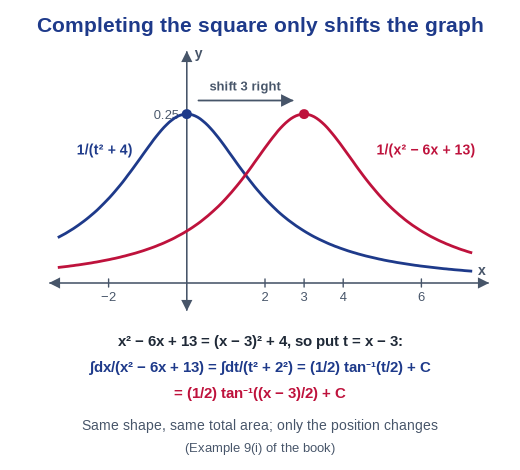
The picture shows why this works: completing the square only slides the graph sideways, so the integral is the standard one with x replaced by the shifted variable.
A linear term on top
For ∫(px + q)/(ax² + bx + c) dx or ∫(px + q)/√(ax² + bx + c) dx, split the numerator into a multiple of the derivative of the quadratic plus a constant:
px + q = A·d/dx(ax² + bx + c) + B = A(2ax + b) + B
Find A and B by comparing the coefficients of x and the constant terms. The A part integrates by substitution (to a log, or to a square root), and the B part is a special integral.
Example: ∫(x + 3)/√(5 − 4x − x²) dx. The derivative of 5 − 4x − x² is −4 − 2x, and x + 3 = −(1/2)(−4 − 2x) + 1. So the integral is
−(1/2)∫(−4 − 2x)/√(5 − 4x − x²) dx + ∫dx/√(9 − (x + 2)²) = −√(5 − 4x − x²) + sin⁻¹((x + 2)/3) + C.
Three more, found by parts
Section 7.6.2 uses integration by parts (with 1 as the second function) to find three more integrals:
- ∫√(x² − a²) dx = (x/2)√(x² − a²) − (a²/2) log|x + √(x² − a²)| + C
- ∫√(x² + a²) dx = (x/2)√(x² + a²) + (a²/2) log|x + √(x² + a²)| + C
- ∫√(a² − x²) dx = (x/2)√(a² − x²) + (a²/2) sin⁻¹(x/a) + C
Again, complete the square first. For ∫√(x² + 2x + 5) dx, write x² + 2x + 5 = (x + 1)² + 2². With y = x + 1 and a = 2, the answer is ((x + 1)/2)√(x² + 2x + 5) + 2 log|x + 1 + √(x² + 2x + 5)| + C.
Where these are used
Exercise 7.4 (25 questions) and Exercise 7.7 (11 questions) practise exactly these forms; both are solved step by step in the NCERT solutions. The methods of integration page covers substitution, partial fractions and parts, which these formulas build on.
Practice
-
∫dx/(x² + 9) equals:
Show answer
Answer: (b) (1/3) tan⁻¹(x/3) + C
-
∫dx/√(4 − x²) equals:
Show answer
Answer: (a) sin⁻¹(x/2) + C
-
Find ∫dx/(x² + 4x + 8).
Show answer
Answer: x² + 4x + 8 = (x + 2)² + 4 = (x + 2)² + 2². Put t = x + 2: ∫dt/(t² + 2²) = (1/2) tan⁻¹(t/2) + C = (1/2) tan⁻¹((x + 2)/2) + C.
-
Find ∫√(9 − x²) dx.
Show answer
Answer: Use ∫√(a² − x²) dx = (x/2)√(a² − x²) + (a²/2) sin⁻¹(x/a) + C with a = 3: (x/2)√(9 − x²) + (9/2) sin⁻¹(x/3) + C.
Questions students ask
How are these formulas proved?
The two log forms come from partial fractions, for example 1/(x² − a²) = (1/2a)[1/(x − a) − 1/(x + a)]. The tan⁻¹ form uses x = a tan θ, the sin⁻¹ form x = a sin θ, and the two √(x² ± a²) forms x = a sec θ and x = a tan θ.
What if the quadratic has a minus sign in front of x²?
Take −1 out: 5 − 4x − x² = 9 − (x + 2)². That has the form a² − t², so ∫dx/√(5 − 4x − x²) = sin⁻¹((x + 2)/3) + C.
How do I find A and B in px + q = A(2ax + b) + B?
Compare the coefficients of x and the constants. For (x + 2)/(2x² + 6x + 5): x + 2 = A(4x + 6) + B, so 4A = 1 and 6A + B = 2, giving A = 1/4 and B = 1/2.
Stuck on a question?
Take a photo and Lagnever AI explains it step by step. Try it for 7 days for ₹2.
Get it on Google Play Open in browser
For parents: after the trial, the plan renews monthly by UPI or card autopay. You can cancel anytime in the app.