
What is drift velocity, and how does it lead to Ohm’s law?
Answer in short
Drift velocity is the small average velocity that free electrons gain against an electric field, v_d = −eEτ/m, where τ is the average time between collisions. It gives a current I = neAv_d. Since v_d is proportional to E, the current density is j = σE with σ = ne²τ/m: this is Ohm’s law, V = IR.
Stuck on a question? Take a photo and Lagnever AI explains it step by step. Try it for 7 days for ₹2. Get it on Google Play
What carries the current in a metal?
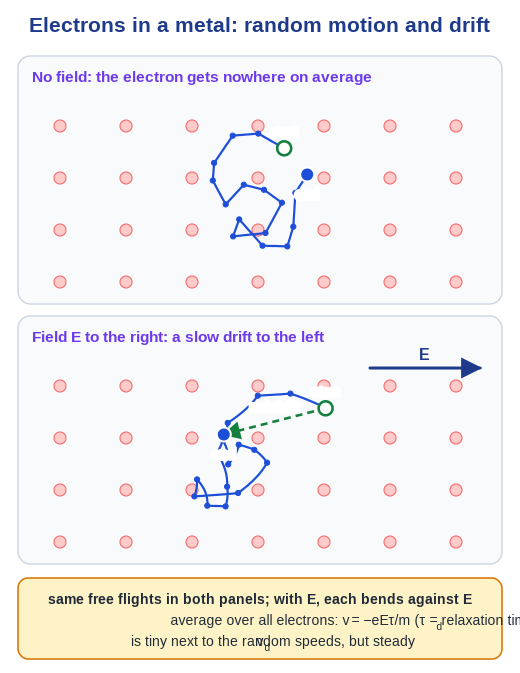
A metal is a lattice of fixed positive ions with some electrons that belong to no single atom. These free electrons move about quickly in all directions, bouncing off the ions. After each collision an electron leaves in a random direction at the same speed. Average over all of them and the velocities cancel, so with no field there is no current.
The current through an area is the net charge crossing it per second, I = ΔQ/Δt, in amperes. In a solid conductor only the electrons move; the ions stay in place.
How do electrons drift in a field?
Apply a field E. Each electron (charge −e, mass m) now has an acceleration a = −eE/m. Take one electron whose last collision was a time tᵢ ago, and which left that collision with velocity vᵢ. Its velocity now is
Vᵢ = vᵢ − eEtᵢ/m
Average this over all the electrons. The vᵢ point every which way, so their average is zero. The times tᵢ differ from electron to electron, but their average is τ, the relaxation time (the average time between collisions). So the average velocity is
vd = −eEτ/m
This is the drift velocity. It is steady, even though every electron is accelerating, because each collision wipes out the velocity it has just gained. The minus sign means electrons drift against E, towards higher potential.
How is the current related to the drift velocity?
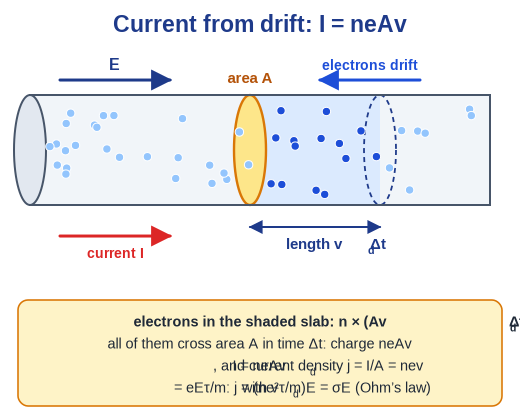
Let n be the count of free electrons in each cubic metre and A the area of cross-section. In a short time Δt, all the electrons within a distance vdΔt of the cross-section get across it. They fill a slab of volume AvdΔt, so the charge crossing is neAvdΔt, and
I = neAvd, current density j = I/A = nevd
For copper n is about 8.5 × 10²⁸ m⁻³. A current of 1 A in a wire of cross-section 1 mm² then needs a drift speed of 1/(8.5 × 10²⁸ × 1.6 × 10⁻¹⁹ × 10⁻⁶) ≈ 7.4 × 10⁻⁵ m s⁻¹, less than a tenth of a millimetre per second.
How does drift explain Ohm’s law?
Put the drift velocity into j = nevd:
j = (ne²τ/m) E = σE
The current density is proportional to the field, which is Ohm’s law, and the conductivity is σ = ne²τ/m. Its inverse is the resistivity, ρ = m/(ne²τ). For a uniform wire of length l, E = V/l and j = I/A, so V = I(ρl/A), that is
V = IR with R = ρl/A
The picture works as long as n and τ do not depend on the field. A wire of resistivity 1.0 × 10⁻⁶ Ω m, 2 m long with a cross-section of 0.5 mm², has R = 1.0 × 10⁻⁶ × 2/(0.5 × 10⁻⁶) = 4 Ω. Stretch it to twice the length: its volume stays the same, so its area halves and R becomes four times as large, 16 Ω.
What is mobility?
Mobility measures how easily a carrier drifts in a field:
µ = |vd|/E = eτ/m
Its SI unit is m² V⁻¹ s⁻¹, which is 10⁴ times the practical unit cm² V⁻¹ s⁻¹. Suppose electrons drift at 4.4 × 10⁻⁴ m s⁻¹ in a field of 0.1 V m⁻¹. Then µ = 4.4 × 10⁻³ m² V⁻¹ s⁻¹, and, with the standard electron mass m = 9.1 × 10⁻³¹ kg, τ = µm/e = 4.4 × 10⁻³ × 9.1 × 10⁻³¹/(1.6 × 10⁻¹⁹) ≈ 2.5 × 10⁻¹⁴ s. In metals the carriers are electrons; in an ionised gas, electrons and positive ions; in an electrolyte, positive and negative ions.
When does Ohm’s law not hold?
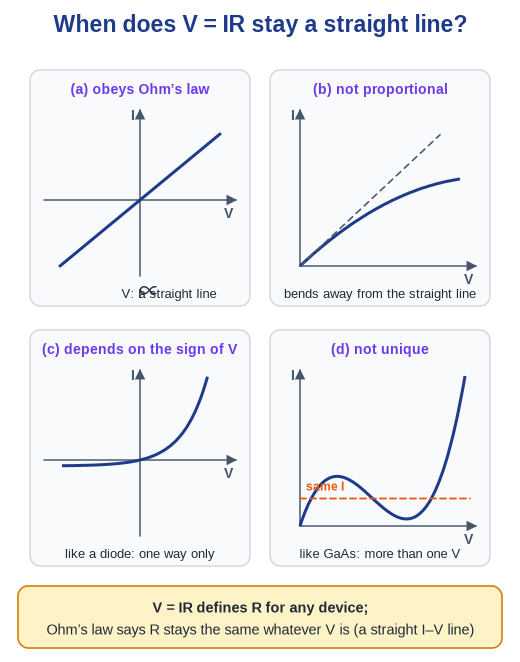
Many materials obey Ohm’s law, but it is not a basic law of nature. It breaks down when V stops being proportional to I, when the current depends on the sign of V (a diode lets current through one way only), or when one current goes with more than one voltage (GaAs). Even good conductors depart from it in very strong fields. Such devices are used widely in electronics, but this chapter works with materials that obey the law.
Next topic: the temperature dependence of resistivity and electrical power. See also the chapter notes and the NCERT solutions.
Practice
-
In a metal wire carrying a current, the free electrons drift:
Show answer
Answer: (b) against the field E
-
If the relaxation time τ of a metal doubled, with n unchanged, its resistivity would:
Show answer
Answer: (b) halve
-
The SI unit of mobility is:
Show answer
Answer: (b) m² V⁻¹ s⁻¹
-
A wire carries 2 A. How much charge, and how many electrons, pass a point in 1 minute?
Show answer
Answer: q = It = 2 A × 60 s = 120 C. Number of electrons = 120/(1.6 × 10⁻¹⁹) = 7.5 × 10²⁰.
-
A wire of resistivity 1.0 × 10⁻⁶ Ω m is 2 m long with cross-section 0.5 mm². Find R, and R after it is stretched to twice the length.
Show answer
Answer: R = ρl/A = 1.0 × 10⁻⁶ × 2/(0.5 × 10⁻⁶) = 4 Ω. Stretched, l doubles and A halves (same volume), so R = 4 × 4 Ω = 16 Ω.
Questions students ask
What is drift velocity in simple words?
It is the slow average velocity of free electrons along a wire when a field acts. Each electron still moves fast in random directions, but on top of that the whole crowd shifts steadily against the field.
If drift velocity is so small, how is the current large?
Because a metal has an enormous number of free electrons, about 10²⁹ per cubic metre. Even a drift of a millimetre per second carries a lot of charge across a cross-section every second, since I = neAv_d.
What is relaxation time?
It is the average time an electron travels between two collisions with the ions of the metal. It decides both the drift velocity, v_d = eEτ/m, and the conductivity, σ = ne²τ/m.
Is V = IR the same as Ohm’s law?
Not quite. V = IR defines the resistance of any device, even a diode. Ohm’s law is the statement that, for a given conductor, this R does not depend on V, so the graph of I against V is a straight line.
Stuck on a question?
Take a photo and Lagnever AI explains it step by step. Try it for 7 days for ₹2.
Get it on Google Play Open in browser
For parents: after the trial, the plan renews monthly by UPI or card autopay. You can cancel anytime in the app.