
Class 12 Physics Chapter 3: Current Electricity Notes
This chapter in five lines
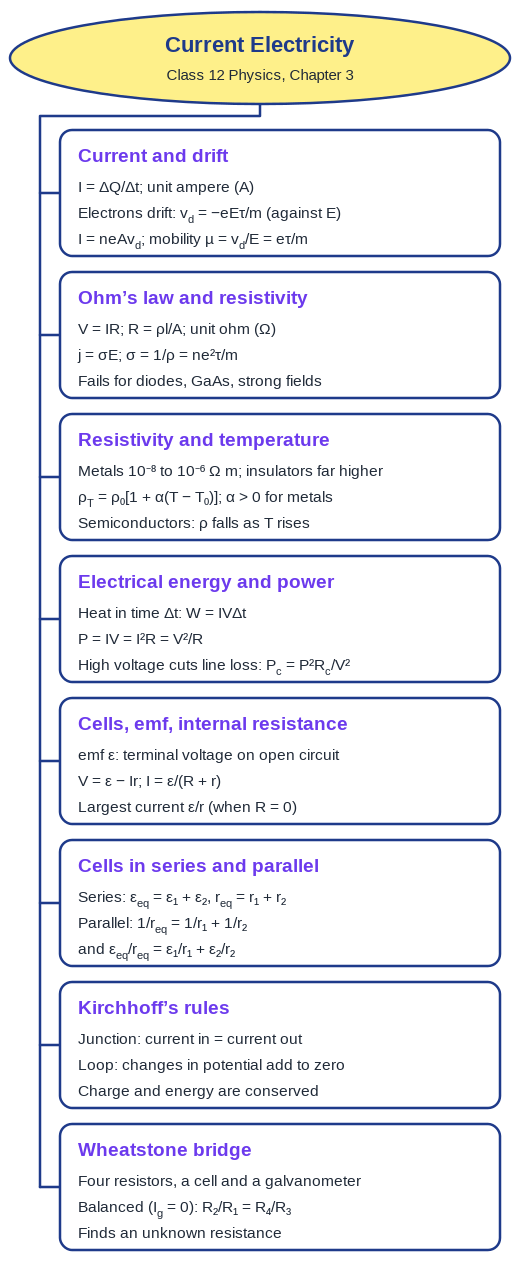
Current is charge flowing per second, I = ΔQ/Δt. In a metal, free electrons drift against the field with v_d = eEτ/m, giving I = neAv_d and Ohm’s law V = IR with R = ρl/A. Resistivity of metals rises with temperature. A cell has emf ε and internal resistance r, so V = ε − Ir. Kirchhoff’s junction and loop rules solve any network, including the Wheatstone bridge.
What is this chapter about?
Chapters 1 and 2 dealt with charges at rest. This chapter sets them moving. A torch, a wall clock run by a cell and a phone charger all carry a steady current, charge flowing smoothly round a closed path. We ask what carries the current inside a metal, why a wire has resistance and gets warm, what a cell really supplies, and how to find every current in a network of cells and resistors.
Safety: Do every circuit experiment from this chapter with cells or a low-voltage battery only. Never connect wires, resistors or meters to a mains socket: the 230 V supply at home can kill.
What is electric current?
Hold an imaginary area across the flow of charge. If a net charge ΔQ crosses it in a short time Δt, the current is
I = ΔQ/Δt (taking the limit as Δt → 0)
For a steady current this is simply charge divided by time, I = q/t. A negative answer means the current flows the other way. The SI unit is the ampere (A), defined through the magnetic effect of currents in the next chapter. Household appliances draw currents of roughly an ampere; a lightning stroke carries tens of thousands of amperes, and the currents in our nerves are only microamperes.
Why do metals carry a current?
A charge moves when a field pushes it, but only if it is not tied down. In a metal, some electrons are not bound to any one atom. These free electrons wander through a lattice of fixed positive ions, while the ions themselves stay in place. So in a solid conductor the current is carried by electrons alone (in an electrolyte, positive and negative ions both move).
Joining the ends of a metal rod to +Q and −Q would give only a brief current: the electrons would quickly neutralise the charges. A cell keeps replacing the charge at the ends, so the field inside stays steady and the current keeps flowing.
What is Ohm’s law?
G. S. Ohm found in 1828 that, for many conductors, the potential difference V across the ends is proportional to the current I:
V = RI
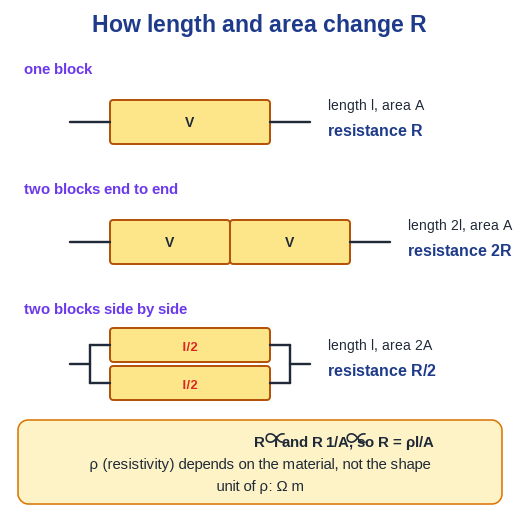
R is the resistance, measured in ohms (1 Ω = 1 V A⁻¹). Joining two equal blocks end to end doubles the voltage needed for the same current, so R ∝ l. Placing them side by side halves the current in each, so R ∝ 1/A. Together
R = ρl/A
where the resistivity ρ (unit Ω m) depends only on the material and its temperature. With current density j = I/A and field E = V/l, the law becomes E = ρj, or j = σE, with conductivity σ = 1/ρ. Read drift velocity and Ohm’s law.
What is drift velocity?
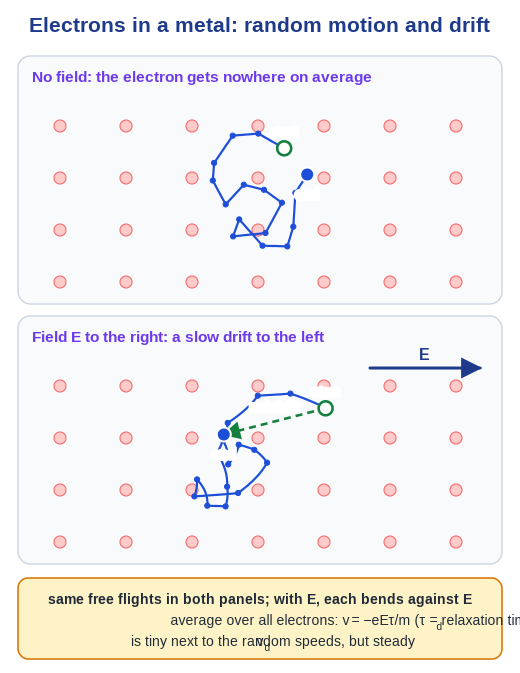
With no field, free electrons fly about at high speed, bouncing off the ions in random directions. On average their velocities cancel, so there is no current. A field E gives every electron an acceleration −eE/m. Between collisions each electron gains a little velocity against E, and a collision scatters it again in a random direction. Averaging over all the electrons, with τ the average time between collisions (the relaxation time), gives a steady drift velocity:
vd = −eEτ/m
The minus sign says electrons drift opposite to E, towards higher potential. The drift is laid over the random motion; it does not replace it.
How does drift give a current?
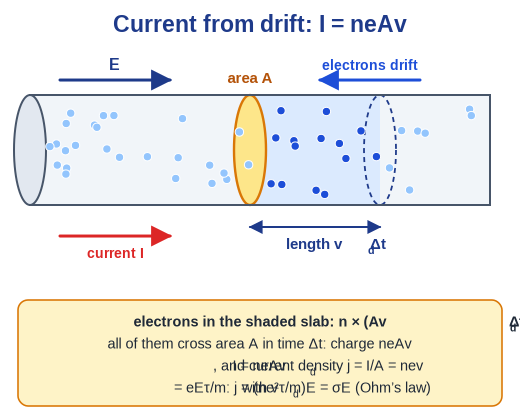
Take a cross-section of area A. In time Δt every electron within a distance vdΔt of it crosses it: that is n(AvdΔt) electrons, where n counts the free electrons in each cubic metre. So
I = neAvd and j = nevd
Putting in vd = eEτ/m gives j = (ne²τ/m)E. This is Ohm’s law, with
σ = ne²τ/m and ρ = m/(ne²τ)
So a simple picture of electrons drifting and colliding explains Ohm’s law, as long as n and τ do not depend on E. For copper, with about 8.5 × 10²⁸ free electrons per m³, a current of 1.5 A in a wire of cross-section 1.0 × 10⁻⁷ m² needs a drift speed of only about 1.1 mm s⁻¹ (Example 3.1).
What is mobility?
Mobility tells how easily a carrier drifts: µ = |vd|/E. From the drift formula, µ = eτ/m. Its SI unit is m² V⁻¹ s⁻¹ (1 m² V⁻¹ s⁻¹ = 10⁴ cm² V⁻¹ s⁻¹, the practical unit). In metals the mobile carriers are electrons; in an ionised gas, electrons and positive ions; in an electrolyte, positive and negative ions.
When does Ohm’s law fail?
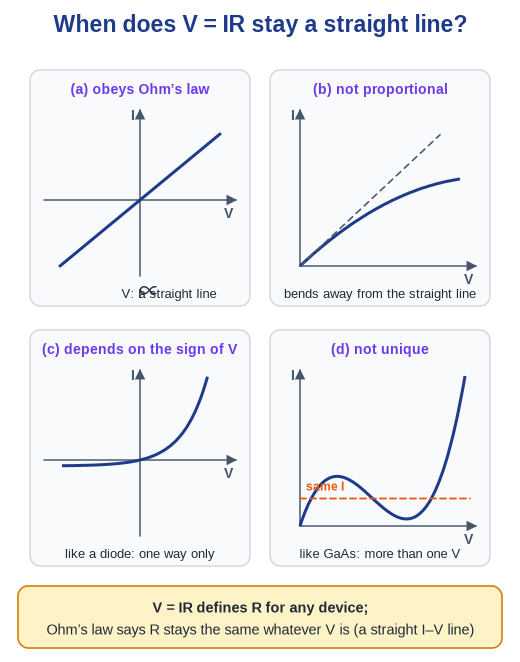
Ohm’s law holds for many materials, but it is not a law of nature. It fails when:
- V stops being proportional to I, for example when the resistivity changes with the current;
- the relation depends on the sign of V, as in a diode, which passes current easily one way only;
- V is not unique, so one current goes with more than one voltage, as in GaAs.
V = IR still defines the resistance of any device. Ohm’s law is the stronger claim that this R does not change with V.
How do materials differ in resistivity?
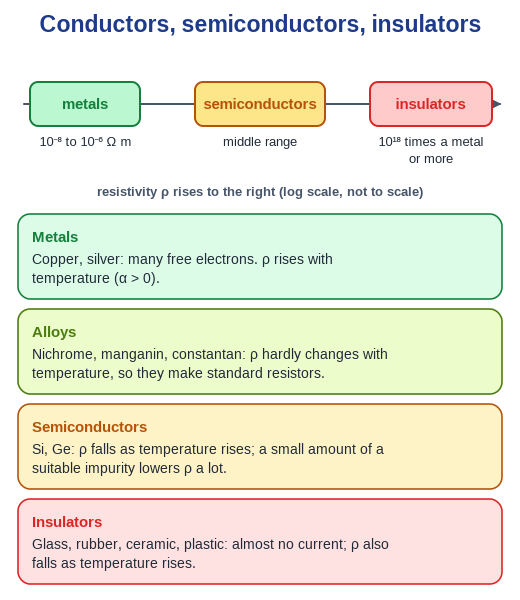
In order of rising resistivity we have conductors, semiconductors and insulators. Metals lie between about 10⁻⁸ and 10⁻⁶ Ω m. Insulators such as ceramic, rubber and plastic have resistivities 10¹⁸ times a metal’s or more. Semiconductors sit in between, and adding a small amount of a suitable impurity lowers their resistivity a lot, which is how electronic devices are made. Read the temperature dependence of resistivity and electrical power.
How does resistivity change with temperature?
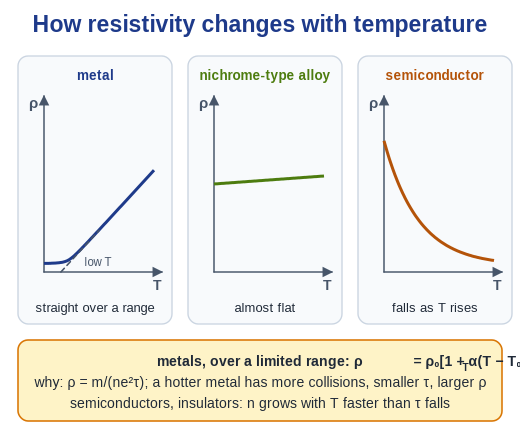
Within a moderate temperature range, a metal’s resistivity climbs along a nearly straight line:
ρT = ρ₀[1 + α(T − T₀)]
Here ρ₀ is the value at a reference temperature T₀ and α is the temperature coefficient of resistivity, in °C⁻¹ (or K⁻¹); α is positive for metals. Far below 0 °C the graph bends away from a straight line. Alloys such as nichrome, manganin and constantan change very little, so they are used for standard resistors. Semiconductors behave the other way: their resistivity falls as they warm up.
The formula ρ = m/(ne²τ) explains this. In a hotter metal the electrons move faster and collide more often, so τ falls and ρ rises, while n hardly changes. In semiconductors and insulators, n rises with temperature, faster than τ falls, so ρ drops.
What are electrical energy and power?
Let a current I flow from A to B through a conductor with potential difference V between its ends. In time Δt a charge IΔt falls through V, losing potential energy IVΔt. Because collisions hold the electrons to a steady drift, this energy does not become kinetic energy of the electrons; it is handed to the ions, which vibrate more, and the conductor heats up. The power dissipated is
P = VI = I²R = V²/R
This ohmic loss makes a heater element or a bulb filament glow. The energy comes from the source: in a cell circuit, from the cell’s chemical energy.
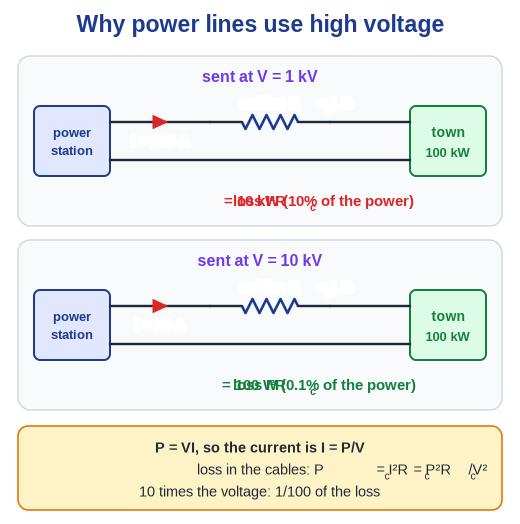
For a power line, the device needs P = VI, so the current is P/V and the loss in cables of resistance Rc is Pc = I²Rc = P²Rc/V². Sending power at a very high voltage keeps the current, and so the loss, small. That is why transmission lines carry danger signs, and why a transformer lowers the voltage before the power reaches homes.
What are emf and internal resistance?
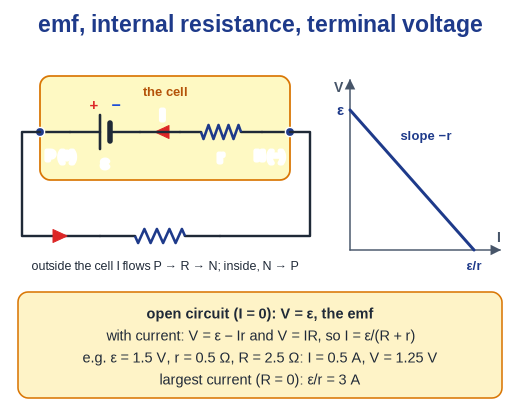
A cell has a positive and a negative electrode in an electrolyte. Each electrode develops a potential difference with the electrolyte next to it. With no current, the potential difference between the terminals is the emf ε. Despite its old name (electromotive force), emf is a potential difference, not a force.
The electrolyte has resistance too, the internal resistance r. When the cell drives a current I through an external resistor R, part of ε is used up inside:
V = ε − Ir, and with V = IR, I = ε/(R + r)
The largest current, with R = 0, is ε/r, though real cells are damaged long before that. Internal resistance can be ignored when Ir is much smaller than ε; dry cells have a much larger r than ordinary electrolytic cells.
How do cells combine in series and in parallel?
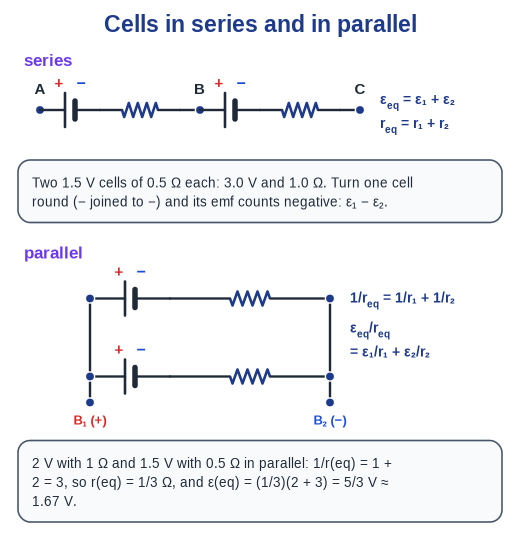
- Series (the negative terminal of one cell joined to the positive of the next): the emfs add and so do the internal resistances, εeq = ε₁ + ε₂ + … and req = r₁ + r₂ + … A cell connected the other way round counts with a minus sign, giving ε₁ − ε₂.
- Parallel (positive terminals joined, negative terminals joined): 1/req = 1/r₁ + 1/r₂ + … and εeq/req = ε₁/r₁ + ε₂/r₂ + … A cell turned round enters with −ε.
For example, a 2 V cell of 1 Ω in parallel with a 1.5 V cell of 0.5 Ω acts like one cell of 5/3 V with 1/3 Ω. Read Kirchhoff’s rules and the Wheatstone bridge, which also covers cells.
What are Kirchhoff’s rules?
Series and parallel formulas cannot untangle every network. Two rules always work. First mark a current, with an arrow, in every branch; a negative answer just means the current runs against the arrow.
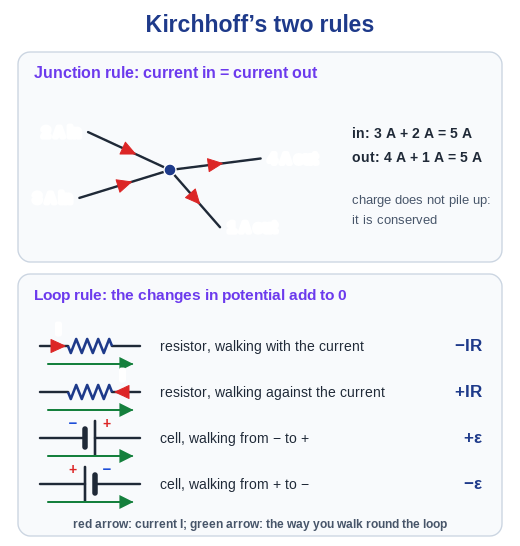
- Junction rule: at any junction, the total current flowing in equals the total current flowing out. When currents are steady, charge cannot pile up anywhere.
- Loop rule: round any closed loop, the changes in potential add up to zero, because the potential at a point has one value, so a walk that returns to its start returns to the same potential.
Signs: crossing a resistor along the current, the potential falls by IR; crossing a cell from − to +, it rises by ε (for a cell with internal resistance, the terminal voltage is ε − Ir when the current flows through it from − to +).
What is a Wheatstone bridge?
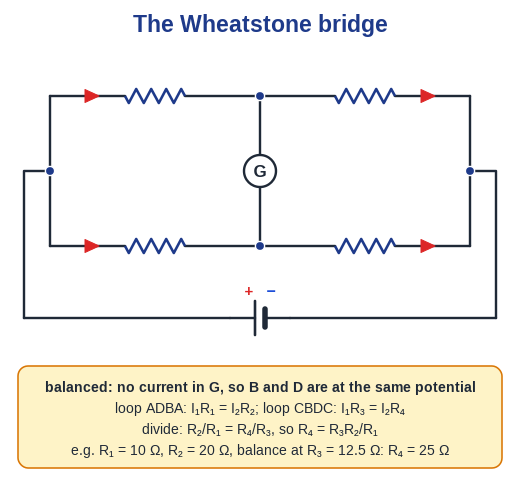
Four resistors R₁, R₂, R₃ and R₄ form a loop A–B–C–D. A cell joins A and C (the battery arm), and a galvanometer G, which detects small currents, joins B and D (the galvanometer arm). The bridge is balanced when no current flows through G. Then the junction rule gives I₃ = I₁ and I₄ = I₂, and the loop rule on the two loops through G gives I₁R₁ = I₂R₂ and I₁R₃ = I₂R₄. Dividing:
R₂/R₁ = R₄/R₃
So if R₄ is unknown, keep R₁ and R₂ fixed, vary R₃ until G reads zero, and R₄ = R₃R₂/R₁. The book names the meter bridge as a practical device built on this idea.
Before we move on
Three ideas carry the chapter: current is drifting charge (I = neAvd), a cell supplies an emf but loses Ir inside itself, and Kirchhoff’s two rules solve any network. Practise the derivations (drift velocity, σ = ne²τ/m, power, V = ε − Ir, cells in series and parallel, the bridge balance) with their diagrams. All 9 exercises and all 7 worked examples are solved in the NCERT solutions for Chapter 3.
Key terms
| Term | Meaning |
|---|---|
| Electric current (I) | The net charge crossing an area per unit time, I = ΔQ/Δt (in the limit of small Δt); unit ampere (A). |
| Drift velocity (v_d) | The small average velocity of free electrons against the field, v_d = −eEτ/m, laid over their fast random motion. |
| Relaxation time (τ) | The average time between successive collisions of an electron with the ions of the metal. |
| Mobility (µ) | Drift speed per unit field, µ = |v_d|/E = eτ/m; SI unit m² V⁻¹ s⁻¹. |
| Ohm’s law | For many conductors V is proportional to I, V = RI; the resistance R does not depend on V. |
| Resistance (R) | R = V/I; for a uniform conductor R = ρl/A; unit ohm, 1 Ω = 1 V A⁻¹. |
| Resistivity (ρ) | A property of the material (and its temperature): R = ρl/A; unit Ω m. Conductivity σ = 1/ρ. |
| Current density (j) | Current through each square metre of cross-section, taken at right angles to the flow: j = I/A = nev_d, in A m⁻²; Ohm’s law reads j = σE. |
| Temperature coefficient of resistivity (α) | The fractional rise in resistivity per degree: ρ_T = ρ₀[1 + α(T − T₀)]; positive for metals. |
| Electromotive force (emf, ε) | The potential difference between the terminals of a cell when no current flows; a voltage, not a force. |
| Internal resistance (r) | The resistance of the electrolyte inside a cell; with current I the terminal voltage is V = ε − Ir. |
| Kirchhoff’s junction rule | At any junction the currents flowing in add up to the currents flowing out (charge is conserved). |
| Kirchhoff’s loop rule | Round any closed loop of resistors and cells, the changes in potential add up to zero. |
| Wheatstone bridge | Four resistors with a cell across one diagonal and a galvanometer across the other; balanced when R₂/R₁ = R₄/R₃. |
Topics in this chapter
Practice
-
The drift velocity of electrons in a wire is related to the electric field E by:
Show answer
Answer: (b) v_d = eEτ/m
-
A wire is stretched to twice its length, its volume staying the same. Its resistance becomes:
Show answer
Answer: (c) four times
-
When the temperature of a copper wire rises, its resistivity:
Show answer
Answer: (b) rises
-
A cell of emf 2 V and internal resistance 0.5 Ω is short-circuited (R = 0). The current is:
Show answer
Answer: (c) 4 A
-
Kirchhoff’s junction rule is a statement of the conservation of:
Show answer
Answer: (b) charge
-
A 1100 W heater works on 220 V. Its resistance is:
Show answer
Answer: (b) 44 Ω
Questions students ask
What are the main topics of Class 12 Physics Chapter 3?
Electric current, the drift of electrons and mobility, Ohm’s law and its limits, resistivity of materials and its temperature dependence, electrical energy and power, cells with their emf and internal resistance, cells in series and in parallel, Kirchhoff’s rules and the Wheatstone bridge.
Which derivations are in Class 12 Physics Chapter 3?
R = ρl/A from Ohm’s law, the drift velocity v_d = −eEτ/m, the current I = neAv_d and the conductivity σ = ne²τ/m, the mobility eτ/m, the power P = VI = I²R, the terminal voltage V = ε − Ir with I = ε/(R + r), the equivalent emf and internal resistance of cells in series and in parallel, and the balance condition of the Wheatstone bridge.
Are the potentiometer and the meter bridge in the 2026-27 Class 12 Physics book?
No. The rationalised Chapter 3 of Physics Part I (Reprint 2026-27, pages 81 to 106) ends with the Wheatstone bridge. It names the meter bridge only as a practical device that uses the balance condition, and it has no potentiometer section. Guides that teach them follow the pre-2022 book.
Why does a bulb light up at once if electrons drift so slowly?
When the switch closes, the electric field spreads along the whole wire at close to the speed of light. Electrons everywhere in the circuit start drifting at almost the same moment, so no electron has to travel from the switch to the bulb.
Stuck on a question?
Take a photo and Lagnever AI explains it step by step. Try it for 7 days for ₹2.
Get it on Google Play Open in browser
For parents: after the trial, the plan renews monthly by UPI or card autopay. You can cancel anytime in the app.