
What are Kirchhoff’s rules, and how does a Wheatstone bridge work?
Answer in short
Kirchhoff’s junction rule says the currents into a junction equal the currents out of it; the loop rule says the changes in potential round any closed loop add to zero. With a cell’s terminal voltage V = ε − Ir, they solve any network. A Wheatstone bridge is balanced, with no galvanometer current, when R₂/R₁ = R₄/R₃.
Stuck on a question? Take a photo and Lagnever AI explains it step by step. Try it for 7 days for ₹2. Get it on Google Play
Safety: Try these circuits only with dry cells or a low-voltage battery. Never connect any wire, resistor or meter to a mains socket.
What are emf and internal resistance?
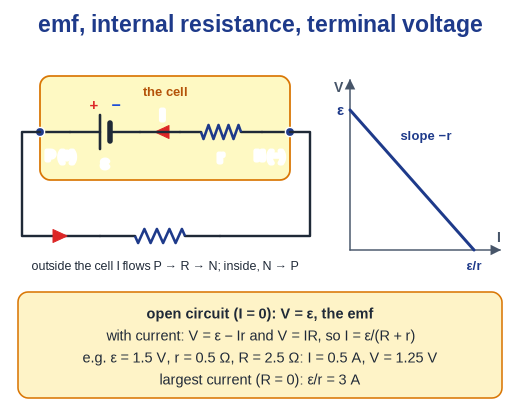
A cell has two electrodes in an electrolyte. With no current flowing, the voltage between its terminals is its emf ε. The electrolyte also resists the current: this is the cell’s internal resistance r. When the cell drives a current I through an outside resistor R, the current also crosses r, inside the cell from the negative electrode to the positive one, so the terminal voltage drops:
V = ε − Ir, and since V = IR, I = ε/(R + r)
For ε = 1.5 V, r = 0.5 Ω and R = 2.5 Ω: I = 0.5 A and V = 1.25 V. Joining the terminals directly (R = 0) gives the largest current, ε/r = 3 A, which would damage a real cell.
How do cells combine?
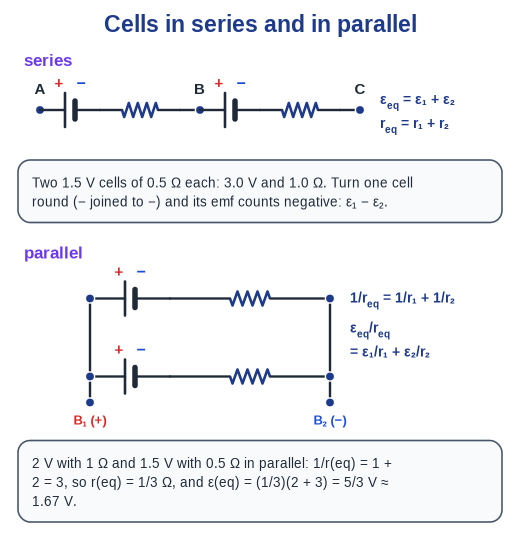
In series, the − terminal of one cell joins the + of the next, and the same current passes through both. Their terminal voltages add, so the pair acts like one cell with εeq = ε₁ + ε₂ and req = r₁ + r₂. If one cell is turned round, its emf enters with a minus sign: ε₁ − ε₂.
In parallel, the + terminals are joined and so are the − terminals. Both cells have the same terminal voltage V, and their currents add. Writing I₁ = (ε₁ − V)/r₁ and I₂ = (ε₂ − V)/r₂ and comparing with V = εeq − Ireq gives
1/req = 1/r₁ + 1/r₂ and εeq/req = ε₁/r₁ + ε₂/r₂
A 2 V cell of 1 Ω with a 1.5 V cell of 0.5 Ω gives req = 1/3 Ω and εeq = 5/3 V.
What are Kirchhoff’s two rules?
Mark a current, with an arrow, in every branch. Then:
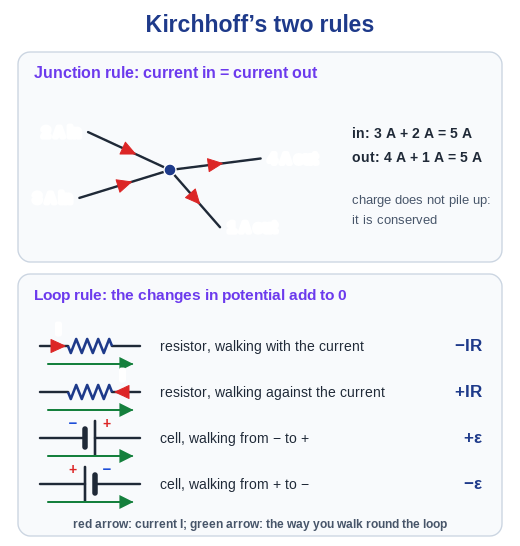
- Junction rule: at every junction, the currents flowing in add up to the currents flowing out. Steady currents cannot pile up charge anywhere.
- Loop rule: walking round any closed loop, the changes in potential add up to zero, since the potential is back where it started.
Signs for the loop rule: a resistor crossed along its current gives −IR, and against it +IR; a cell crossed from − to + gives +ε, and from + to − gives −ε.
How do you solve a circuit with them?
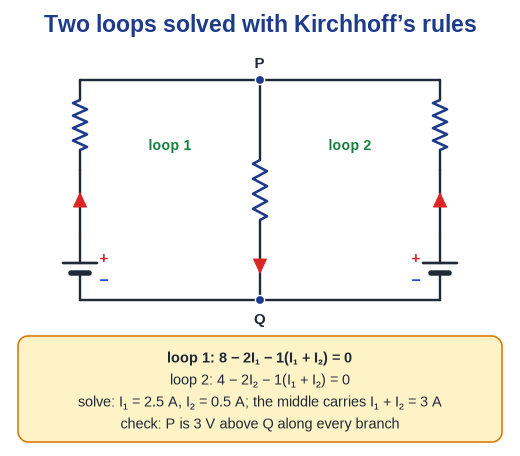
Take an 8 V cell with a 2 Ω resistor in one branch, a 4 V cell with 2 Ω in a second, and 1 Ω in the middle branch, all three joining the same two points P and Q.
- Junction rule at P: if I₁ and I₂ flow up the outer branches, I₁ + I₂ flows down the middle.
- Loop rule on the left loop: 8 − 2I₁ − 1(I₁ + I₂) = 0.
- Loop rule on the right loop: 4 − 2I₂ − 1(I₁ + I₂) = 0.
- Solving: I₁ = 2.5 A, I₂ = 0.5 A and 3 A in the middle. Check: P is 3 V above Q along each branch.
What is the Wheatstone bridge?
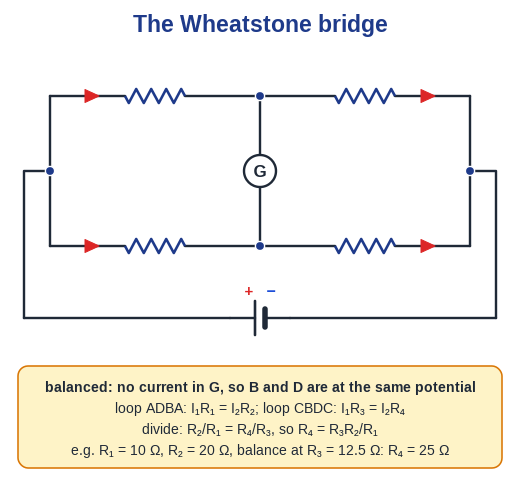
Four resistors form a loop A–B–C–D: R₂ from A to B, R₄ from B to C, R₁ from A to D and R₃ from D to C. A cell joins A and C, and a galvanometer joins B and D. The bridge is balanced when the galvanometer shows no current. Then the junction rule at B and D gives I₄ = I₂ and I₃ = I₁. The loop through A, D, B gives I₁R₁ = I₂R₂, and the loop through C, B, D gives I₁R₃ = I₂R₄. Dividing one by the other:
R₂/R₁ = R₄/R₃
To measure an unknown R₄, keep R₁ and R₂ fixed and vary R₃ until the galvanometer reads zero; then R₄ = R₃R₂/R₁. With R₁ = 10 Ω, R₂ = 20 Ω and balance at R₃ = 12.5 Ω, R₄ = 25 Ω.
Previous topic: the temperature dependence of resistivity and electrical power. See also the chapter notes and the NCERT solutions.
Practice
-
A cell of emf ε and internal resistance r supplies a current I. Its terminal voltage is:
Show answer
Answer: (b) ε − Ir
-
Two identical cells, each of emf ε and internal resistance r, are joined in parallel. The combination has:
Show answer
Answer: (b) emf ε, resistance r/2
-
Kirchhoff’s loop rule holds because:
Show answer
Answer: (b) the potential at a point has a single value
-
A cell of emf 6 V and internal resistance 0.5 Ω is joined to a 2.5 Ω resistor. Find the current and the terminal voltage.
Show answer
Answer: I = ε/(R + r) = 6/(2.5 + 0.5) = 2 A. V = ε − Ir = 6 − 2 × 0.5 = 5 V (check: IR = 2 × 2.5 = 5 V).
-
In a Wheatstone bridge R₁ = 100 Ω and R₂ = 10 Ω, and the galvanometer reads zero when R₃ = 470 Ω. Find R₄.
Show answer
Answer: R₄ = R₃R₂/R₁ = 470 × 10/100 = 47 Ω.
Questions students ask
What is the difference between emf and terminal voltage?
The emf ε is the voltage between the terminals when no current flows. When the cell supplies a current I, part of the voltage is used up across its internal resistance, so the terminal voltage is less: V = ε − Ir.
What do Kirchhoff’s rules conserve?
The junction rule rests on the conservation of charge: with steady currents, charge cannot pile up at a junction. The loop rule rests on the potential having one value at each point, so going round a loop and back brings no net change, which is energy conservation for a unit charge.
When is a Wheatstone bridge balanced?
When no current flows through the galvanometer, that is when R₂/R₁ = R₄/R₃. Then B and D are at the same potential, and one unknown resistance can be found from the other three.
How many loop equations do I need for a circuit?
As many as there are unknown currents left after using the junction rule. Extra loops give no new information; they only serve as a check.
Stuck on a question?
Take a photo and Lagnever AI explains it step by step. Try it for 7 days for ₹2.
Get it on Google Play Open in browser
For parents: after the trial, the plan renews monthly by UPI or card autopay. You can cancel anytime in the app.