
How does resistivity change with temperature, and what is electrical power?
Answer in short
Over a limited range, a metal’s resistivity rises linearly with temperature, ρ_T = ρ₀[1 + α(T − T₀)] with α positive, because hotter electrons collide more often. Alloys such as nichrome barely change; semiconductors fall. A current I through a resistance R turns electrical energy into heat at the rate P = VI = I²R = V²/R.
Stuck on a question? Take a photo and Lagnever AI explains it step by step. Try it for 7 days for ₹2. Get it on Google Play
How do materials compare in resistivity?
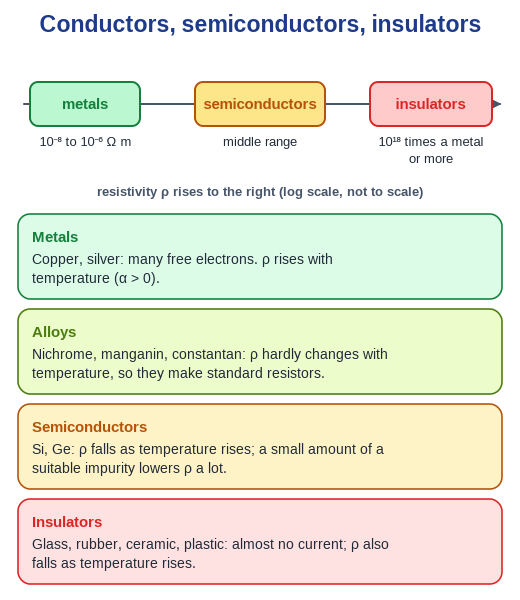
Sorted by resistivity, from small to large, materials are conductors, semiconductors and insulators. Metals have resistivities of about 10⁻⁸ to 10⁻⁶ Ω m. Insulators such as ceramic, rubber and plastic have resistivities at least 10¹⁸ times those of metals. Semiconductors lie in between, and two things make them special: their resistivity falls as they warm up, and a small amount of a suitable impurity lowers it a great deal. Electronic devices are built on that second fact.
How does the resistivity of a metal change with temperature?
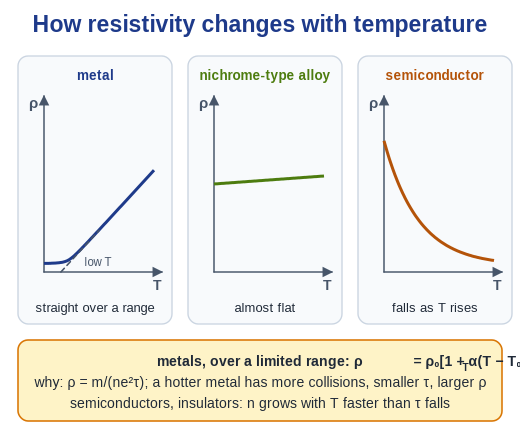
Within a moderate range of temperature, a metal’s resistivity rises almost in a straight line:
ρT = ρ₀[1 + α(T − T₀)]
ρ₀ is the resistivity at a reference temperature T₀, and α is the temperature coefficient of resistivity, the fractional rise in ρ per degree, with unit °C⁻¹ (or K⁻¹). For metals α is positive. The straight line is only an approximation near T₀; far below 0 °C the real graph curves away from it.
Since a wire’s length and area change very little on heating, its resistance follows the same rule, RT = R₀[1 + α(T − T₀)]. A wire of 10 Ω at 20 °C with α = 4 × 10⁻³ °C⁻¹ has 10 × (1 + 0.2) = 12 Ω at 70 °C.
The book uses this to find hot temperatures from resistance. A toaster’s nichrome element, 75.3 Ω at 27.0 °C, draws a steady 2.68 A on 230 V, so it settles at about 847 °C (Example 3.3). A platinum wire of 5 Ω at the ice point and 5.23 Ω at the steam point reads 5.795 Ω in a hot bath, which is at 345.65 °C (Example 3.4).
Why do metals and semiconductors behave differently?
The drift picture gives ρ = m/(ne²τ). Resistivity is large when there are few carriers (small n) or when they collide often (small τ).
- Metals: n is fixed by the metal and hardly changes with temperature. Heating makes the electrons move faster, so they collide more often and τ falls. So ρ rises.
- Semiconductors and insulators: heating frees more carriers, so n rises. This rise outweighs the fall in τ, so ρ falls.
- Alloys such as nichrome (nickel, iron and chromium), manganin and constantan change very little with temperature. That is why standard wire-wound resistors are made from them.
What is electrical power?
Let a current I flow through a conductor from A to B, with a potential difference V between them. In time Δt a charge ΔQ = IΔt moves from A to B and loses potential energy ΔQ × V = IVΔt. If nothing stopped them, the charges would speed up and gain that much kinetic energy. But collisions keep them at a steady drift, so the energy passes to the ions, which vibrate harder: the conductor heats up. The heat produced in Δt is IVΔt, and the power is
P = VI = I²R = V²/R
using V = IR. This is the ohmic loss. It makes a heater coil and a bulb filament glow. A 60 W bulb on 230 V has R = (230)²/60 ≈ 882 Ω when lit and draws about 0.26 A. A 1000 W heater running for 2 hours turns 1000 × 7200 = 7.2 × 10⁶ J into heat. The energy comes from the source that keeps the current going, for a cell its chemical energy.
Why is power sent at a high voltage?
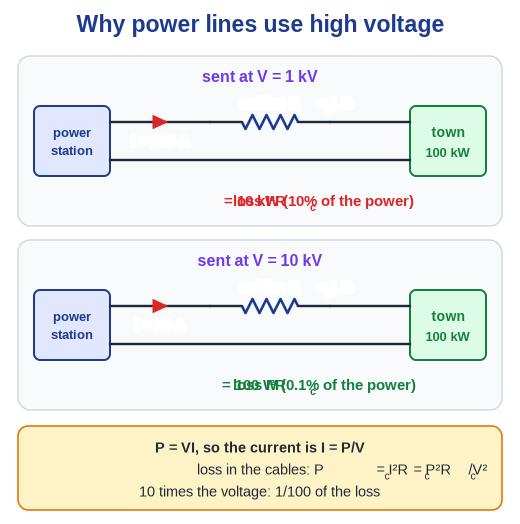
A town needs a power P = VI at the end of cables with resistance Rc. The current in the cables is I = P/V, so the power wasted in them is
Pc = I²Rc = P²Rc/V²
The loss falls as 1/V². Sending 100 kW through 1 Ω of cable loses 10 kW at 1 kV but only 100 W at 10 kV. So transmission lines run at very high voltages (hence the danger signs on their towers), and a transformer lowers the voltage to a safe value near the user.
Previous topic: drift velocity and Ohm’s law. Next topic: Kirchhoff’s rules and the Wheatstone bridge. See also the chapter notes and the NCERT solutions.
Practice
-
The SI unit of the temperature coefficient of resistivity α is:
Show answer
Answer: (b) °C⁻¹ (or K⁻¹)
-
When a piece of pure semiconductor is warmed, its resistivity:
Show answer
Answer: (b) falls
-
At a fixed voltage, a heater coil is replaced by one of twice the resistance. The power becomes:
Show answer
Answer: (b) half
-
A wire has a resistance of 10 Ω at 20 °C and α = 4 × 10⁻³ °C⁻¹. Find its resistance at 70 °C.
Show answer
Answer: R = 10[1 + 4 × 10⁻³ × (70 − 20)] = 10 × 1.2 = 12 Ω.
-
A bulb is rated 60 W at 230 V. Find its resistance when lit and the current it draws.
Show answer
Answer: R = V²/P = (230)²/60 ≈ 882 Ω, and I = P/V = 60/230 ≈ 0.26 A.
Questions students ask
Why does the resistance of a metal increase with temperature?
In a metal, ρ = m/(ne²τ). Heating makes the electrons move faster, so they collide more often and the relaxation time τ gets shorter, while the number of free electrons n hardly changes. A shorter τ means a larger resistivity.
Why are nichrome, manganin and constantan used in standard resistors?
Their resistivity changes very little with temperature, so a resistor made from them keeps nearly the same value as it warms up during use.
Why is electric power transmitted at very high voltage?
For a given power P = VI, a higher voltage needs a smaller current. The loss in the cables is I²R_c = P²R_c/V², so raising V cuts the loss sharply. Transformers lower the voltage again before the power is used.
What is the temperature coefficient of resistivity?
It is the fractional increase in resistivity for each degree rise in temperature, α in ρ_T = ρ₀[1 + α(T − T₀)]. Its unit is per degree Celsius (or per kelvin).
Stuck on a question?
Take a photo and Lagnever AI explains it step by step. Try it for 7 days for ₹2.
Get it on Google Play Open in browser
For parents: after the trial, the plan renews monthly by UPI or card autopay. You can cancel anytime in the app.