
What is an angle?
Answer in short
An angle is formed by two rays that start from the same point. The common starting point is the vertex and the two rays are the arms. ∠DBE has vertex B and arms BD and BE. Its size is the amount of turn about the vertex from one arm to the other, not the length of the arms.
Stuck on a question? Take a photo and Lagnever AI explains it step by step. Try it for 7 days for ₹2. Get it on Google Play
Two rays and a vertex
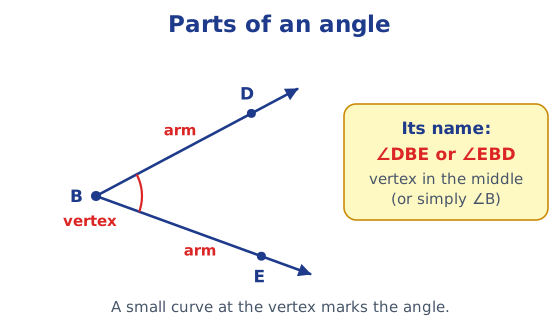
An angle is formed by two rays having a common starting point. In the figure, rays BD and BE both start at B. The point B is the vertex of the angle, and the rays BD and BE are its arms.
Naming an angle
We can call it simply angle B. To be clearer, we use a point on each arm with the vertex: angle DBE or angle EBD, written ∠DBE or ∠EBD. The vertex is always the middle letter. A small curve drawn at the vertex shows which angle we mean.
Using three letters matters when several angles share a vertex. If rays PA, PB and PC all start from P, there are three angles at P: ∠APB, ∠BPC and ∠APC. Writing ∠P would not tell which one you mean, so ∠APB cannot be labelled ∠P.
The size of an angle is a turn
Watch Vidya opening the cover of her book. At first the cover is lifted only a little; then more and more, until it lies flat on the table, and finally it goes all the way round when she folds it back to write while holding the book. Each time the angle between the cover and the pages grows, because she rotates the cover more.
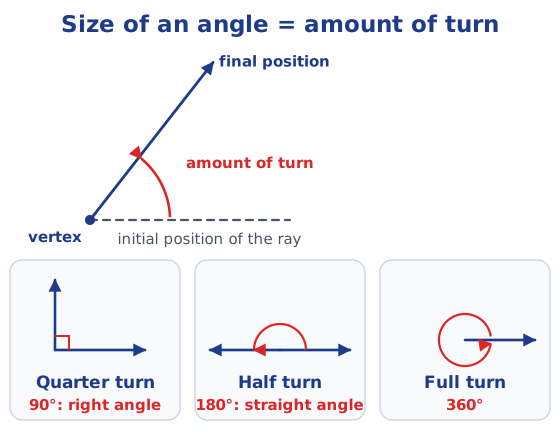
Just as we talk about the size of a line segment by its length, we talk about the size of an angle by its amount of rotation: the turn about the vertex needed to move the first ray onto the second.
Angles around us
Angles appear wherever one part turns against another:
- In a compass or divider, the arms turn about the joint, which is the vertex.
- A pair of scissors opens about the screw; the blades are the arms.
- Spectacles, a wallet, a stapler, a pencil box and a box lid all open to make angles.
- The frame of a bicycle makes angles where its tubes meet, for example ∠BDC at the pedal joint D.
Comparing angles
Some angles are easy to compare by looking, like animals opening their mouths wide or narrow. But 89° and 91° look almost the same, so we need a method.
Superimposition: trace one angle and place it on the other so that the vertices coincide and one arm lies on top of the other arm. The angle whose second arm lies outside the other is the larger one. If the second arms also lie on top of each other, the angles are equal: the same turn is needed in both.
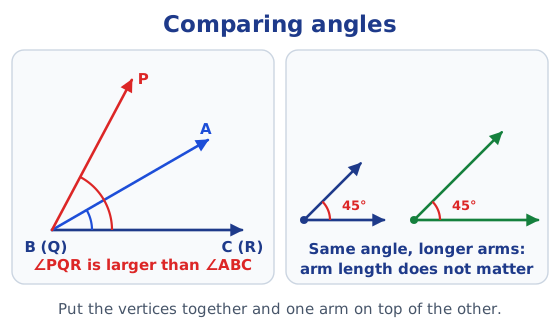
Without tracing: place a transparent circle with its centre on the vertex of one angle, mark where the arms cross the circle, then move the circle to the other angle. This is how the book settles which crane opens its beak wider.
Arm length does not matter
Make ‘rotating arms’ from two paper straws and a paper clip, set them at different angles, and try to pass them through an angle-shaped slit cut in cardboard. Only the pair whose angle exactly matches the slit passes through, whatever the length of the straws. So an angle stays the same however long its arms are drawn.
Counting angles from points
Mark three points A, B and C not on one line and draw lines through each pair: you get 3 lines (AB, BC, CA) and can name 3 angles: ∠ABC, ∠BCA and ∠CAB. With four points, no three on a line, you get 6 lines and can name 12 angles, three at each point.
Next, see how angles are grouped by size in types of angles, or go back to the Chapter 2 notes.
Practice
-
In ∠XYZ, the arms are:
Show answer
Answer: (b) YX and YZ
-
The size of an angle depends on:
Show answer
Answer: (b) the amount of turn between its arms
-
Three points A, B, C are not on one line. How many angles can you name using only these letters?
Show answer
Answer: (c) 3
-
Rays PA, PB and PC start from P. Why can't ∠APB be called ∠P?
Show answer
Answer: Three angles have vertex P: ∠APB, ∠BPC and ∠APC. Writing ∠P would not tell which one is meant, so three letters are needed.
-
Name the arms and the vertex of the angle made by the blades of an open pair of scissors.
Show answer
Answer: The vertex is the screw where the blades are joined; the two blades are the arms.
Questions students ask
What is an angle?
An angle is formed by two rays having a common starting point. The starting point is called the vertex and the rays are called the arms. Its size is the amount of rotation about the vertex needed to move one arm onto the other.
How do we name an angle?
Use a point on each arm with the vertex in the middle, like ∠DBE or ∠EBD for the angle at B between rays BD and BE. If only one angle has that vertex, ∠B is enough. A small curve at the vertex shows which angle is meant.
How can we compare two angles?
By superimposition: trace one angle and place it on the other so that the vertices and one pair of arms coincide. The angle whose other arm lies outside is larger. A transparent circle with its centre on the vertex can also be used.
Stuck on a question?
Take a photo and Lagnever AI explains it step by step. Try it for 7 days for ₹2.
Get it on Google Play Open in browser
For parents: after the trial, the plan renews monthly by UPI or card autopay. You can cancel anytime in the app.