
Class 6 Maths Chapter 2: Lines and Angles Notes
This chapter in five lines
A point marks a location; a line segment joins two points by the shortest path; a line goes on forever both ways and a ray goes on forever one way from its starting point. An angle is formed by two rays with a common starting point, the vertex, and its size is the amount of turn from one arm to the other. Angles are measured in degrees with a protractor: a full turn is 360°, a straight angle 180° and a right angle 90°. Angles are acute, right, obtuse, straight or reflex.
Points, line segments, lines and rays
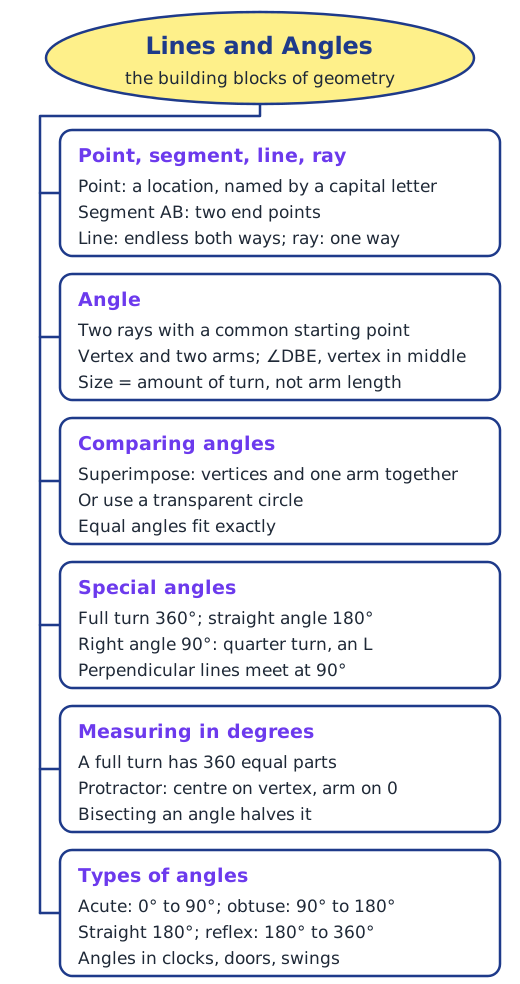
These are the building blocks of plane geometry. A point is a precise location: the tip of a sharp pencil or a needle gives an idea of it. It has no length, breadth or height and is named by a capital letter, like point P.
Fold a paper and unfold it: the crease gives the idea of a line segment. Of all the routes between two points A and B, the shortest is the line segment AB, with end points A and B. Extend it forever beyond both ends and you get a line AB, sometimes named by one small letter like l. A ray starts at a point and goes on forever in one direction, like light from a torch, a lighthouse or the Sun. Ray AP starts at A and passes through P.
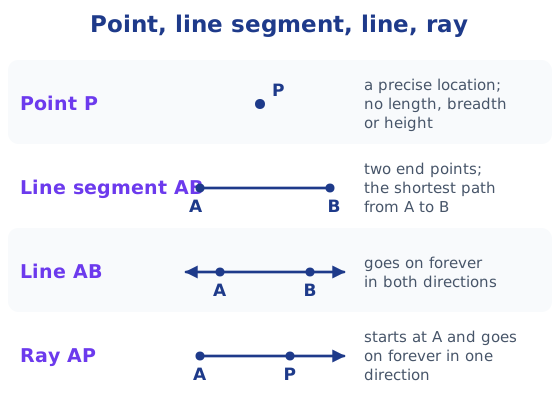
Through one point you can draw as many lines as you like, but through two points there is exactly one line. Read more in point, line, line segment and ray.
Angles
An angle is formed by two rays with a common starting point. In ∠DBE, the rays BD and BE are the arms and B is the vertex. We write the vertex in the middle: ∠DBE or ∠EBD, or simply ∠B when there is no confusion.
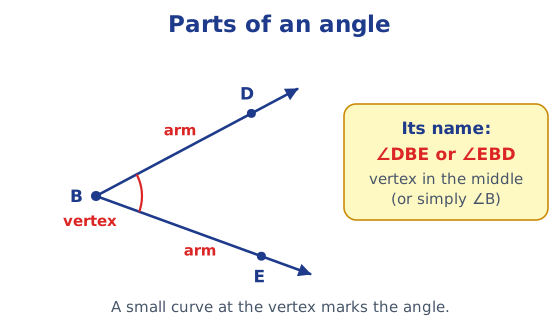
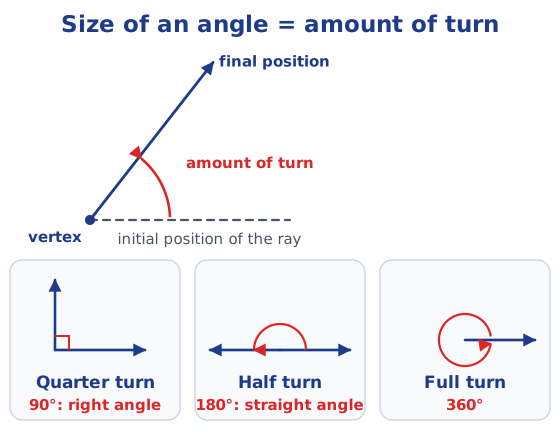
As Vidya opens the cover of her book further and further, the angle grows. The size of an angle is the amount of rotation, or turn, about the vertex needed to move one arm onto the other. A compass, a pair of scissors, spectacles, a wallet and a box lid all make angles by turning one arm against the other. Read more in what is an angle.
Comparing angles
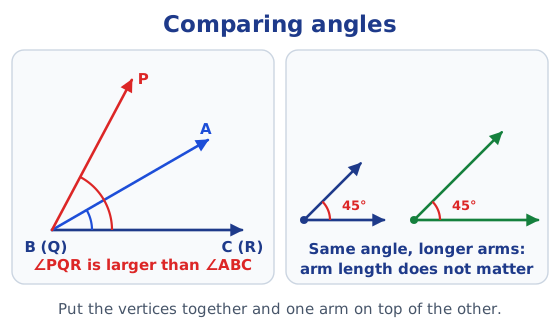
Two angles can be compared by superimposition: place one on the other with the vertices together and one arm on top of the other. If the other arms also coincide, the angles are equal. A transparent circle placed with its centre on the vertex also helps compare angles without tracing them. The ‘rotating arms’ activity shows that only arms with exactly the same angle pass through an angle-shaped slit, whatever their length.
Special angles
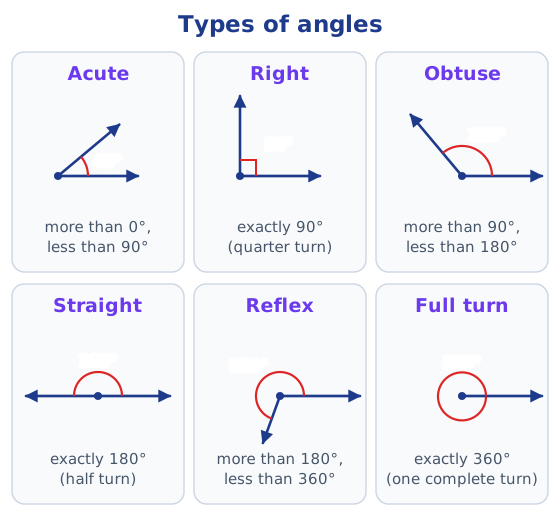
When Vidya opens her book flat on the table, the cover makes a half turn and its arms lie in a straight line: a straight angle. Folding a straight angle so that its arms overlap gives two equal angles, each a right angle: a quarter turn, shaped like an L. Two lines meeting at a right angle are perpendicular. Angles smaller than a right angle are acute (sharp); angles between a right angle and a straight angle are obtuse (blunt). Read more in types of angles.
Measuring angles in degrees
Mathematicians divided a full turn into 360 equal parts, each 1 degree (1°). So a full turn is 360°, a straight angle 180° and a right angle 90°. The number 360 is ancient: the Rigveda speaks of a wheel with 360 spokes, many old calendars had 360 days, and 360 can be divided evenly by every number from 1 to 10 except 7.
A protractor shows 180 equal parts on a half circle, with long marks every 10° and medium marks every 5°. It has two sets of numbers, one running each way, so that you can start from 0 on either side.
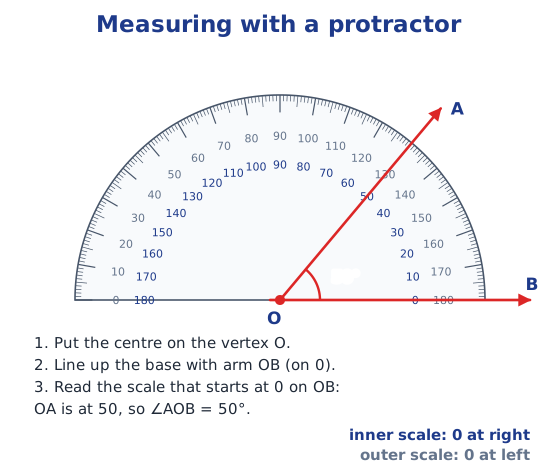
You can also make a paper protractor by folding a semicircle in half again and again: the creases mark 90°, then 45° and 135°, then every 22.5°. Getting half of an angle by folding is called bisecting it, and the crease is the angle bisector. To draw ∠TIN = 30°, draw IN, place the protractor’s centre on I with IN on 0, mark T at 30 and join IT. Read more in how to measure an angle with a protractor.
Types of angles and their measures
| Type | Measure |
|---|---|
| Acute | more than 0° and less than 90° |
| Right | exactly 90° |
| Obtuse | more than 90° and less than 180° |
| Straight | exactly 180° |
| Reflex | more than 180° and less than 360° |
| Full turn | exactly 360° |
Angles around us
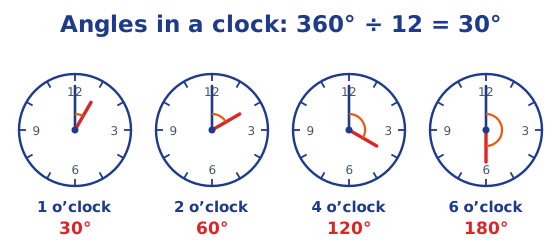
The hands of a clock, a door opening on its hinges, a swing pulled back and the slope of a slide all make angles. The 12 marks on a clock split 360° into 30° parts, so at 1 o’clock the hands make 30° and at 6 o’clock 180°. The 24 spokes of the Ashoka Chakra make 15° gaps.
Answers to every “Figure it Out” question are in the NCERT solutions for Chapter 2.
Key terms
| Term | Meaning |
|---|---|
| Point | A precise location with no length, breadth or height, named by a capital letter such as P. |
| Line segment | The shortest path between two points, including them. Segment AB has two end points, A and B. |
| Line | A line segment extended forever in both directions. Any two points fix exactly one line through them. |
| Ray | A part of a line that starts at one point and goes on forever in one direction, like a beam of light. |
| Angle | The figure formed by two rays with a common starting point. ∠DBE is formed by rays BD and BE. |
| Vertex and arms | The common starting point of the two rays is the vertex; the rays are the arms of the angle. |
| Degree (°) | The unit of angle measure. A full turn is divided into 360 equal parts, and each part is 1°. |
| Protractor | A tool marked in degrees, usually a half circle with 180 equal parts, used to measure and draw angles. |
| Right angle | An angle of 90°, a quarter turn, shaped like an L. Two lines meeting at a right angle are perpendicular. |
| Straight angle | An angle of 180°, a half turn, whose arms lie in a straight line. |
| Acute and obtuse angles | An acute angle is more than 0° and less than 90°; an obtuse angle is more than 90° and less than 180°. |
| Reflex angle | An angle of more than 180° and less than 360°. |
| Angle bisector | The line that divides an angle into two equal angles. Folding an angle so its arms overlap bisects it. |
Topics in this chapter
Practice
-
How many lines can pass through two given points?
Show answer
Answer: (b) Exactly one
-
In ∠PQR, the vertex is:
Show answer
Answer: (b) Q
-
A straight angle measures:
Show answer
Answer: (b) 180°
-
An angle of 135° is:
Show answer
Answer: (c) obtuse
-
What is the angle between the hands of a clock at 3 o'clock?
Show answer
Answer: (c) 90°
Questions students ask
What are the main topics of Class 6 Maths Chapter 2?
Points, line segments, lines and rays; angles, their vertex and arms; comparing angles; right and straight angles; measuring and drawing angles in degrees with a protractor; and acute, obtuse and reflex angles.
Is Lines and Angles in the new Ganita Prakash book?
Yes. Lines and Angles is Chapter 2 of Ganita Prakash, the Class 6 Maths textbook (Reprint 2026-27). It comes after Chapter 1, Patterns in Mathematics.
How many questions does Chapter 2 have?
There is no single exercise at the end: the questions come in many “Figure it Out” sets through the chapter, with a puzzle and the Ashoka Chakra question at the end. Our NCERT solutions page answers all of them and checks them against NCERT's own answers.
Stuck on a question?
Take a photo and Lagnever AI explains it step by step. Try it for 7 days for ₹2.
Get it on Google Play Open in browser
For parents: after the trial, the plan renews monthly by UPI or card autopay. You can cancel anytime in the app.