
How do you measure an angle with a protractor?
Answer in short
Place the centre of the protractor on the vertex of the angle and line up its base so that one arm passes through 0. Then read where the other arm crosses the scale, using the set of numbers that starts at 0 on the first arm. Angles are measured in degrees: a full turn is 360°.
Stuck on a question? Take a photo and Lagnever AI explains it step by step. Try it for 7 days for ₹2. Get it on Google Play
Degrees
To give every angle a number, mathematicians divided the angle around the centre of a circle into 360 equal parts. Each part is 1 degree, written 1°. The measure of an angle is the number of 1° parts it contains: an angle holding 30 such parts measures 30°.
- A full turn contains 360 parts: 360°.
- A straight angle, half a full turn, is 180°.
- A right angle, half a straight angle, is 90°.
Why 360? The reason is not fully known. The Rigveda, among the oldest texts of humanity, speaks of a wheel with 360 spokes; calendars of India, Persia, Babylonia and Egypt over 3,000 years old had 360 days; and Babylonian mathematicians counted in 60s. Above all, 360 can be divided evenly by every number from 1 to 10 except 7, and by 12 and 24, so a circle splits neatly into many equal parts.
The protractor
A protractor is a half circle divided into 180 equal parts of 1° (some protractors are full circles of 360°). Starting from the rightmost point of the base, there is a long mark every 10° and a medium mark every 5°, so you can count in 10s and 5s. A labelled protractor has two sets of numbers: one increases from right to left, the other from left to right. This lets you measure an angle whichever way it opens.
Measuring an angle
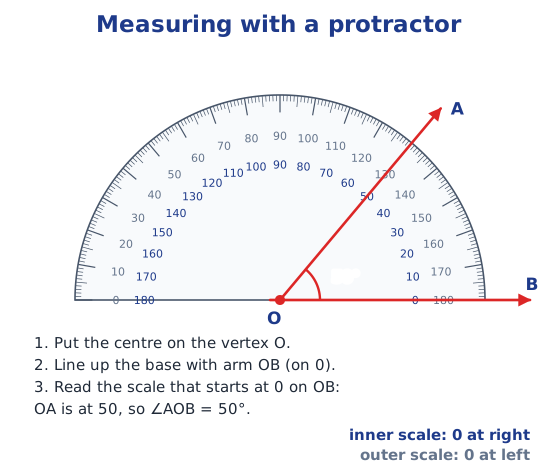
- Place the centre of the protractor exactly on the vertex.
- Turn the protractor so that one arm passes through 0 along the base line.
- Find where the other arm crosses the scale and read the number on the scale that starts at 0 on the first arm.
If neither arm is on 0, you can still find the angle by subtraction. In the book’s example, arms OT and OS pass through 20 and 55 on the outer scale, so ∠TOS = 55° − 20° = 35°.
To measure a reflex angle, measure the smaller angle between the same arms and subtract it from 360°. If the smaller angle is 100°, the reflex angle is 260°.
Drawing an angle
To draw ∠TIN = 30°:
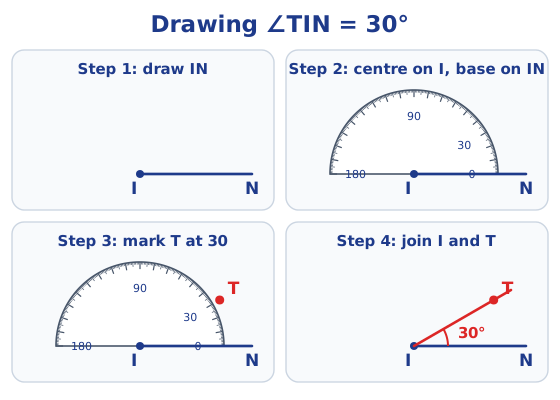
- Draw the arm IN with a ruler.
- Place the protractor’s centre on I with IN along the 0 line.
- Counting up from 0 on that scale, mark a point T at 30.
- Join I and T with a ruler. ∠TIN = 30° is ready.
Common mistakes to avoid
The book’s ‘Mind the Mistake’ shows a student making these errors:
- Neither arm on 0: reading where one arm crosses the scale gives the wrong answer if the other arm is not on 0. Turn the protractor, or subtract the two readings.
- Centre not on the vertex: the reading is meaningless if the protractor’s centre sits on the end of an arm or anywhere other than the vertex.
- Wrong scale: after lining an arm up with an outer 0, reading the inner numbers gives 180° minus the right answer.
Make your own protractor
Cut out a paper circle, fold it in half and cut along the crease to get a semicircle marked 0° and 180° at the ends. Folding it in half gives 90°; folding again gives 45° and 135°; once more gives every 22.5°. Getting half of an angle by folding is called bisecting it, and the crease is the angle bisector.
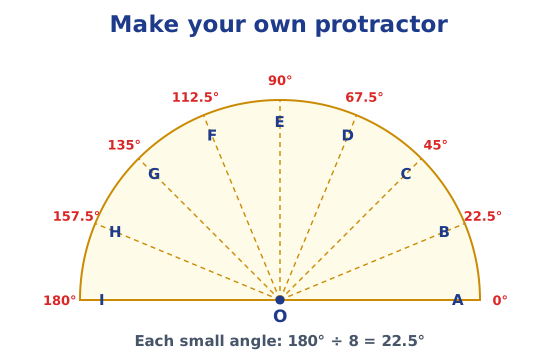
A paper protractor can only read angles that land on its creases, which is why a marked protractor is needed for angles like 42° or 116°. For angle types, see types of angles; for the textbook’s questions, see the Chapter 2 NCERT solutions.
Practice
-
How many degrees make a full turn?
Show answer
Answer: (d) 360°
-
When measuring an angle, the centre of the protractor must be on:
Show answer
Answer: (b) the vertex
-
OT passes through 20 and OS through 55 on the same scale. ∠TOS is:
Show answer
Answer: (b) 35°
-
The smaller angle between two arms is 100°. What is the reflex angle between them?
Show answer
Answer: 360° − 100° = 260°.
-
List the steps to draw an angle of 30°.
Show answer
Answer: Draw a ray IN. Put the protractor's centre on I with IN along 0. Count up from 0 to 30 on that scale and mark T. Join I and T with a ruler: ∠TIN = 30°.
Questions students ask
Why does a protractor have two sets of numbers?
So that you can measure from either side. One scale starts at 0 on the right and the other at 0 on the left. Always use the scale whose 0 lies on one arm of your angle.
Why is a full turn 360 degrees?
The exact reason is not known. The Rigveda speaks of a wheel with 360 spokes, many ancient calendars had 360 days, and Babylonian mathematicians counted in 60s. Also, 360 can be divided evenly by every number from 1 to 10 except 7, and by 12 and 24, which makes it very convenient.
How do you measure a reflex angle with a protractor?
Measure the smaller angle between the two arms, then subtract it from 360°. For example, if the smaller angle is 100°, the reflex angle is 360° − 100° = 260°.
Stuck on a question?
Take a photo and Lagnever AI explains it step by step. Try it for 7 days for ₹2.
Get it on Google Play Open in browser
For parents: after the trial, the plan renews monthly by UPI or card autopay. You can cancel anytime in the app.