
NCERT Solutions Class 6 Maths Chapter 2: Lines and Angles
Answers to every “Figure it Out” question in Chapter 2, Lines and Angles, of Ganita Prakash (Reprint 2026-27), with the in-text questions, the protractor activities and the puzzle. The page numbers match the book, and the answers are checked against NCERT’s own solutions printed with the chapter. Where a question asks you to measure a figure, small differences of a degree or two are normal. Short notes: Chapter 2 notes.
Figure it Out: points, segments, lines and rays (pages 15–17)
1. Rihan and Sheetal. Through Rihan’s one point, infinitely many lines can be drawn. Through Sheetal’s two points, exactly one line can be drawn.
2. Fig. 2.4. The line segments are LM, MP, PQ and QR. Points L and R lie on exactly one segment; M, P and Q lie on two segments each.
3. Fig. 2.5. The rays are TA, TN, TB and NB (TN and TB point the same way along one path). T is the starting point of TA, TN and TB, but not of NB, which starts at N.
4. Rough figures:
- a. Draw two lines crossing at a point O, one through P and one through Q.
- b. Draw a line through P and Q, and a ray starting at X and passing through Y that crosses the line at a point M.
- c. Draw a line l through points E and F, and mark a point D away from it.
- d. Draw a segment AB and mark a point P between A and B.
5. Fig. 2.6.
- a. Five points: D, E, O, B and C.
- b. A line: DB (it can also be named DE, DO, EO, EB or OB).
- c. Four rays: OC, OB, OE and OD.
- d. Five line segments: DE, DO, DB, EO and EB (OB and OC are also possible).
6. Ray OA through B. a. Yes: it starts at O and B lies on it in the same direction, so OA and OB are the same ray. b. No: OA starts at O, but AO would start at A and point towards O, a different ray.
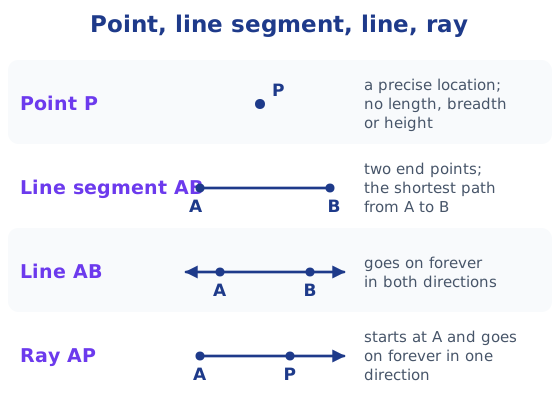
Figure it Out: angles (pages 19–21)
1. Angles in the pictures. Yes. In the bicycle, one angle is ∠BDC, with vertex D and arms DB and DC. The ladder, the bridge and the wooden crate also have angles wherever two bars or planks meet.
2. An angle with arms ST and SR. Draw rays ST and SR from the same point S. The angle is ∠TSR (or ∠RST), with vertex S.
3. Why ∠APB cannot be called ∠P. Three rays start from P, so three angles have vertex P: ∠APB, ∠BPC and ∠APC. ‘∠P’ would not tell which one is meant.
4. The marked angles are ∠RTQ and ∠RTP.
5. Three points A, B, C, not on one line. You get 3 lines: AB, BC and CA. You can name 3 angles: ∠ABC, ∠BCA and ∠CAB.
6. Four points, no three on one line. You get 6 lines: AB, BC, CD, DA, AC and BD. You can name 12 angles, three at each point: ∠BAC, ∠CAD, ∠BAD, ∠ABC, ∠ABD, ∠CBD, ∠BCA, ∠ACD, ∠BCD, ∠ADB, ∠ADC and ∠BDC.
Comparing angles (pages 21–23)
Animals opening their mouths. Each mouth is an angle with its vertex at the corner of the mouth and the jaws as arms. From the picture, one order from smallest to largest is: the fish, the crocodile, the snake, and the chick, whose beak is open widest.
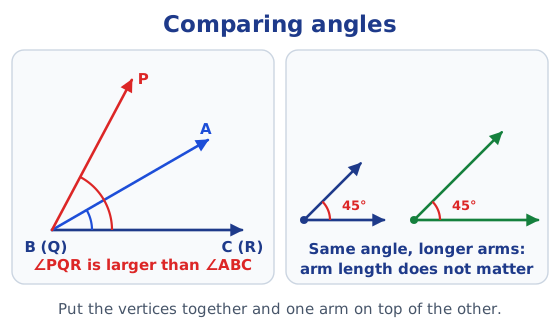
Is it always easy to compare two angles? No. Angles like 89° and 91° look almost the same and can only be compared by superimposing or measuring.
Where else do we use superimposition? To compare line segments, squares, circles and other shapes, for example placing one ruler or coin on another.
Figure it Out (page 23):
1. The folded sheet. The fold EF makes four angles with the sides: ∠AEF, ∠BEF, ∠DFE and ∠CFE. With a slanting fold, ∠AEF and ∠CFE are larger than ∠BEF and ∠DFE. Folding in other ways gives other angles; a fold straight across, parallel to a side, gives four right angles.
2. a. ∠AOB is greater: ∠XOY lies inside it, since ∠AOB = ∠AOX + ∠XOY + ∠YOB. b. ∠AOB is greater, because OX lies inside it. c. Neither: B and C lie on the same ray, so ∠XOB = ∠XOC.
3. ∠XOY or ∠AOB? Here one angle does not lie inside the other, so looking is not enough: superimpose them or measure them. Measured on the book’s figure, ∠XOY is about 105° and ∠AOB about 55°, so ∠XOY is greater.
The two cranes. With the circle’s centre on the vertex and OA along OX, the arm OY falls inside ∠AOB. So the first crane makes the bigger angle.
Special types of angles (pages 27–29)
Can OC split a straight angle into two equal angles? Yes. Fold so that OB lies exactly on OA; the crease OC gives two equal angles, which fit on each other exactly. Each is a right angle.
What part of a full turn is a right angle? One quarter of a full turn (half of a half turn).
Figure it Out (pages 29–31):
1. Right angles in the classroom. Each rectangular window has 4 right angles at its corners, more if it is divided into panes. Doors, the blackboard, desks and book covers also have right angles at their corners.
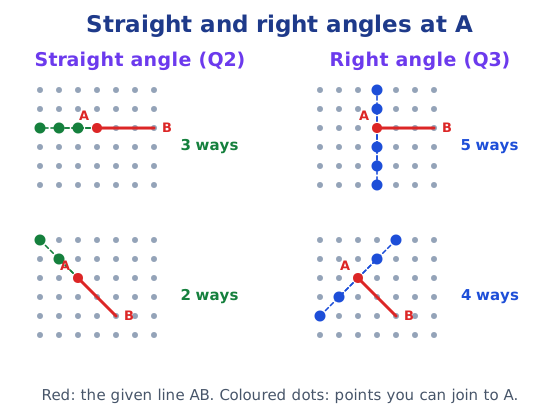
2. Straight angle on the grid. Join A to any dot that lies on line BA extended beyond A. In the first grid, that is any of the 3 dots to the left of A on the same row; in the second grid, either of the 2 dots further up the same slanting line.
3. Right angle on the grid. In the first grid, join A to any of the 2 dots above it or the 3 dots below it in the same column (5 ways). In the second grid, join A to any of the 4 dots on the slanting line through A that crosses AB at right angles.
4. Two perpendicular creases. a. You get 4 right angles. Fold along both creases and the four angles fit exactly on top of one another, so they are equal, and four equal angles make a full turn: each is a quarter turn, a right angle. b. For example: make any slanting fold and crease it. Keeping it folded, fold again so that one part of the first crease lies exactly on the other part, and crease. Unfold: the second crease is perpendicular to the first.
Classifying angles (pages 31–32)
1. Angles in the earlier figures. For example: Vidya’s book cover in Case 1 makes an acute angle and in Case 3, lying flat, a straight angle; the window corners are right angles; ∠ATB in Fig. 2.5 is acute; and in the labelled protractor figure ∠POS (125°) is obtuse.
2. Draw a few angles smaller than a right angle (acute) and a few between a right angle and a straight angle (obtuse), turned in different directions; they keep their type whichever way they face.
3. Why ‘acute’ and ‘obtuse’? Acute means sharp and obtuse means blunt. An acute angle has a narrow opening, like a sharp point; an obtuse angle opens wider than a right angle and looks blunt.
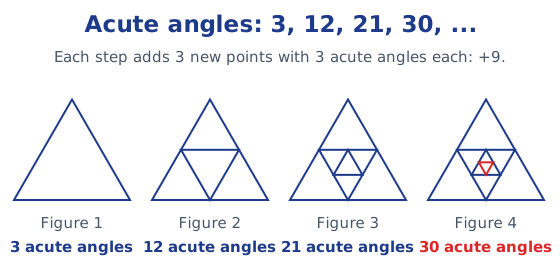
4. Acute angles in the triangles. The figures have 3, 12 and 21 acute angles. The next figure, made by dividing the smallest triangle again, has 30. The count goes up by 9 each time, because each new division adds 3 new points with 3 acute angles each.
Measuring angles (pages 32–37)
A circle divided into equal parts (page 34):
| Parts | 1 | 2 | 3 | 4 | 5 | 6 | 8 | 9 | 10 | 12 |
|---|---|---|---|---|---|---|---|---|---|---|
| Each angle | 360° | 180° | 120° | 90° | 72° | 60° | 45° | 40° | 36° | 30° |
Figure it Out, unlabelled protractor (page 35): a. ∠KAL = 30°; yes, the medium and long marks let you count in 5s and 10s. b. ∠WAL = 50°. c. ∠TAK = 120°.
Why two sets of numbers? So that an angle can be read from 0 on either side: one scale starts at 0 on the right, the other at 0 on the left.
Angles in the labelled protractor figure (page 36):
| Angle | Measure | Angle | Measure |
|---|---|---|---|
| ∠POQ | 35° | ∠QOU | 145° |
| ∠POR | 95° | ∠ROS | 30° |
| ∠POS | 125° | ∠ROT | 65° |
| ∠POT | 160° | ∠ROU | 85° |
| ∠QOR | 60° | ∠SOT | 35° |
| ∠QOS | 90° | ∠SOU | 55° |
| ∠QOT | 125° | ∠TOU | 20° |
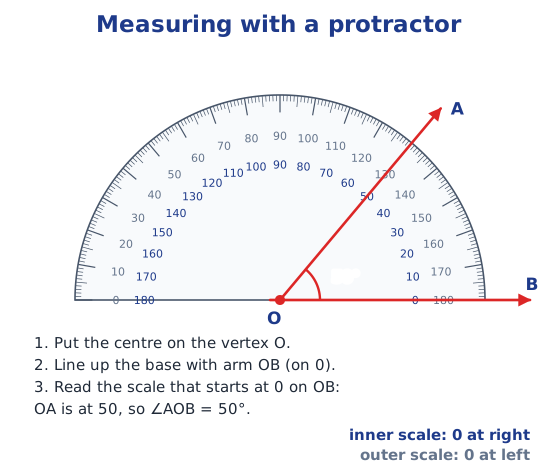
∠TOQ is the same angle as ∠QOT, 125°. For angles with an arm on OP use the inner scale, and for angles with an arm on OU the outer scale. ∠TOS = 55° − 20° = 35°: yes, subtraction works. In the next figure, OB is on 0 and OA passes through 80, so ∠AOB = 80°.
Make your own protractor and Think! (pages 37–40)
Half a turn = ½ of 360° = 180°. A quarter turn = ¼ of 360° = ½ of 180° = 90°. One-eighth of a turn = ⅛ of 360° = ¼ of 180° = ½ of 90° = 45°, giving creases at 45° and 135°. Another half fold gives 22.5°.
Think! ∠AOB = ∠BOC = … = ∠HOI = 22.5°, because the straight angle of 180° has been folded into 8 equal parts: 180° ÷ 8 = 22.5°.
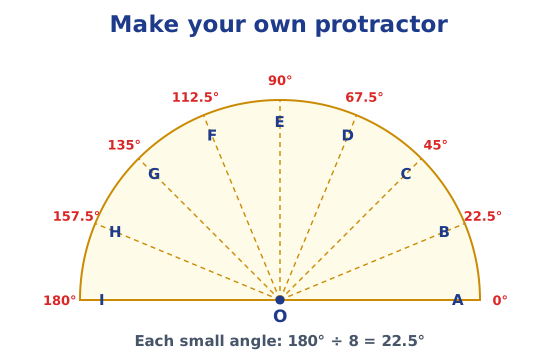
Figure it Out: measuring (pages 40–43)
1. The three angles measure about 47°, 23° (∠GHK, the same as ∠IHJ) and 108°.
2. Answers depend on your classroom: corners of a book or door are 90°; an open door or window may make any angle up to about 180°.
3. ∠IHJ = 42° and ∠IHJ = 116°. A paper protractor cannot measure these exactly, because its creases are only every 22.5°.
4. The marked reflex angle. Measure the angle on the other side of the arms, about 100°, and subtract: 360° − 100° = 260°.
5. a. 80° b. 120° c. 60° d. 130° e. 130° f. 60°.
6. ∠BXE = 115°, ∠CXE = 85°, ∠AXB = 65° and ∠BXC = 30°.
7. ∠PQR = 45°, ∠PQS = 100° and ∠PQT = 150°.
8. The paper craft. The creases of the folded square meet at angles of 45°, 90° and 135°, because folding a square along its diagonal halves its right-angled corners.
9. Angles of a triangle. Measured on the book’s figures: (a) about 45°, 65° and 70°; (b) about 54°, 63° and 63°; (c) about 31°, 52° and 97°. Each set adds up to 180°. Conjecture: the three angles of any triangle add up to 180°.
Mind the Mistake, Mend the Mistake (page 44)
| Angle | What went wrong | Correct measure (about) |
|---|---|---|
| ∠U = 35° | Neither arm lies on the 0 line: one arm is below the base. Turn the protractor so one arm passes through 0. | 60° |
| ∠V = 80° | The lower arm passes through 10, not 0. Subtract: 80° − 10° | 70° |
| ∠W = 70° | The protractor’s centre is on the end of an arm, not on the vertex where the arms meet. | 73° |
| ∠X = 150° | The vertex is not at the protractor’s centre, and the wrong scale was read. | 22° |
| ∠Y = 120° | Neither arm lies on the base line through 0. Turn the protractor so one arm passes through 0. | 145° |
| ∠Z = 85° | One arm lies on 0 of the outer scale, so the outer scale must be read. | 105° |
Where are the angles? (pages 45–46)
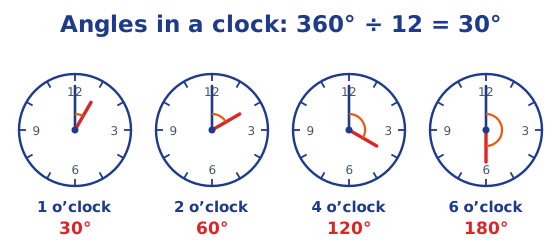
1. Clock. a. The 12 numbers divide the full turn of 360° into 12 equal parts, so the angle between two neighbouring numbers is 360° ÷ 12 = 30°. b. At 2 o’clock, 60°; at 4 o’clock, 120°; at 6 o’clock, 180°. c. At 3 o’clock and at 9 o’clock the hands make a right angle, 90° (measured the other way round at 9 o’clock it is 270°).
2. Door. Yes. The vertex is on the line where the door is hinged to the frame; the arms are the door in its closed position (along the wall) and the door in its open position.
3. Swing. The angle is between the swing’s chains when it hangs straight down at rest and the chains in the position where Vidya starts swinging. Its vertex is the point where the chains hang from the frame.
4. Toy slabs. Yes. For each slab, one arm is the slab’s edge, which you can see, and the other is the vertical side (or an imaginary horizontal line) at the point where the slab is attached, which you cannot see. The greater the angle with the horizontal, the steeper the slope and the faster the balls roll.
5. The rotated insect. Yes. The vertex is the point on the horizontal line about which the insect turns; one arm runs along the horizontal line and the other along the insect’s body after it has rotated. The angle between them is the amount of rotation.
Drawing angles (pages 46–50)
Figure it Out (page 49), 1. Fig. 2.23. Angles include ∠CAP, ∠ACD, ∠APL, ∠DLP, ∠RPL, ∠SLP, ∠PRS, ∠LSR, ∠BRS and ∠CLP, and more such as ∠BAC and ∠PLS. Guess each, then measure and compare in a table.
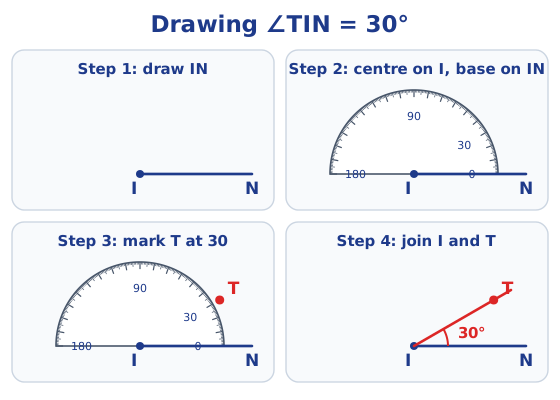
2. Drawing 110°, 40°, 75°, 112° and 134°. Draw a ray, place the protractor’s centre on its starting point with the ray on 0, count up from 0 on that scale to the required number, mark a point and join it to the vertex.
3. Copying ∠HIJ. Measure it first: it is about 116°. Then draw a ray, put the protractor’s centre on its starting point with the ray on 0, mark 116 on that scale and join the mark to the vertex.
Types of angles and their measures (pages 50–54)
Figure it Out (pages 51–52), 1. Grids. With AB pointing right in the first grid: joining A to a dot to the right of A’s column (but not on A’s row) gives an acute angle; to a dot left of A’s column (not on A’s row) gives an obtuse angle. In the second grid, compare with the slanting line through A at right angles to AB: dots on B’s side give acute angles, dots on the other side obtuse ones. For a reflex angle, join A to any dot and mark the larger angle on the outside of the two arms.
2. a. ∠PTR = 30° (acute) b. ∠PTQ = 60° (acute) c. ∠PTW = 102° (obtuse) d. ∠WTP = 258° (reflex).
Let’s Explore (page 53). ∠REB is a straight angle, so ∠BET = 180° − 80° = 100°. ∠SER is a right angle, so ∠SET = 90° − 80° = 10°.
Figure it Out (pages 53–54):
1. Draw 140°, 82°, 70° and 35° directly with a protractor. For 195°, a reflex angle, draw 360° − 195° = 165° and mark the larger angle on the outside.
2. Estimate and measure. Measured on the book’s figures: a. about 45° (acute) b. about 165° (obtuse) c. about 120° (obtuse) d. about 34° (acute) e. about 99° (obtuse) f. about 348° (reflex, marked all the way round).
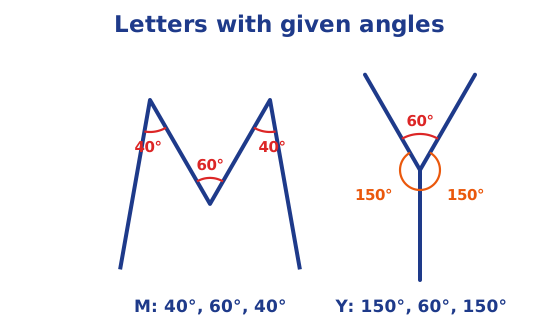
3. Three acute, one right and two obtuse angles. For example, draw four rays OA, OB, OC and OD from a point O with ∠AOB = 30°, ∠BOC = 60° and ∠COD = 40°. Then ∠AOB, ∠BOC and ∠COD are acute, ∠AOC = 90° is right, and ∠BOD = 100° and ∠AOD = 130° are obtuse.
4 and 5. The letters M and Y.
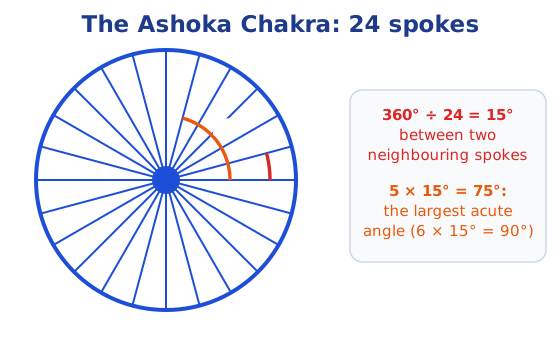
6. The Ashoka Chakra. 360° ÷ 24 = 15° between neighbouring spokes. The largest acute angle between two spokes is 75° (5 gaps), since 6 gaps make exactly 90°.
7. Puzzle. Four times the angle must be less than 90°, so the angle is less than 22.5°; five times it must be more than 90°, so it is more than 18°. In whole degrees, the angle can be 19°, 20°, 21° or 22°.
For revision, read point, line, line segment and ray, what is an angle, types of angles and how to measure an angle with a protractor.
Practice
-
How many angles can you name using four points A, B, C, D, no three of them on one line?
Show answer
Answer: (d) 12
-
At 2 o'clock, the angle between the hands of a clock is:
Show answer
Answer: (b) 60°
-
An angle measures 258°. It is:
Show answer
Answer: (d) reflex
-
What is the measure of each angle when a straight angle is folded into eight equal parts?
Show answer
Answer: 180° ÷ 8 = 22.5°.
-
Arms OT and OS pass through 20 and 55 on the same scale of a protractor. Find ∠TOS.
Show answer
Answer: 55° − 20° = 35°.
Stuck on a question?
Take a photo and Lagnever AI explains it step by step. Try it for 7 days for ₹2.
Get it on Google Play Open in browser
For parents: after the trial, the plan renews monthly by UPI or card autopay. You can cancel anytime in the app.