
What are the types of angles?
Answer in short
Angles are grouped by size. An acute angle is more than 0° and less than 90°; a right angle is exactly 90°; an obtuse angle is between 90° and 180°; a straight angle is exactly 180°; and a reflex angle is between 180° and 360°. A full turn is 360°. Lines meeting at a right angle are perpendicular.
Stuck on a question? Take a photo and Lagnever AI explains it step by step. Try it for 7 days for ₹2. Get it on Google Play
Full turn, straight angle and right angle
Vidya makes a full turn of her book’s cover when she folds it right round to write while holding the book: that is 360°. When she opens the book flat on the table, the cover makes a half turn and its two arms lie in a straight line. Such an angle is a straight angle: 180°.
Draw a straight angle AOB along the edge of a sheet of paper and fold the paper so that OB lies exactly on OA. The crease divides the straight angle into two equal angles. Each is a right angle, a quarter of a full turn: 90°. So a straight angle contains two right angles.
A right angle looks like the letter L. Two lines that meet at a right angle are perpendicular to each other. You can find right angles at the corners of windows, doors, books and the blackboard.
Acute and obtuse angles
Compare any angle with a right angle, for example the corner of a sheet of paper:
- An angle less than a right angle, less than a quarter turn, is an acute angle.
- An angle greater than a right angle but less than a straight angle, between a quarter and a half turn, is an obtuse angle.
Acute means sharp and obtuse means blunt, which matches how these angles look: an acute angle is narrow and pointed, an obtuse angle wide and blunt.
Types of angles by measure
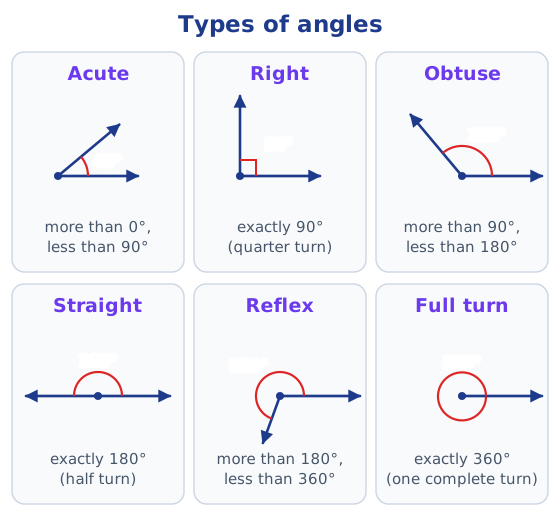
| Type | Measure | Turn |
|---|---|---|
| Acute | more than 0° and less than 90° | less than a quarter turn |
| Right | exactly 90° | a quarter turn |
| Obtuse | more than 90° and less than 180° | between a quarter and a half turn |
| Straight | exactly 180° | a half turn |
| Reflex | more than 180° and less than 360° | between a half and a full turn |
| Full turn | exactly 360° | one complete turn |
Reflex angles are the large angles on the outside of two arms. If two arms make 102° on one side, the reflex angle on the other side is 360° − 102° = 258°.
Working with angle types
Using a straight angle. B, E and R lie on a straight line, so ∠REB = 180°. If ∠TER = 80°, then ∠BET = 180° − 80° = 100°. If ES is perpendicular to the line, ∠SER = 90° and ∠SET = 90° − 80° = 10°.
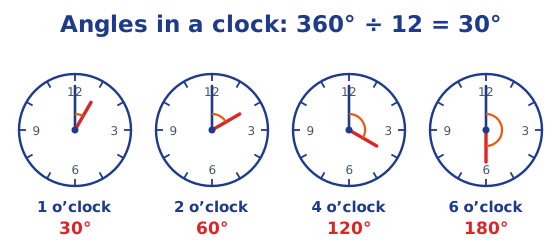
Angles in a clock. The 12 numbers split the full turn of 360° into 12 equal parts of 30°. At 1 o’clock the hands make 30° (acute), at 3 o’clock 90° (right), at 4 o’clock 120° (obtuse) and at 6 o’clock 180° (straight).
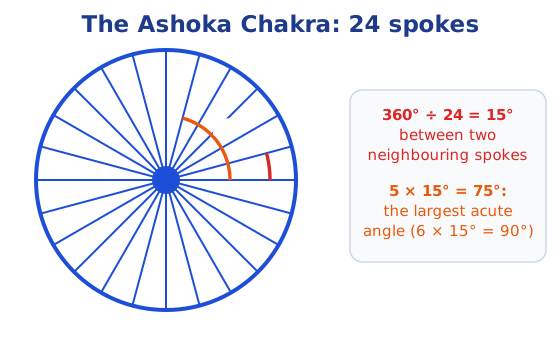
The Ashoka Chakra. Its 24 equally spaced spokes divide 360° into 24 parts of 15°. The largest acute angle between two spokes is 5 × 15° = 75°, because 6 × 15° = 90° is already a right angle.
A puzzle from the book. An acute angle stays acute when doubled, tripled and quadrupled, but becomes obtuse when multiplied by 5. Four times it must be less than 90°, so it is less than 22.5°; five times it must be more than 90°, so it is more than 18°. In whole degrees it can be 19°, 20°, 21° or 22°.
To find the exact measure of an angle, use a protractor: see how to measure an angle with a protractor. For the whole chapter, see the Chapter 2 notes.
Practice
-
An angle of 90° is:
Show answer
Answer: (b) right
-
Which of these is a reflex angle?
Show answer
Answer: (c) 200°
-
Two lines that meet at a right angle are called:
Show answer
Answer: (b) perpendicular lines
-
∠REB is a straight angle and ∠TER = 80°. Find ∠BET.
Show answer
Answer: ∠BET = 180° − 80° = 100°, because the two angles together make the straight angle REB.
-
The Ashoka Chakra has 24 spokes. What angle lies between two neighbouring spokes?
Show answer
Answer: 360° ÷ 24 = 15°. The largest acute angle between two spokes is 75° (5 gaps), since 6 gaps make exactly 90°.
Questions students ask
What are the five main types of angles?
Acute (between 0° and 90°), right (90°), obtuse (between 90° and 180°), straight (180°) and reflex (between 180° and 360°). A full turn of 360° is also called a complete angle.
Why are they called acute and obtuse?
Acute means sharp and obtuse means blunt. An acute angle has a narrow opening that looks pointed and sharp; an obtuse angle opens wide and looks blunt.
What is a reflex angle?
An angle of more than 180° and less than 360°. Every pair of arms makes a smaller angle on one side and a reflex angle on the other; together they add up to 360°.
Stuck on a question?
Take a photo and Lagnever AI explains it step by step. Try it for 7 days for ₹2.
Get it on Google Play Open in browser
For parents: after the trial, the plan renews monthly by UPI or card autopay. You can cancel anytime in the app.