
NCERT Solutions Class 6 Science Chapter 1: The Wonderful World of Science
Chapter 1, The Wonderful World of Science, of Curiosity (Reprint 2026-27) has no “Let us enhance our learning” exercise. It has three activities, 1.1 to 1.3, and several questions in the text. Here are answers to all of them. The activities ask about your own life, so the answers below are models: write your own examples in the same way. Short notes: Chapter 1 notes.
What is science? (page 1)
Science is a way of thinking, observing and doing things to understand the world we live in and to uncover the secrets of the universe. It is a big adventure: we ask questions, explore the world and try to understand how things work. The most important thing for it is curiosity.
What will we explore with the help of this book? (pages 3–5)
The chapter asks a series of questions that later chapters answer:
| Question in the chapter | A short answer | Chapter of Curiosity |
|---|---|---|
| How do plants and animals grow? | Living things need food, water and air, and grow and change; the book looks at the variety of life and its features | Chapters 2 and 10 |
| What are our dishes made of? How do we find out? | Food contains components like carbohydrates, proteins and fats, which can be tested for | Chapter 3 |
| Why and how does it rain? | The Sun’s heat makes water evaporate; the vapour cools, forms clouds and falls as rain | Chapter 8 |
| How do we understand hot and cold? | By measuring temperature with a thermometer | Chapter 7 |
| What are things made of? | Different materials, like paper, metal, plastic and rubber, each with its own properties | Chapter 6 (and magnets in Chapter 4) |
| How do we separate materials? | By methods like handpicking, sieving, filtration and evaporation | Chapter 9 |
| What about things beyond Earth? | The Sun is a star; the Moon goes around the Earth; there are many stars and galaxies | Chapter 12 |
How can we find answers to our questions on our own? (page 5)
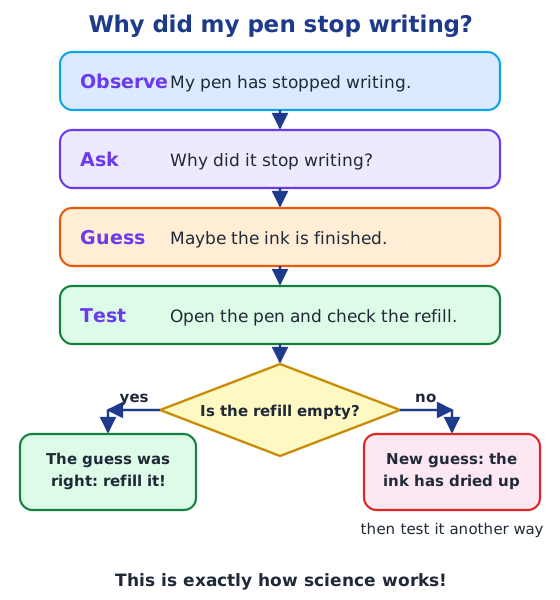
By following the scientific method, as in the chapter’s example of a pen that stops writing: we observe the problem, ask why it happened, guess an answer (the ink has finished), test the guess (check the refill), and look at the result. If the guess was wrong, we make a new guess (the ink has dried up) and test again.
Activity 1.1: let us think and write (page 5)
Write about a problem you tried to solve, and the steps you took. A model answer:
Problem: The TV remote stopped working.
- Observed: pressing the buttons did nothing.
- Asked: why is the remote not working?
- Guessed: the batteries are dead.
- Tested: I put the batteries into a torch. It did not light up, so I put new batteries into the remote.
- Result: the remote worked, so my guess was right. (If it had still not worked, my next guess would have been that something was blocking the remote’s light, and I would have cleaned its front end and tried again.)
Activity 1.2: someone following the scientific method (page 6)
Describe a daily-life situation where someone was following a scientific method. A model answer: my grandmother noticed that the leaves of her tulsi plant were turning yellow (observation). She wondered why (question) and guessed that she was watering it too much, because the soil was always wet (guess). For a week she watered it only when the top of the soil felt dry (test). New leaves came out green, so she concluded that too much water had been the problem (analysis).
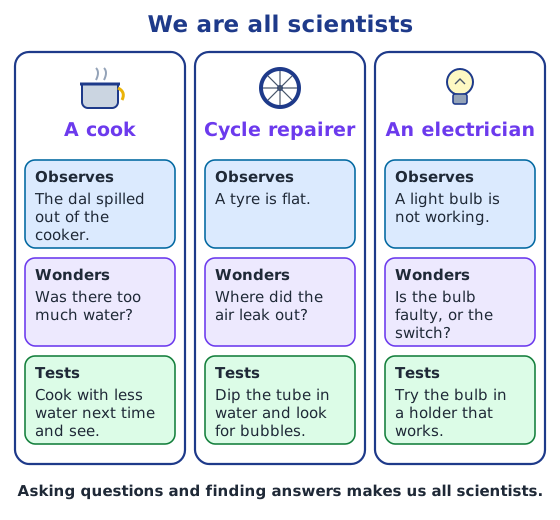
Other examples from the chapter: a cook working out why the dal spilled out of the cooker, a bicycle repairer finding where the air leaked out of a tyre, and an electrician checking whether a bulb or its switch is faulty.
Activity 1.3: asking “Why?” (page 7)
If you had to ask “Why?” about something, what would you ask? How would you try to find an answer? A model answer:
Question: Why do some seeds sprout faster than others?
- Guess: seeds soaked in water sprout faster than dry seeds.
- Test: take 20 moong seeds. Soak 10 in water overnight and keep 10 dry. Next morning, place both sets on wet cotton in two similar bowls, kept in the same place. Check them every day and note how many have sprouted.
- Analyse: if the soaked seeds sprout first, the guess is supported. If not, make a new guess, for example about warmth or light, and test that, changing only one thing at a time.
The steps of the scientific method (page 6)
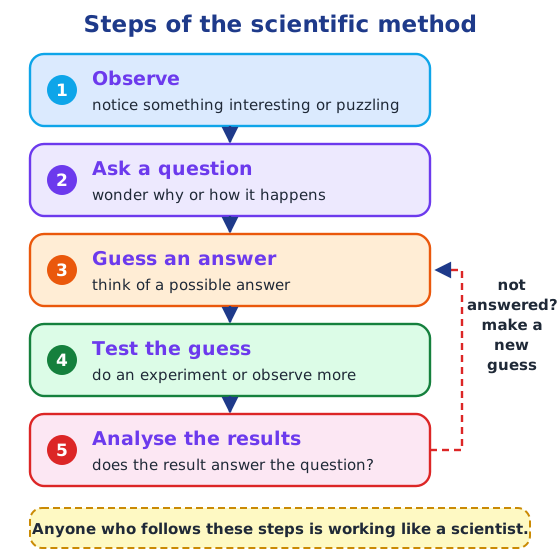
- Observe something interesting, or something we do not understand.
- Ask a question about it.
- Guess a possible answer.
- Test the guess through experiments or more observations.
- Analyse the results to see whether they answer the question.
Anyone who follows these steps is working like a scientist. Read more in steps of the scientific method.
Practice
-
Which of these is NOT a step of the scientific method in the chapter?
Show answer
Answer: (c) Memorise the answer
-
A bicycle repairer looking for where the air leaked out of a tyre is:
Show answer
Answer: (a) working like a scientist
-
Which chapter of Curiosity explores why and how it rains?
Show answer
Answer: (b) Chapter 8, A Journey through States of Water
-
Why is it good to work on questions with friends?
Show answer
Answer: Science is rarely done alone; scientists work in teams. Friends can share ideas and help when you are stuck, and discovering things together is more fun.
-
Name the five steps of the scientific method.
Show answer
Answer: Observe, ask a question, guess a possible answer, test the guess, and analyse the results.
Stuck on a question?
Take a photo and Lagnever AI explains it step by step. Try it for 7 days for ₹2.
Get it on Google Play Open in browser
For parents: after the trial, the plan renews monthly by UPI or card autopay. You can cancel anytime in the app.