
What are the steps of the scientific method?
Answer in short
The scientific method is a step-by-step way to find answers. First we observe something interesting or puzzling, then ask a question about it, guess a possible answer, test the guess through experiments or more observations, and analyse the results. If the results do not answer the question, we make a new guess and test it again.
Stuck on a question? Take a photo and Lagnever AI explains it step by step. Try it for 7 days for ₹2. Get it on Google Play
Finding answers on our own
How can we find answers to our questions on our own? Science is not just memorising facts and figures, or doing experiments. It is about following a step-by-step process that helps us find answers. This process is called the scientific method, and you have probably used it already without knowing.
The pen that stopped writing
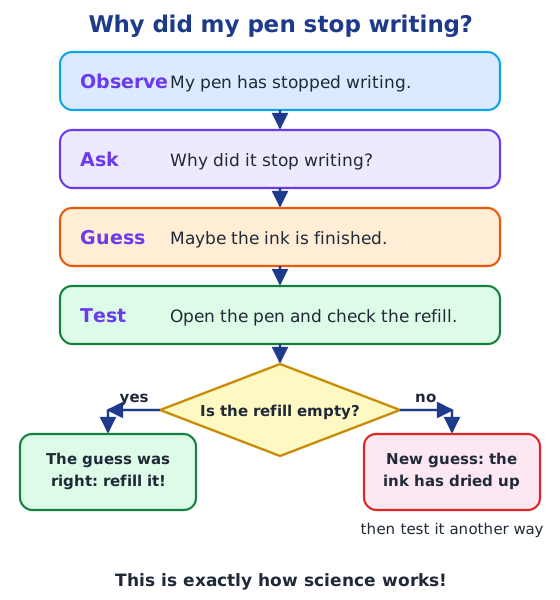
Suppose your pen stops writing:
- You notice the problem: the pen has stopped writing.
- You ask: “Why did my pen stop writing?”
- You guess: perhaps the ink has finished.
- You test the guess by opening the pen and checking the ink refill.
- You look at the result. If the refill is empty, your guess was correct. If it is not, you make another guess, perhaps that the ink has dried up, and test that in another way.
This is exactly how science works.
The five steps
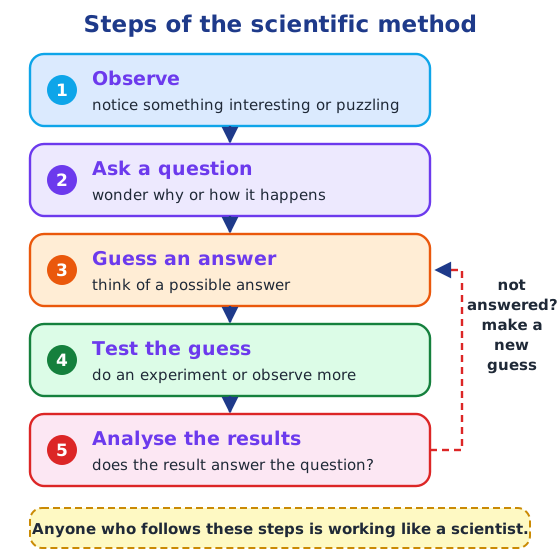
| Step | What we do | Pen example |
|---|---|---|
| 1. Observe | Notice something interesting, or something we do not understand | The pen has stopped writing |
| 2. Ask a question | Wonder why or how it happens | Why did it stop? |
| 3. Guess an answer | Think of a possible answer | The ink has finished |
| 4. Test the guess | Do an experiment or make more observations | Open the pen and check the refill |
| 5. Analyse the results | Check whether the result answers the question | Empty refill: yes. Ink left: make a new guess |
(Extra: scientists call a guess that can be tested a hypothesis.)
When a guess is wrong
A wrong guess is not a failure. It tells us something: one possible answer has been ruled out, so we can make a better guess and test again. Scientists often go round this loop many times before they find an answer.
Everyday scientists
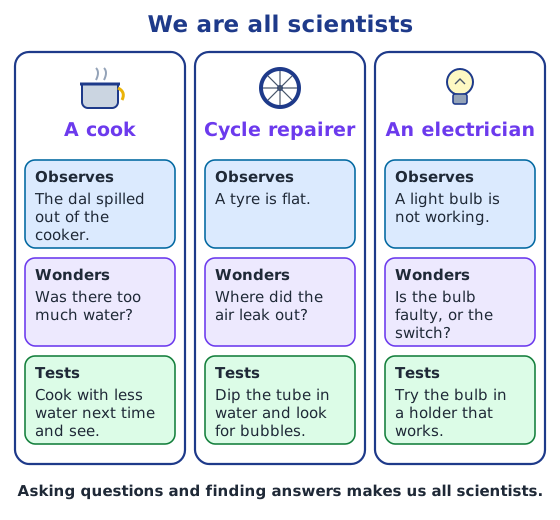
Scientists are people who follow the scientific method to solve problems or discover new things, but anyone who follows it is working like a scientist:
- a cook wonders why the dal spilled out of the cooker: was there too much water?
- a bicycle repairer tries to find where the air leaked out of a flat tyre;
- an electrician tries to find out whether a light bulb or its switch is faulty.
When we ask questions and find answers, we are all, in a way, scientists.
Try it yourself
Observe: the chapati in your tiffin is hard by lunchtime. Ask: why does it get hard? Guess: it dries out because air gets into the box. Test: one morning, pack one chapati in a tightly closed box and another in a box with its lid loose, and keep both in your bag. Analyse: at lunch, compare them. If the one in the closed box is softer, your guess is supported; if both are equally hard, make a new guess and test again.
Tips for young scientists
- Be curious and observe your surroundings keenly; questions start with what you notice.
- Ask how and why, and write your questions down.
- Test one guess at a time, so you know which change made the difference.
- Work together: scientists often work in large teams, and friends can help when you are stuck.
For what science is and why curiosity matters, read the Chapter 1 notes.
Practice
-
Which step comes right after asking a question?
Show answer
Answer: (b) Guessing a possible answer
-
Checking the ink refill of a pen that has stopped writing is an example of:
Show answer
Answer: (b) testing a guess
-
An electrician wonders whether the bulb or the switch is faulty. This is the step of:
Show answer
Answer: (a) asking a question and guessing
-
The refill is not empty, but the pen still does not write. What should you do?
Show answer
Answer: Make a new guess, for example that the ink has dried up, and test it in a different way, such as warming the tip a little or trying the refill on rough paper.
-
Put these steps in order: test, observe, analyse, guess, ask.
Show answer
Answer: Observe, ask, guess, test, analyse.
Questions students ask
What are the steps of the scientific method?
Observe something interesting or puzzling, ask a question about it, guess a possible answer, test the guess through experiments or more observations, and analyse the results to see if they answer the question.
What happens if the guess is wrong?
We make another guess and test it. In the chapter's example, if the pen's refill still has ink, the next guess is that the ink has dried up.
Is the scientific method used only by scientists?
No. A cook, a bicycle repairer, an electrician and you yourself use it whenever you find out why something happened by guessing and testing.
Why is the scientific method useful?
It gives a clear, step-by-step way to find answers ourselves instead of only remembering facts, and learning it helps us solve bigger problems.
Stuck on a question?
Take a photo and Lagnever AI explains it step by step. Try it for 7 days for ₹2.
Get it on Google Play Open in browser
For parents: after the trial, the plan renews monthly by UPI or card autopay. You can cancel anytime in the app.