
Class 6 Science Chapter 1: The Wonderful World of Science Notes
This chapter in five lines
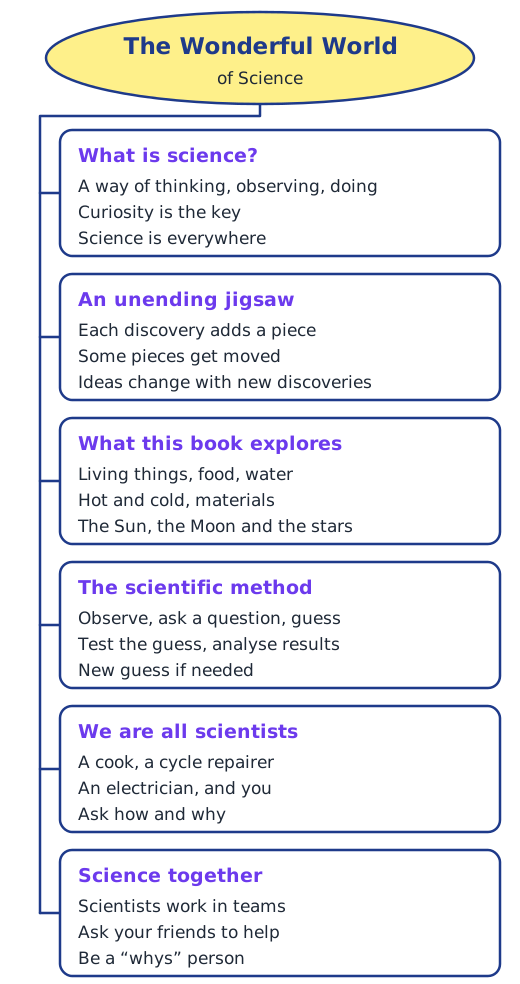
Science is a way of thinking, observing and doing things to understand the world we live in and uncover the secrets of the universe. Its key is curiosity: asking how and why. Science is like a giant, unending jigsaw puzzle in which every discovery adds a piece. Scientists follow the scientific method: observe, ask a question, guess an answer, test the guess and analyse the results. Anyone who does this, like a cook or an electrician, is working like a scientist.
Welcome to science
As human beings, we have always been curious about our surroundings, and we start exploring and asking questions as children. In the Middle Stage of school, this journey continues with a new subject: science. Science is a way of thinking, observing and doing things to understand the world we live in and to uncover the secrets of the universe. It is a big adventure in which we ask questions, explore and try to understand how things work. For this, the most important thing is curiosity, which gives the textbook its name.
Science is everywhere
There is always something new to discover, whether we study tiny grains of sand or huge mountains, a blade of grass or a vast forest. Why do the stars shine? How does a flower know when to open? Science helps us unravel such mysteries, and it is everywhere: from the depths of the ocean to outer space, and from what is cooking in the kitchen to what is happening on the playground. Some of the greatest discoveries have come from unexpected places.
A giant, unending jigsaw puzzle
Science is like a giant jigsaw puzzle that never ends. Every new discovery adds a piece, and every new piece leads to more questions, so there is no limit to what we can find out. Sometimes we find that a piece was put in the wrong place and has to be moved: new discoveries often change our understanding of the world. As we discover more, we also start to see that all these ideas are connected.
What will we explore?
The chapter asks many questions that the rest of the book takes up:
| Question in Chapter 1 | Where the Curiosity book explores it |
|---|---|
| How do plants and animals grow? How varied is life on Earth? | Chapter 2, Diversity in the Living World; Chapter 10, Living Creatures |
| What are our tasty dishes made of? | Chapter 3, Mindful Eating |
| Why and how does it rain? | Chapter 8, A Journey through States of Water |
| How do we understand hot and cold? | Chapter 7, Temperature and its Measurement |
| What are things made of, like paper, a key, a ruler and an eraser? | Chapter 6, Materials Around Us; Chapter 4, Exploring Magnets |
| How do we separate materials from one another? | Chapter 9, Methods of Separation |
| How do things move? | Chapter 5, Measurement of Length and Motion |
| What about our planet’s environment? | Chapter 11, Nature’s Treasures |
| What about the Sun, the Moon and the stars? | Chapter 12, Beyond Earth |
The scientific method
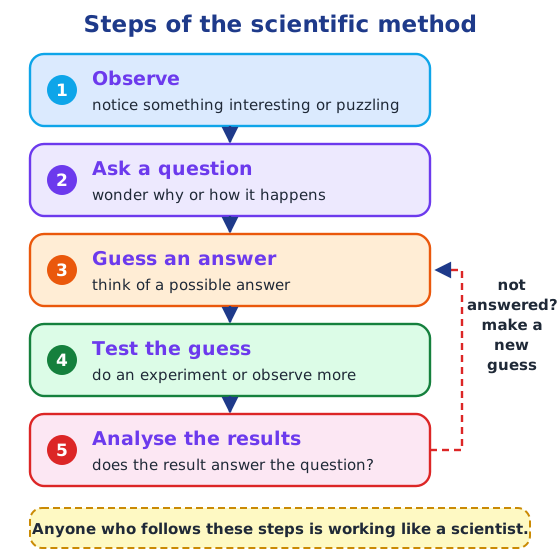
You already find answers like a scientist. Suppose your pen stops writing. You ask, “Why did my pen stop writing?” and guess that the ink has finished. You test the guess by opening the pen and checking the refill. If it is empty, your guess was right. If not, you make another guess, perhaps that the ink has dried up, and test that. This is the scientific method: we observe something, ask a question, guess a possible answer, test the guess through experiments or more observations, and analyse the results to see whether they answer the question. Read more in steps of the scientific method.
We are all scientists
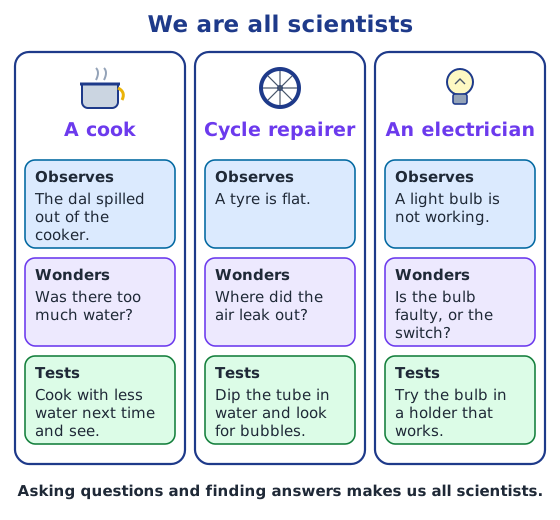
Scientists follow the scientific method to solve problems or discover new things, but anyone who follows it works like a scientist. A cook wonders why the dal spilled out of the cooker: was there too much water? A bicycle repairer tries to find where the air leaked out of a flat tyre. An electrician checks whether a light bulb or its switch is at fault. Learning science builds our ability to solve bigger problems and more mysteries of the universe. Read more in what is science.
Science is done together
Science is rarely done alone: scientists across the world work together, often in large teams. If you cannot find an answer yourself, ask your friends; discovering together is more fun. You will not find answers to all your questions in Grade 6, and that is fine: your journey in science goes on for years. As the chapter says, to be a wise person, you must be a “whys” person. Answers to every activity and question are in the NCERT solutions for Chapter 1.
Key terms
| Term | Meaning |
|---|---|
| Science | A way of thinking, observing and doing things to understand the world we live in and uncover the secrets of the universe. |
| Curiosity | The wish to find out and understand. It is the most important thing for doing science, and the title of the textbook. |
| Observation | Noticing something carefully. It is the first step of the scientific method. |
| Question | Wondering how or why something happens, after observing it. |
| Guess | A possible answer to a question, which we then test. (Extra: scientists call a guess that can be tested a hypothesis.) |
| Experiment | A test done to check whether a guess is correct. |
| Analysis | Studying the results of a test to see whether they answer the question. |
| Scientific method | A step-by-step way of finding answers: observe, ask a question, guess, test and analyse. |
| Scientist | A person who follows the scientific method to solve problems or discover new things. |
| Discovery | Finding out something new. Each discovery adds a piece to the jigsaw puzzle of science. |
Topics in this chapter
Practice
-
Which is the first step of the scientific method?
Show answer
Answer: (b) Observe
-
According to the chapter, the most important thing for doing science is:
Show answer
Answer: (b) curiosity
-
Your pen stops writing and you guess that the ink is finished. What should you do next?
Show answer
Answer: (b) Open the pen and check the refill
-
The chapter compares science to:
Show answer
Answer: (b) a giant, unending jigsaw puzzle
-
If a test shows that your guess was wrong, you should:
Show answer
Answer: (b) make a new guess and test it
Questions students ask
What are the main topics of Class 6 Science Chapter 1?
What science is, why curiosity matters, how science is everywhere, the idea of science as an unending jigsaw puzzle, what the Curiosity book explores, the scientific method with the example of a pen that stops writing, everyday scientists, and why science is done together.
Does Chapter 1 have exercise questions?
No. Chapter 1 has no “Let us enhance our learning” section. It has three activities, 1.1 to 1.3, and several questions in the text. Our NCERT solutions page answers all of them.
Is The Wonderful World of Science in the new Curiosity book?
Yes. The Wonderful World of Science is Chapter 1 of Curiosity, the Class 6 Science textbook used in the 2026-27 session. It introduces the whole book.
Stuck on a question?
Take a photo and Lagnever AI explains it step by step. Try it for 7 days for ₹2.
Get it on Google Play Open in browser
For parents: after the trial, the plan renews monthly by UPI or card autopay. You can cancel anytime in the app.