
What is science?
Answer in short
Science is a way of thinking, observing and doing things to understand the world we live in and uncover the secrets of the universe. It begins with curiosity: noticing things and asking how and why. Science is everywhere, from grains of sand to outer space, and every discovery adds a piece to a giant, unending jigsaw puzzle.
Stuck on a question? Take a photo and Lagnever AI explains it step by step. Try it for 7 days for ₹2. Get it on Google Play
A new subject
Right from childhood, we explore our surroundings and ask questions. In the Middle Stage of school, this exploring gets a new name: science. The chapter calls it a wonderful world, and invites us to explore it.
Science is a way of thinking and doing
Science is a way of thinking, observing and doing things to understand the world we live in and to uncover the secrets of the universe. It is like a big adventure: we ask questions, explore the world around us, and try to understand how things work. Science is not just a pile of facts and figures to learn by heart, and it is not just doing experiments. It is a step-by-step way of finding answers to questions.
It begins with curiosity
The most important thing in science is curiosity, the wish to find out. That is where the Class 6 Science textbook, Curiosity, gets its name. When we are curious, we observe our surroundings carefully and start asking how and why. The world is full of things we do not know yet, waiting to be explored.
Science is everywhere
There is always something new and exciting to discover:
| Where | A question to wonder about |
|---|---|
| The night sky | Why do the stars shine? |
| A garden | How does a flower know when to open? |
| The kitchen | What are our dishes made of? |
| A rainy day | Why and how does it rain? |
| The playground | How do things move? |
| Mountains, deserts, coasts, oceans | How do plants and animals live in such different places? |
From tiny grains of sand to huge mountains, from a blade of grass to a vast forest, from the depths of the ocean to outer space, science is everywhere. Some of the greatest discoveries have come from unexpected places.
A giant, unending jigsaw puzzle
The chapter compares science to a giant jigsaw puzzle that never ends:
- every new discovery adds another piece to the puzzle;
- there is no limit to what we can discover, because every new piece of knowledge leads to more questions;
- sometimes a piece has been put in the wrong place and needs to be moved: new discoveries often change our understanding of the world;
- as we discover more, we realise that the pieces, our ideas, are all connected.
Science in daily life
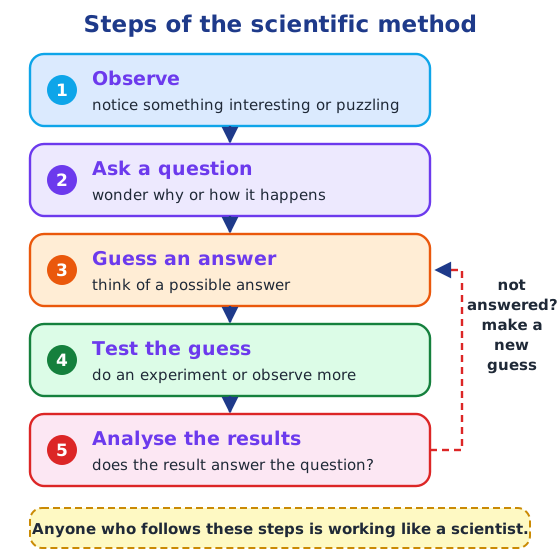
Science is not only for laboratories. Some of what we find out in science is useful in our daily lives, and we already use the way of science without knowing it, whenever we try to work out why something has gone wrong and test our guesses. That step-by-step way is called the scientific method. Read about it in steps of the scientific method.
Be a “whys” person
You will not find answers to all your questions in Grade 6, and that is fine: the journey of science goes on for years. Ask your friends when you are stuck, because science is rarely done alone. As the chapter puts it, to be a wise person, you must be a “whys” person.
Practice
-
Which of these describes science?
Show answer
Answer: (b) a way of thinking, observing and doing things
-
Where does the textbook's title, Curiosity, come from?
Show answer
Answer: (a) It is the most important thing in science
-
What does the chapter mean when it says a piece of the puzzle may need to be moved?
Show answer
Answer: (b) New discoveries can change what we thought was true
-
Give two questions from the chapter that science helps us answer.
Show answer
Answer: Why do the stars shine? How does a flower know when to open? (Others: why and how does it rain? What is our food made of?)
-
Why does every discovery lead to more questions?
Show answer
Answer: Because each new piece of knowledge shows us more things we do not yet understand, so the puzzle of science never ends.
Questions students ask
What is science, according to Class 6 Chapter 1?
Science is a way of thinking, observing and doing things to understand the world we live in and to uncover the secrets of the universe.
Why is curiosity important in science?
Curiosity makes us observe our surroundings keenly and ask how and why. These questions are where every scientific discovery starts.
Why is science compared to a jigsaw puzzle?
Each new discovery adds a piece, the puzzle never ends because new knowledge brings new questions, and sometimes a piece put in the wrong place has to be moved when new discoveries change our understanding.
Is science only done by scientists?
No. Anyone who asks questions and finds answers step by step, like a cook, a bicycle repairer or an electrician, is working like a scientist.
Stuck on a question?
Take a photo and Lagnever AI explains it step by step. Try it for 7 days for ₹2.
Get it on Google Play Open in browser
For parents: after the trial, the plan renews monthly by UPI or card autopay. You can cancel anytime in the app.