
What are renewable and non-renewable resources?
Answer in short
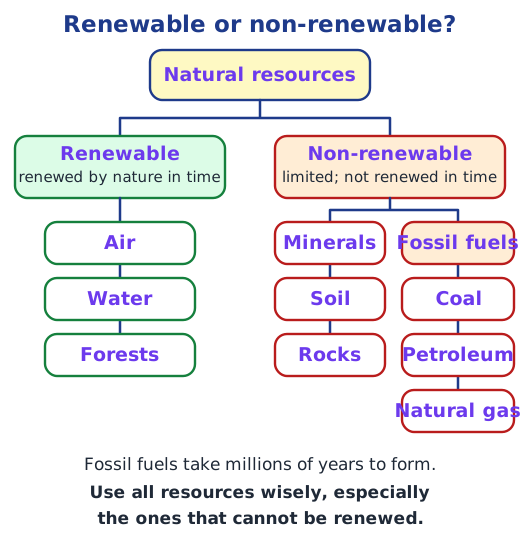
Renewable resources are natural resources that get renewed, replenished or restored by natural processes within a reasonable time, such as air, water and forests. Non-renewable resources are found in limited amounts and are not replenished within a reasonable time, so they get used up. Examples are minerals, soil, rocks and the fossil fuels coal, petroleum and natural gas.
Stuck on a question? Take a photo and Lagnever AI explains it step by step. Try it for 7 days for ₹2. Get it on Google Play
Two kinds of natural resources
Nature gives us everything we need: heat and light from the Sun, water from rivers, and food from plants and animals. But not every resource comes back once we use it. Natural resources are grouped into two kinds, depending on whether nature can renew them in a reasonable time.
Renewable resources
Remember the nellikai (Indian gooseberries) that Bhoomi and Surya collected? Ajji let them take only the fruits that had fallen on the ground, leaving enough for animals and birds. Seeds in the droppings of animals and birds grow into new trees, though it takes some years before those trees bear fruit. In this way, nature renews the forest.
Resources that get renewed, replenished or restored within a reasonable period of time are called renewable resources. Examples are air, water and forests. Even so, we must use them carefully: if we cut trees faster than new ones grow, or pollute water faster than nature can clean it, these resources will not last.
How nature renews water
Water is renewed through the water cycle you learnt about in the chapter on the states of water: the Sun’s heat evaporates water from seas, rivers and lakes, and it falls back as rain or snow, filling rivers, lakes and wells again. But polluted water does not become fit to use so easily, so we must keep it clean.
Non-renewable resources
Fossil fuels take millions of years to form. They are found in limited quantities, and once used, they are gone. Resources that are not produced or replenished within a reasonable time are called non-renewable resources. Examples are minerals, soil, rocks, coal, petroleum and natural gas. Soil and rocks are included because they take thousands to millions of years to form.
A closer look at fossil fuels
Different vehicles fill up with different fuels. Petrol and diesel are the most widely used. Petrol, diesel and kerosene are obtained from petroleum. Petroleum, natural gas and coal are called fossil fuels, because they formed from the remains of microorganisms and plants that were buried deep inside the Earth and changed over millions of years.
| Fossil fuel | Main uses |
|---|---|
| Petroleum | Petrol and diesel for vehicles, kerosene |
| Natural gas | Cooking, electricity, CNG for vehicles |
| Coal | Producing electricity |
Earlier, coal, wood and dung cakes were burnt for cooking; today, less polluting natural gas and LPG (Liquefied Petroleum Gas) have largely replaced them. CNG (Compressed Natural Gas) is a cleaner fuel than petrol or diesel.
Why we must save non-renewable resources
If we keep using fossil fuels as we do now, they will soon run out. Burning them also releases smoke and carbon dioxide, which pollute the air; in cities, vehicle smoke makes the air smell bad. So we should:
- walk or cycle to nearby places;
- use public transport;
- choose cleaner vehicles, such as those running on CNG, and electric vehicles, which give out no smoke;
- look for other sources of energy, such as the Sun and the wind.
Rocks and minerals, too, take thousands to millions of years to form, so they must be used responsibly. Learn practical ways to save every resource in how to conserve natural resources.
Practice
-
Which of these is a non-renewable resource?
Show answer
Answer: (c) Coal
-
Petrol and diesel are obtained from:
Show answer
Answer: (b) petroleum
-
Which fuel is cleaner than petrol or diesel for vehicles?
Show answer
Answer: (c) CNG
-
Why is petroleum called a non-renewable resource?
Show answer
Answer: It formed over millions of years from the remains of tiny organisms and plants buried deep inside the Earth. It is found in limited amounts, and once used up it cannot be replaced within a reasonable time.
-
Classify: coal, water, natural gas, forests, minerals.
Show answer
Answer: Renewable: water and forests. Non-renewable: coal, natural gas and minerals.
Questions students ask
What is the difference between renewable and non-renewable resources?
Renewable resources, like air, water and forests, are renewed by natural processes within a reasonable time. Non-renewable resources, like minerals, soil, rocks and fossil fuels, are limited and are not replenished within a reasonable time.
What are fossil fuels?
Coal, petroleum and natural gas. They formed from the remains of microorganisms and plants buried deep inside the Earth, over millions of years.
Is soil renewable or non-renewable?
The chapter lists soil as non-renewable, because it forms from rocks very slowly, over thousands of years, so lost soil cannot be replaced in a reasonable time.
Why must we save fossil fuels?
They are limited and will run out if we keep using them as we do now. Burning them also releases smoke and carbon dioxide, which pollute the air. So we should walk or cycle short distances, use public transport and look for other sources of energy.
Stuck on a question?
Take a photo and Lagnever AI explains it step by step. Try it for 7 days for ₹2.
Get it on Google Play Open in browser
For parents: after the trial, the plan renews monthly by UPI or card autopay. You can cancel anytime in the app.