
NCERT Solutions Class 6 Science Chapter 12: Beyond Earth
Answers to Activities 12.1 to 12.4, the in-text questions, all 11 questions of “Let us enhance our learning” and the Learning further tasks in Chapter 12, Beyond Earth, of Curiosity (Reprint 2026-27). The page numbers match the book. Sky watching depends on your place, date and weather, so your own observations may differ a little. Short notes: Chapter 12 notes.
Activity 12.1: let us draw (page 232)
Join the bright stars in Fig. 12.2 with imaginary lines to make patterns, name each pattern after an animal or object it reminds you of, and make up a story about it. What you will notice: your friends join the same stars in different ways and give them different names and stories. That is exactly what people of different cultures did long ago, which is why many cultures have their own names for star patterns.
Stars and constellations (pages 233–236)
Do we find patterns among the stars just for fun, or is there some use? Both. Patterns are fun to imagine, and they also help us recognise stars. Before the magnetic compass, they helped sailors and travellers find directions at sea or on land, and they are still a backup method in emergencies.
How can we identify some of these constellations in the night sky? Learn the shape of each pattern from pictures like Fig. 12.3 and Fig. 12.4, find out when and in which part of the sky it can be seen from your place (a sky-map app such as Sky Map or Stellarium helps), and look for its brightest stars first, like the three belt stars of Orion or the seven stars of the Big Dipper.
Can we find any constellation or star of our choice on any night from our location? No. Not all stars and constellations are visible from all places on Earth, or on all nights of the year. For example, the Pole Star cannot be seen from the southern hemisphere, and in India Orion is easiest to see from December to April, after sunset.
Activity 12.2: the Big Dipper and the Pole Star (page 238)
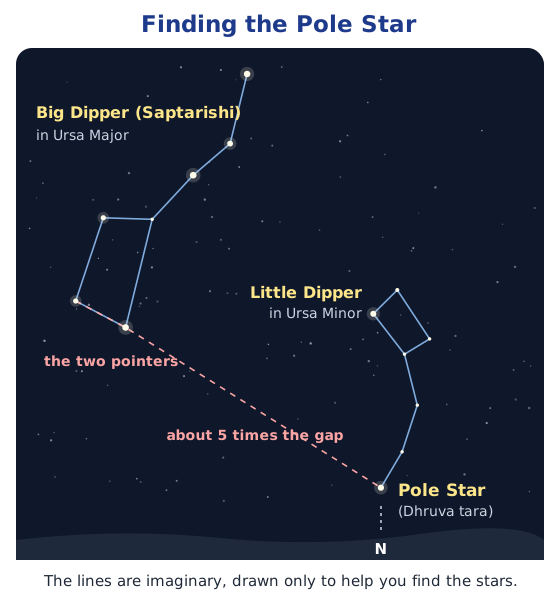
In summer, around 9 p.m., look towards the northern part of the sky and find the seven stars of the Big Dipper. Take the two stars at the end of its cup, the pointers, and imagine a straight line through them going north. At about five times the distance between these two stars, the line reaches a star that is not very bright: the Pole Star.
Activity 12.3: Orion and Sirius (page 238)
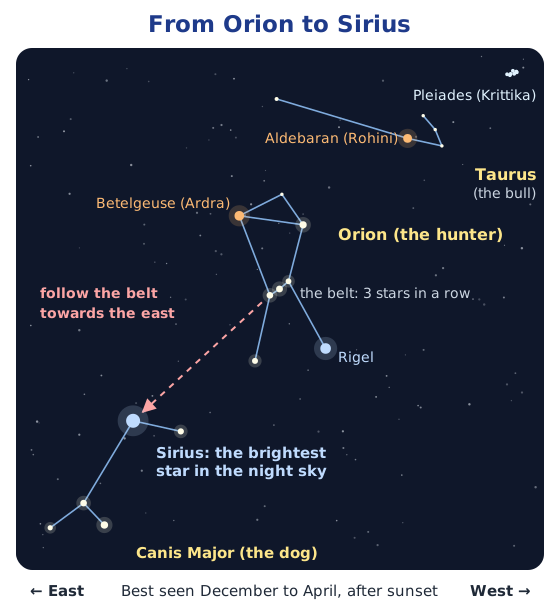
Between December and April, after sunset, find three bright stars close together in a short straight line: the belt of Orion. Then imagine a straight line through these three stars and follow it towards the east. It leads to Sirius, the brightest star in the night sky.
Our Solar System (pages 238–247)
Which star is closest to us? The Sun. After the Sun, the nearest star is Proxima Centauri, about 2,69,000 au away.
The Sun is also a star. Why does it look big and light up the sky, while other stars look like dots and cannot be seen in the daytime? The Sun is much closer to us than the other stars, so it looks much bigger and brighter. The other stars are so far away that they look like points, even though some are much bigger than the Sun. In the daytime, the Sun is so bright that the other stars cannot be seen.
Are stars the only objects in the sky? No. There are planets, moons, asteroids and comets, which together with the Sun form the Solar System, and beyond it the Milky Way and other galaxies.
Can we identify a planet the way we identified constellations? Yes. Venus is the easiest: it is the brightest object in the sky after the Sun and the Moon. Mercury, Mars, Jupiter and Saturn can also be seen with the naked eye. They look like shining dots, but unlike stars they do not twinkle much.
How can we see the planets that are not visible to the naked eye? With a pair of binoculars or, better, a telescope, which shows objects brighter and larger and shows dim objects we cannot see with our eyes. Night sky events by colleges, astronomy clubs, museums and planetariums often let students use one.
Are there any objects that move around planets? Yes, satellites. Moons are natural satellites: the Earth has one Moon, Mars has two, and Jupiter, Saturn, Uranus and Neptune have many.
What is beyond the Solar System? Countless other stars. The Solar System is part of our galaxy, the Milky Way, which has millions to billions of stars.
What is beyond the Milky Way Galaxy? Many more galaxies in outer space; all of them are part of the Universe.
Is there life anywhere else in the Universe? We do not know yet. Scientists are searching, mostly on exoplanets, planets that revolve around other stars, but no evidence of life has been found so far.
Activity 12.4: finding Venus (page 243)
With the help of a sky-map app, find out whether Venus can be seen at dawn or at dusk these days. At dawn, look near the east before sunrise; at dusk, look near the west after sunset. It is the brightest point of light in that part of the sky and does not twinkle much.
Let us enhance our learning (pages 249–251)
1. Match the columns.
| Column I | Column II |
|---|---|
| (i) Satellite of Earth | (d) Moon |
| (ii) Red planet | (c) Mars |
| (iii) Constellation | (a) Orion |
| (iv) Planet which is commonly called an evening star | (b) Venus |
2. Solve the riddle, and make two of your own.
(i) The letter in MAN but not in CAN is M; the letter in both ACE and FAN is A; the letter in RAT but not in CAT is R; the letter in SUN but not in FUN is S. The planet is MARS.
(ii) Two riddles:
- My first letter is in VAN but not in CAN; my second is in BEE but not in BOO; my third is in NUT but not in CUT; my fourth is in RUN but not in RAN; my fifth is in SIT but not in BIT. I am the brightest planet in the sky. (VENUS)
- My first letter is in PEN but not in PIN; my second is in CAT but not in COT; my third is in RAM but not in HAM; my fourth is in TOP but not in POP; my fifth is in HAT but not in CAT. I am the Blue Planet, with one Moon. (EARTH)
3. Which is not a member of our Solar System?
(i) Sirius. It is a star far outside the Solar System. Comets, asteroids and the dwarf planet Pluto all revolve around the Sun.
4. Which is not a planet of the Sun?
(ii) Pluto. Since 2006 it has been called a dwarf planet. Jupiter, Neptune and Saturn are planets.
5. Which is the brighter star, the Pole Star or Sirius?
Sirius. It is the brightest star in the night sky, while the Pole Star is not very bright.
6. Is the order of the planets in Fig. 12.12 correct?
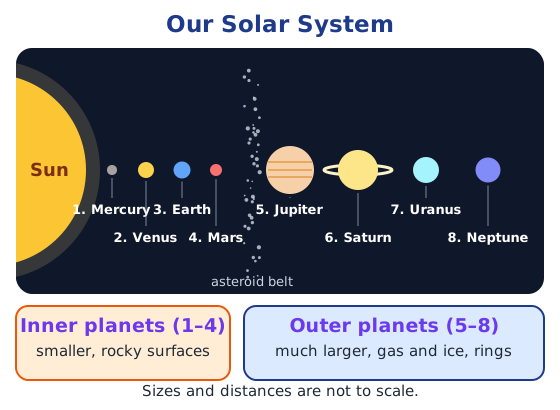
No. Two pairs are swapped: the blue Earth is drawn second, where Venus should be, with Venus third, and Uranus (pale blue, with a thin upright ring) is drawn sixth, before Saturn (with its large rings). Moving outwards from the Sun, the boxes should read: Mercury, Venus, Earth, Mars, Jupiter, Saturn, Uranus, Neptune.
7. Find the Big Dipper, the Little Dipper and the Pole Star in Fig. 12.13.
Find the seven bright stars that make a cup with a bent handle: that is the Big Dipper. Join them. Take the two stars at the outer end of the cup, the pointers, and follow the line through them for about five times their gap: you reach the Pole Star. The Pole Star is the end of the handle of the Little Dipper; join it with the fainter stars that curve away from it and end in a small cup. Label all three. (Our diagram above shows the same patterns as they appear in the sky.)
8. Draw Orion and label Sirius in Fig. 12.14.
Find three stars in a short straight line, Orion’s belt, and the four bright stars around them, two above (the shoulders) and two below (the feet). Join them into the hunter’s shape. Then follow the line of the belt towards the east to the brightest star in that part of the sky and label it Sirius.
9. Why do we not see stars during the day?
The stars are in the sky during the day too, but the Sun, being so much closer, is extremely bright, and its light outshines the faint light of the faraway stars. (Extra: the air scatters sunlight and makes the whole sky bright.) At dawn, as the sky gets brighter, the stars fade away one by one; at dusk, as the sky gets darker, they appear again.
10. Watch the Big Dipper every 2 to 3 hours. Does it appear to move?
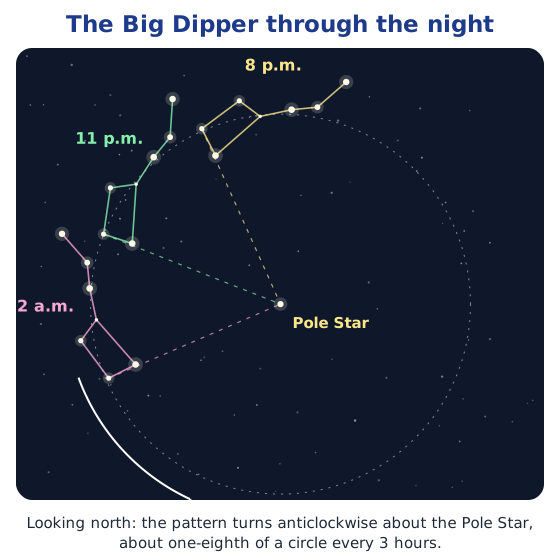
Yes. Through the night, the Big Dipper appears to move in a circle around the Pole Star, while the Pole Star stays in nearly the same place. Looking north, it turns anticlockwise, about one-eighth of a full circle every three hours, and its two pointer stars always point towards the Pole Star. In your sketch, draw the Pole Star in the middle and the Big Dipper at each time you observed it, with the time written beside it. (Extra: this happens because the Earth rotates about its axis.)
11. Write a poem or a story about the night sky.
A sample poem:
When the Sun goes down and the sky turns deep,
the stars wake up while the cities sleep.
Orion stands with his belt of three,
and bright Sirius follows faithfully.
The Dipper turns round the steady North,
where Dhruva shines to guide us forth.
And far beyond, a river of light,
the Milky Way flows across the night.
Learning further (pages 251–252)
- Planets in your language: for example, in Hindi, Budh (Mercury), Shukra (Venus), Prithvi (Earth), Mangal (Mars), Brihaspati or Guru (Jupiter), Shani (Saturn), Arun (Uranus) and Varun (Neptune). Star stories to draw include Saptarishi and Dhruva, the grandmother’s cot of Central Indian tribes and the boat of the Konkan fishermen.
- Planetarium or science museum: go on a night sky session to see the Moon, planets and stars through a telescope, or in the daytime to see models, pictures and sky shows.
- Light pollution: (Extra) bright lights at night can disturb people’s sleep, confuse birds that migrate at night and baby sea turtles that need to find the sea, draw crowds of insects to lamps, and waste electricity. A personal action: switch off lights you do not need, and use covered lamps that shine downwards.
- Hanle, Ladakh: (Extra) the Indian Institute of Astrophysics chose Hanle because it is a cold, dry desert with very little rain or water vapour in the air, clear, cloudless skies on most nights, thin air at a height of about 4,500 m, and almost no light pollution. Its observatory has the Himalayan Chandra Telescope, and the area became the Hanle Dark Sky Reserve in December 2022.
- Embroidery or art: stitch or draw the constellations you have seen on dark cloth or paper, using white or yellow thread or paint for the stars.
Practice
-
Which of these is not a member of our Solar System?
Show answer
Answer: (a) Sirius
-
After the Sun and the Moon, the brightest object in the sky is:
Show answer
Answer: (b) Venus
-
Which object helps you find North at night in India?
Show answer
Answer: (c) The Pole Star
-
What is an astronomical unit (au)?
Show answer
Answer: A unit for distances in the Solar System, about 150 million km, roughly the distance between the Sun and the Earth.
-
Why does a comet become hard to see as it moves away from the Sun?
Show answer
Answer: Away from the Sun its frozen material stops evaporating, so it loses its tail and becomes dim, too dim to see with the naked eye.
Stuck on a question?
Take a photo and Lagnever AI explains it step by step. Try it for 7 days for ₹2.
Get it on Google Play Open in browser
For parents: after the trial, the plan renews monthly by UPI or card autopay. You can cancel anytime in the app.