
Class 6 Science Chapter 12: Beyond Earth Notes
This chapter in five lines
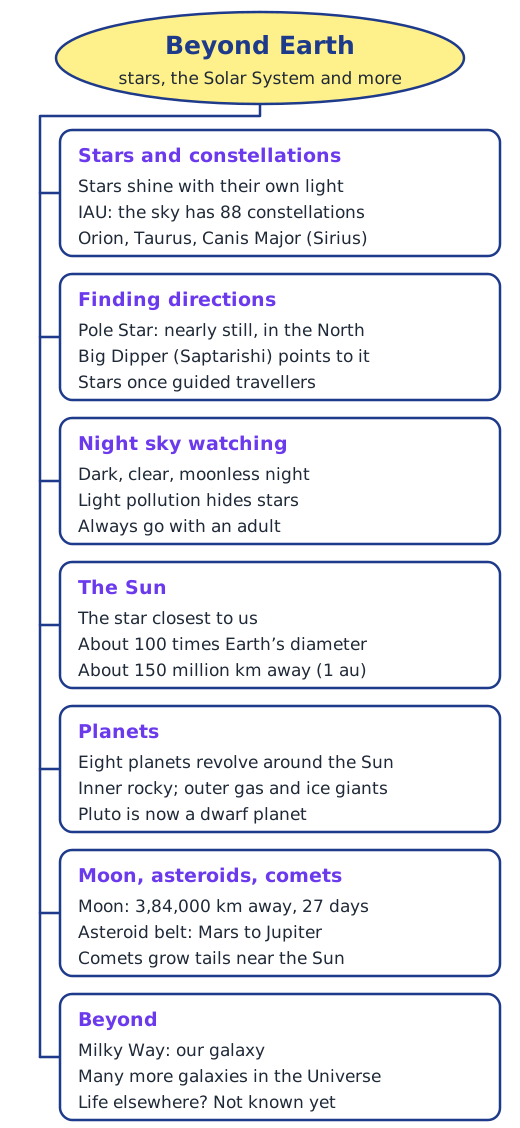
Beyond Earth, the night sky is full of stars, which shine with their own light. Groups of stars that seem to form patterns, and the regions of sky around them, are constellations; the sky is divided into 88 of them. The Pole Star stays nearly still in the North and helps us find directions. The Sun is our nearest star. The Sun, eight planets, their moons, asteroids and comets form the Solar System, which is part of the Milky Way Galaxy.
Under the night sky of Nubra
Yangdol and her twin brother Dorjay live in Nubra, in Ladakh. The weather there is almost cloudless and there is almost no air or light pollution, so on most nights the sky is lit up with thousands of stars. Their elders tell them how certain stars once helped caravans find their way through Nubra. Like them, we can look for patterns among the stars and join them with imaginary lines, as in Activity 12.1.
Stars and constellations
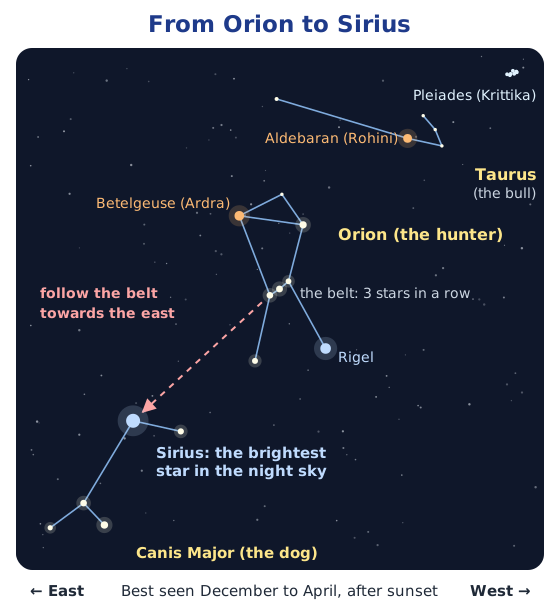
Stars shine with their own light; some look bright and others dim. Long ago, people linked groups of stars with animals, things or characters in stories, and these shapes helped them recognise the stars. Before the magnetic compass, star patterns helped sailors and travellers find directions, and they are still a backup in emergencies. Such groups of stars were called constellations. In the early twentieth century the International Astronomical Union (IAU) divided the whole sky into 88 regions, which are now the constellations.
Orion is pictured as a hunter with three stars in a row for his belt, followed by his dog, Canis Major, and facing a bull, Taurus. Canis Major has Sirius, the brightest star in the night sky. In Indian astronomy a nakshatra is a star or a group of stars: Ardra (Betelgeuse in Orion), Krittika (the Pleiades in Taurus) and Rohini (Aldebaran in Taurus). Read more in stars and constellations.
The Pole Star and the Big Dipper
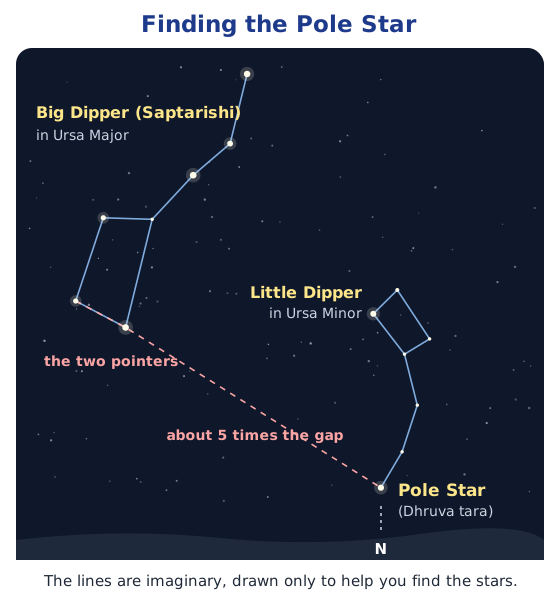
The Big Dipper (Saptarishi), in the constellation Ursa Major, and the Little Dipper, in Ursa Minor, are two easy star patterns. The Pole Star (Dhruva tara), at the end of the Little Dipper, appears nearly still in the North, so it helps find North in the northern hemisphere. To find it, follow the two stars at the end of the Big Dipper’s cup for about five times the gap between them. Tribes in Central India see four stars of the Big Dipper as a grandmother’s cot with three thieves stealing it, and fishermen on the Konkan coast see a boat.
Watching the night sky
In big cities only a few stars are seen because of light pollution (too much artificial light at night), smoke and dust, and tall buildings and trees may block the view. Not every star can be seen from every place on every night: the Pole Star, for example, cannot be seen from the southern hemisphere. Sky-map apps such as Sky Map and Stellarium show what to look for and where. Go only with an adult to a dark, open place, choose a clear, moonless night, and wait about half an hour for your eyes to get used to the dark.
The Sun, our star
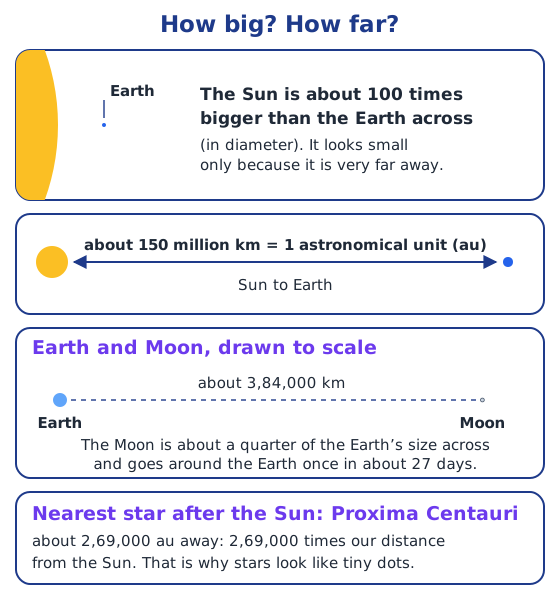
The Sun is a star: an extremely hot, spherical ball of gases and the star closest to us. It is about 100 times bigger than the Earth in diameter and about 150 million km away; this distance is about one astronomical unit (au). It gives the heat and light that make life on Earth possible, and drives the weather, seasons, winds and the water cycle. Other stars look like dots because they are much farther away; the nearest after the Sun, Proxima Centauri, is about 2,69,000 au away. In the daytime the Sun is so bright that we cannot see the other stars.
Planets
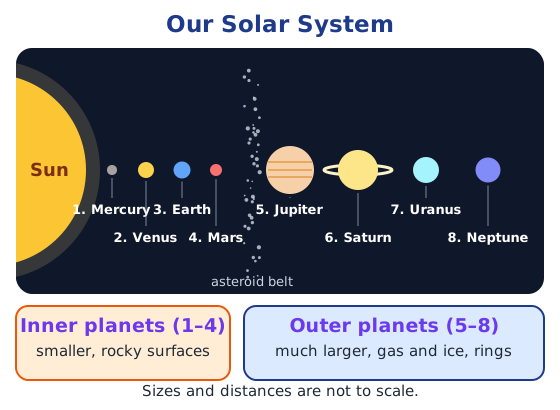
A planet is a large, nearly spherical object that revolves around the Sun. The Earth takes nearly one year for one revolution, and spins on its axis once in about 24 hours, which is a day. The eight planets, in order from the Sun, are Mercury, Venus, Earth, Mars, Jupiter, Saturn, Uranus and Neptune. The inner four are smaller, with rocky surfaces; the outer four are much larger, mostly made of gas and ice, and have rings. Venus, the brightest planet, is the Morning or Evening Star; Mars is the Red Planet; Earth is the Blue Planet. Since 2006 Pluto has been called a dwarf planet. Read more in planets of the Solar System.
The Moon, asteroids and comets
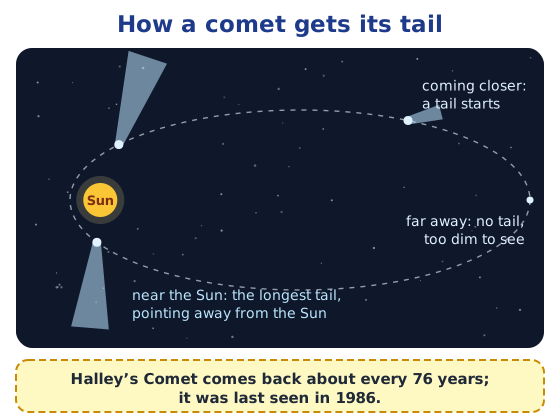
Objects that move around planets are satellites; moons are natural satellites. The Earth has one Moon and Mars two. The Moon is about 3,84,000 km away, takes about 27 days to go around the Earth, is about a quarter of the Earth’s diameter, has hardly any atmosphere, and its surface is covered with craters made by impacts. India’s Chandrayaan-3 landed near the Moon’s south pole on 23 August 2023, now celebrated as National Space Day. Asteroids are small, rocky, irregular objects, many in the asteroid belt between Mars and Jupiter. Comets are made of dust, gases, rocks and ice and grow a tail near the Sun; Halley’s Comet returns about every 76 years. Read more in Moon, asteroids and comets.
The Milky Way and the Universe
From a very dark place on a moonless night, a faint band of light stretches across the sky. This is our home galaxy, the Milky Way Galaxy or Akash Ganga, and our Solar System is a part of it. A galaxy has millions to billions of stars, and there are many more galaxies in the Universe. We do not yet know if there is life anywhere else; scientists are searching, mostly on exoplanets, planets that revolve around other stars. In Ladakh, the Hanle Dark Sky Reserve, notified in December 2022, protects dark skies around the Indian Astronomical Observatory. Answers to every question in the chapter are in the NCERT solutions for Chapter 12.
Key terms
| Term | Meaning |
|---|---|
| Star | A huge, very hot ball of gases that shines with its own light. The Sun is the star closest to us. |
| Constellation | Now, a defined region of the sky that often includes a pattern of stars; the word is still used for the star pattern too. The IAU divided the whole sky into 88 constellations. |
| Nakshatra | In Indian astronomy, a certain star or group of stars, such as Ardra (Betelgeuse), Krittika (the Pleiades) and Rohini (Aldebaran). |
| Pole Star (Dhruva tara) | A star that appears nearly stationary in the North direction. It helps find North in the northern hemisphere. |
| Big Dipper (Saptarishi) | A pattern of seven bright stars in the constellation Ursa Major. Its two pointer stars lead to the Pole Star. |
| Light pollution | Too much artificial light at night. Along with smoke and dust, it hides stars in cities. |
| Solar System | The Sun, the eight planets, their moons and many smaller objects such as asteroids and comets. |
| Planet | A large, nearly spherical object that revolves around the Sun. |
| Revolution | The movement of an object around the Sun or a planet. The Earth takes nearly one year to revolve around the Sun. |
| Satellite | An object that moves around a planet. Moons are natural satellites; the Moon is Earth's. |
| Asteroid | A small, rocky object with an irregular shape. Many revolve around the Sun between Mars and Jupiter, in the asteroid belt. |
| Comet | An icy-rocky object made of dust, gases, rocks and ice that grows a tail as it comes close to the Sun. |
| Astronomical unit (au) | A unit for distances in the Solar System: about 150 million km, roughly the distance between the Sun and the Earth. |
| Milky Way Galaxy (Akash Ganga) | Our home galaxy, seen as a faint band of light across a dark sky. A galaxy has millions to billions of stars. |
Topics in this chapter
Practice
-
Which is the brightest star in the night sky?
Show answer
Answer: (b) Sirius
-
Which star appears nearly stationary in the North direction?
Show answer
Answer: (c) The Pole Star
-
Which planet is called the Red Planet?
Show answer
Answer: (b) Mars
-
Many asteroids revolve around the Sun between:
Show answer
Answer: (b) Mars and Jupiter
-
Into how many constellations did the IAU divide the sky?
Show answer
Answer: (c) 88
Questions students ask
What are the main topics of Class 6 Science Chapter 12?
Stars and constellations, finding the Pole Star, watching the night sky and light pollution, the Sun, the eight planets, natural satellites and the Moon, the Chandrayaan missions, asteroids, comets, the Milky Way Galaxy and the Universe.
Is Beyond Earth in the new Curiosity book?
Yes. Beyond Earth is Chapter 12, the last chapter, of Curiosity, the Class 6 Science textbook used in the 2026-27 session.
How many questions are in the chapter exercise?
“Let us enhance our learning” has 11 questions, including a riddle, a figure of the planets to correct and star patterns to draw. Our NCERT solutions page answers all of them, along with Activities 12.1 to 12.4, the in-text questions and the Learning further tasks.
Stuck on a question?
Take a photo and Lagnever AI explains it step by step. Try it for 7 days for ₹2.
Get it on Google Play Open in browser
For parents: after the trial, the plan renews monthly by UPI or card autopay. You can cancel anytime in the app.