
What are the Moon, asteroids and comets?
Answer in short
The Moon is Earth's natural satellite: it is about 3,84,000 km away, goes around the Earth in about 27 days and has craters. Asteroids are small, rocky, irregular objects, many revolving around the Sun between Mars and Jupiter. Comets, made of dust, gases, rocks and ice, grow a tail when they come close to the Sun.
Stuck on a question? Take a photo and Lagnever AI explains it step by step. Try it for 7 days for ₹2. Get it on Google Play
Satellites
Planets move around the Sun, and some objects move around planets. Objects that move around planets are commonly called satellites. They are smaller than the planets they go around. Moons are natural satellites. The Earth has one Moon, Mars has two, and Jupiter, Saturn, Uranus and Neptune have a large number of moons. In general, any object that moves around a much larger object can be called a satellite, so the Earth can be thought of as a satellite of the Sun.
The Moon
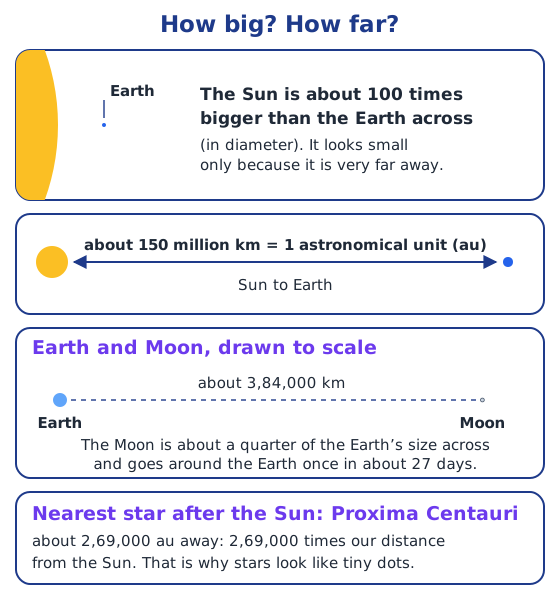
The Moon is Earth’s natural satellite and our nearest neighbour in space:
- it is about 3,84,000 km away from the Earth;
- it takes about 27 days to go once around the Earth;
- its diameter is about a quarter of the Earth’s;
- unlike the Earth, it has hardly any atmosphere.
The Moon’s surface has circular, bowl-like hollows called craters. Most of them formed when asteroids or rocks from space hit the Moon. Since there is no atmosphere, water or life on the Moon, these marks stay on its surface for a very long time.
India’s missions to the Moon
India has sent three Chandrayaan missions to study the Moon. Chandrayaan-1 was launched in 2008 and Chandrayaan-2 in 2019. Chandrayaan-3 was launched in July 2023, and its Vikram lander, carrying the Pragyan rover, soft-landed on the Moon on 23 August 2023. India became the first country to land near the little-explored south pole of the Moon, and the Government of India declared 23 August National Space Day. A fourth mission, Chandrayaan-4, is being planned to bring back soil and rock samples from the Moon.
Asteroids
The Sun and the planets are nearly spherical, but the Solar System also has many small objects that are rocky and irregular in shape. These are asteroids. Their sizes range from about 10 m to about 500 km. Many of them revolve around the Sun in paths between those of Mars and Jupiter, a region called the asteroid belt. Occasionally, an asteroid passes very close to the Earth.
Comets
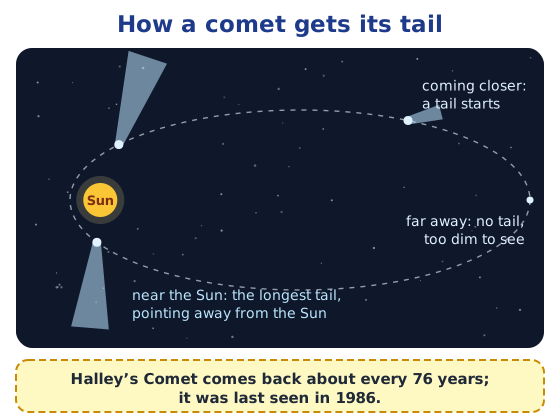
Comets are visitors from the outer regions of the Solar System, made of dust, gases, rocks and ice. As a comet comes close to the Sun, the frozen material in it starts evaporating, and this forms its long tail. (Extra: the tail always points away from the Sun.) As the comet moves away from the Sun it becomes dim, and we can no longer see it with the naked eye.
Many comets revolve around the Sun and return regularly. Halley’s Comet appears about every 76 years; it last appeared in 1986. A few comets escape from the Solar System, and some break up or fall into the Sun or a planet.
In Sanskrit and some other Indian languages a comet is called Dhumaketu, and some tribes in India call it Pucchya-Taro (a star with a tail) or Zendya-Taro (a star like a flag). In many cultures comets were feared as signs of bad luck, but scientists have shown that they are just icy-rocky visitors on a trip close to the Sun.
The Solar System, all together
The Solar System is the Sun, the eight planets, their moons, and many smaller objects including asteroids and comets. The Sun is the largest and heaviest object in it and produces almost all its energy. Everything else, including the Moon, shines by reflecting sunlight. To see how the stars beyond fit in, read stars and constellations.
Practice
-
How many moons does Mars have?
Show answer
Answer: (c) Two
-
On which date did Chandrayaan-3's Vikram lander land on the Moon?
Show answer
Answer: (b) 23 August 2023
-
A comet gets its tail when:
Show answer
Answer: (b) frozen material in it evaporates near the Sun
-
Why do craters stay on the Moon for a very long time?
Show answer
Answer: There is no atmosphere, water or life on the Moon, so nothing wears the craters away.
-
Halley's Comet last appeared in 1986. When is it due again?
Show answer
Answer: It appears about every 76 years, so it is due again around 2061–62 (1986 + 76 = 2062).
Questions students ask
What is a natural satellite?
An object that moves around a planet, such as the Moon around the Earth. Moons are natural satellites. (Extra: satellites built and launched by people, such as ISRO's Cartosat, are called artificial satellites.)
How big is the Moon compared with the Earth?
The Moon's diameter is about a quarter of the Earth's.
What did Chandrayaan-3 achieve?
Launched in July 2023, its Vikram lander carrying the Pragyan rover soft-landed on the Moon on 23 August 2023. India became the first country to land near the Moon's south pole, and 23 August is now National Space Day.
What is the difference between an asteroid and a comet?
Asteroids are rocky, irregular objects, many in the asteroid belt between Mars and Jupiter. Comets are made of dust, gases, rocks and ice, come from the outer regions of the Solar System, and grow a tail near the Sun.
Stuck on a question?
Take a photo and Lagnever AI explains it step by step. Try it for 7 days for ₹2.
Get it on Google Play Open in browser
For parents: after the trial, the plan renews monthly by UPI or card autopay. You can cancel anytime in the app.