
What are the planets of the Solar System?
Answer in short
A planet is a large, nearly spherical object that revolves around the Sun. There are eight: Mercury, Venus, Earth, Mars, Jupiter, Saturn, Uranus and Neptune, in order from the Sun. The inner four are smaller and rocky; the outer four are much larger, mostly made of gas and ice, and have rings. Pluto is now called a dwarf planet.
Stuck on a question? Take a photo and Lagnever AI explains it step by step. Try it for 7 days for ₹2. Get it on Google Play
What is a planet?
Stars are not the only objects in the sky. The Earth and some other objects, together with the Sun, form our Solar System, and most of them move around the Sun. The movement of an object around the Sun is called revolution. A planet is a large, nearly spherical object that revolves around the Sun. The Earth is a planet: it takes nearly one year to complete one revolution. While revolving, it also rotates about its axis, once in about 24 hours, which is a day. Other planets also rotate while they revolve.
The eight planets in order
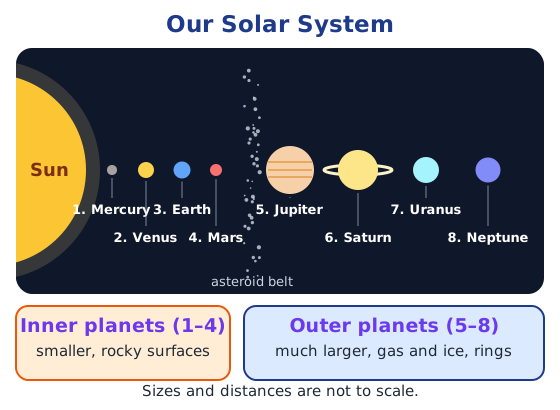
In order of their increasing distance from the Sun, the eight planets are Mercury, Venus, Earth, Mars, Jupiter, Saturn, Uranus and Neptune. (A memory aid: My Very Eager Mother Just Served Us Noodles.) Pictures of the Solar System are not to scale: the real sizes and distances are far too large to fit on a page.
Inner and outer planets
| Inner planets | Outer planets | |
|---|---|---|
| Which | Mercury, Venus, Earth, Mars | Jupiter, Saturn, Uranus, Neptune |
| Size | Smaller | Much larger than the Earth |
| Made of | Solid surfaces with rocks | Mostly gas and ice |
| Rings | No | Large, flat rings of dust and rocky material |
Between Mars and Jupiter lies the asteroid belt, where many small rocky objects revolve around the Sun.
Planets with special names
- Venus usually shines brightly at dawn and dusk, so it is called the Morning Star or Evening Star, even though it is not a star.
- Mars is the Red Planet, because its soil is reddish.
- Earth is the Blue Planet, because water covers a large part of its surface and it looks blue from space.
Indian names for the planets we can see with the naked eye have been used for ages: Budha (Mercury), Shukra (Venus), Prithvi (Earth), Mangala (Mars), Brihaspati or Guru (Jupiter) and Shani (Saturn).
Hot and cold planets
Planets get most of their energy from the Sun, so in general, the farther a planet is, the colder it is. But an atmosphere can trap heat and change a planet’s temperature a lot. That is why Venus is hotter than Mercury, even though it is farther from the Sun.
What happened to Pluto?
Pluto lies beyond Neptune and revolves around the Sun, but it is smaller than the Earth’s Moon. When it was discovered it was called a planet. Later, more small objects like it were found, so in 2006 the IAU redefined what a planet is. Pluto and these smaller objects are now called dwarf planets.
Spotting planets in the sky
Mercury, Venus, Mars, Jupiter and Saturn can be seen with the naked eye, but they look like shining dots, just like stars. One clue: stars appear to twinkle a lot, while planets do not. Venus is the easiest to find. After the Sun and the Moon, it is the brightest object in the sky. Look for it in the east before sunrise or in the west after sunset. Binoculars or a telescope show planets brighter and larger, and also show dim objects we cannot see with our eyes; night sky watching events by colleges, astronomy clubs, museums and planetariums are a chance to use one.
Planets have moons too, and the Solar System has many smaller objects. Read about them in Moon, asteroids and comets.
Practice
-
Which planet is nearest to the Sun?
Show answer
Answer: (c) Mercury
-
Which planet is hotter than Mercury, although it is farther from the Sun?
Show answer
Answer: (b) Venus Venus has an atmosphere that traps heat.
-
How long does the Earth take to revolve once around the Sun?
Show answer
Answer: (c) Nearly one year
-
How can you tell a planet from a star in the night sky?
Show answer
Answer: Stars appear to twinkle a lot, while planets do not. Venus is also very bright and is seen in the east before sunrise or in the west after sunset.
-
Why is Mars called the Red Planet and the Earth the Blue Planet?
Show answer
Answer: Mars looks red because its soil is reddish. A large part of the Earth's surface is covered with water, so it looks blue from space.
Questions students ask
How many planets are there in the Solar System?
Eight: Mercury, Venus, Earth, Mars, Jupiter, Saturn, Uranus and Neptune, in order of their distance from the Sun.
Why is Pluto not called a planet now?
Pluto is smaller than the Earth's Moon. After more small objects like it were found, the IAU in 2006 redefined what a planet is, and Pluto and these objects became dwarf planets.
Which planets can we see with the naked eye?
Mercury, Venus, Mars, Jupiter and Saturn. Venus is the easiest to spot: after the Sun and the Moon, it is the brightest object in the sky.
What is the difference between revolution and rotation?
Revolution is moving around the Sun; the Earth takes nearly one year. Rotation is spinning about its own axis; the Earth takes about 24 hours, which is a day.
Stuck on a question?
Take a photo and Lagnever AI explains it step by step. Try it for 7 days for ₹2.
Get it on Google Play Open in browser
For parents: after the trial, the plan renews monthly by UPI or card autopay. You can cancel anytime in the app.