
What are stars and constellations?
Answer in short
Stars are very hot balls of gases that shine with their own light; the Sun is the nearest. Groups of stars that seem to form patterns, like Orion the hunter, are called constellations, and today the whole sky is divided into 88 constellation regions. Star patterns help us recognise stars and find directions, like North from the Pole Star.
Stuck on a question? Take a photo and Lagnever AI explains it step by step. Try it for 7 days for ₹2. Get it on Google Play
What is a star?
On a clear night we see many stars; some are bright and others are dim. Stars shine with their own light. The Sun is also a star, the one closest to us: an extremely hot ball of gases. Other stars look like tiny dots only because they are very far away, even though some are much bigger than the Sun.
Patterns among the stars
Look at the night sky for a while and some groups of stars seem to form shapes, like dots joined in a drawing. Long ago, watching the stars was a favourite pastime, and people linked these patterns with animals, things or characters from stories. Different cultures gave them different names. The imaginary shapes made the stars easier to recognise.
These patterns were useful too. Before modern technology, and even before the magnetic compass, recognising stars helped people, especially sailors and travellers, to find directions at sea or on land. Stars once guided the caravans that passed through Nubra in Ladakh, and star patterns are still a backup method in emergencies.
88 constellations
Groups of stars forming patterns were called constellations. Because cultures marked the sky in different ways, the International Astronomical Union (IAU) agreed on a single set of boundaries in the early twentieth century and listed 88 constellations, dividing the whole sky into 88 regions. Today, a constellation is one of these regions, but the word is still commonly used for the bright star patterns inside them.
Orion, Taurus and Canis Major
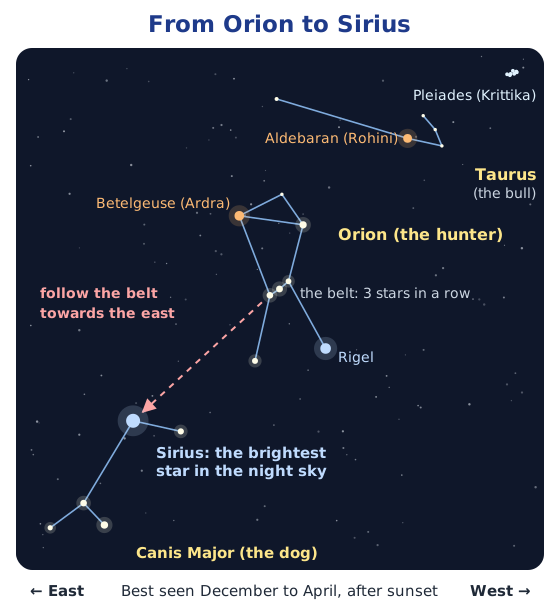
Orion is often pictured as a hunter. Three stars in a short straight line in the middle make his belt. Some people imagine Orion, followed by his dog (Canis Major), battling a bull (Taurus). In India, Orion is easiest to see from December to April, after sunset. To find Sirius, the brightest star in the night sky, find the belt first, then follow a line through its three stars towards the east.
Nakshatras
In Indian astronomy, a nakshatra is a certain star or a group of stars:
| Nakshatra | What it is | Constellation |
|---|---|---|
| Ardra | the star Betelgeuse | Orion |
| Krittika | the star group Pleiades | Taurus |
| Rohini | the star Aldebaran | Taurus |
The Big Dipper and the Pole Star
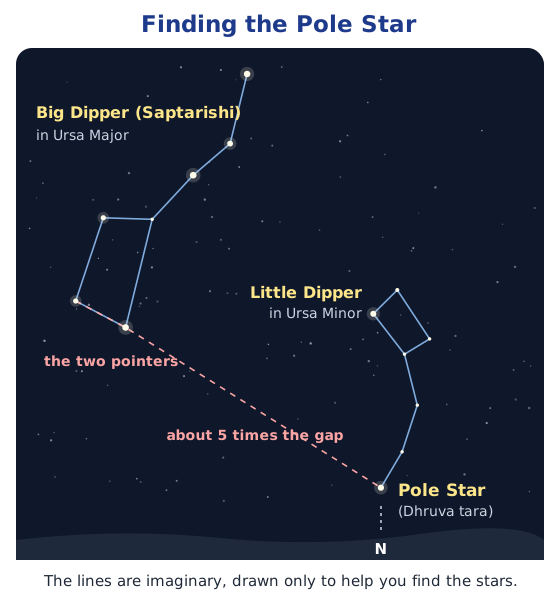
The Big Dipper, called Saptarishi in India, is a pattern of seven stars in the constellation Ursa Major; the Little Dipper is in Ursa Minor. The Pole Star (Dhruva tara), at the end of the Little Dipper, appears nearly stationary in the North, which helps locate North in the northern hemisphere. To find it, look north around 9 p.m. in summer and spot the Big Dipper. The two stars at the end of its cup are the pointers: follow a line through them for about five times the gap between them, and you reach a star that is not very bright. That is the Pole Star.
Stories in the stars
Many forest-dwelling communities and tribes of India have their own stories. Tribes in Central India see the four stars of the Big Dipper that make a rough rectangle as a “grandmother’s cot”, with the other three stars as thieves stealing it. Fishermen on the Konkan coast see the four stars as a boat, with the last three stars as its neck.
Seeing them yourself
Not every star or constellation is visible from every place on every night; the Pole Star, for example, cannot be seen from the southern hemisphere. Use images of the patterns and a sky-map app to know when and where to look, go with an adult to a dark, open place on a clear, moonless night, and wait about half an hour for your eyes to adjust. Next, read about the planets of the Solar System.
Practice
-
Which constellation is pictured as a hunter?
Show answer
Answer: (b) Orion
-
In India, the Big Dipper is known as:
Show answer
Answer: (b) Saptarishi
-
The Pole Star cannot be seen from:
Show answer
Answer: (b) the southern hemisphere The Pole Star lies in the North; from the southern half of the Earth it stays below the horizon.
-
Why were star patterns useful in olden times?
Show answer
Answer: They helped people recognise stars and, before the magnetic compass, helped sailors and travellers find directions at sea or on land. They are still used as a backup in emergencies.
-
How do you find Sirius in the night sky?
Show answer
Answer: First find the three bright stars in a short straight line in the middle of Orion, its belt. Imagine a line through them and follow it towards the east: it leads to Sirius.
Questions students ask
What is a constellation?
Earlier, a group of stars forming a pattern was called a constellation. Now the IAU uses the word for each of 88 regions of the sky that include these groups of stars, but people still use it for the star patterns themselves.
Which is the brightest star in the night sky?
Sirius, in the constellation Canis Major. The Pole Star is much fainter.
What is a nakshatra?
In Indian astronomy, a nakshatra is a certain star or group of stars, such as Ardra (the star Betelgeuse in Orion), Krittika (the star group Pleiades in Taurus) and Rohini (the star Aldebaran in Taurus).
How does the Pole Star help find North?
It appears nearly still in the North while the other stars move across the sky, so in the northern hemisphere, facing the Pole Star means facing North.
Stuck on a question?
Take a photo and Lagnever AI explains it step by step. Try it for 7 days for ₹2.
Get it on Google Play Open in browser
For parents: after the trial, the plan renews monthly by UPI or card autopay. You can cancel anytime in the app.