
NCERT Solutions Class 6 Social Science Chapter 12: Grassroots Democracy — Part 3: Local Government in Urban Areas
Answers to the Big Questions, the Let’s Explore activities, the Think About It question and the “Questions, activities and projects” of Chapter 12, Grassroots Democracy — Part 3: Local Government in Urban Areas, in Exploring Society: India and Beyond. Many of these are discussion questions, so the answers below are model answers and ideas: use them to prepare, then add examples from your own town or city. Short notes: Chapter 12 notes.
The Big Questions (page 173)
1. What are urban local bodies and what are their functions?
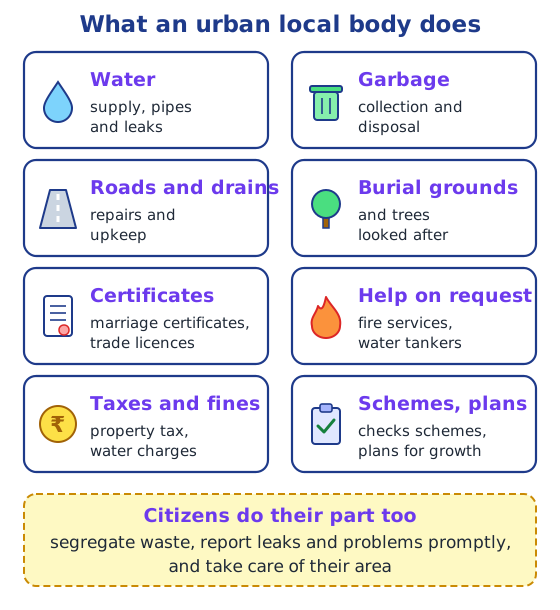
Urban local bodies are the structures of local government in cities and towns. A city of more than 10 lakh people has a Municipal Corporation (Mahanagar Nigam), a city of 1 lakh to 10 lakh people a Municipal Council (Nagar Palika), and a smaller town a Nagar Panchayat. Cities and towns are divided into wards, each with a ward committee. Their functions include:
- helping take care of infrastructure such as water supply, roads and drains;
- collecting and disposing of garbage, and maintaining burial grounds;
- checking that government schemes are carried out;
- collecting local taxes and fines, and providing services such as licences, certificates, fire services and water tankers;
- playing some role in planning the area’s economic and social development;
- through ward committees, running health camps and campaigns, and reporting leaks, blocked drains and damaged roads.
2. Why are they important in governance and democracy?
- They are decentralised: instead of one central authority deciding everything, local communities have a direct say in how their area is managed.
- Local problems, like a water leak or a damaged road, can be dealt with quickly by people who know the area.
- Citizens elect members who represent them, and they can take part through ward committees, so democracy works at the grassroots of a city.
- They make it a participatory democracy: people learn their rights and their duties, such as segregating waste and reporting problems.
- As Rustom K. Sidhwa said in the Constituent Assembly in 1949, local bodies let people understand administration, voting, powers and rights in a small sphere, in their own town.
Let’s Explore: cities and diversity (page 174)
Why is a city like Kolkata, Chennai or Mumbai more complex and diverse than a village or a town?
- It has far more people, millions instead of hundreds or thousands, living close together.
- People come from many States and speak many languages; they follow different religions and customs and do thousands of different jobs.
- It needs many more services: water for tall buildings, buses and trains, traffic control, hospitals, waste disposal for huge amounts of garbage, fire services and more.
- It has industries, offices, ports or markets that affect people far beyond the city.
- People often do not know their neighbours, so problems cannot be solved just by everyone meeting together, as in a village.
List the diverse communities in a city you know. For example, in a big city you may find people speaking Hindi, Bengali, Tamil, Marathi, Gujarati, Punjabi, Malayalam, Urdu and many other languages; followers of different religions; and people who came from villages and other States for work or study. What you may observe: the list grows very long; many communities have their own festivals, food and places of worship, yet they live, work and celebrate together as neighbours.
Let’s Explore: rural and urban local government (page 175)
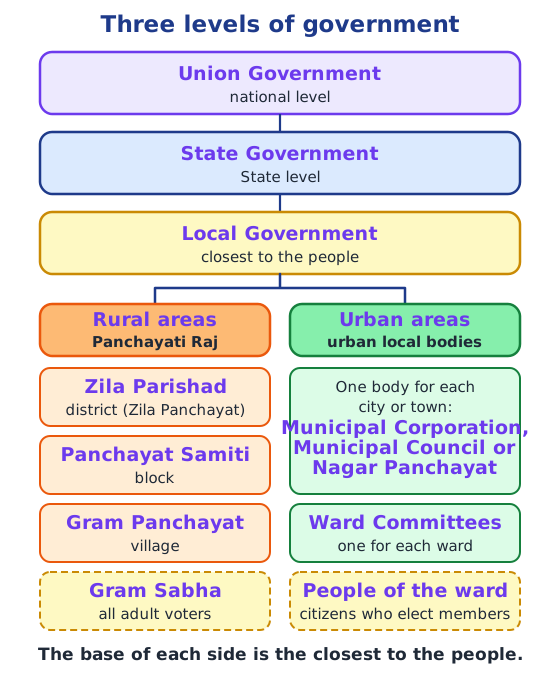
Similarities: both are local government, the level below the Union and State governments and closest to the people; both have the people at their base (the Gram Sabha in a village, the people of the ward in a city); both have elected members; and both look after local needs.
Differences: the rural side has three tiers (Gram Panchayat, Panchayat Samiti and Zila Parishad), while the urban side has one main body for each city or town, with ward committees below it; and the type of urban body depends on the population of the place.
Let’s Explore: more actions for responsible citizens (page 177)
Besides segregating waste and reporting water leaks, responsible citizens can:
- use dustbins and never litter or spit in public places;
- avoid single-use plastics and carry a cloth bag;
- save water and electricity, and report public taps left running or streetlights left on during the day;
- report potholes, open manholes, broken streetlights and fallen trees to the local body;
- take care of parks, public toilets and other public property, and not paste posters on walls;
- pay property tax and water charges on time, and, as adults, vote in local elections.
Think About It: Indore (page 179)
What could have been the role of Indore’s citizens in its being named the cleanest city seven years in a row? Citizens could have:
- segregated wet and dry waste at home and handed it to the garbage collectors;
- stopped littering and used dustbins;
- reduced single-use plastics;
- reported garbage heaps and blocked drains through the corporation’s complaint system;
- joined cleanliness drives and encouraged neighbours, shopkeepers and visitors to keep the city clean;
- taken pride in their city and kept up these habits year after year.
Let’s Explore: urban local bodies near you (page 179)
How to find out the type of urban local body: check the city’s official website or the State’s urban development department website, read local newspapers, look at signboards on the local body’s office or its bills (for example, the property tax or water bill), or ask elders and teachers. The name often helps: Nagar Nigam or Mahanagar Palika means a Municipal Corporation, Nagar Palika or Nagar Parishad a Municipal Council.
A sample table (add cities from your own State and the neighbouring States):
| City or town | State | Type of urban local body |
|---|---|---|
| Mumbai | Maharashtra | Municipal Corporation (Municipal Corporation of Greater Mumbai) |
| Chennai | Tamil Nadu | Municipal Corporation (Greater Chennai Corporation) |
| Indore | Madhya Pradesh | Municipal Corporation (Indore Municipal Corporation) |
| Kolkata | West Bengal | Municipal Corporation (Kolkata Municipal Corporation) |
| Your town or city |
How do urban local bodies fund their activities? From the Indore pictures: property tax; water charges; fees for business, hoarding and trade licences and for certificates such as marriage certificates; charges for services on request; and fines. (Extra: they also get grants from the State and Union governments.)
Are some of them paid services? Yes. Services on request, such as a water tanker, a septic tanker, booking the auditorium, a funeral van, a mobile toilet or an ambulance, are usually paid for, and water is paid for through water charges.
Questions, activities and projects (pages 181–182)
1. A water pipe is leaking on the way to school. What would you and your friends do?
- Note exactly where the leak is, using a landmark, and how bad it is.
- Tell a teacher or parents at once; with an adult’s help, report it to the urban local body by phone, its complaint app or website, or the ward office, or tell the ward committee member.
- Do not try to repair it yourselves, and keep away if there are electric wires nearby.
- If it is still leaking after a day or two, follow up with the office.
- Talk about it in class, so that others also learn to report leaks: reporting promptly prevents further wastage of precious water.
2. Invite a member of an urban local body to your class. Prepare questions.
With your teacher’s help, write an invitation letter, decide who will welcome the guest, who will ask which question and who will take notes, and send a thank-you note afterwards. Some questions to ask:
- Which ward or area do you represent, and how were you chosen?
- What are your main responsibilities?
- What are the biggest problems in our area, and how are they being solved?
- How does the local body get money, and how does it decide how to spend it?
- How can citizens report a problem, and how long does it take to fix?
- What does the ward committee do?
- How can students help keep our area clean and safe?
3. Make a list of what the adults around you expect from the urban local body.
Answers will vary. Common expectations: clean water every day; daily garbage collection; clean drains so that streets do not flood in the monsoon; good roads and footpaths without potholes; working streetlights; parks and playgrounds; clean public toilets; control of mosquitoes and health camps; quick action on complaints; easy and honest payment of taxes and bills, including online; quick fire and ambulance services; and planting and protecting trees.
4. List the characteristics of a good urban local body.
- It provides basic services, such as water, cleanliness, roads and streetlights, regularly and well.
- It listens to citizens and acts quickly on complaints.
- It is honest and open about how it spends public money.
- It involves people, for example through ward committees, meetings and campaigns.
- It treats all areas and all people fairly, rich and poor alike.
- It plans for the future: water, waste, traffic, housing and green spaces.
- It protects the environment, for example by reducing plastic and planting trees.
- It is easy to reach, through offices, helplines and online services.
5. What are the similarities and differences between Panchayati Raj and urban local bodies?
| Panchayati Raj (rural) | Urban local bodies | |
|---|---|---|
| Where | Villages | Cities and towns |
| Bodies | Three tiers: Gram Panchayat, Panchayat Samiti, Zila Parishad | One main body for each place: Municipal Corporation, Municipal Council or Nagar Panchayat, with ward committees |
| Base | Gram Sabha: all the adult voters of a village | The people of each ward |
| Which body | Every village has a Gram Panchayat; blocks and districts have the higher tiers | Depends on population: Nagar Panchayat, Municipal Council (1 lakh to 10 lakh) or Municipal Corporation (more than 10 lakh) |
| How people take part | Often directly, in the Gram Sabha, since everyone knows everyone | Mostly through elected members and ward committees |
Similarities: both are local government, decentralised and close to the people; both have members elected by the local people; both look after local needs such as water, cleanliness and roads and make sure government schemes reach people; both work under rules made by the State, so details differ from State to State; and in both, citizens have duties too.
Practice
-
The Madras Corporation was set up in:
Show answer
Answer: (a) 1688
-
In the chapter's diagram of the levels of government, what is at the base of the urban side?
Show answer
Answer: (b) People of the ward
-
Which of these is NOT among the Indore Municipal Corporation's services shown in the chapter?
Show answer
Answer: (d) Passport
-
Who asked in the Constituent Assembly for full-fledged local bodies, and when?
Show answer
Answer: Rustom K. Sidhwa, a member of the Constituent Assembly, on 13 October 1949.
-
Name the three types of urban local bodies and the population each serves, according to the chapter.
Show answer
Answer: Nagar Panchayat for smaller towns, Municipal Council (Nagar Palika) for cities of 1 lakh to 10 lakh people, and Municipal Corporation (Mahanagar Nigam) for cities of more than 10 lakh people.
Stuck on a question?
Take a photo and Lagnever AI explains it step by step. Try it for 7 days for ₹2.
Get it on Google Play Open in browser
For parents: after the trial, the plan renews monthly by UPI or card autopay. You can cancel anytime in the app.