
Class 6 Social Science Chapter 12: Grassroots Democracy — Part 3: Local Government in Urban Areas Notes
This chapter in five lines
In cities and towns, local government is run by urban local bodies. They are decentralised, so local communities have a direct say in how their area is managed. A city of more than 10 lakh people has a Municipal Corporation, a city of 1 to 10 lakh a Municipal Council, and a smaller town a Nagar Panchayat. Cities are divided into wards with ward committees. These bodies look after water, garbage, roads and local taxes, and citizens must do their part too.
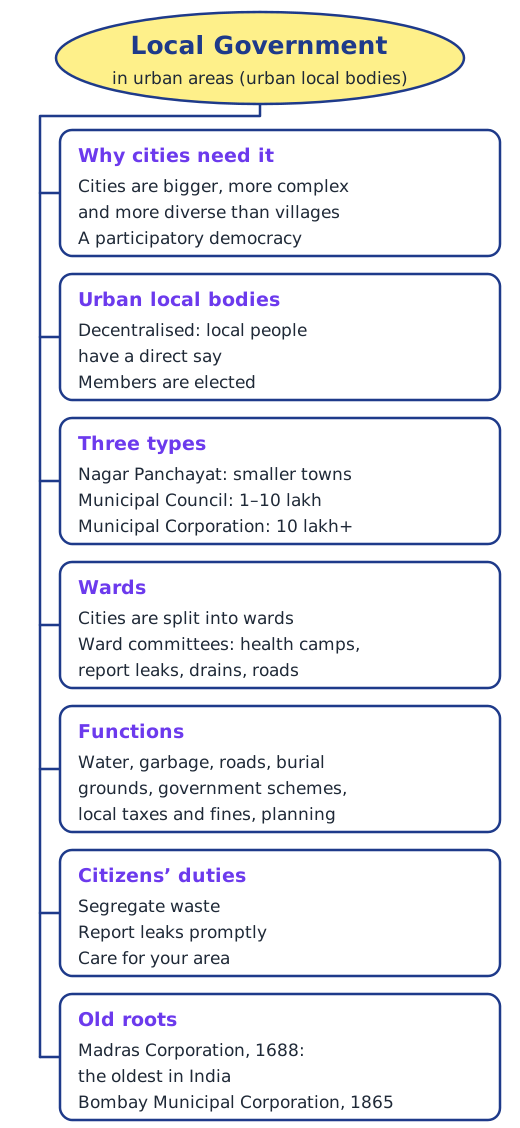
Why do cities need their own government?
In a democracy, good governance aims to let citizens take an active part in how their country works, at the rural, regional, urban, State or national level. This is called participatory democracy. Chapter 11 showed how it works in villages. Cities like Kolkata, Chennai or Mumbai are generally more complex and diverse than a village or a small town: far more people, from many communities, with many more needs. So the system that governs a city has to be more complex too. The chapter looks at its basic principles.
Three levels of government
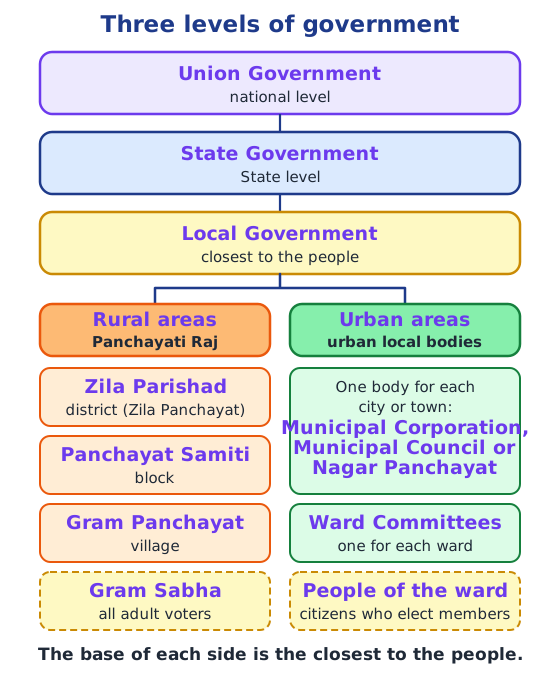
Think of India’s system of governance as a pyramid. At the top is the Union Government at the national level, then the State Government, and at the base, closest to the people, local government. Local government has two sides: in rural areas it is the Panchayati Raj system, and in urban areas it is made up of urban local bodies. On both sides, the people themselves are at the base.
Urban local bodies and wards
Urban local bodies are decentralised. Instead of everything being run by a central authority at the top, the local communities have a direct say in how their areas are managed and how their problems are solved. As in villages, these bodies have elected members who represent the local citizens.
Cities and towns are divided into smaller units called wards. Ward committees run activities such as health camps and campaigns against single-use plastics. They also keep an eye on anything that might go wrong, like a water leak, a blocked drain or a damaged road, and report it to the authorities. How wards work differs from State to State.
What urban local bodies do
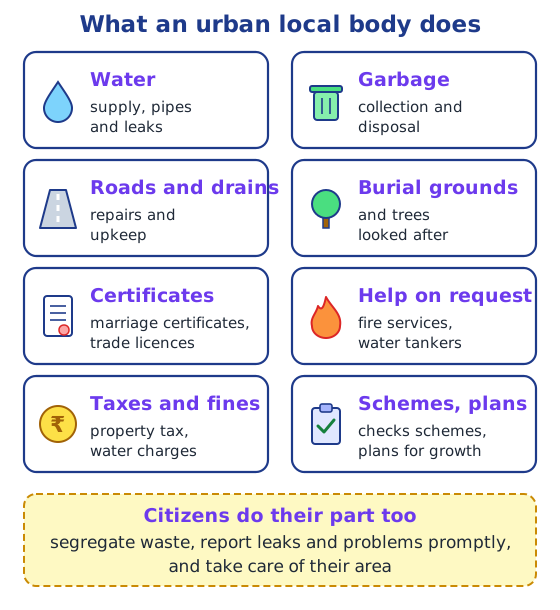
Urban local bodies help take care of the city’s infrastructure, maintain burial grounds, collect and dispose of garbage, check that government schemes are carried out, and collect local taxes and fines. They also have some role in planning the area’s economic and social development. The Indore Municipal Corporation, for example, handles property tax, water charges, solid waste management, trade licences, marriage certificates, fire services and complaints, and provides water tankers, septic tankers, an auditorium, funeral vans, mobile toilets and ambulances on request. Some of these are paid services, which is one way the body raises money.
Citizens have duties too
These bodies can work well only if people do their part and show care for their area: this is a participatory democracy. If people follow the instructions on waste segregation, garbage collection becomes easier; if someone reports a water leak in the street promptly, precious water is saved. Indore has been named the cleanest city in India under the Swachh Survekshan survey seven years in a row, and its citizens had a role in that.
Three types of urban local bodies
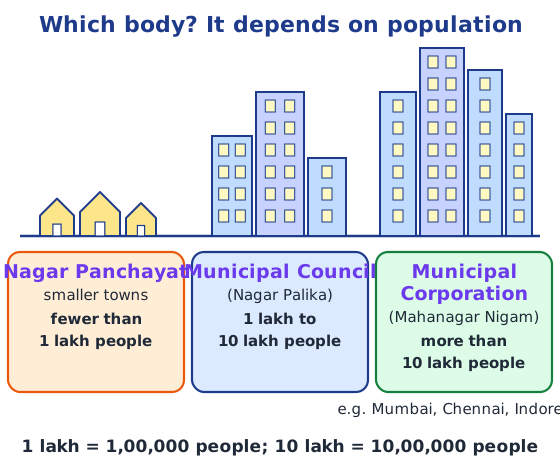
| Population of the city or town | Highest urban local body |
|---|---|
| More than 10 lakh | Municipal Corporation (Mahanagar Nigam), as in Mumbai, Chennai and Indore |
| 1 lakh to 10 lakh | Municipal Council (Nagar Palika) |
| Smaller towns | Nagar Panchayat |
More in Municipal Corporation and Municipal Council.
A village and a city: Sameer and Anita
In the chapter, Anita, visiting from the city, meets Sameer in his village. She says the city is busy, crowded and noisy, and people often do not know their neighbours, yet when a house collapsed after heavy rain, dozens of people came to help clear the rubble. Her city has local bodies with elected representatives. Sameer says it sounds like his village Panchayat, only bigger: in the village everyone knows everyone, and even children were heard when they reported a dangerously low electric wire to a Gram Sabha member, and the post was shifted. They agree that the city system is more complicated, but the idea is the same: everyone’s voice matters.
Old roots
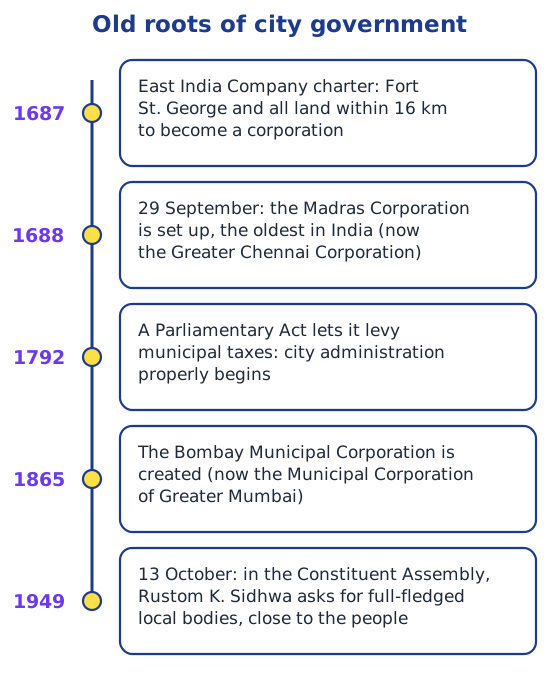
The Madras Corporation (now the Greater Chennai Corporation), set up on 29 September 1688, is the oldest municipal institution in India. A year earlier, the East India Company had issued a charter making the town of Fort St. George and all land within 16 km of it a corporation, and a Parliamentary Act of 1792 gave it the power to levy municipal taxes, which is when city administration properly began. The Bombay Municipal Corporation, now the Municipal Corporation of Greater Mumbai, was created in 1865. In the Constituent Assembly on 13 October 1949, Rustom K. Sidhwa asked for full-fledged local bodies to be formed, so that people could learn about administration, voting, powers and rights in their own town or village. Answers to every question in the chapter are in the NCERT solutions for Chapter 12.
Key terms
| Term | Meaning |
|---|---|
| Urban area | A town or city. Cities are generally bigger, more complex and more diverse than villages. |
| Urban local body | A body of local government in a city or town: a Municipal Corporation, a Municipal Council or a Nagar Panchayat. |
| Decentralised | Not run by one central authority at the top: the local communities have a direct say in how their areas are managed. |
| Participatory democracy | A democracy in which citizens take an active part in how their area and country are run, at the rural, urban, State and national levels. |
| Ward | One of the smaller units into which a city or town is divided. |
| Ward committee | A committee for a ward. It runs activities such as health camps and reports problems like water leaks, blocked drains and damaged roads to the authorities. |
| Municipal Corporation (Mahanagar Nigam) | The highest urban local body in a city of more than 10 lakh people, such as Mumbai, Chennai or Indore. |
| Municipal Council (Nagar Palika) | The highest urban local body in a city of 1 lakh to 10 lakh people. |
| Nagar Panchayat | The urban local body of a town with a smaller population. |
| Waste segregation | Sorting waste into different kinds, such as wet and dry waste, so that garbage collection and disposal become easier. |
| Property tax | A local tax on houses, shops and other buildings, collected by the urban local body. |
| Swachh Survekshan | A government survey that ranks Indian cities for cleanliness. Indore was named the cleanest city seven years in a row. |
Topics in this chapter
Practice
-
A city with a population of more than 10 lakh has a:
Show answer
Answer: (c) Municipal Corporation
-
Cities and towns are divided into smaller units called:
Show answer
Answer: (b) wards
-
Which is the oldest municipal institution in India?
Show answer
Answer: (c) Madras Corporation
-
Another name for a Municipal Council is:
Show answer
Answer: (b) Nagar Palika
-
Which of these helps the urban local body do its work?
Show answer
Answer: (b) Reporting a water leak promptly Reporting a leak quickly prevents more precious water from being wasted. Citizens' duties are part of a participatory democracy.
Questions students ask
What are the main topics of Class 6 SST Chapter 12?
Why cities need their own local government, the levels of government in India, urban local bodies and why they are decentralised, wards and ward committees, what urban local bodies do, citizens' duties, the Madras and Bombay corporations, Indore's services and cleanliness, the three types of urban local bodies, and a conversation comparing a village and a city.
Is Local Government in Urban Areas in the new Exploring Society book?
Yes. Grassroots Democracy — Part 3: Local Government in Urban Areas is Chapter 12 of Exploring Society: India and Beyond, the Class 6 Social Science textbook used in the 2026-27 session. It follows Chapter 11 on local government in rural areas.
How many end-of-chapter questions does Chapter 12 have?
The “Questions, activities and projects” section has 5 items, from a leaking water pipe to comparing Panchayati Raj with urban local bodies. Our NCERT solutions page answers them, along with the Big Questions, the Think About It question and the Let's Explore activities.
Stuck on a question?
Take a photo and Lagnever AI explains it step by step. Try it for 7 days for ₹2.
Get it on Google Play Open in browser
For parents: after the trial, the plan renews monthly by UPI or card autopay. You can cancel anytime in the app.