
NCERT Solutions Class 6 Social Science Chapter 13: The Value of Work
Answers to the Big Questions, the Let’s Explore tables, the Think About It questions and the “Questions, activities and projects” of Chapter 13, The Value of Work, in Exploring Society: India and Beyond. Many of these are discussion questions, so the answers below are model answers and ideas: use them to prepare, then add examples from your own family and neighbourhood. Short notes: Chapter 13 notes.
The Big Questions (page 183)
1. What are the different types of activities that people engage in?
People engage in two types of activities:
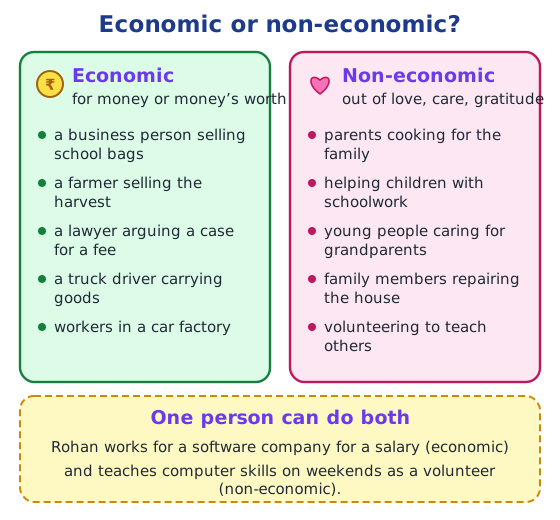
- Economic activities, which involve money or are done in exchange for money or money’s worth: working for a salary (Geeta Aunty, the Air Force pilot; Rohan, the software engineer), working for a wage (Sahil, the farm labourer), giving professional services for a fee (a doctor, a lawyer, Kavya’s aunt’s online classes), selling goods (Anu’s parents’ shop, Rajesh’s chairs) and producing or carrying goods (farmers, factory workers, truck drivers).
- Non-economic activities, which earn no income and are done out of love, care, gratitude and respect: cooking for the family, helping children with schoolwork, caring for grandparents, volunteering, sevā and community work.
2. What is their contribution to our everyday lives?
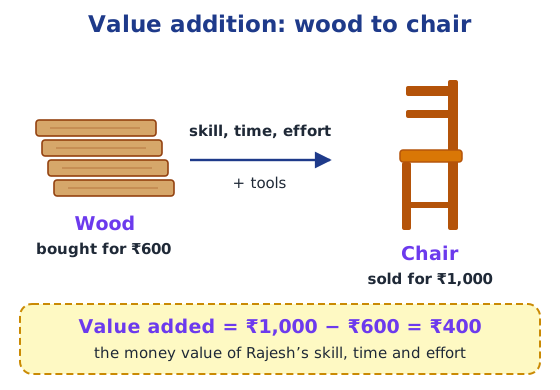
- Economic activities give us the goods and services we use every day, such as food, clothes, furniture, transport and healthcare, and give people the income to buy what they need. Each stage of production adds value, as when wood becomes a chair.
- Non-economic activities look after the people around us and the places we live in: meals and care at home, clean streets through the Swachh Bharat Abhiyan, trees through Van Mahotsav, food for all at langars. They add to social welfare, personal wellbeing and the quality of life.
Let’s Explore: who does what (pages 185 and 187)
The table with the third column labelled “economic / non-economic activity”:
| Character in the story | Activities they are engaged in | Economic / non-economic |
|---|---|---|
| Geeta Aunty | Pilot in the Indian Air Force, paid a salary | Economic |
| Kabir’s grandfather | Teaching Geography to the neighbourhood children without a fee; tending the vegetable garden; running errands for the home | Non-economic |
| Anu’s father (Appa) | Running a shop that sells uniforms and ready-made garments | Economic |
| Anu’s mother (Maa) | Working in the shop | Economic |
| Anu’s mother (Maa) | Helping a voluntary group that teaches stitching to women | Non-economic |
| Rohan | Software engineer in a company that makes computer applications | Economic |
| Rohan | Teaching computer skills on weekends as a volunteer | Non-economic |
Think About It: teaching without a fee (page 187)
Kabir’s grandfather teaches the neighbourhood children for no fee. Is that economic or non-economic? How is it different from your teachers teaching at school? It is a non-economic activity: he earns nothing from it and does it out of care for the children and to share what he knows. Your school teachers do the same kind of work, but they are paid a salary for it, so their teaching is an economic activity. The difference is not the work but the payment.
What non-economic activities are important to you and your family? Why are they valuable? For example: cooking meals together, caring for elders when they are unwell, helping younger siblings study, cleaning the home, tending plants, and celebrating festivals together. They are valuable because they keep us healthy and cared for, build love and trust in the family, teach us values and skills, and save money that would otherwise be spent on paid help.
Think About It: on the way to school (page 189)
Some economic activities you may see, and how those people are usually paid:
| Person | How they are paid |
|---|---|
| Shopkeeper, vegetable or fruit seller | By selling goods for more than they paid for them |
| Bus conductor, driver of a company bus | Salary |
| Auto-rickshaw or taxi driver | Fares from passengers |
| Construction or farm labourer | Daily wage, sometimes partly in kind |
| Traffic police officer, school teacher | Salary |
| Doctor in a clinic | Fee from patients |
Let’s Explore: activities that create monetary value (page 191)
| Activity / profession | Creates monetary value? | Example of money-related value creation |
|---|---|---|
| 1. Baker | ✓ | Turns flour, sugar and butter into bread and cakes that sell for more than the ingredients cost |
| 2. Tailor | ✓ | Turns cloth into a shirt and charges for stitching it |
| 3. Farmers repairing their tractor | ✓ | The tractor is used to grow crops for sale, and repairing it themselves saves paying a mechanic |
| 4. Doctor | ✓ | Earns a fee or salary for treating patients |
| 5. Parents cooking dinner for their family | ✗ | Done out of love and care, not for money |
| 6. Scientist | ✓ | Paid for research that leads to new products, medicines and machines |
| 7. Person taking care of a sick grandparent | ✗ | Done out of love and care, not for money |
| 8. Potter | ✓ | Turns clay into pots and sells them |
| 9. Mechanic | ✓ | Repairs vehicles and charges for the work |
Think About It: community participation (page 193)
Community practices in your area: for example, community kitchens like langars, bhandaras and annadanam at temples and festivals; cleanliness drives; tree planting; blood donation camps; neighbours helping each other during weddings, illness or floods; and shramdaan, voluntary labour to repair a road, pond or school.
Festivals: are these non-economic activities, and why do they still hold value? Decorating together, cooking and sharing food are non-economic activities: people do them out of joy, faith and togetherness, not for money (even though shops and decorators earn from festivals, which is economic). They hold value because they bring families and neighbours together, keep traditions alive for children, help people who are in need, and make everyone feel part of a community.
Community programmes in your school or locality: for example, a cleanliness drive, a tree plantation drive, a health check-up camp or a collection of books and clothes for those in need. What you may observe: people of all ages volunteer, work as a team and share tasks, the place becomes cleaner or greener, and everyone feels proud and responsible for their surroundings.
Questions, activities and projects (page 193)
1. How are economic activities different from non-economic activities?
| Economic activities | Non-economic activities |
|---|---|
| Involve money, or are done in exchange for money or money’s worth | Do not involve money and do not earn income or wealth |
| Done to earn a living | Done out of love, care, gratitude and respect |
| Paid as a salary, wage, fee or payment in kind, or earn through sales | Not paid at all |
| Example: a lawyer arguing a case for a fee | Example: parents helping their children with schoolwork |
The same work can be either: paid teaching at school is economic, while Kabir’s grandfather’s teaching without a fee is non-economic.
2. What kind of economic activities do people engage in? Illustrate with examples.
- Jobs for a salary: Geeta Aunty, a pilot in the Indian Air Force; Rohan, a software engineer; Kavya’s uncle, a bulldozer technician; her aunt at the post office.
- Work for a wage: Sahil, a farm labourer paid daily.
- Professional services for a fee: doctors, lawyers, and Kavya’s aunt’s online classes.
- Business and trade: Anu’s parents’ uniform and clothes shop; a business person selling school bags in the market.
- Farming: farmers growing and selling their harvest.
- Making goods: Rajesh the carpenter making chairs; workers in a car factory.
- Transport: a truck driver carrying goods from one place to another.
3. “There is great value attached to people who are engaged in community service activities.” Comment.
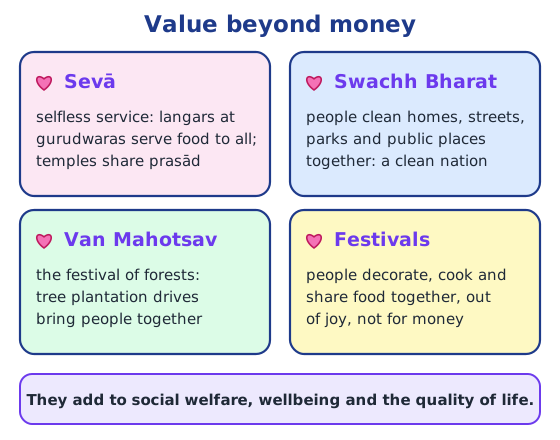
The statement is true. People who do community service earn no money from it, yet they create a great deal of value:
- For people in need: langars feed every visitor without charge, and volunteers like Rohan and Anu’s mother teach skills that help others earn a living.
- For the environment: Swachh Bharat Abhiyan keeps streets, parks and public places clean, and Van Mahotsav plants trees.
- For society: working together builds unity, trust and a sense of belonging, and sets an example for children.
- For themselves: sevā gives a sense of satisfaction and gratitude and is a way of giving back to society without expecting anything in return.
That is why such people are respected: they add to social welfare, personal wellbeing and the quality of life.
4. What are the various ways in which people are paid for economic activities? Give some examples.
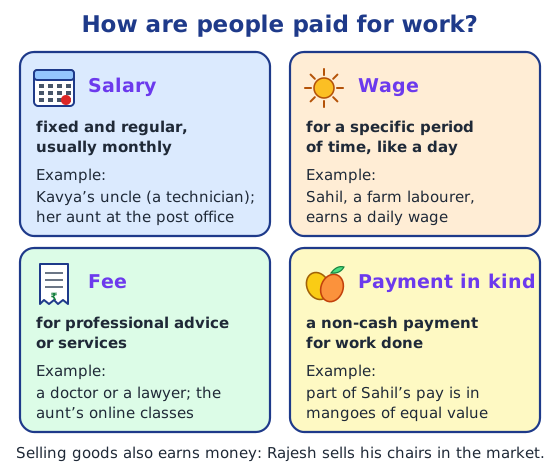
| Way of payment | Meaning | Example |
|---|---|---|
| Salary | A fixed, regular payment, usually monthly, by an employer | Kavya’s uncle (bulldozer technician); her aunt at the post office; Geeta Aunty |
| Wage | A payment for a specific period of time | Sahil, the farm labourer, paid daily |
| Fee | A payment for professional advice or services | A doctor’s or lawyer’s fee; Kavya’s aunt’s weekly fee for online classes |
| Payment in kind | A non-cash payment for work | Part of Sahil’s pay in mangoes of equal value |
| Earnings from selling goods | The price received for goods, more than their cost | Rajesh sells a chair for ₹1,000 after buying the wood for ₹600 |
Practice
-
Geeta Aunty is a pilot in the:
Show answer
Answer: (b) Indian Air Force
-
Kavya's aunt charges a weekly amount for her online classes. This payment is a:
Show answer
Answer: (c) fee
-
Which of these is an example of sevā from the chapter?
Show answer
Answer: (b) Langars at gurudwaras
-
How much time will the new highway near Kamlapur save on the trip to the nearest town?
Show answer
Answer: Three hours: the trip will take two hours instead of five.
-
Name the three things whose money value makes up the ₹400 Rajesh adds to the wood.
Show answer
Answer: His skill, his time and his effort.
Stuck on a question?
Take a photo and Lagnever AI explains it step by step. Try it for 7 days for ₹2.
Get it on Google Play Open in browser
For parents: after the trial, the plan renews monthly by UPI or card autopay. You can cancel anytime in the app.