
Class 6 Social Science Chapter 13: The Value of Work Notes
This chapter in five lines
People do two kinds of work. Economic activities involve money or money's worth, like selling goods, a lawyer's fee or a pilot's salary. Non-economic activities are done out of love, care, gratitude and respect, like parents cooking for the family or a volunteer teaching others. Economic work is paid as a salary, a wage, a fee or in kind, and making things adds value. Non-economic work, like sevā, Swachh Bharat Abhiyan and Van Mahotsav, adds to wellbeing and the quality of life.
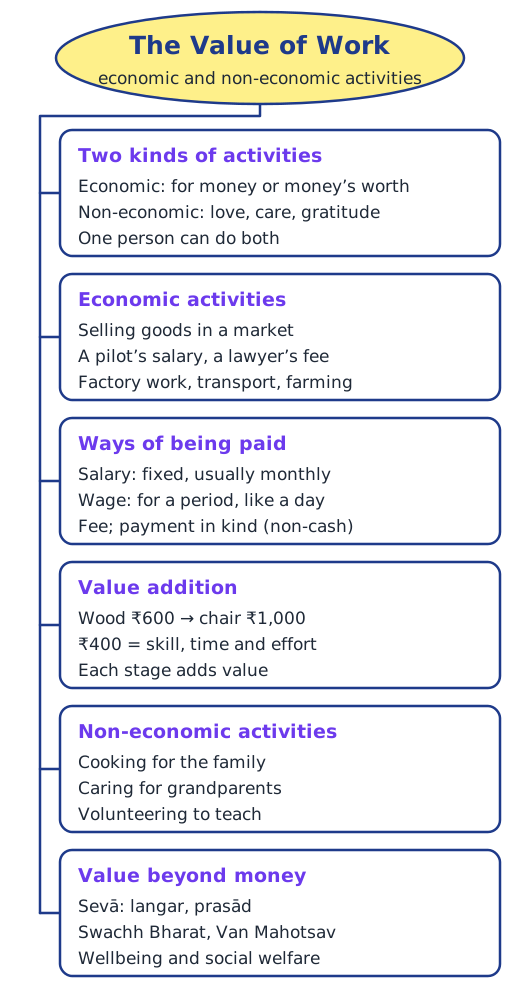
Everyone around us works
The chapter opens with Swami Vivekananda’s advice to give any work our full attention, as if it were worship. Then Anu and Kabir, playing in the park, see their neighbour Geeta Aunty, a pilot in the Indian Air Force, coming home in her uniform. Kabir’s grandfather, who retired from the Border Security Force, now teaches Geography to the neighbourhood children without charging them, tends the vegetable garden and runs errands for the home. Anu’s parents run a shop selling uniforms and ready-made clothes, and her mother also helps a voluntary group that teaches stitching to women. Anu’s brother Rohan is a software engineer who, on weekends, teaches computer skills to young people as a volunteer. As Kabir says, everyone around us does so many things every day.
Economic and non-economic activities
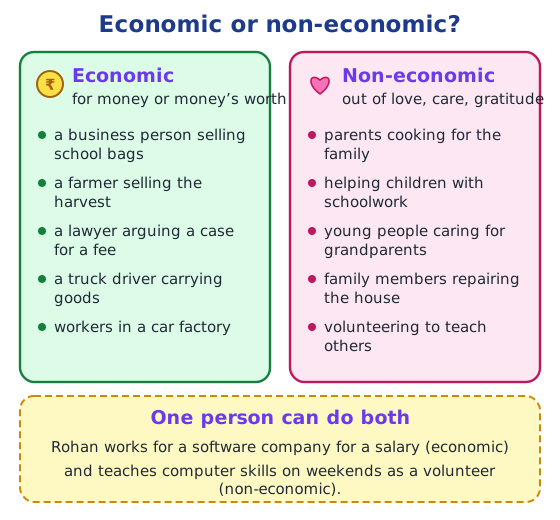
All these activities fall into two groups. Economic activities involve money, or are done in exchange for money or money’s worth: a business person selling school bags in a market, farmers selling their harvest, a lawyer arguing a case for a fee, a truck driver carrying goods, workers in a car factory. Non-economic activities do not earn income or wealth; they are done out of love, care, gratitude and respect: parents cooking for the family or helping with schoolwork, young people caring for their grandparents, family members repairing the house.
The same person often does both. Geeta Aunty serves the country and is paid a salary, so her work is economic. Rohan is paid by his company, but his weekend teaching is non-economic. Read more in economic and non-economic activities.
How people are paid
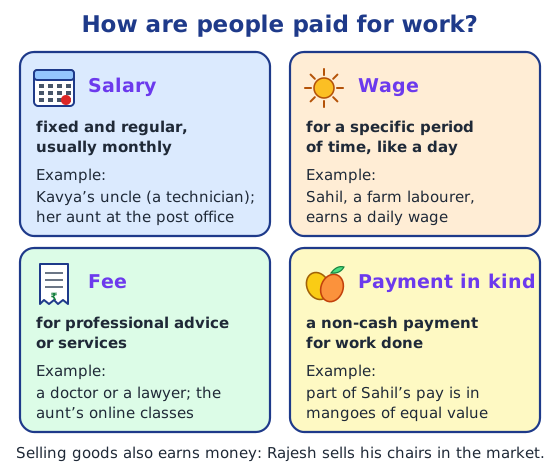
On a visit to her aunt in Kamlapur, Kavya sees a highway being built that will cut the trip to the town from five hours to two. Her uncle, a technician who operates a bulldozer, gets a monthly salary. Her aunt works at the village post office for a salary, and in the evenings runs online classes for school exams, for which she charges a weekly fee. At a mango orchard, Kavya meets Sahil, a farm labourer who earns a daily wage: part of it in cash and the rest in mangoes of equal value, which is payment in kind.
Value addition
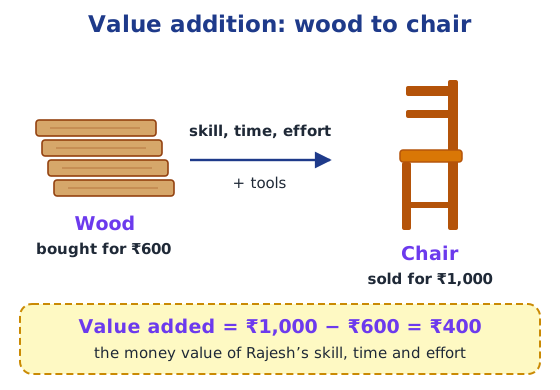
Economic activities have value in terms of money, and they add value at each stage of turning something into another form. This is value addition. Kavya’s father, Rajesh, a carpenter, buys wood for ₹600, uses his tools and skill to make a chair, and sells it for ₹1,000. The remaining ₹400 is the money value of his skill, time and effort. From buying the wood to selling the chair, every step involves payment, so all of it is economic activity.
Why non-economic activities matter
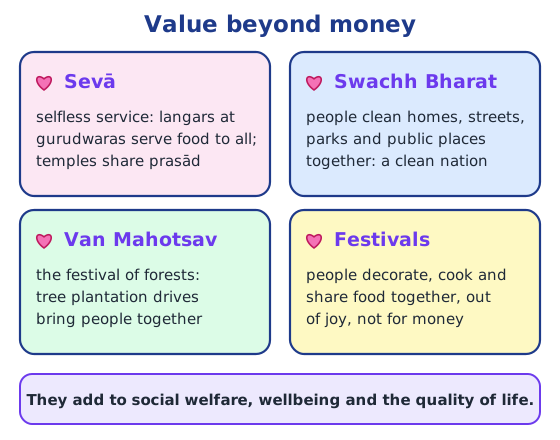
Non-economic activities may not involve money, but the value they create is important in our lives:
- Sevā (selfless service): seen at temples, gurudwaras, mosques and churches. Langars, or community kitchens, at gurudwaras serve food to every visitor without charge. Such practices build satisfaction and gratitude and are a way of giving back to society without expecting anything in return.
- Swachh Bharat Abhiyan: we keep our own homes clean, and people also come together to clean streets, roads, parks and public places, for a clean neighbourhood, society and nation.
- Van Mahotsav: the festival of forests brings the community together for tree plantation drives and spreads awareness about trees and forests.
Together, such activities add to social welfare, personal wellbeing and the overall quality of life. Answers to every question in the chapter are in the NCERT solutions for Chapter 13.
Key terms
| Term | Meaning |
|---|---|
| Economic activity | An activity that involves money, or is done in exchange for money or money's worth, like a farmer selling the harvest or a lawyer earning a fee. |
| Non-economic activity | An activity that does not earn income or wealth and is done out of love, care, gratitude or respect, like caring for grandparents. |
| Market | A place where people exchange goods and services, mostly for money. |
| Money's worth | The money value a person places on something, based on the benefit they get from it. |
| Salary | A fixed, regular payment, usually monthly, made by an employer to an employee. |
| Wage | A payment made by an employer to a worker for a specific period of time, such as a day. |
| Fee | A payment to a person or organisation for professional advice or services, like a doctor's or a lawyer's fee. |
| Payment in kind | A non-cash payment for work, such as mangoes given to a farm labourer as part of his pay. |
| Value addition | The value added at each stage of turning something into another form, like wood into a chair. |
| Sevā | Selfless service, done without expecting anything in return, as in langars at gurudwaras. |
| Swachh Bharat Abhiyan | A movement based on the efforts of all citizens to keep homes, streets and public places clean. |
| Van Mahotsav | The festival of forests, with tree plantation drives that spread awareness about the value of trees. |
Topics in this chapter
Practice
-
Which of these is an economic activity?
Show answer
Answer: (b) A lawyer arguing a case for a fee
-
A fixed, regular payment made every month by an employer is a:
Show answer
Answer: (b) salary
-
Sahil gets part of his pay in mangoes of equal value. This is called:
Show answer
Answer: (c) payment in kind
-
Rajesh buys wood for ₹600 and sells a chair for ₹1,000. The value he adds is:
Show answer
Answer: (c) ₹400
-
Van Mahotsav is a festival of:
Show answer
Answer: (b) forests
Questions students ask
What are the main topics of Class 6 SST Chapter 13?
Economic and non-economic activities with examples from Anu and Kabir's neighbourhood, money's worth, salary, wage, fee and payment in kind from Kavya's visit to Kamlapur, value addition by Rajesh the carpenter, and the value of non-economic activities such as sevā, Swachh Bharat Abhiyan and Van Mahotsav.
Is The Value of Work in the new Exploring Society book?
Yes. The Value of Work is Chapter 13 of Exploring Society: India and Beyond, the Class 6 Social Science textbook used in the 2026-27 session. It is part of the theme Economic Life Around Us.
How many end-of-chapter questions does Chapter 13 have?
The “Questions, activities and projects” section has 4 questions. Our NCERT solutions page answers them, along with the Big Questions, the Let's Explore tables and the Think About It questions.
Stuck on a question?
Take a photo and Lagnever AI explains it step by step. Try it for 7 days for ₹2.
Get it on Google Play Open in browser
For parents: after the trial, the plan renews monthly by UPI or card autopay. You can cancel anytime in the app.