
What are economic and non-economic activities?
Answer in short
Economic activities are done for money or money's worth, like a farmer selling the harvest, a lawyer earning a fee or a pilot drawing a salary. Non-economic activities earn no income and are done out of love, care, gratitude or respect, like parents cooking for the family or a volunteer teaching others. The same person can do both kinds.
Stuck on a question? Take a photo and Lagnever AI explains it step by step. Try it for 7 days for ₹2. Get it on Google Play
Two kinds of activities
People do many different things every day: they work in offices, farms, shops and factories; they cook, clean and care for their families; they help their neighbours. All these activities can be divided into two groups: economic activities and non-economic activities.
Economic activities
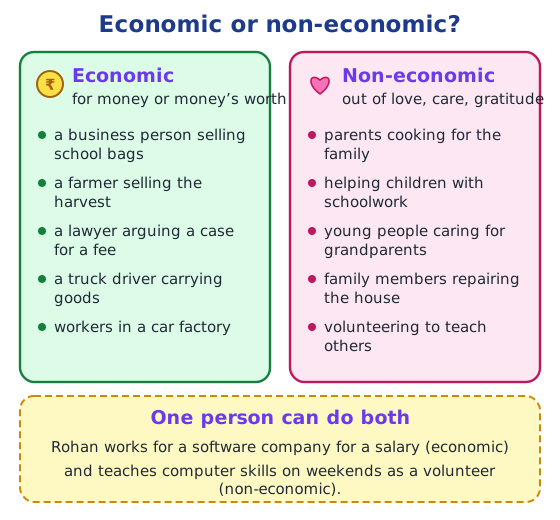
Economic activities are those that involve money, or are done in exchange for money or money’s worth, for the people involved. Examples from the chapter:
- a business person selling school bags in the market;
- farmers selling their harvest in the market;
- a lawyer arguing a case and earning a fee;
- a truck driver transporting goods from one place to another;
- workers employed in a car factory.
Three words help here. A market is a place where people exchange goods and services, mostly for money. A fee is a payment for professional advice or services, like a doctor’s or a lawyer’s. Money’s worth is the money value a person places on something, based on the benefit they get from it.
Non-economic activities
Non-economic activities do not generate income or wealth. They are done out of feelings like love, care, gratitude and respect:
- parents cooking food for the family;
- parents helping their children with schoolwork;
- young people taking care of their grandparents;
- family members helping to renovate the house.
The same work can be either
What makes an activity economic is the payment, not the work itself. Kabir’s grandfather teaches Geography to the neighbourhood children without charging them: that is non-economic. Your school teachers teach too, but they are paid a salary for it: that is economic. In the same way, Anu’s brother Rohan works for a software company for a salary, but teaches computer skills to young people on weekends as a volunteer.
| Person in the chapter | Economic activity | Non-economic activity |
|---|---|---|
| Geeta Aunty | flying as an Indian Air Force pilot, for a salary | |
| Kabir’s grandfather | teaching Geography without a fee, gardening, running errands | |
| Anu’s parents | running a uniform and clothes shop | Maa helps a voluntary stitching group |
| Rohan | software engineer, for a salary | teaching computer skills as a volunteer |
How economic work is paid
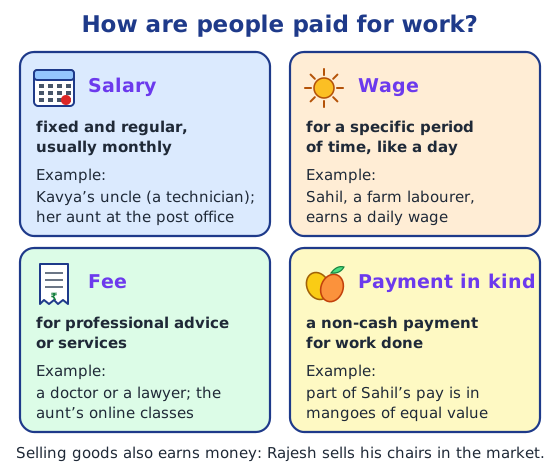
- Salary: a fixed, regular payment, usually monthly, from an employer, like Kavya’s uncle, a bulldozer technician, and her aunt at the post office.
- Wage: a payment for a specific period of time, like Sahil’s daily wage as a farm labourer.
- Fee: a payment for professional services, like the weekly fee Kavya’s aunt charges for her online classes.
- Payment in kind: a non-cash payment, like the mangoes that make up part of Sahil’s pay.
Why non-economic activities matter
Non-economic activities do not involve money, but they hold great value. A family that cooks, cleans and cares for its members creates value every day, even though no one is paid. Sevā at temples, gurudwaras, mosques and churches, the shared work of the Swachh Bharat Abhiyan and tree planting on Van Mahotsav add to social welfare, personal wellbeing and the quality of life. For value addition and the whole chapter, read the Chapter 13 notes.
Practice
-
Which of these is a non-economic activity?
Show answer
Answer: (c) Parents helping their child with schoolwork
-
Rohan teaches computer skills to young people on weekends without pay. His teaching is:
Show answer
Answer: (b) non-economic, because he earns nothing from it
-
Payment made for professional advice, such as a doctor's, is called a:
Show answer
Answer: (b) fee
-
Why is a school teacher's teaching an economic activity, but Kabir's grandfather's teaching non-economic?
Show answer
Answer: The school teacher is paid a salary for teaching, so it is done in exchange for money. Kabir's grandfather teaches the neighbourhood children without charging anything, out of care for them, so it earns no income.
-
Give two examples each of economic and non-economic activities from your home.
Show answer
Answer: Economic (examples): a parent working in an office for a salary; a family member selling vegetables at a shop. Non-economic (examples): cooking meals for the family; looking after a sick grandparent.
Questions students ask
What is the difference between economic and non-economic activities?
Economic activities involve money or money's worth and earn income, like selling goods or working for a salary. Non-economic activities earn no income and are done out of love, care, gratitude or respect, like caring for family members or volunteering.
What does money's worth mean?
It is the money value that a person places on something, based on the benefit they get from it. Being paid in mangoes instead of cash is being paid in money's worth.
Can one person do both kinds of activities?
Yes. In the chapter, Rohan works for a software company for a salary (economic) and teaches computer skills on weekends as a volunteer (non-economic). Anu's mother works in the family shop and also helps a voluntary group that teaches stitching.
Are non-economic activities important?
Yes. Sevā, cleanliness drives, tree planting and caring for family members add to social welfare, personal wellbeing and the quality of life, even though no money is involved.
Stuck on a question?
Take a photo and Lagnever AI explains it step by step. Try it for 7 days for ₹2.
Get it on Google Play Open in browser
For parents: after the trial, the plan renews monthly by UPI or card autopay. You can cancel anytime in the app.