
NCERT Solutions Class 6 Social Science Chapter 14: Economic Activities Around Us
Answers to the Big Questions, the Think About It and Let’s Explore boxes, the Don’t Miss Out questions and the “Questions, activities and projects” of Chapter 14, Economic Activities Around Us, in Exploring Society: India and Beyond. Many of these are activities, so the answers below are models and ideas: use them to prepare, then add examples from your own neighbourhood. Short notes: Chapter 14 notes.
The Big Questions (page 195)
1. How are economic activities classified?
Economic activities that share similar characteristics are grouped into broader groups called economic sectors. There are three main sectors: primary, secondary and tertiary.
2. What differentiates these activities to be grouped into sectors?
What they depend on and what they do:
- Primary: people depend directly on nature to produce goods, extracting raw materials (farming, fishing, mining, raising livestock, forestry).
- Secondary: people depend on the outputs of the primary sector and transform them into goods for sale or use (manufacturing, construction, and water, electricity and gas supply).
- Tertiary: people provide services that support the other two, without making goods (transport, trade, banking, communication, schools, hospitals, shops).
3. How are the three sectors interconnected?
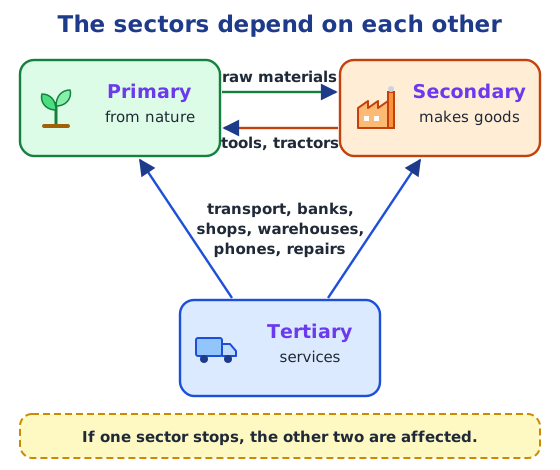
Each sector needs the others. Raw materials from the primary sector are processed by the secondary sector, and the tertiary sector transports, stores, finances and sells both. In AMUL’s story, farmers milk their cows (primary), factories make milk powder, ghee, cheese and butter (secondary), and lorries, trains, planes, ships and shops carry and sell the products (tertiary). A textbook likewise needs trees, paper mills and printing presses, and trucks, warehouses and bookshops.
Think About It: primary activities you have seen (page 199)
Answers will vary. Two examples:
- Farmers growing paddy or wheat: natural resources used are soil, water (rain, canals or wells) and sunlight.
- People fishing in a pond, river or the sea: natural resources used are water and fish.
Other examples: cattle grazing (grass and water), collecting firewood or fallen leaves (forest), keeping hens for eggs (birds and their feed), digging sand or stone (riverbeds and hills).
Let’s Explore: two more secondary activities (page 200)
For example:
- Making sugar or jaggery from sugarcane in a sugar mill or a village kolhu.
- Making bricks from clay in a brick kiln.
Others: weaving cloth on a power loom, making bread in a bakery, making pickles and jam from fruits, generating electricity in a power plant, building a house.
Don’t Miss Out: AMUL’s products and cooperatives near you (pages 204–205)
Can you name a few AMUL products? Milk, butter, ghee, cheese, paneer, curd, buttermilk, milk powder, ice cream and chocolate.
Can you name a cooperative around you that has helped people come together? Answers depend on where you live: your State’s milk cooperative (such as Nandini, Aavin, Sudha or Verka), a farmers’ or fishers’ cooperative society, a handloom weavers’ cooperative, or a cooperative bank. (Extra: Shri Mahila Griha Udyog Lijjat Papad, started by seven women in Mumbai in 1959, is run by its women members, and SEWA in Gujarat has helped women workers form cooperatives.)
Think About It and Let’s Explore: from trees to textbooks (pages 206–207)
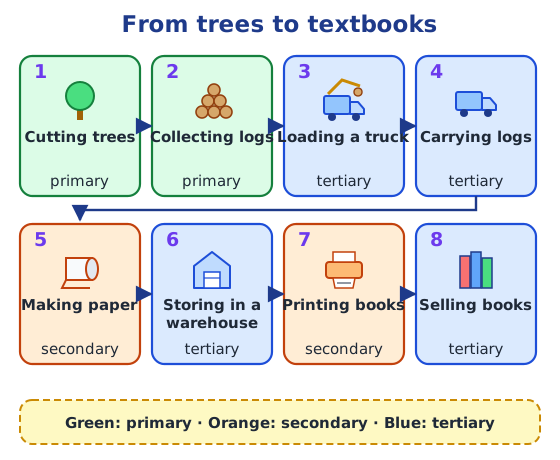
Labelling the pictures of Fig. 14.1, in the order of the arrows:
| Picture | What happens | Sector |
|---|---|---|
| 1 | A worker cuts a tree | Primary |
| 2 | A machine stacks the logs | Primary |
| 3 | A crane loads the logs onto a truck | Tertiary |
| 4 | A truck carries the logs on the highway | Tertiary |
| 5 | A paper mill turns the pulp into rolls of paper | Secondary |
| 6 | A forklift moves the paper into a warehouse | Tertiary |
| 7 | A press prints the pages | Secondary |
| 8 | A bookshop sells the textbooks | Tertiary |
Observing the stages: each stage depends on the one before it, and if any one stops, for example if trucks cannot run, the books never reach you.
How can we use paper wisely in school? Write on both sides of a sheet; use one-sided printouts for rough work; print only when needed and share notices on boards or online; keep a paper-recycling bin in every class; make rough notebooks from unused pages at the end of the year; and pass on old textbooks to juniors.
Let’s Explore: economic activities in your neighbourhood (page 208)
A sample list (yours will differ):
| Activity | Sector |
|---|---|
| A farmer growing vegetables | Primary |
| A dairy farmer keeping cows | Primary |
| A flour mill (chakki) grinding wheat | Secondary |
| A sweet shop making sweets from milk | Secondary |
| A tailor stitching clothes | Secondary |
| A vegetable vendor | Tertiary |
| An auto-rickshaw driver | Tertiary |
| A bank and a mobile phone shop | Tertiary |
How they are connected (draw arrows): farmer → vegetable vendor → your home; dairy farmer → sweet shop → customers; wheat farmer → flour mill → shop; the auto-rickshaw driver and the bank serve all of them.
What if one stopped? If, say, the vegetable vendors stopped, farmers could not sell their crops and would lose income, and families would struggle to buy vegetables. If transport stopped, milk would spoil, mills would run out of grain, and shops would be empty.
Questions, activities and projects (page 208)
1. What is the primary sector? How is it different from the secondary sector? Give two examples.
The primary sector is the group of activities in which people depend directly on nature to produce goods, extracting raw materials, as in farming, fishing, mining, raising livestock and forestry.
| Primary sector | Secondary sector |
|---|---|
| Takes raw materials directly from nature | Depends on the primary sector’s output |
| Extracts or grows things | Transforms raw materials into products |
| Example: growing cotton | Example: making cloth from cotton |
| Example: mining iron ore | Example: making steel and cars from iron ore |
2. How does the secondary sector depend on the tertiary sector? Illustrate with examples.
Factories and mills can make goods, but they need services at every step:
- Transport: trucks bring logs to the paper mill and milk to AMUL’s plants, and lorries, trains, planes and ships carry finished goods away.
- Storage: warehouses store paper and other products before they are sold.
- Trade and retail: shops and retail stores sell the goods to people; without them, factories would have no buyers.
- Banking: banks lend money to buy machines and raw materials.
- Communication: phones and the internet are used to take orders and run the business.
- Repairs and power: mechanics, technicians and electricians keep machines and electricity running.
3. Give an example of interdependence between the three sectors, and show it in a flow diagram.
From cotton to a shirt:
Cotton farm (primary: cotton is grown) → Truck (tertiary: carries the cotton) → Textile mill (secondary: spins and weaves cloth) → Garment factory (secondary: stitches shirts) → Warehouse and truck (tertiary: store and carry the shirts) → Shop (tertiary: sells them) → You
Banks (tertiary) lend money to the farmer and the factories, and factories (secondary) make the tractors and machines the farmer uses. Another example is AMUL: cows and farmers (primary) → milk plants making butter, ghee and milk powder (secondary) → trucks, trains and shops (tertiary) → your home.
Practice
-
Making steel from iron ore belongs to the:
Show answer
Answer: (b) secondary sector
-
Who led AMUL when it was set up in 1946, along with Tribhuvandas Patel?
Show answer
Answer: (b) Dr Varghese Kurien
-
Which of these is NOT a milk cooperative brand named in the chapter?
Show answer
Answer: (d) Lijjat
-
How much landfill space does recycling one tonne of paper save, according to the chapter?
Show answer
Answer: About 2.5 cubic metres, and it also saves 17 trees.
-
Why did milk farmers in Anand district depend on middlemen before AMUL?
Show answer
Answer: Milk spoils quickly in hot weather, and walking or cycling to sell it in nearby villages took great effort for little money, so they sold it in bulk to middlemen, who paid them very low prices.
Stuck on a question?
Take a photo and Lagnever AI explains it step by step. Try it for 7 days for ₹2.
Get it on Google Play Open in browser
For parents: after the trial, the plan renews monthly by UPI or card autopay. You can cancel anytime in the app.