
Class 6 Social Science Chapter 14: Economic Activities Around Us Notes
This chapter in five lines
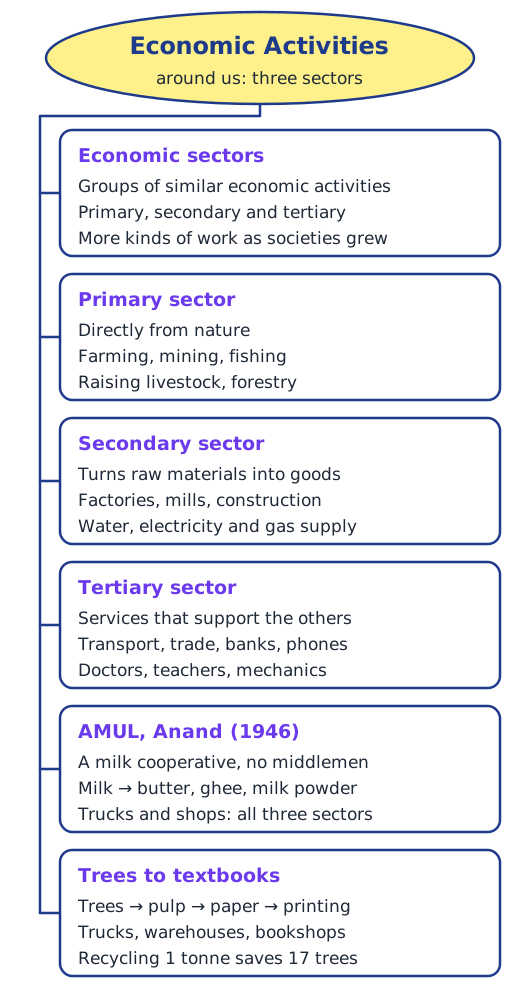
Economic activities are grouped into three sectors. The primary sector gets goods directly from nature: farming, mining, fishing, raising livestock and forestry. The secondary sector turns these raw materials into goods in mills and factories, and includes construction and the supply of water, electricity and gas. The tertiary, or service, sector supports both: transport, trade, banking, communication, doctors and teachers. The sectors depend on each other, as the AMUL milk cooperative and the making of a textbook show.
Why group economic activities?
The chapter opens with a thought from Kautilya’s Arthashastra: economic activity is the root of prosperity, and without it a society faces hardship now and in the future. In Chapter 13 we saw that activities that create monetary value, value that can be measured in money, are economic activities. Long ago, most people farmed, reared animals, made tools and pots, or wove cloth. Today there are far more kinds of work: making computers, phones and drones; working in banks, schools and hotels; driving vehicles; making furniture; tailoring with machines; creating software; repairing fridges and washing machines. Grouping these activities into economic sectors helps us see how they work and how they are linked.
The three sectors
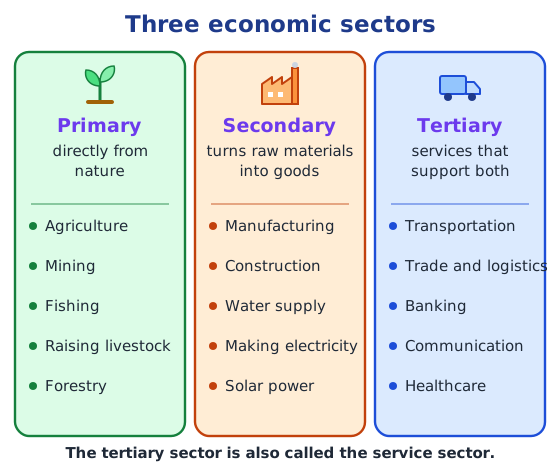
Primary sector: activities in which people depend directly on nature to produce goods, such as growing grains and vegetables, collecting wood from forests, extracting coal from mines, catching fish and collecting eggs from poultry farms. The most common are agriculture, mining, fishing, raising livestock and forestry.
Secondary sector: activities that take the outputs of the primary sector and transform them into goods. It includes construction of buildings and roads, supplying water, electricity and gas, and manufacturing in factories: grain becomes flour in mills, groundnuts give oil, tea leaves are processed into tea, wood becomes furniture and paper, cotton becomes clothes, and steel from iron ore becomes cars and trucks.
| Vehicles made in India in 2022 | Units |
|---|---|
| Passenger vehicles like cars | 45 lakh |
| Commercial vehicles like trucks | 10.3 lakh |
| Three-wheelers | 8.6 lakh |
| Two-wheelers | 2 crore |
(Source given in the chapter: Society of Indian Automobile Manufacturers.)
Tertiary sector: activities that support the other two by providing services we may not see but cannot do without: truck drivers carrying grain to factories and markets, vegetable vendors, doctors, nurses, teachers, lawyers and pilots, technicians and mechanics, electricians, mobile and internet services, software development, and services at hotels, banks, schools, hospitals, airports, shops and warehouses. It is also called the service sector. Read more in primary, secondary and tertiary activities.
AMUL: the sectors working together
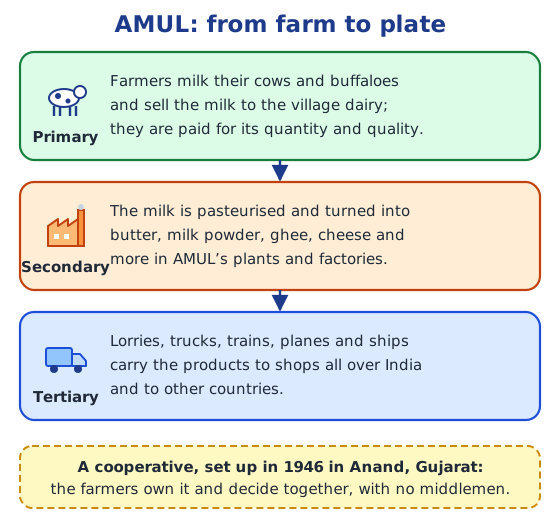
Today, farmers in Anand district, Gujarat, milk their cows and buffaloes, sell the milk to the village dairy, and are paid at the end of the month for its quantity and quality. In the early 1940s it was different: they walked or cycled in the heat to sell milk in nearby villages before it spoiled, and middlemen bought it in bulk at very low prices. The farmers went to Sardar Vallabhbhai Patel, who advised them to form a cooperative. AMUL (Anand Milk Union Limited) was set up in 1946, led by Tribhuvandas Patel, a lawyer and freedom fighter, and Dr Varghese Kurien, an engineer. The farmers, women among them, now took their own decisions on production, pasteurisation and sale, shared the work, and earned more. The cooperative grew, set up a factory in Anand for butter and milk powder, and today sells its products across India and exports them.
| Sector | What happens in AMUL’s story |
|---|---|
| Primary | Farmers milk their cows and buffaloes |
| Secondary | Milk is made into milk powder, ghee, cheese, butter and more in factories |
| Tertiary | Lorries, trucks, railways, planes and ships carry the products; retail stores and shops sell them |
Other milk cooperatives include Nandini (Karnataka), Mother Dairy (Delhi-NCR), Aavin (Tamil Nadu), Vijaya (Andhra Pradesh), Kevi (Nagaland), Sudha (Bihar) and Verka (Punjab).
From trees to textbooks
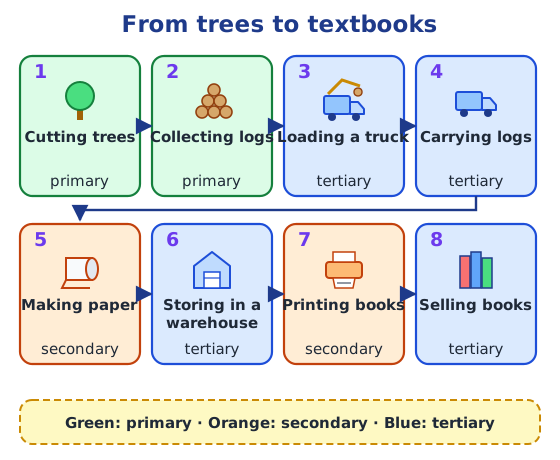
The books you study are made from pulp, the wooden fibre of trees. Trees are cut and the logs collected (primary), trucks carry them (tertiary), mills turn the pulp into paper (secondary), warehouses store it (tertiary), presses print the books (secondary) and shops sell them (tertiary). None of this would be possible without all three sectors working together. Used paper can also be recycled: recycling one tonne saves 17 trees and 2.5 cubic metres of landfill space, and takes 70 per cent less energy and water than making new paper from pulp.
The sectors depend on each other
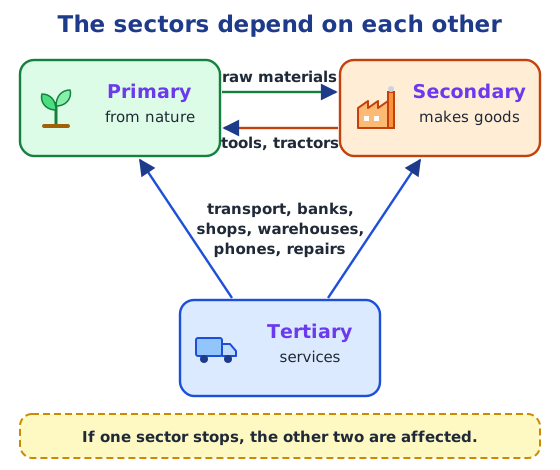
Factories need raw materials from farms, forests and mines; farmers need tractors and tools from factories; and both need trucks, banks, shops, warehouses, phones and repair services. If one activity stops, the others are affected. Answers to every question in the chapter are in the NCERT solutions for Chapter 14.
Key terms
| Term | Meaning |
|---|---|
| Monetary value | The value of something that can be measured in terms of money. Activities that create monetary value are economic activities. |
| Economic sector | A broad group of similar economic activities that help the economic prosperity of a nation. |
| Primary sector | Activities that take raw materials directly from nature, such as farming, fishing, mining and forestry. |
| Secondary sector | Activities that turn raw materials from the primary sector into products for sale or use, such as making flour, cloth, paper or cars. |
| Tertiary sector (service sector) | Activities that provide services supporting the primary and secondary sectors, such as transport, banking, trade and business management. |
| Warehouse | A large building used to store products before they are sold or used, or rented out to shops. |
| Dairy | A place where milk is collected and stored. |
| Cooperative | A group of people who come together by choice to meet their economic and social needs in a formal way. They own it and decide together. |
| Middlemen | People who buy goods from producers and sell them to consumers, charging a fee for this service. |
| Pasteurisation | Heating milk to a set temperature to kill harmful bacteria, so that it keeps longer. |
| Retail | Selling goods in small quantities to the people who use them, not for resale. |
| Export | Goods and services made in one country and sold to buyers in another country. |
Topics in this chapter
Practice
-
Fishing is a:
Show answer
Answer: (a) primary activity
-
Turning groundnuts into oil is a:
Show answer
Answer: (b) secondary activity
-
Which sector is also called the service sector?
Show answer
Answer: (c) Tertiary
-
Who advised the farmers of Anand district to form a cooperative?
Show answer
Answer: (b) Sardar Vallabhbhai Patel
-
In which year was AMUL set up?
Show answer
Answer: (b) 1946
Questions students ask
What are the main topics of Class 6 SST Chapter 14?
How economic activities are classified into the primary, secondary and tertiary sectors, examples of each, the AMUL milk cooperative of Anand, Gujarat, how a textbook is made from trees, and how the three sectors depend on each other.
Is Economic Activities Around Us in the new Exploring Society book?
Yes. Economic Activities Around Us is Chapter 14, the last chapter, of Exploring Society: India and Beyond, the Class 6 Social Science textbook used in the 2026-27 session. It follows Chapter 13, The Value of Work.
How many end-of-chapter questions does Chapter 14 have?
The “Questions, activities and projects” section has 3 questions, including a flow diagram of the three sectors. Our NCERT solutions page answers them, along with the Big Questions, the Think About It and Let's Explore boxes, and the Don't Miss Out questions.
Stuck on a question?
Take a photo and Lagnever AI explains it step by step. Try it for 7 days for ₹2.
Get it on Google Play Open in browser
For parents: after the trial, the plan renews monthly by UPI or card autopay. You can cancel anytime in the app.