
What are primary, secondary and tertiary activities?
Answer in short
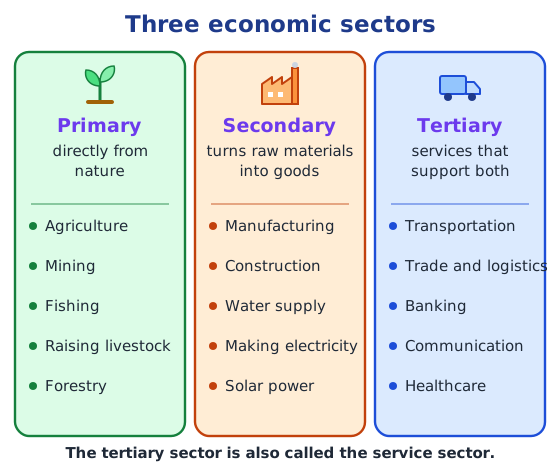
Primary activities take goods directly from nature, like farming, mining and fishing. Secondary activities turn these raw materials into goods, like flour, cloth, furniture or cars, and include construction and electricity supply. Tertiary activities are services that support both, like transport, trade, banking, teaching and healthcare. Each sector depends on the others.
Stuck on a question? Take a photo and Lagnever AI explains it step by step. Try it for 7 days for ₹2. Get it on Google Play
Three groups of economic activities
There are thousands of different jobs, so we group economic activities that share similar features into economic sectors: broad groups of activities that help a nation prosper. The three main sectors are primary, secondary and tertiary.
From a few kinds of work to many
Long ago, most people worked in agriculture, reared livestock, made tools and pots, or wove cloth. As societies grew, the number of ways to earn a living grew enormously. Today people manufacture computers, mobile phones and drones; work in banks, schools and hotels; drive vehicles; make furniture; stitch clothes on machines; create software; and repair fridges and washing machines. Sorting all these activities into sectors helps us understand how each one works and how they are linked.
Primary activities: straight from nature
In primary activities, people depend directly on nature to produce goods. They extract raw materials from the land, water and forests.
| Activity | What it takes from nature |
|---|---|
| Agriculture | grains and vegetables from farms |
| Forestry | wood from forests |
| Mining | coal and other minerals from the earth |
| Fishing | fish from rivers, seas and fish farms |
| Raising livestock | milk, eggs and wool from animals |
Secondary activities: making goods
Secondary activities depend on the outputs of the primary sector and transform them into goods that can be sold or used. They include manufacturing in factories, construction of buildings and roads, and providing utilities such as water, electricity and gas.
| Raw material (primary) | Product (secondary) |
|---|---|
| Wheat and other grains | Flour, made in mills |
| Groundnuts | Cooking oil |
| Tea leaves | Tea |
| Wood | Furniture and paper |
| Cotton | Cloth and clothes |
| Iron ore | Steel for cars and trucks |
Tertiary activities: services
Tertiary activities support both the other sectors. They do not make goods; they provide services. A truck driver carries grain from a farm to a factory or market; vendors sell vegetables to households; doctors, nurses, teachers, lawyers and pilots serve people; mechanics, technicians and electricians keep machines and power running; and mobile and internet services, software, hotels, banks, schools, hospitals, airports, shops and warehouses all provide services. That is why this is also called the service sector.
How to tell them apart
Ask three questions about any activity:
- Does it take something straight from nature? Then it is primary.
- Does it change a raw material into a new product, or build or supply something like a road or electricity? Then it is secondary.
- Does it provide a service to people or businesses? Then it is tertiary.
For example, a farmer growing cotton is primary, a mill making cloth from it is secondary, and the truck and shop that bring the cloth to you are tertiary.
Try sorting these yourself: a miner (primary), a potter making pots (secondary), a construction worker (secondary), a warehouse worker (tertiary), a software developer (tertiary) and someone raising goats (primary).
The sectors need each other
No sector works alone. In the AMUL milk cooperative of Anand, Gujarat, farmers milk their cows (primary), factories turn the milk into butter, ghee and milk powder (secondary), and trucks, trains and shops carry and sell the products (tertiary). Even your textbook needed trees, paper mills and printers, and trucks and bookshops. Read the whole story in the Chapter 14 notes.
Practice
-
Collecting eggs from a poultry farm is a:
Show answer
Answer: (a) primary activity
-
Processing tea leaves into tea is a:
Show answer
Answer: (b) secondary activity
-
Which of these is a tertiary activity?
Show answer
Answer: (c) A bank giving a loan
-
Name the sector of each: a fisherman, a cloth mill worker, a nurse.
Show answer
Answer: Fisherman: primary. Cloth mill worker: secondary. Nurse: tertiary (a service).
-
Why is the tertiary sector important even though it makes no goods?
Show answer
Answer: Its services keep the other sectors running: trucks carry raw materials and goods, shops sell them, banks lend money, warehouses store goods, and doctors, teachers and mechanics serve everyone.
Questions students ask
What is the primary sector?
The group of activities in which people depend directly on nature to produce goods, by extracting raw materials, such as farming, fishing, mining, raising livestock and forestry.
What is the difference between the primary and secondary sectors?
The primary sector takes raw materials from nature, like cotton or iron ore. The secondary sector processes them into products, like cloth or steel for cars. So the secondary sector depends on the primary sector's output.
Why is the tertiary sector called the service sector?
Because it does not make goods; it provides services, such as transport, trade, banking, communication, teaching and healthcare, that support people in the primary and secondary sectors.
How are the three sectors connected?
Raw materials from the primary sector are made into goods by the secondary sector, and the tertiary sector moves, stores, finances and sells them. In AMUL, farmers milk cows (primary), factories make butter and ghee (secondary), and trucks and shops deliver and sell them (tertiary).
Stuck on a question?
Take a photo and Lagnever AI explains it step by step. Try it for 7 days for ₹2.
Get it on Google Play Open in browser
For parents: after the trial, the plan renews monthly by UPI or card autopay. You can cancel anytime in the app.