
What are the oceans of the world?
Answer in short
Oceans are the largest water bodies on the Earth. There are five: the Pacific, the largest, then the Atlantic, the Indian, the Southern (or Antarctic) and the Arctic, the smallest. They are all connected, and the lines between them are only conventions. Oceans hold most of the Earth's water, which is salty, and are full of marine life.
Stuck on a question? Take a photo and Lagnever AI explains it step by step. Try it for 7 days for ₹2. Get it on Google Play
The largest water bodies
Seen from space, the Earth looks blue because almost three-fourths of its surface is water. The largest water bodies on the globe are the oceans. Their smaller extensions have other names, such as a sea, a bay or a gulf.
The five oceans
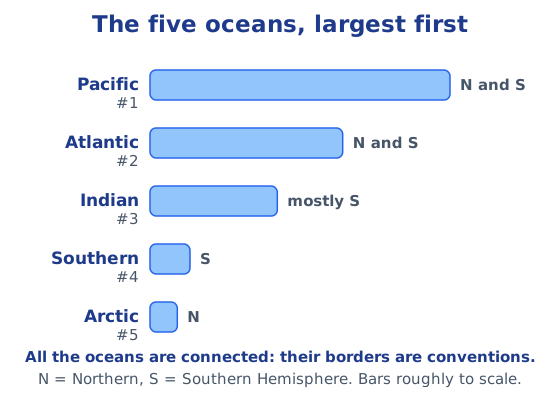
The world map shows five oceans: the Pacific Ocean, the Atlantic Ocean, the Indian Ocean, the Arctic Ocean and the Southern (or Antarctic) Ocean. By size:
- Pacific, the largest
- Atlantic
- Indian
- Southern
- Arctic, the smallest
Oceans and hemispheres
The Equator divides the Earth into the Northern and Southern Hemispheres. Some oceans lie in both:
| Ocean | Northern Hemisphere | Southern Hemisphere |
|---|---|---|
| Pacific | Yes | Yes |
| Atlantic | Yes | Yes |
| Indian | Yes (a smaller part) | Yes (most of it) |
| Southern | No | Yes |
| Arctic | Yes | No |
The Southern Hemisphere holds much more water than the Northern, which has more land.
One connected ocean
Although we list five oceans, they are not really separate. The lines dividing them on the map are conventions, and the natural world does not follow such boundaries. Seawater constantly flows from one ocean into another, carrying nutrients and warmth, and many plant and animal species are found across several oceans.
Life in the oceans
Marine means related to or found in the oceans and seas. The marine flora includes tiny plants called algae and all kinds of seaweeds; the marine fauna includes thousands of kinds of colourful fish, dolphins, whales, sharks, sea turtles, starfish and countless mysterious deep-sea creatures. Coral reefs are home to tropical fish, and emperor penguins live along the icy Southern Ocean. Each part of the ocean, from the sunlit surface to the dark depths, has its own life forms.
The Indian Ocean and India
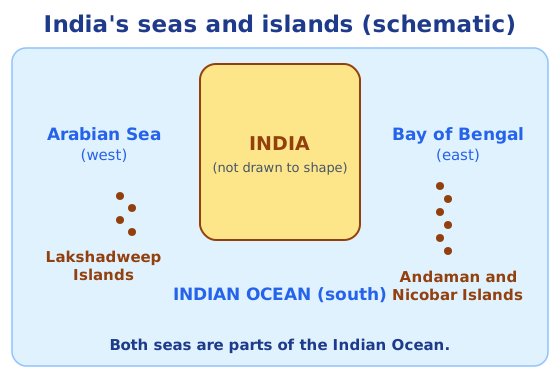
The Indian Ocean is bounded by Asia to the north, Africa to the west and Australia to the east, with the Southern Ocean to the south. On either side of India lie two of its parts: the Arabian Sea to the west and the Bay of Bengal to the east. India’s two major island groups lie in them: the Lakshadweep Islands in the Arabian Sea and the Andaman and Nicobar Islands in the Bay of Bengal.
Salty water
The oceans hold most of the water on the planet, but it is salty and cannot be drunk by humans or most land animals. Freshwater, found in glaciers, rivers, lakes, the air and underground, is only a very small share. That is why saving water is important even on a ‘blue planet’.
Oceans, rain and disasters
Clouds that form over the oceans bring rain to the land; the monsoon rains India waits for every summer come from the ocean. But oceans also produce cyclones, violent storms with extreme rain or very strong winds that can damage coasts, and tsunamis, huge waves usually caused by an earthquake or a volcanic eruption under the ocean floor.
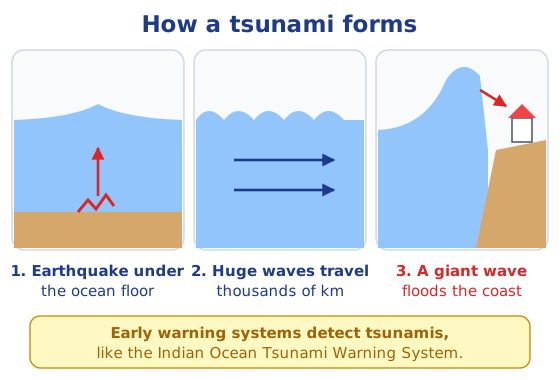
On 26 December 2004, a tsunami set off by an earthquake in Indonesia struck India and 13 other countries, and more than two lakh people lost their lives. Early warning systems, such as the Indian Ocean Tsunami Warning System, now help protect lives.
Why oceans need protection
Oceans give rain, make more than half of the world’s oxygen and feed millions of people, yet we throw millions of tonnes of plastic into them every year, and overfishing reduces marine life. Read about the land in continents of the world, or see the whole chapter in the Chapter 2 notes.
Practice
-
Which is the smallest ocean?
Show answer
Answer: (c) Arctic
-
Which ocean lies only in the Northern Hemisphere?
Show answer
Answer: (b) Arctic
-
A tsunami is usually caused by:
Show answer
Answer: (c) an earthquake or volcanic eruption under the ocean
-
Name the continents that border the Indian Ocean.
Show answer
Answer: Asia to the north, Africa to the west and Australia to the east; the Southern Ocean lies to its south.
-
Why can't we drink ocean water?
Show answer
Answer: Seawater is salty, which makes it unfit for drinking by humans and most land animals. Only freshwater, a very small part of all water, is fit to drink.
Questions students ask
What are the five oceans of the world?
The Pacific, Atlantic, Indian, Southern (or Antarctic) and Arctic oceans. In order of size, the Pacific is the largest, followed by the Atlantic, the Indian and the Southern, and the Arctic is the smallest.
Are the oceans connected?
Yes. The lines that divide them on maps are only conventions; the natural world does not follow them. Seawater keeps flowing from one ocean into another, and many plants and animals are found in several oceans.
Which oceans are found in both hemispheres?
The Pacific and the Atlantic stretch across both the Northern and Southern Hemispheres, and so does the Indian Ocean, though most of it lies in the south. The Southern Ocean is in the Southern Hemisphere and the Arctic Ocean in the Northern.
Stuck on a question?
Take a photo and Lagnever AI explains it step by step. Try it for 7 days for ₹2.
Get it on Google Play Open in browser
For parents: after the trial, the plan renews monthly by UPI or card autopay. You can cancel anytime in the app.