
Class 6 Social Science Chapter 2: Oceans and Continents Notes
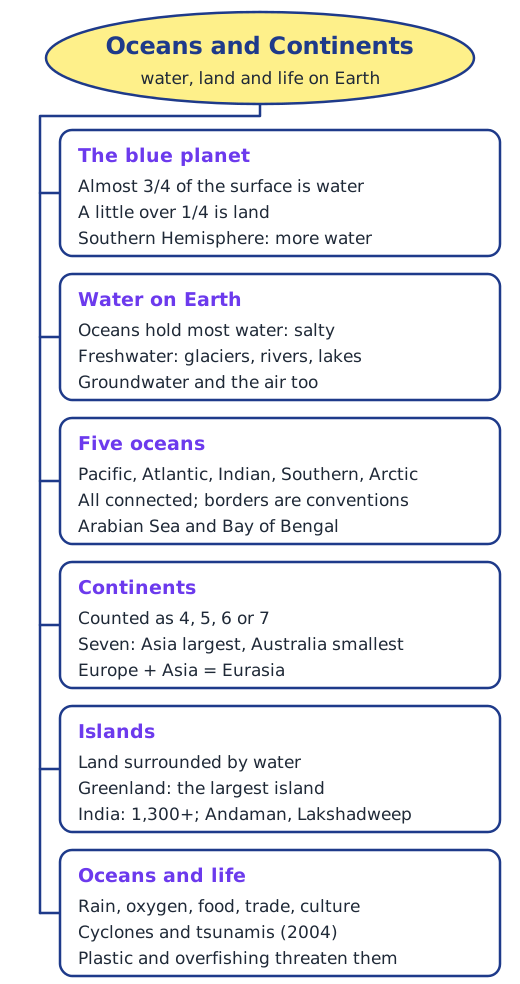
This chapter in five lines
Almost three-fourths of the Earth's surface is water, which is why it is called the blue planet, and a little over one-fourth is land. The largest water bodies are the five oceans: the Pacific, Atlantic, Indian, Southern and Arctic, all connected with one another. The large expanses of land are continents, most often counted as seven, with Asia the largest and Australia the smallest. Smaller lands surrounded by water are islands. Oceans bring rain, make much of our oxygen and shape life, but need protection from pollution.
The blue planet
The chapter opens with Jules Verne’s words from 1870: the ocean covers seven-tenths of the globe and is the vast reservoir of Nature. A photograph of the Earth taken from the Moon’s orbit shows why. Rotate a globe and the most widespread colour is blue: water. Almost three-fourths of the Earth’s surface is water, so early astronauts lovingly called the Earth the ‘blue planet’. The largest water bodies are oceans.
The brown patches are land, covering a little over one-fourth of the globe. A large body of land is a landmass, and a large continuous expanse of land is a continent. Oceans and continents shape the Earth’s climate and affect all plants, animals and people. Even the Indian Navy’s motto, Sam no Varunah, ‘Be auspicious to us, O Varuna’, calls on the Vedic deity of the oceans.
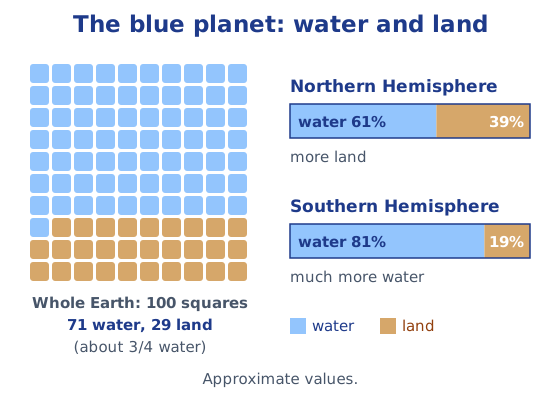
Water and land are not shared equally between the hemispheres: maps drawn from above the North and South Poles show that the Southern Hemisphere holds much more water and the Northern Hemisphere more land.
Salty water and freshwater
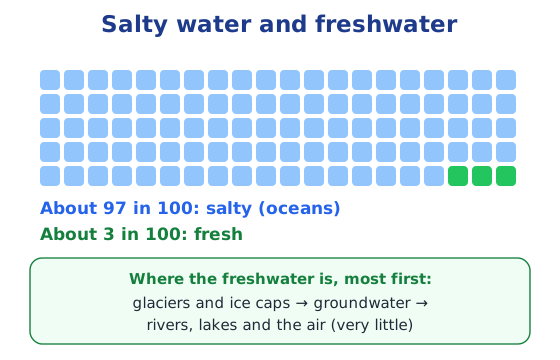
The oceans hold most of the planet’s water, but seawater is salty and unfit for most land animals, including humans. Freshwater is only a very small part: it is found in glaciers, rivers, lakes, the atmosphere and underground (groundwater). That is why, despite so much water, people talk of water scarcity, and why saving water matters.
The five oceans
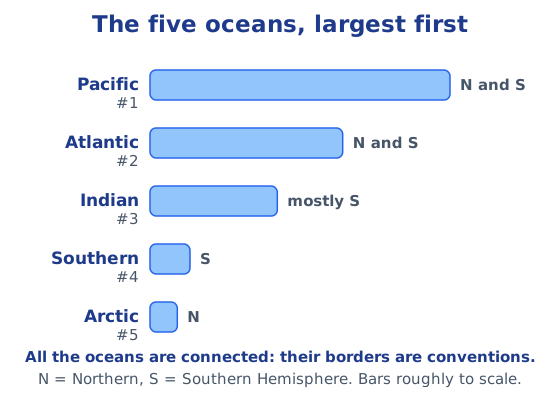
The five oceans are the Pacific, Atlantic, Indian, Southern (or Antarctic) and Arctic. The Pacific is the largest, then the Atlantic, the Indian, the Southern, and the Arctic is the smallest. They are not really separate: the lines dividing them are only conventions, seawater flows across them and many species live in several oceans. Their marine life ranges from tiny algae and seaweeds (flora) to fish, dolphins, whales and mysterious deep-sea creatures (fauna). Read more in oceans of the world.
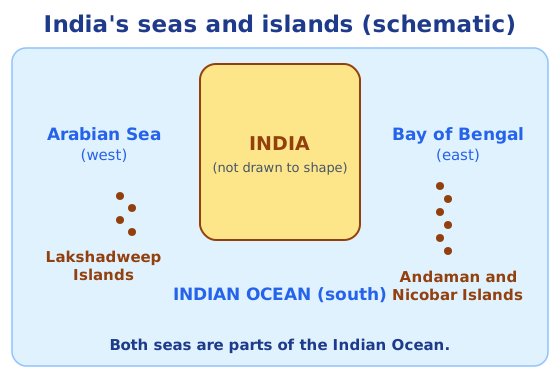
The Indian Ocean is bounded by Asia to the north, Africa to the west, Australia to the east and the Southern Ocean to the south. On either side of India lie two of its parts: the Arabian Sea to the west and the Bay of Bengal to the east.
Oceans and disasters
The white shapes in the picture of the Earth are clouds. Clouds from the ocean bring rain to the continents: India’s monsoon rains originate in the ocean, and without them agriculture and all life would suffer. But oceans also give rise to cyclones, storms with extreme rain or very strong winds, and to tsunamis, huge waves usually set off by an undersea earthquake or volcanic eruption, which can travel thousands of kilometres.
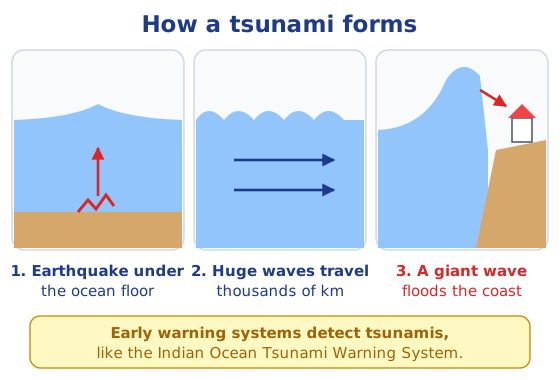
On 26 December 2004, an earthquake in Indonesia caused a tsunami that struck India and 13 other countries around the Indian Ocean; more than two lakh people died. The Andaman and Nicobar Islands and the coasts of Tamil Nadu and Kerala were badly hit. Today countries share early warning systems, including the Indian Ocean Tsunami Warning System, and India’s National Disaster Management Authority handles disasters.
Continents
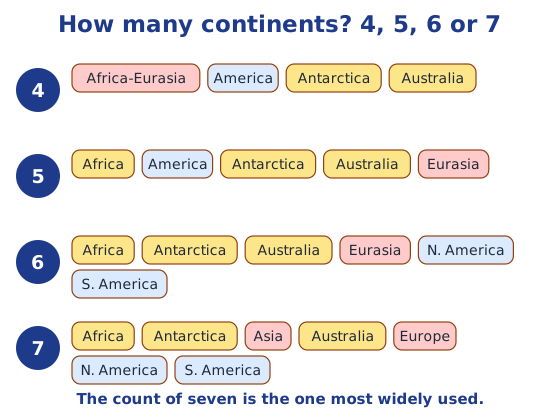
How many continents are there? Between four and seven, depending on how we count: North and South America can be one landmass or two; Europe and Asia form a single landmass, Eurasia, but are usually counted separately for historical and cultural reasons; and Africa and Eurasia are sometimes counted as one. The count of seven is the most widely used. The five Olympic rings stand for five inhabited continents: Africa, America, Asia, Australia and Europe. Read more in continents of the world.
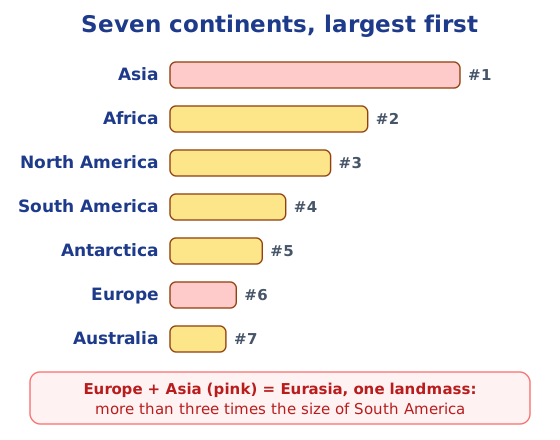
By size, Asia is the largest continent, followed by Africa, North America, South America, Antarctica and Europe, and Australia is the smallest.
Islands
Continents do not include all land. Smaller pieces of land surrounded by water on all sides are islands; continents are surrounded by water too but are too large to be called islands. There are lakhs of islands. Greenland is the largest: to match its size you would have to add up the 10 largest States of India. India itself has more than 1,300 small islands, including the Andaman and Nicobar Islands in the Bay of Bengal and the Lakshadweep Islands in the Arabian Sea.
Since 1981, the Indian Antarctica Programme has explored icy Antarctica. In 1983 India set up its first base there, Dakshin Gangotri, and two more bases later; about 40 teams of Indian scientists have studied its climate and environment, and the scientists’ settlement even has a library and a post office.
Oceans and life
Oceans send rain to the continents as part of the water cycle; without them the Earth would be a desert. More than half of the world’s oxygen is made by ocean plants, so oceans are called ‘the planet’s lungs’. People have used the seas to migrate, trade, fight wars and fish, and coastal cultures everywhere have tales of sea gods, monsters and treasures. The United Nations marks 8 June as World Oceans Day.
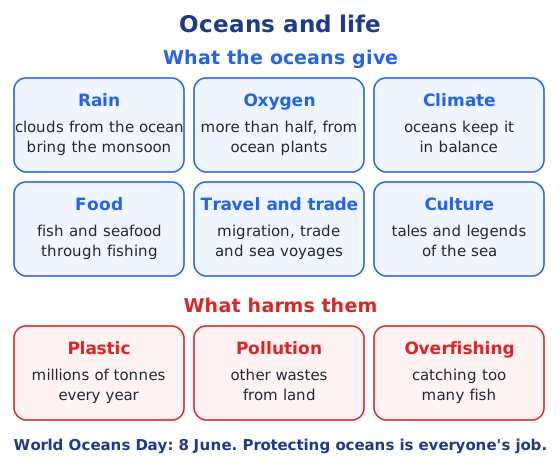
But we throw several million tonnes of plastic into the oceans every year, along with other pollution, and overfishing reduces marine life. Protecting the oceans is our collective responsibility. Answers to every question in the chapter are in the NCERT solutions for Chapter 2.
Key terms
| Term | Meaning |
|---|---|
| Ocean | One of the largest water bodies on the Earth. There are five: the Pacific, Atlantic, Indian, Southern and Arctic. |
| Continent | A large continuous expanse of land. Most often seven are counted: Africa, Antarctica, Asia, Australia, Europe, North America and South America. |
| Landmass | A large body of land. |
| Island | A piece of land, smaller than a continent, surrounded by water on all sides. |
| Sea, bay and gulf | Smaller extensions of the oceans, such as the Arabian Sea and the Bay of Bengal. |
| Freshwater | Water that is not salty, found in glaciers, rivers, lakes, the atmosphere and underground. It is a very small part of all water. |
| Groundwater | Freshwater found under the ground. |
| Marine | Related to or found in the oceans and seas. |
| Flora and fauna | The plant life (flora) and animal life (fauna) of a particular region or period of time. |
| Cyclone | A violent storm that forms over the ocean, with extreme rainfall or very strong winds, which can damage coastal regions. |
| Tsunami | A huge, powerful wave, generally caused by a strong earthquake or a volcanic eruption at the bottom of the ocean. |
| Eurasia | Europe and Asia seen together as the single landmass they form. |
Topics in this chapter
Practice
-
About how much of the Earth's surface is covered with water?
Show answer
Answer: (c) Almost three-fourths
-
Which is the largest ocean?
Show answer
Answer: (c) Pacific
-
Which is the smallest continent?
Show answer
Answer: (b) Australia
-
The Bay of Bengal is a part of which ocean?
Show answer
Answer: (c) Indian
-
Which hemisphere has more water?
Show answer
Answer: (b) Southern
Questions students ask
What are the main topics of Class 6 SST Chapter 2?
How water and land are spread over the Earth, salty water and freshwater, the five oceans and marine life, cyclones and tsunamis, the ways of counting continents and their sizes, islands, India's work in Antarctica, and why oceans matter and need protection.
Is Oceans and Continents in the new Exploring Society book?
Yes. Oceans and Continents is Chapter 2 of Exploring Society: India and Beyond, the Class 6 Social Science textbook used in the 2026-27 session. It follows Chapter 1, Locating Places on the Earth.
How many end-of-chapter questions does Chapter 2 have?
The “Questions, activities and projects” section has 4 tasks: explaining three terms, drawing the continents, labelling a world map and a crossword. Our NCERT solutions page answers them, along with the Big Questions and every Let's Explore and Think About It box.
Stuck on a question?
Take a photo and Lagnever AI explains it step by step. Try it for 7 days for ₹2.
Get it on Google Play Open in browser
For parents: after the trial, the plan renews monthly by UPI or card autopay. You can cancel anytime in the app.